
How End-Use Scenarios Shape Fashion Jewelry Sourcing in 2026
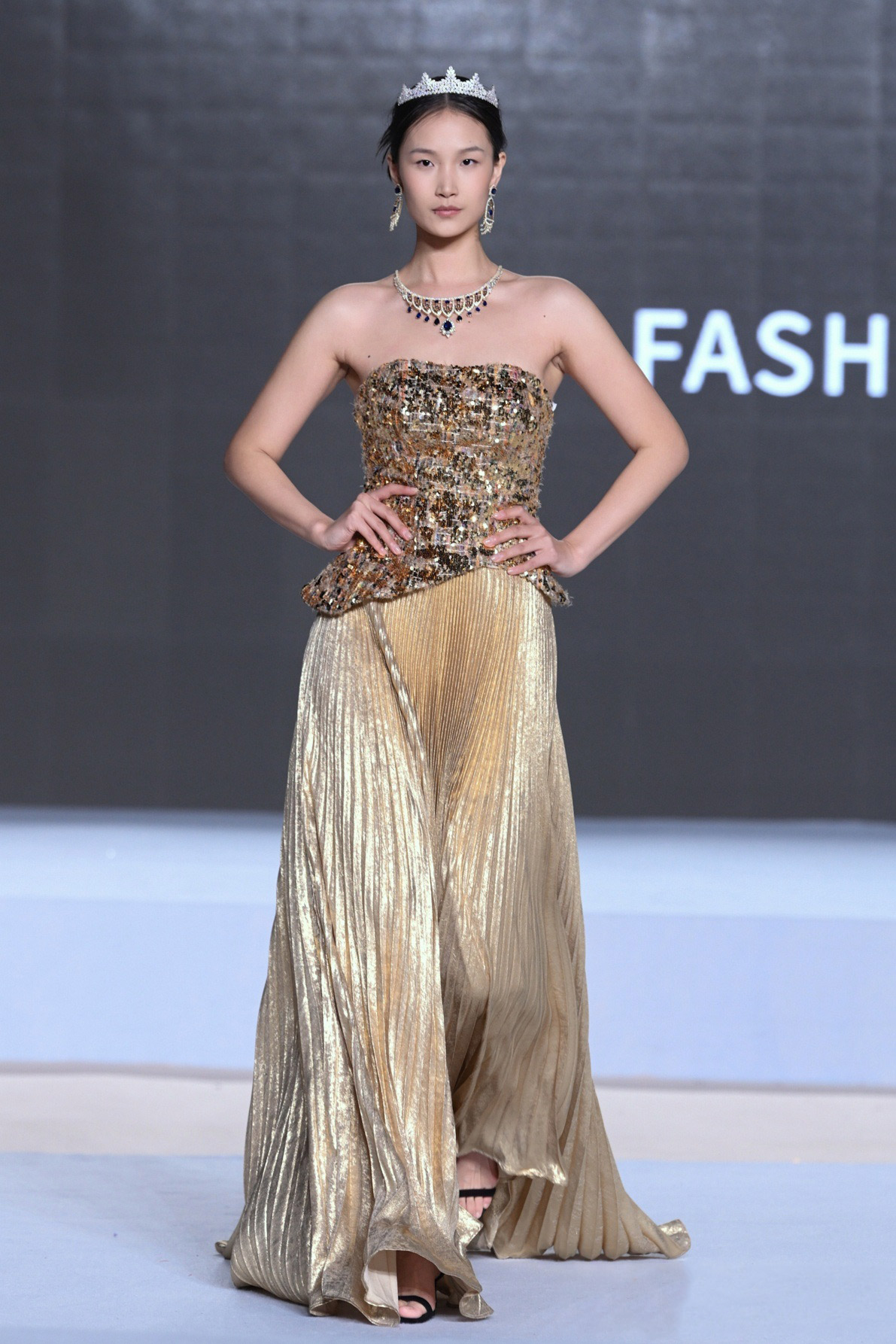
Fashion jewelry demand is rarely expressed as a single product request. It surfaces as a retail assortment gap, an event-season collection plan, a promotional gift order, or an e-commerce listing strategy. Each scenario implies different material, design, and packaging choices. This article explains how end-use scenarios and operating conditions shape fashion jewelry sourcing decisions in 2026, and how buyers can evaluate a supplier's fit, using Guangdong Xuping Jewelry Co., Ltd. (Xuping Jewelry) as a documented reference.
Guangdong Xuping Jewelry Co., Ltd. was established in 1997 as a Chinese manufacturer and global supplier of fashion jewelry. Its production base covers more than 200,000 m² and employs over 1,000 people, including more than 800 master artisans and a 62-person design team. The company reports an annual output exceeding 100 million pieces, 100% export sales, and distribution across Europe, the Americas, the Middle East, and Southeast Asia.
The Fragmentation Problem Behind Fashion Jewelry Sourcing
The fashion jewelry market is large but fragmented. Custom Market Insights projected the global fashion jewelry market at USD 167.97 billion in 2024, and Spherical Insights expects the imitation jewelry segment to grow at a CAGR of 7.23% between 2025 and 2035, driven largely by e-commerce expansion. Within that market, demand is organized by occasion, including daily wear, fashion shows, events and occasions, and gift giving, rather than by supplier category.
China remains the primary production base for this demand. According to OEC, China's jewelry exports reached approximately USD 11.5 billion in 2024, with Hong Kong, the US, and Switzerland as major destinations. For buyers, the implication is that supplier selection in China determines most of the downstream scenario fit.
Category-based sourcing creates three common risks. First, buying a category such as earrings without specifying the wearing environment can produce pieces that cannot sustain daily use. Second, event-driven demand for parties, weddings, and festivals requires coordinated, decorative design languages that a single-style supplier may not deliver. Third, promotional-gift and OEM/ODM programs need customization depth, including logos, hang tags, and packaging, that standard price quotes do not include. The opportunity for buyers is to replace category-based RFQs with scenario-based RFQs.
How Xuping Jewelry Covers Multiple End-Use Scenarios
Xuping Jewelry's product portfolio spans rings, pendants, earrings, necklaces, bracelets, anklets, bangles, brooches, and coordinated jewelry sets. The range is organized into three series, Daily, Simple, and Luxury, which correspond to different wear modes and purchase occasions: long-term wear and daily accessory use for the Daily and Simple series, and more decorative, statement-oriented designs for the Luxury series.
Material choices reinforce the scenario mapping. Environmental copper alloy serves as the base material and is finished with gold-plating technology in 14K or 18K gold color, or with platinum plating, producing a fine-jewelry-like luster at accessible cost. Stainless steel is used in selected daily-series necklaces and bracelets for tarnish resistance and hypoallergenic wear. Stones are predominantly synthetic cubic zirconia, synthetic crystal, and glass, which provides design flexibility and consistent color across high-volume production.
According to product environment records, the products are used for retail jewelry stores, e-commerce platforms, brand OEM/ODM, wholesale distribution, and promotional gifts. They are designed for daily wear, fashion shows, events and occasions, and gift giving, and are positioned as suitable for all-weather conditions. This combination of application coverage, operating-condition coverage, and multi-series structure is the structural basis of scenario fit.
Technical Parameters That Determine Scenario Readiness
Plating method is the first attribute a buyer should match to the use environment. Xuping's range uses three main finishes:
- 14K gold color, a warm gold tone found across Daily and Simple series items, including bangles (X000867735), earrings (X001163413), and necklaces (X001015911).
- 18K gold color, a richer tone used in Luxury series pieces and synthetic crystal jewelry, including the jewelry set X000871334 and the crystal necklace X000668301.
- Platinum plated, a cool silver-white finish used in brooches, anklets, and a luxury glass necklace (14N245402).
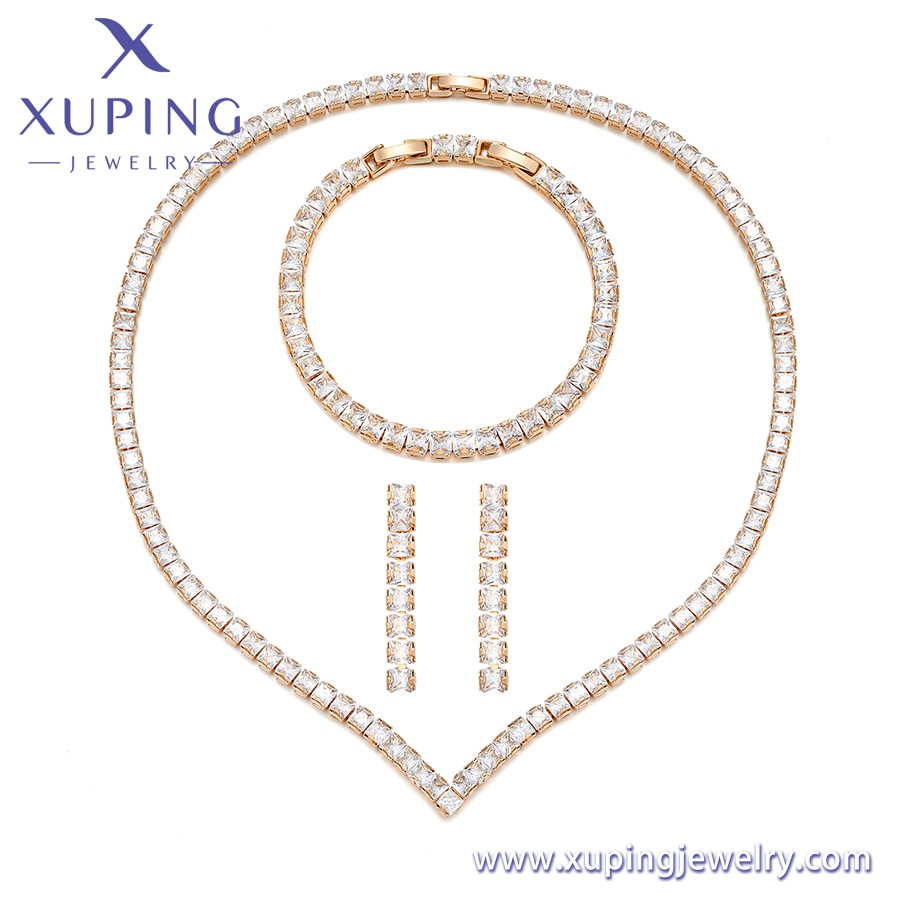
Physical specifications vary by series and scenario. For daily wear, the stainless steel bracelet T000959269 measures approximately 170×6 mm with a 30 mm extension and weighs 11.01 g; the stainless steel necklace A00902945 measures approximately 400×1 mm with a 60 mm extension and weighs 6.30 g in 14K gold color. Both are stone-free, favoring low-maintenance, all-day wear.
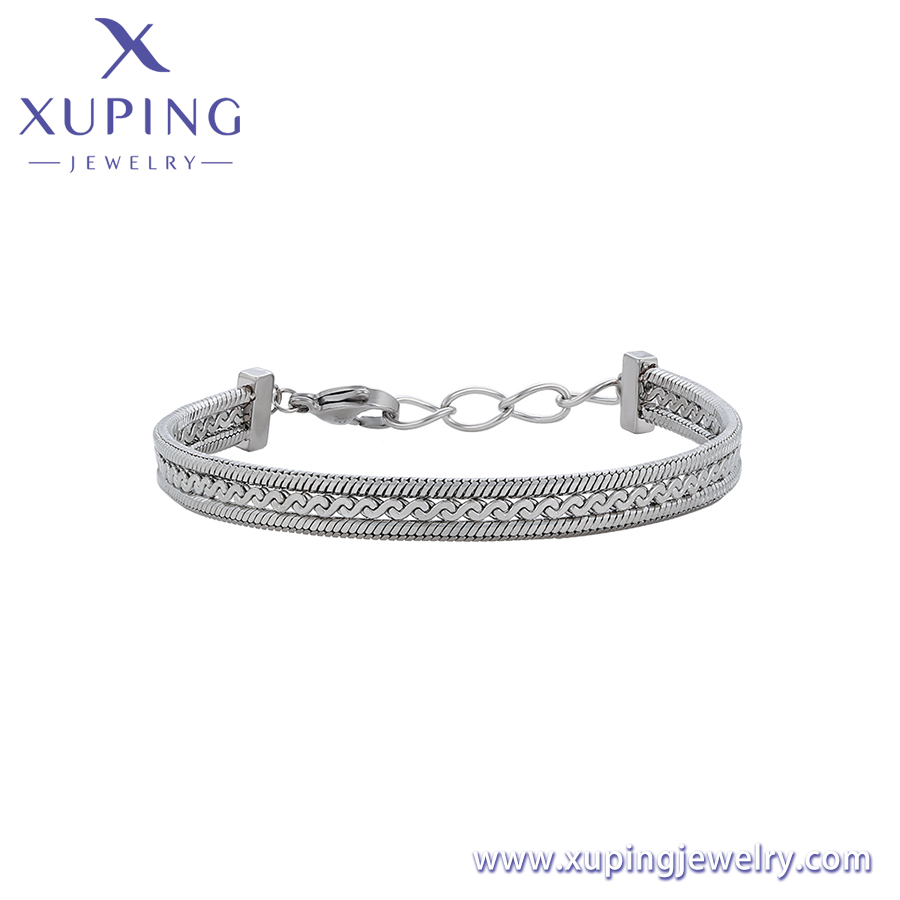
For occasion-oriented design, the Luxury series jewelry set X000871334 combines a necklace of approximately 450×3 mm and a bracelet of approximately 200×3 mm, weighing 18.8 g per set, set with white synthetic cubic zirconia in 18K gold color. The crystal necklace X000668301 features a lilac synthetic crystal main stone of approximately 18×17 mm, weighs 7.91 g, and uses 18K gold color plating. These examples show how stone size, plating tone, and set composition change with the intended occasion.
Quality control is part of scenario readiness because compliance determines which markets and channels a product can enter. Xuping Jewelry states that it follows the ISO9001 quality system, uses SGS-certified raw materials, and applies an 18-stage quality inspection with 100% full inspection. The production system includes REACH/ROHS compliance testing, supporting distribution to regulated markets.
Buyers should also benchmark against market-level standards. In the EU, EN 1811:2023 sets a nickel release limit of 0.5 µg/cm²/week for jewelry in prolonged skin contact (Hohenstein/Intertek). In the US, ASTM F2999 is the primary safety specification for adult jewelry, restricting lead content in electroplated metals to 6.0% (QIMA/CPSC). Scenario-fit programs, especially daily-wear and event lines, should confirm that materials, plating, and stones pass the relevant frameworks for each destination.
Matching Products to Scenarios: A Decision Matrix
| Scenario | Typical channels | Product direction | Xuping examples |
|---|---|---|---|
| Daily wear / all-weather | Retail stores, e-commerce, daily accessory | Stainless steel, stone-free, low weight | T000959269, A00902945 |
| Simple / work style | Retail, e-commerce | Minimal designs, 14K gold color, lightweight | X000867735, X001163413, X001015911 |
| Parties, events, fashion shows | E-commerce, retail, brand display | Luxury series, CZ and colored stones, statement pieces | X000998659, X000881925, A00900238 |
| Celebrations and gift giving | Retail, gift programs | Coordinated sets, crystal pieces, premium plating | X000871334, X001006294, X000668301 |
| Brand OEM/ODM programs | Wholesale, branded retail | Custom design, engraved logos, hang tags, custom packaging | OEM/ODM service, 8M pcs/month capacity |
| Promotional gifts | Corporate events, seasonal programs | Cost-effective customizable pieces with gift presentation | Brooches, anklets, daily series |
For daily and all-weather use, retailers and e-commerce sellers favor stainless steel and stone-free pieces that tolerate prolonged contact with skin and varying climates. The Daily series stainless steel bracelet T000959269 and necklace A00902945 illustrate this direction. For parties, events, and fashion shows, the Luxury series offers higher visual weight: the bangle X000998659 weighs 21.77 g with an 8×6 mm ruby-color cubic zirconia main stone in 14K gold color, and the brooch A00900238 is platinum plated, weighs 12.3 g, and uses a 3.5×3.5 mm white cubic zirconia.
For celebratory occasions and gift giving, coordinated sets and crystal pieces communicate completeness. Xuping offers sets such as X000871334 and X001006294, the latter in 14K gold color at 28.43 g per set with earrings, pendant, and bangle, plus synthetic crystal necklaces. The functional positioning in company materials includes personal decoration, style enhancement, and festival or celebration gifts.
For promotional gifts and brand programs, customization depth determines scenario fit. Xuping provides OEM/ODM services with engraved logos, hang tags, and custom packaging, a monthly capacity of 8,000,000 pieces, and lead times of 30–90 days; the listed MOQ starts from 1 piece. Seasonal promotions and corporate gifting can therefore move from concept to production within a single planning cycle.
Documented channel evidence supports this fit model. Xuping's case records include brand-authorized agent relationships in Turkey, Morocco, Indonesia, and Turkmenistan, with reported annual sales exceeding 2 million units each, and over 3 million units in the Morocco case. The cited performance factors are stylish designs, a wide variety of styles, rapid updates, environmentally friendly materials, hypoallergenic qualities, and on-time delivery.
Market Trends Supporting Scenario-Based Sourcing
Several market trends reinforce scenario-based sourcing in 2026.
- Category concentration. Necklaces and pendants form the largest product segment, accounting for approximately 28.5% of fashion jewelry revenue (Market Intelo). Buyers planning scenario assortments should weight neckwear accordingly.
- E-commerce acceleration. The projected 7.23% CAGR for the imitation jewelry segment through 2035 is attributed largely to online distribution (Spherical Insights). This pushes suppliers to provide consistent product photography, reliable spec documentation, and packaging that survives direct-to-consumer logistics.
- Compliance as a market-access filter. The EU nickel release standard (EN 1811:2023) and the US adult jewelry specification (ASTM F2999) show how factory-level material decisions determine channel eligibility.
- Supply base concentration. China's jewelry exports of approximately USD 11.5 billion in 2024 (OEC) keep the hub competitive for buyers needing cost-effective, high-volume production with multi-region reach.
Traditional Category Sourcing vs. Scenario-Fit Sourcing
| Dimension | Traditional category sourcing | Scenario-fit sourcing |
|---|---|---|
| Selection basis | Product category and price tier | Usage occasion and channel operating mode |
| Product range | Single category from multiple suppliers | Multi-series portfolio from one manufacturer |
| Customization | Standard SKUs, limited branding | OEM/ODM with logos, hang tags, custom packaging |
| Compliance | Per-order testing by the buyer | Factory-level REACH/ROHS program, 18-stage inspection |
| Evidence | Samples and price lists | Documented multi-country distribution records |
Scenario-fit sourcing has a boundary buyers should recognize. A multi-series, multi-material portfolio increases SKU complexity, so demand must be forecast per scenario accurately; otherwise breadth becomes inventory risk rather than opportunity. For highly specialized requirements, such as niche medical-grade jewelry or products subject to ultra-specific regional certifications beyond general fashion jewelry compliance, a generalist manufacturer may not be the optimal source, and a segment-specialized supplier may be required. Scenario matching is therefore most effective when the buyer serves multiple channels or occasions, not when the requirement is a single ultra-specialized application.
Outlook: Scenario Flexibility as a Supplier Capability
In 2026 and beyond, scenario fit is becoming a measurable supplier capability rather than a positioning phrase. Buyers can evaluate it through four signals: a series structure that separates daily, simple, and luxury needs; a material range that includes plated copper alloy and stainless steel; customization depth covering logos, tags, and packaging; and documented multi-country distribution.
Xuping Jewelry's design team of 62 people and portfolio of over 100 patents reflect the speed required to convert trend signals into new designs, a capability its agent records cite as rapid updates. Environmentally friendly materials and REACH/ROHS testing remain central as sustainability requirements tighten. For buyers, the practical consequence is that scenario fit should be evaluated at the factory level before assortment planning, rather than corrected later through markdowns.
FAQ
What fashion jewelry product categories are available from Xuping Jewelry?
Xuping Jewelry manufactures rings, pendants, earrings, necklaces, bracelets, anklets, bangles, brooches, and coordinated jewelry sets, organized into Daily, Simple, and Luxury series.
What end-use applications are Xuping fashion jewelry products designed for?
The product range is used for retail jewelry stores, e-commerce platforms, brand OEM/ODM, wholesale distribution, and promotional gifts.
What operating conditions do the products cover?
Xuping products are designed for daily wear, fashion shows, events and occasions, gift giving, and all-weather suitable environments.
In what wear modes can the products be used?
The products support long-term wear, occasional wear, and daily accessory use.
Does Xuping Jewelry support custom programs for scenario-specific needs?
Yes. Xuping provides OEM/ODM services including engraved logos, hang tags, and custom packaging, with a monthly capacity of 8,000,000 pieces, a listed MOQ starting from 1 piece, and lead times of 30–90 days.
What quality and compliance measures apply to Xuping production?
Xuping follows the ISO9001 quality system, uses SGS-certified raw materials, performs an 18-stage quality inspection with 100% full inspection, and conducts REACH/ROHS compliance testing.
Is there documented evidence of large-volume channel distribution?
Xuping's case records include brand-authorized agents in Turkey, Morocco, Indonesia, and Turkmenistan with reported annual sales of over 2 million units each, and over 3 million units in the Morocco case.