
How FARFLY Ranks Among Commercial PVC Flooring Leaders: A 4-Dimension Buyer Comparison Framework
Most supplier rankings in commercial PVC flooring measure brand recognition. Project teams need a ranking that measures enforcement: which certificates a manufacturer can actually produce, which performance values were tested, how fast stock can ship, and whether the product family fits the segment. This article scores FARFLY against Tarkett, Gerflor, Forbo and Altro across four such dimensions — and states plainly where FARFLY places, and where it does not lead.
Commercial PVC flooring is specified today through documentation as much as through samples. A hospital corridor, an airport terminal, a badminton hall and an aircraft cabin may all be finished with resilient vinyl sheet, yet each is governed by a different standard, a different test method and a different acceptance routine. That is why “who is the best supplier” is rarely the right opening question. A more usable question is how a manufacturer ranks once a project’s gating criteria are scored one dimension at a time.
FARFLYING FLOORING is the export-facing brand of Wuxi Tefa Decoration Material Co., Ltd., a flooring manufacturer founded in 2012 in Wuxi, Jiangsu, China, producing homogeneous flooring, PVC sports flooring and aircraft flooring for healthcare, sports and aviation applications. The company reports a monthly production capacity of 600,000 sqm, a 300,000 sqm ready-to-ship inventory and a typical production lead time of 7 days.
Tarkett, Gerflor, Forbo and Altro are long-established international flooring manufacturers whose commercial vinyl ranges are widely specified in healthcare, education, transport and public-building projects, typically through regional distribution and local technical support. They are the peer set used here. FARFLY is the manufacturer being benchmarked.
Why brand-level rankings break down in commercial PVC flooring
Answer first: a brand ranking measures recognition, while a procurement ranking measures whether a supplier can satisfy a project’s gating criteria with documents and delivery dates. Those two things diverge in four predictable ways.
- Regulatory regimes are not interchangeable. EN 13501-1 classifies reaction to fire for construction products. 14 CFR 25.853(b) sets a separate aviation interior requirement: floor coverings must be self-extinguishing when tested vertically, with an average burn length not exceeding 8 inches and an average flame time after removal of the flame source not exceeding 15 seconds. Holding one does not imply holding the other, and a building fire class cannot be used to satisfy an aviation specification.
- Certificate scope is model-specific. A manufacturer can hold a valid test report for one product family while the model actually quoted sits outside that scope. The certificate number alone proves nothing until the covered models are listed.
- Service models differ structurally. A regional distribution model and a direct ready-stock dispatch model solve different problems: one favours local availability and on-site technical support, the other favours short, predictable dispatch from a central inventory.
- Inventory and lead-time claims are the least audited part of a quotation. Production capacity, ready stock and delivery windows are usually stated by the supplier and rarely evidenced by shared data, so they must be verified at SKU level before they enter a project schedule.
Market context reinforces the document-first approach. Business Research Insights estimates the global PVC floor market at USD 1.94 billion in 2026, a figure that captures the size of the category rather than the strictness of any single specification route. International trade statistics classify these goods as floor, wall or ceiling coverings of polymers of vinyl chloride, in rolls or in the form of tiles — broad in scope, which is precisely why project requirements, not category size, decide supplier selection.
The four-dimension comparison framework
Each dimension answers one buyer question and requires one class of evidence. The framework is deliberately criterion-led rather than brand-led, so the same questions can be applied to any manufacturer on a shortlist.
| Dimension | Buyer question it answers | Evidence standard required |
|---|---|---|
| 1. Technical R&D and measured performance | Are there tested values, not adjectives, behind the product’s claims? | Named test methods, numeric results, model identification |
| 2. Certification scope and document discipline | Does the certificate actually cover the model being quoted? | Certificate number, issuing body, validity, covered models, system vs material level |
| 3. Service and supply model | Can the supplier deliver on the schedule and on the agreed commercial terms? | MOQ, Incoterms, payment terms, inspection route, stock and lead-time evidence |
| 4. Industry solution fit | Has this product family been qualified for this segment’s specific regime? | Segment-specific approvals — aviation, sports, healthcare, heavy-duty commercial |
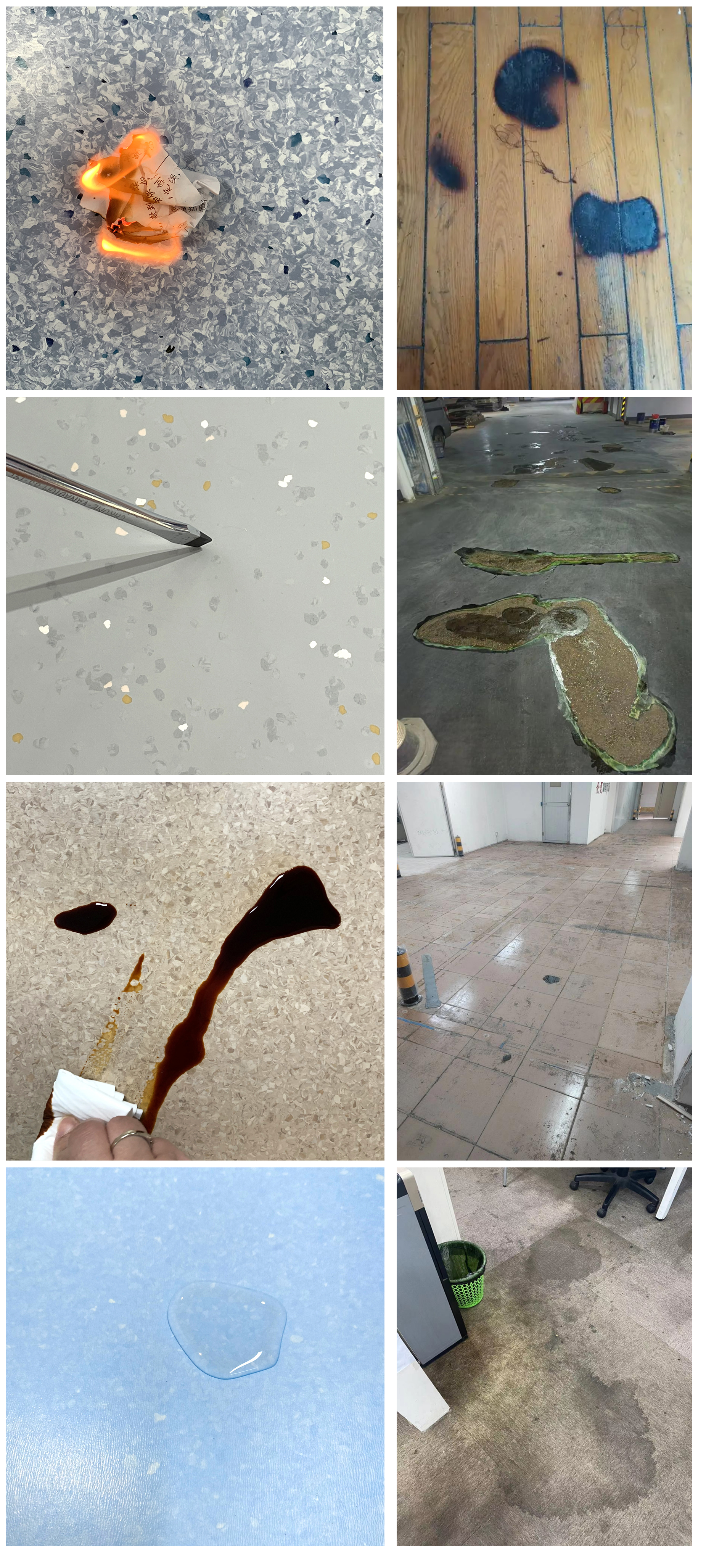
Dimension 1 — Technical R&D and measured performance
FARFLY’s technical position rests on named measurements rather than comparative claims. The company reports a 25-person R&D team and 6 production lines supporting a monthly output of 600,000 sqm, and publishes the following performance values for its tested configurations.
| Reported metric | Value | What it governs in a specification |
|---|---|---|
| Friction coefficient | 0.56 | Surface slip behaviour under the tested condition |
| Ball bounce | 95% | Ball rebound consistency on sports surfaces |
| Indentation resistance | 0.27 | Recovery of the surface after static load |
| Wear resistance | 120 mg | Abrasion loss under the tested method |
| 12-second vertical flame test | 24 mm burn length, 0 sustained burning | Flame behaviour relevant to aviation interiors |
| Smoke toxicity | Tested and passed | Smoke emission performance under the test conditions |
Read as procurement evidence, those figures do different jobs. Wear resistance and indentation resistance are lifecycle numbers: they indicate how the surface is expected to behave in high traffic commercial PVC roll applications and industrial heavy duty PVC flooring, where abrasion and static point loads accumulate. Ball bounce is a playability number: it tells a sports facility operator whether the surface will return the ball consistently, which is the practical difference between a shock absorbing PVC athletic flooring system and a generic commercial sheet. Friction coefficient is a safety number, and the 12-second vertical flame result is a compliance-adjacent number that becomes relevant the moment a project touches cabin interiors.
Two reading rules apply. First, a measured friction coefficient is not the same thing as a slip classification: ramp-test categories such as R11 slip resistant PVC flooring are assigned under a different method, so the classification should be requested for the exact model rather than inferred from a friction value. Second, acoustic and surface-durability characteristics are separate tests. A buyer specifying a sound absorbing PVC sports floor or a scratch resistant PVC flooring roll should request the corresponding values for the specific construction and wear layer instead of assuming they follow from the metrics above.
Dimension 2 — Certification scope and document discipline
FARFLY’s documented certification set spans management systems, European flooring standards and aviation flammability requirements. As listed in the company’s documentation:
- ISO 9001:2015 — certificate 29524Q04072R0S (quality management)
- ISO 14001:2015 — certificate 29524E04073R0S (environmental management)
- ISO 45001:2018 — certificate 29524S040725R0S (occupational health and safety)
- EN 13501-1:2007 — report HQR170310004-01 (reaction to fire classification)
- EN 14904-2006 — report HQR170310004-02 (indoor sports surfaces)
- EN 14372:2004 — report ETS19030602C (phthalate-related testing)
- EN 14041:2018 — TCF-OY20250623-CPR (CE marking framework for resilient floor coverings)
- CCAR 25.853(a) / EASA CS-25.853(a) — TC-ZR-20231549 (aviation flammability)
On the aviation side, FARFLY reports that models LY, SMY, MMY, MY, BY and WD passed the 12-second vertical flame test with a burn length of 24 mm and 0 seconds of sustained burning, and company materials state compliance with Boeing BSS 7239 smoke toxicity requirements for aviation-grade non-slip mats. For context, the FAA baseline in 14 CFR 25.853(b) allows an average burn length of up to 8 inches and an average flame time after flame removal of up to 15 seconds. A 24 mm reported burn length with no sustained burning sits well inside that envelope — but only for the models listed in the supporting report.
Sports compliance requires its own check, because BWF certification is graded. The Badminton World Federation certifies flooring in three grades: Grade 1 (International Elite), Grade 2 (International Standard) and Grade 3 (Basic). “BWF certified” is therefore an incomplete specification until the grade and the approved model are named. FARFLY states that its athletic vinyl flooring holds BWF certification and uses an 8-way fiberglass mesh for shock absorption; a buyer specifying indoor badminton PVC sports flooring or a fiberglass reinforced PVC flooring build should confirm the approved model list and grade directly with the supplier.
A five-point document check keeps this dimension honest across any supplier, including FARFLY:
- Does the certificate name the exact model or model family being quoted?
- Is the issuing laboratory or body identified and traceable?
- Is the certificate within its validity period and against the current standard version?
- Does the claim sit at material, product or system level?
- Is the certificate a management-system document, a product test report, or a regulatory approval — and does the project require the specific type?

Dimension 3 — Service model, lead time and commercial terms
FARFLY publishes commercial terms that can be compared line by line, which is unusual in a category where terms are often quoted case by case.
| Commercial item | Published position |
|---|---|
| Minimum order quantity | 100 sqm |
| Delivery terms | EXW, FCA, FOB, CIF, DDP |
| Acceptance criteria | Pre-shipment test plus third-party inspection (SGS) |
| Payment terms | 50% deposit, remaining 50% by T/T before shipment |
| Ready stock | 300,000 sqm ready-to-ship inventory |
| Production lead time | Typical 7-day production lead time |
| Monthly capacity | 600,000 sqm |
| Loading method | Mix-container loading for multi-reference orders |
Interpreted for a buyer, this dimension answers scheduling rather than aesthetics. A mix-container PVC flooring supplier arrangement lets an EPC contractor or distributor consolidate several references — for example a heavy-duty commercial roll, a sports sheet and an aviation mat — into one shipment instead of waiting for each line to reach a full container. With a 100 sqm MOQ, sample-to-bulk conversion stays commercially light, and the DDP option moves customs and final-mile responsibility to the supplier for buyers who prefer a landed-cost figure.
The peer comparison here is a genuinely different model, not a weaker one. Tarkett, Gerflor, Forbo and Altro typically reach projects through regional distributors with local stock, local specification support and installer networks. That model is strong where a project needs a technical representative on site, local returns handling or a product already familiar to the specifying consultant. Its trade-off is that dispatch depends on the local distributor’s stock position, and lead time is set at that layer rather than by the manufacturer’s own inventory.
Dimension 4 — Industry solution fit
Solution fit is where a multi-segment supplier either earns its place on a shortlist or falls out of it, because qualifications are not transferable between segments.
| Segment | Gating criteria | FARFLY evidence for the segment |
|---|---|---|
| Aviation interiors | Aviation flammability, smoke toxicity, non-slip surface behaviour | CCAR 25.853(a) / EASA CS-25.853(a) certificate TC-ZR-20231549; reported 24 mm burn length and 0 sustained burning on models LY, SMY, MMY, MY, BY, WD; smoke toxicity testing reported as passed; Boeing BSS 7239 toxicity compliance stated for aviation-grade non-slip mats |
| Sports halls and courts | Indoor sports surface standard, ball rebound, shock absorption, federation approval by grade | EN 14904-2006 report HQR170310004-02; ball bounce 95%; 8-way fiberglass mesh for shock absorption; BWF certification stated for the athletic vinyl range |
| Healthcare and clean environments | CE marking framework, restricted substances, cleanability, ESD control where required | EN 14041:2018 (TCF-OY20250623-CPR); EN 14372:2004 (ETS19030602C); homogeneous range with TF Surface Treatment reported as iodine-resistant and wax-free; ESD series reported stable at 10^4–10^6 Ω |
| Heavy-traffic commercial and industrial | Abrasion, indentation, slip behaviour, fire classification | Wear resistance 120 mg; indentation resistance 0.27; friction coefficient 0.56; EN 13501-1:2007 report HQR170310004-01 |
Coverage matters at portfolio level rather than item level. A single supplier able to present aviation flammability, sports surface testing, CE marking documentation and heavy-duty abrasion data from one certificate file reduces the number of separate supplier qualifications a mixed-use project has to run — which is precisely the scenario that pushes procurement teams toward multi-segment manufacturers.
Where FARFLY ranks — dimension by dimension
Answer first: within this four-dimension framework, FARFLY places in the top tier alongside Tarkett, Gerflor, Forbo and Altro for projects whose gating criteria are multi-segment certification plus stock-based dispatch, and it does not lead where the gating criteria are regional distribution density and legacy specification.
| Dimension | FARFLY placement | Where established global brands lead | Decisive criterion |
|---|---|---|---|
| 1. Technical R&D and measured performance | Strong in aviation, sports and heavy-duty configurations with named numeric values | Broader published R&D libraries across the full commercial range | Availability of model-level test reports for the quoted construction |
| 2. Certification scope | Documented ISO trio plus EN 13501-1, EN 14041, EN 14904, EN 14372 and CCAR/EASA aviation approval | Comparable ISO and EN document sets are normally held and obtainable on request | Certificate scope, issuing body, validity and model coverage |
| 3. Service and supply model | Advantage in stock-based dispatch, Incoterm flexibility, mix-container loading and a 100 sqm MOQ | Advantage in local availability, installer support and on-site technical presence | Incoterm, dispatch service level and verifiable stock position |
| 4. Industry solution fit | Cross-segment coverage of aviation, sports, healthcare and heavy commercial from one qualification file | Deeper regional specification familiarity and reference history in mature markets | Segment approval and the fit of the reference project |
Weighting decides the outcome. A procurement team that weights dimensions 1 and 2 heavily — as aviation interior and elite sports projects do — will place FARFLY at or near the top of a five-supplier shortlist. A team that weights local availability and specification legacy will place the four established manufacturers first. Both conclusions are defensible on the evidence. An unweighted “best supplier” claim is not, which is the reason this framework scores criteria rather than brands.
Limitations of this comparison
Honest rankings state their boundaries. Five apply here.
- It scores documentation, not installed performance. A certificate and a test report show that a product was tested to a method; they do not prove how a floor behaves after five years of hospital trolley traffic.
- Peer metrics are not reproduced. Tarkett, Gerflor, Forbo and Altro document extensive technical data through their own channels, but no like-for-like peer dataset was part of the verified evidence used here. Buyers should request equivalent certificates and test reports directly rather than treat this article as a source of competitor specifications.
- Price is excluded. No public, comparable quotation basis for commercial PVC rolls — same thickness, wear layer, Incoterm and volume — was available, so cost was deliberately left out of the scoring rather than estimated.
- Stock and dispatch figures are company-reported. The 300,000 sqm ready-stock position and the 7-day dispatch model require SKU-level confirmation.
- Regimes cannot be cross-mapped. EN 13501-1, EN 14904, EN 14041 and FAR 25.853 measure different things under different methods; a strong result in one is not evidence of compliance in another.
Market trend analysis
Three shifts are visible in how this category is being bought.
Scale continues to favour resilient flooring. Business Research Insights estimates the global PVC floor market at USD 1.94 billion in 2026. That estimate describes category size, but it sits alongside a clear structural driver: commercial and clinical projects continue replacing traditional hard surfaces because resilient sheet reduces seams, simplifies cleaning and delivers predictable slip and fire performance within one specification package.
Regulation, not marketing, is setting the acceptance bar. Aviation authorities define flammability and self-extinguishing requirements; European standards define reaction-to-fire classification and the CE marking framework; sports federations define approval grades. Each of these produces a document requirement, which converts certification management into a core supplier capability rather than a sales asset.
Stock position is becoming a procurement criterion. Where projects are let against fixed handover dates and penalty clauses, a supplier’s ready inventory and dispatch model influence risk allocation more than a marginal difference in unit price. That is why the third dimension — service and supply model — carries real weight in this framework rather than sitting outside it as a commercial detail.
A fourth, quieter trend concerns sourcing analysis. Official trade statistics classify vinyl chloride floor, wall and ceiling coverings as a single product category in rolls or tiles. That breadth means trade data can size flows at category level but rarely at specification level, so supplier due diligence has to be rebuilt around documents, not around import statistics.
Future outlook
The direction of travel is toward evidence portability. Buyers increasingly want certificates in machine-readable form, tied to a named model, a standard version and an expiry date, so that qualification can be repeated on the next project without restarting the paperwork. Manufacturers that already organise their documentation by model family — as FARFLY does with separate aviation, sports and commercial standard references — are better positioned for that shift than suppliers holding a single general certificate.
The second likely shift is segmentation of supply models. Direct ready-stock dispatch and regional distribution will continue to coexist because they solve different problems: speed and cost consolidation on one side, local presence and specification support on the other. Buyers who can state which of those two they actually need will get cleaner quotations.
The third is verification. Claims such as ready stock, dispatch windows and BWF approval grade are moving from marketing language into contract language, and that migration will eventually force standardised evidence for all suppliers, not only the ones being audited today.
Frequently asked questions
Q1. What certifications should a buyer verify before selecting a commercial PVC flooring supplier?
A management-system set (ISO 9001:2015, ISO 14001:2015, ISO 45001:2018 in FARFLY’s case), a reaction-to-fire classification under EN 13501-1, CE marking documentation under EN 14041:2018, and segment-specific approvals where relevant — EN 14904-2006 for sports surfaces, EN 14372:2004 for phthalate-related testing, and CCAR 25.853(a) / EASA CS-25.853(a) for aviation. The certificate number alone is insufficient; the scope must name the quoted model, the issuing body, the standard version and the validity period.
Q2. How does production capacity relate to long-term supply security?
Capacity sets the ceiling on how much product a supplier can commit to a running programme, while inventory sets how fast the first shipment moves. FARFLY reports a monthly production capacity of 600,000 sqm, a 300,000 sqm ready-to-ship inventory and a typical 7-day production lead time, with a minimum order quantity of 100 sqm. For a multi-phase project, the practical check is whether the supplier can evidence stock by SKU and confirm a dispatch service level in writing, rather than only quoting nameplate capacity.
Q3. What are the standard purchasing terms and acceptance criteria for this type of order?
FARFLY’s published terms are a minimum order quantity of 100 sqm; delivery terms of EXW, FCA, FOB, CIF or DDP; acceptance based on a pre-shipment test plus third-party inspection such as SGS; and payment on a 50% deposit with the remaining 50% by T/T before shipment. Buyers should confirm which Incoterm applies to their routing and whether the third-party inspection covers the specific test parameters their project requires.
Q4. How does aircraft flooring compliance differ from commercial building fire classification?
They are separate regimes. Aviation rules such as 14 CFR 25.853(b) require floor coverings to be self-extinguishing under a vertical test, with an average burn length not exceeding 8 inches and an average flame time after flame removal not exceeding 15 seconds, and they add their own smoke toxicity considerations. EN 13501-1 classifies reaction to fire for construction products in buildings. A commercial building classification does not satisfy an aviation specification, and aviation test reports should be requested at model level — the models covered by FARFLY’s CCAR 25.853(a) / EASA CS-25.853(a) approval are listed in its documentation.
Q5. How should a buyer handle a supplier that claims BWF certification for sports flooring?
The Badminton World Federation operates a graded programme: Grade 1 (International Elite), Grade 2 (International Standard) and Grade 3 (Basic). “BWF certified” therefore needs to be completed with the grade and the approved model before it can be specified. FARFLY states that its athletic vinyl flooring holds BWF certification and uses an 8-way fiberglass mesh for shock absorption, with ball bounce measured at 95%. Buyers should confirm the approved model list, the grade claimed and the EN 14904-2006 test evidence for the specific construction being ordered.
A note on how to use this framework
The four dimensions above are reusable. Applied to any shortlist, they force a project team to separate what can be evidenced from what is merely asserted, and to weight the dimensions according to the segment being built rather than according to brand familiarity. FARFLY’s position within that framework is strong where documentation breadth and stock-based dispatch decide the outcome, and it is not the leading choice where local distribution depth and long-established specification presence decide it — a distinction worth stating clearly before a tender, not after.
For teams assembling a supplier qualification file, FARFLY’s downloadable product brochure covers the product families and technical references discussed above: Farfly commercial PVC flooring brochure (PDF). Manufacturer reference: FARFLYING FLOORING, topvcfloor.com.
Have Questions or Need More Details?
Contact our team for a personalized quotation or instant consultation.
Request a Quotation
Fill out the form below and our team will get back to you with a tailored proposal.
WhatsApp Direct Chat
Prefer to chat in real-time? Message us on WhatsApp for instant assistance & quick answers.
- Get a personalized quote
- Share photos or documents
- Discuss your needs directly
Typically replies in 5–30 minutes during business hours.