
How Forwarders Verify Compliance in China to India Airport-to-Airport Air Freight
Airport-to-airport air freight from China to India is executed in two halves: a China-side first leg that ends when the aircraft departs, and a destination-side leg that begins when it lands. Compliance risk is not distributed evenly across those halves. Export customs clearance, air waybill issuance and the accuracy of declared shipment data are all created on the China side, before the shipment is airborne.
Bilateral trade between China and India exceeded USD 155 billion in 2025, with Chinese exports to India surpassing USD 135 billion (The Times of India / Chinese Customs). India's air cargo market reached 3.6 million tons in 2025 and is forecast to grow at a CAGR of 11.38% through 2034 (IMARC Group). Trade moving at that scale does not tolerate qualification guesswork.
This guide is written for freight forwarders working at the decision and execution stages of partner selection on this lane. It sets out which credentials matter, which process step each credential authorises, what evidence proves it, and where the responsibility line falls between client and provider.
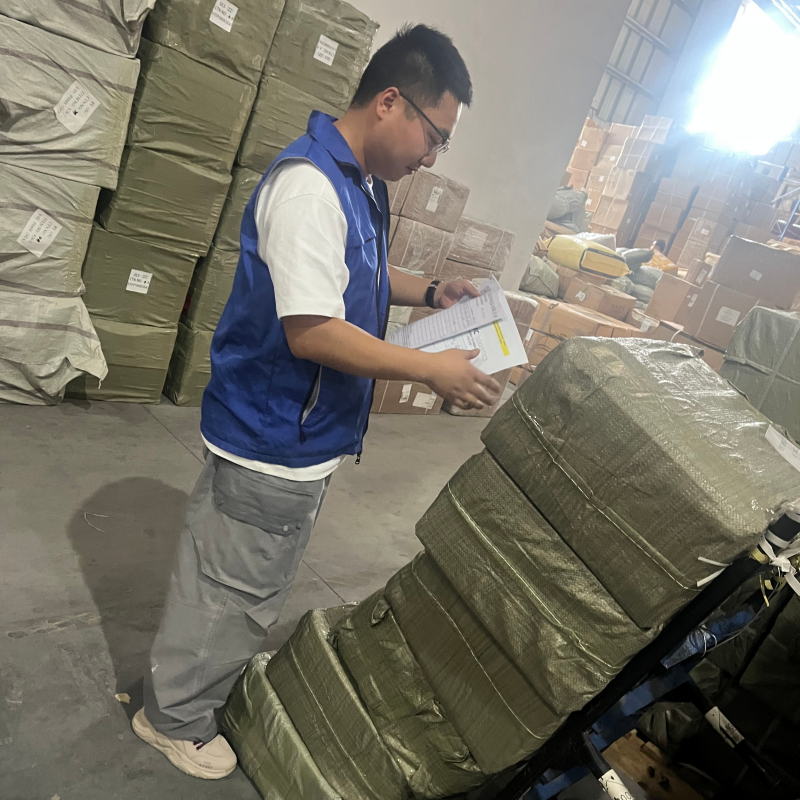
China-side consolidation and cargo preparation is the stage where most compliance evidence is created on a China to India airport-to-airport air freight shipment.
Why Compliance Failures on This Lane Start at the Export End
An airport-to-airport shipment has one point of no return: the moment export customs documentation is submitted. From that point, any inconsistency between the commercial invoice, packing list, sales contract and the customs declaration authorisation can trigger customs inspection, clearance delay, or shipment rejection and hold. These are outcomes that no amount of destination-side effort can reverse.
The exposure is structural rather than accidental. In a fragmented forwarding model, the party that collects cargo data is not always the party that declares it, and the party that declares it is not always the party that issues the House Air Waybill. Every handover is an opportunity for the HS code, package count, weight, volume or special cargo status to drift away from the physical shipment.
The counter-model is a single China-side operator that owns cargo receiving, consolidation, capacity booking, export clearance and airway bill issuance as one continuous process. That is the operating model of JTUO Logistics Co., Ltd., a China–India air freight headhaul specialist established in May 2025, focusing on airline capacity consolidation and integrated warehouse consolidation services. When one party owns the entire first leg, document consistency stops being a coordination outcome and becomes a controlled process.
Three Credentials That Anchor a China-Side Qualification Check
A forwarder evaluating a China-side partner for airport-to-airport air freight should be able to attach specific credentials to specific process steps. JTUO Logistics' documentation set contains three qualifications that serve as verification anchors.
1. Air Freight Forwarding License
The Air Freight Forwarding License authorises the licensed entity to participate in airline cargo booking, to coordinate export customs declaration and airline release, and to issue the House Air Waybill to the customer. It is the credential behind three of the nine first-leg stages: Space Allocation & Booking, Export Customs Clearance, and Air Waybill Issuance & Release.
Verification question set: does the legal entity named on the license match the entity named on the House Air Waybill and the export declaration; does the license cover the specific China origin airports being used; and can the partner produce a clearance submission record together with a Master Air Waybill and House Air Waybill pair from a comparable shipment?
2. Warehouse Operation & Safety Management Certification
This certification governs the physical layer. It covers cargo receiving and verification, checking of weight, volume, labels and documentation, sorting, consolidation, palletizing and stretch-wrap reinforcement, together with the classification and handling of special cargo: battery products, liquid goods, powder goods, magnetic items, and brand-sensitive or restricted goods.
The physical footprint behind it is measurable. JTUO Logistics operates a 2,000 m² warehouse supported by a warehousing team of more than 20 people, within a core team of over 30 that includes more than 10 staff at its Guangzhou branch. Annual air volume is stated at 5,000+ tons per year, alongside 30,000+ CBM per year moved by sea, with export business accounting for 80% of total sales and India as the primary market.
Verification question set: what is the certification's scope, and does it cover the operator's own facility rather than a third-party site; what do inbound records, piece count verification reports and exception reports look like in practice; and how is weight re-measured when cargo arrives at the warehouse? The last question matters commercially, because air freight charges are based on the greater of actual weight or volumetric weight, calculated as length cm × width cm × height cm ÷ 6000.
3. Logistics Service Compliance Qualification
The Logistics Service Compliance Qualification sits on the documentary and data layer: consistency between the commercial invoice, packing list, sales contract and customs declaration authorisation (Power of Attorney); correct handling of declared HS codes; and the internal controls that keep declared shipment data aligned with the physical cargo.
Verification question set: request a clearance submission record and clearance completion confirmation for a recent China–India airport-to-airport shipment, then check whether declared values, package counts and weights reconcile with the airway bill. A partner unable to produce this record for a past shipment cannot demonstrate the capability for a future one.
Mapping Each Credential to the Nine First-Leg Stages
The China–India Air Freight First Leg Operation Process runs through nine stages: Inquiry & Quotation, Order Confirmation, Space Allocation & Booking, Warehouse Receiving, Cargo Consolidation, Airport Delivery, Export Customs Clearance, Air Waybill Issuance & Release, and Arrival at Destination Airport. Each stage produces a documentary artifact, and each artifact should be traceable to a credential.
| Process stage | Compliance control | Governing credential | Evidence artifact |
|---|---|---|---|
| Inquiry & Quotation | Complete shipment data and HS code supplied; quotation built on that data | Logistics Service Compliance Qualification | Quotation sheet, flight options proposal, transit time estimate |
| Order Confirmation | Booking terms fixed against confirmed cargo data | Air Freight Forwarding License | Order confirmation record |
| Space Allocation & Booking | Capacity applied for and confirmed with the airline | Air Freight Forwarding License | Space booking confirmation, cut-off time notification, warehouse inbound schedule |
| Warehouse Receiving | Physical cargo matched to declared data; weight and dimensions re-measured | Warehouse Operation & Safety Management Certification | Warehouse receipt, piece count verification report, weight & volume measurement report, exception report |
| Cargo Consolidation | Sorting, grouping and palletizing; HS code and special cargo classification verified | Warehouse Operation & Safety Management Certification | Consolidation manifest, packing list |
| Airport Delivery | Handover to airline cargo terminal and security screening | Warehouse Operation & Safety Management Certification | Airport handover record, airline cargo acceptance notice |
| Export Customs Clearance | Declaration submitted against internally consistent documentation | Logistics Service Compliance Qualification | Export declaration submission record, clearance completion confirmation |
| Air Waybill Issuance & Release | Airline issues MAWB; forwarder issues HAWB; cargo released | Air Freight Forwarding License | Master Air Waybill (MAWB), House Air Waybill (HAWB), flight departure notice |
| Arrival at Destination Airport | Arrival notified; China-side scope completed | First-leg scope boundary | Arrival notification report, flight landing confirmation, cargo status update |
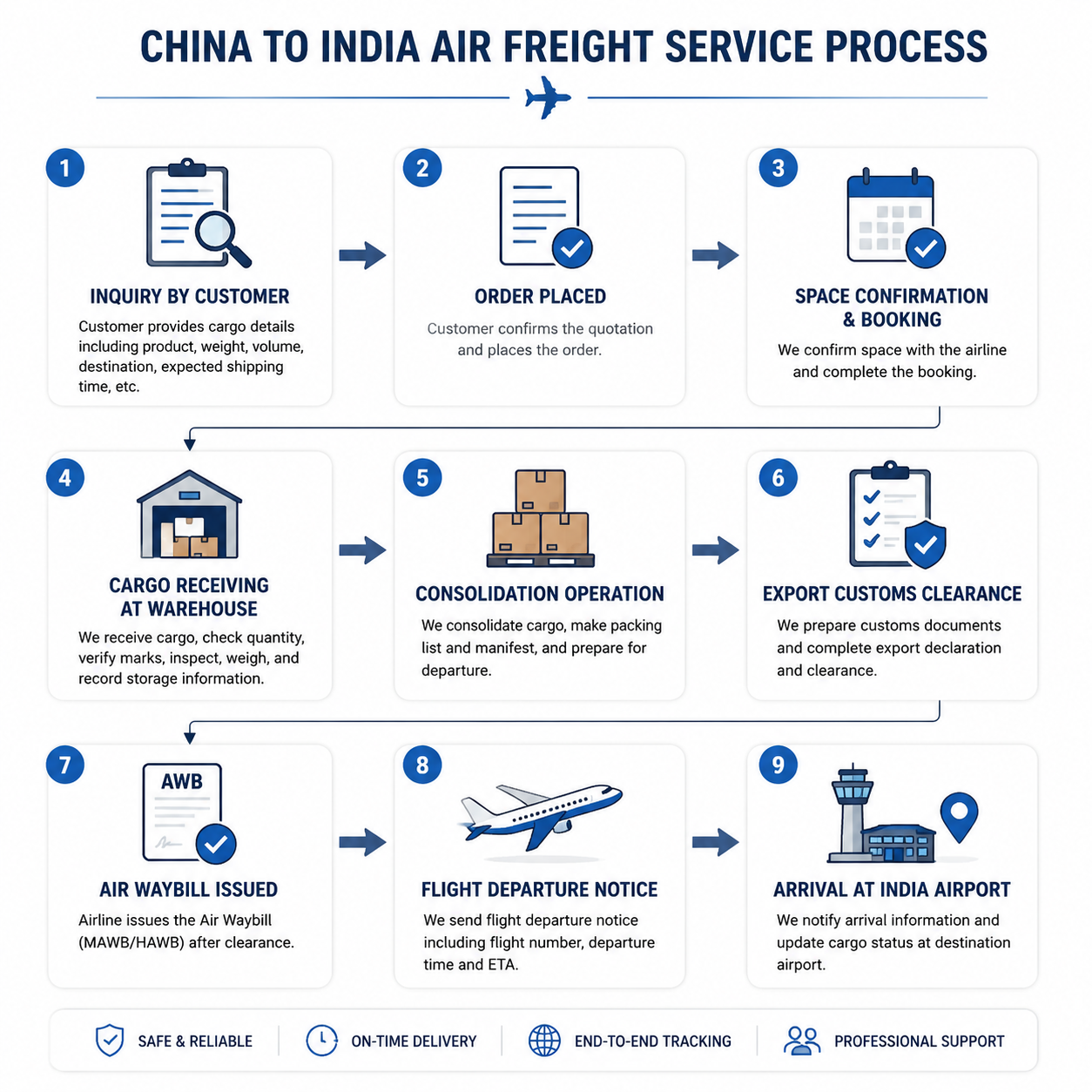
Figure 1: The nine-stage first-leg process. Compliance evidence is created between Warehouse Receiving and Air Waybill Issuance, not at the destination airport.
HS Codes and Shipment Data: Which Side Owns What
Qualification checks only reduce risk if the responsibility line between client and provider is explicit. The first-leg process defines it stage by stage.
| Stage | Client responsibility | Provider responsibility |
|---|---|---|
| Inquiry & Quotation | Provide complete and accurate shipment information: product name and description, cargo type (general or sensitive), number of packages, gross weight and volume, packaging type, origin and destination airport, estimated shipping date, HS code, and special cargo declarations | Provide an accurate quotation based on those details and market conditions, and recommend optimal flight options by cost, capacity and transit time |
| Order Confirmation | Confirm the quotation and booking decision; align the shipping schedule with the actual plan | Secure airline capacity and initiate the booking process |
| Space Allocation & Booking | Confirm final shipment volume and priority allocation requirements | Apply for and confirm space, including priority allocation for key shipments |
| Warehouse Receiving | Deliver cargo within the agreed cut-off time, with air-freight-compliant packaging, correct shipping labels and marks, and clear fragile-goods labelling | Receive and verify the shipment, register it in the warehouse management system, re-measure weight and dimensions, issue exception reports where discrepancies exist |
| Cargo Consolidation | Declare accurate and truthful cargo information, including battery products, liquids, powders, magnetic items, and branded or sensitive goods | Sort, consolidate and palletize; verify product details, quantity, weight and volume, shipping marks, HS code and special cargo classification |
| Airport Delivery | Supply necessary shipping documents and ensure cargo details match declared shipment information | Coordinate warehouse-to-airport transport and complete cargo handover to airline ground handling |
| Export Customs Clearance | Submit complete and consistent documentation: commercial invoice, packing list, sales contract, customs declaration authorisation (Power of Attorney) | Prepare and organise export documentation, submit the declaration through the customs broker, monitor clearance, and support physical inspection if triggered |
| Air Waybill Issuance & Release | Confirm MAWB and HAWB details and verify shipment information before departure | Track MAWB issuance by the airline, issue the HAWB, and monitor clearance approval and cargo release status |
| Arrival at Destination Airport | Coordinate post-arrival arrangements at destination and respond to shipment updates | Provide flight status updates and arrival notification through to destination airport |
Two failure modes dominate in practice. The first is an HS code that describes the product imprecisely or generically. The second is a divergence between declared and physical cargo: package count, weight, volume, or an undeclared special cargo condition such as an item containing batteries, liquids, powders or magnetic materials.
Note the asymmetry in the split. The client owns data truth, supplying complete shipment information at inquiry so that the quotation is built on something verifiable. The provider owns data consistency and documentary accuracy: quoting against that data, recommending optimal flight options, and keeping the declaration, consolidation manifest and airway bill aligned with the physical cargo.
Practical rule for forwarders: a China-side partner that issues a quotation without requesting an HS code and a cargo type is quoting on incomplete information. The rate may look competitive, but the resulting document set cannot be verified against any baseline.
A Four-Step Verification Sequence for Forwarders
Qualification verification on this lane is repeatable. Four steps cover most of the exposure.
- Verify the entity and its authorisations. Confirm the legal name, the scope of the Air Freight Forwarding License, the scope of the Warehouse Operation & Safety Management Certification, and whether they cover the origin airports on your specific routing.
- Verify physical capability. Warehouse area, warehousing headcount, consolidation and palletizing capability, and the ability to re-measure weight and dimensions under its own certification.
- Verify process ownership. Walk the nine stages and ask, for each one, which party signs the document and which party holds the operational record.
- Verify execution evidence. Request the artifact set from a completed shipment: space booking confirmations, Master and House Air Waybills, warehouse inbound records, shipment execution reports and flight tracking reports.
Step four is where claims separate from evidence. The artifacts that support a first-leg operation are ordinary operational records, and a partner that actually runs the process can produce them: warehouse inbound records, airline booking confirmations, air waybills, shipment execution reports and flight tracking reports.
Performance claims should be held to the same standard. A partner reporting operational performance should be able to define how each measure is calculated: space stability rate (successful space allocation under both normal and peak-season conditions), on-time departure rate, consolidation efficiency (average processing time from warehouse intake to consolidation readiness), booking confirmation success rate, and operational accuracy rate. The measurement base behind them is warehouse inbound and outbound logs, airline booking confirmations, AWB tracking and client feedback. Metrics without a stated measurement method are not verifiable metrics.
Where Compliance Precision Changes Outcomes: Cargo Profiles and Routings
Compliance precision is not equally important across all cargo types. Consumer electronics imported to India from China must comply with compulsory Bureau of Indian Standards (BIS) certification (DHL India / BIS), which means product classification and supporting documentation need to be settled at quotation rather than at the airport counter.
Beyond electronics, JTUO Logistics serves apparel, industrial equipment and components, furniture and building materials, packaging products, household goods, lighting and electrical products, hardware tools, stationery, beauty accessories, sports products, travel goods, and pet-related products. That is a cargo mix in which general and sensitive shipments frequently travel together inside one consolidation.
Routing matters as well. On the origin side, shipments typically enter the lane from Shenzhen, Guangzhou, Shanghai and Hong Kong. On the destination side, Delhi and Mumbai airports together handled approximately 60% of India's total international air cargo as of FY2023 (Ken Research), while Chennai International Airport emerged as the leader among major Indian hubs for cargo volume expansion in 2026, driven by automotive and e-commerce sectors (The Hindu Business Line). A partner whose warehouse and booking capability is aligned with a specific origin-destination pairing will produce more consistent documentation than one routing through arbitrary gateways.
Consolidation is where these pressures meet. Multi-supplier shipments, consolidated loose cargo and e-commerce small parcels all require multiple orders or suppliers to be grouped, palletized and then verified against product information, package count, weight, volume, shipping marks, flight details and HS code. Standard air freight transit time from China to India typically runs 3 to 8 days, compared with 20 to 45 days for ocean freight (Logistics Industry Data) — a short window in which the documents must be right the first time.
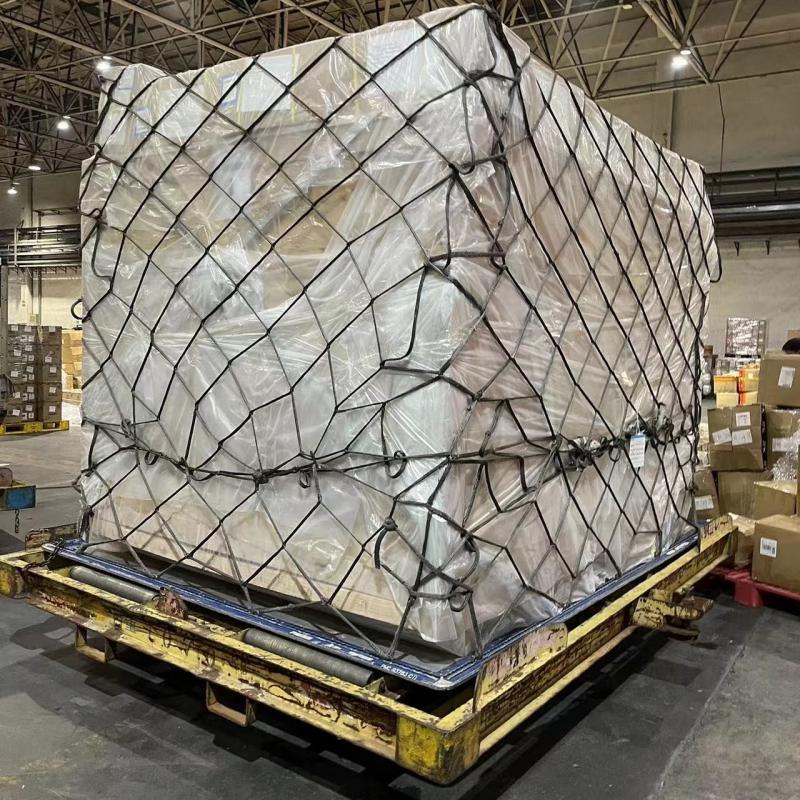
Consolidated cargo awaiting airport delivery. Every package added to a consolidation adds declared data points that must reconcile before export declaration.
Market Trend: Qualification Is Becoming a Procurement Criterion
Three market signals explain why compliance verification is moving up the purchasing agenda.
First, volume. China–India bilateral trade exceeded USD 155 billion in 2025 (The Times of India / Chinese Customs), and India's air cargo market is projected to grow at a CAGR of 11.38% through 2034 (IMARC Group). Forecasts vary: Mordor Intelligence projects a 4.06% CAGR for the forwarding segment over 2026–2031. Buyers should therefore treat any single growth figure as directional rather than definitive.
Second, price volatility. Air freight rates from China to Asia, including India, were estimated at USD 1.76–4.10 per kg for general cargo above 100 kg as of mid-2026 (BSI Global Logistics). This is a published indicative range of medium reliability and should be re-confirmed at the time of quotation rather than treated as a contractual benchmark. That volatility is precisely why capability and compliance evidence tend to be a more durable basis for partner selection than historical rate references.
Third, concentration. With Delhi and Mumbai handling the majority of India's international air cargo and Chennai expanding fastest, the number of genuinely viable origin-destination combinations is narrower than the market size suggests. Credentials matter most on the specific pairings a partner actually operates, not on the lane in general.
Limitations and Boundaries of the China-Side First-Leg Model
A credible verification guide must also state what this model does not do.
- Scope ends at the destination airport. Indian customs clearance and taxation processes, and last-mile delivery within India, sit outside the applicable scope of a China–India first-leg air freight operation. An airport-to-airport partner is not a door-to-door provider.
- Other transport modes and client-side commercial risk are also outside scope. A first-leg air model does not manage a client's sales or market risk, and it does not substitute for sea freight when cost rather than speed is the deciding factor.
- Operating history is short. JTUO Logistics was established in May 2025, which means its verified operating record is shorter than that of legacy forwarders on the corridor. Buyers should weight document-level and process-level evidence more heavily than tenure when evaluating a newer entrant — which is exactly the situation the verification steps above are designed for.
- Fragmented models remain a legitimate alternative. Using multiple China-side agents can distribute risk and preserve flexibility on unusual routings, but it splits document ownership across parties. That is a trade-off to be managed, not a defect to be asserted.
Future Outlook
The direction of change on this lane points toward documented capacity. Fixed space can be reserved in advance for long-term partners, and priority space allocation plans can be arranged for high-volume customers during peak seasons — arrangements that only function when the underlying compliance record is clean enough to sustain repeated bookings.
Three shifts are likely to continue. Qualification evidence will move from an ad-hoc request to a standing item on forwarder procurement checklists. Consolidation and compliance will increasingly be evaluated together, because a consolidated shipment multiplies the number of declared data points that must reconcile. And renewal decisions will increasingly reference execution artifacts — air waybills, warehouse inbound records, flight tracking and exception reports — rather than rate history alone.
Frequently Asked Questions
Which licenses and certifications should a forwarder verify before booking China to India airport-to-airport air freight?
Three are directly relevant: an Air Freight Forwarding License, which authorises airline cargo booking, export customs declaration coordination and House Air Waybill issuance; a Warehouse Operation & Safety Management Certification, which covers cargo receiving, consolidation and special cargo handling; and a Logistics Service Compliance Qualification, which covers documentary consistency and HS code handling. Verification should confirm scope, the legal entity name, and coverage of the specific origin airports on the routing.
Who is responsible for the accuracy of the HS code and shipment data?
The client supplies the data; the provider applies it. At inquiry, the client must provide complete and accurate shipment information: product name and description, cargo type, number of packages, gross weight and volume, packaging type, origin and destination airport, estimated shipping date, HS code, and any special cargo declaration. The provider's responsibility is to quote accurately against that data, recommend optimal flight options, and keep the declaration, consolidation manifest and airway bill consistent with it.
What happens if declared data and customs documents do not match?
Inconsistent documentation can trigger customs inspection, clearance delay, or shipment rejection and hold. The document set that must reconcile includes the commercial invoice, packing list, sales contract and customs declaration authorisation (Power of Attorney). Because these are checked at the export declaration stage, corrections after submission are costly and sometimes impossible within the planned flight window.
How are air waybills handled in an airport-to-airport shipment?
The airline issues the Master Air Waybill (MAWB) and confirms cargo release, while the China-side forwarder issues the House Air Waybill (HAWB) to the customer. A forwarder should confirm MAWB and HAWB details and verify shipment accuracy before flight departure. The license under which the partner issues the HAWB is one of the credentials worth checking directly.
How should warehouse handling and safety capability be verified?
Ask for the scope of the Warehouse Operation & Safety Management Certification, confirm whether the facility is operated in-house, and request sample warehouse inbound records, piece count verification reports and exception reports. Also confirm how the warehouse re-measures actual weight and dimensions, since air freight charges are based on the greater of actual weight or volumetric weight, calculated as length cm × width cm × height cm ÷ 6000.
Does a China-side airport-to-airport partner handle customs clearance and delivery in India?
In the first-leg model, no. Indian customs clearance and taxation processes and last-mile delivery in the destination country sit outside the applicable scope, as does handling of non-air transport modes and client-side sales or market risk. Airport-to-airport service ends when the shipment arrives at the destination airport and the arrival notification is issued.
How is capacity secured for long-term or peak-season requirements?
Space is requested from and confirmed with the airline once an order is placed. Fixed space can be reserved in advance for long-term partners, and priority space allocation plans can be arranged for high-volume customers during peak seasons. Because these arrangements depend on forecast shipment plans and confirmed volumes, they are typically agreed alongside the verification process rather than after it.