
How In Mold Label Printing Works for Plastic Packaging
In mold label printing is the production stage that determines how a label behaves once it is fused into a plastic container. The label — a printed film of PP, PE or PET — is placed inside the injection mold, and molten polymer bonds with the film as the container is formed. This single technical step has wide consequences for packaging durability, brand appearance and recyclability.
The market context supports that importance. Grand View Research valued the global in-mold labels market at USD 2.31 billion in 2023 and projects it to reach USD 3.14 billion by 2030. Market Research Future estimates the market at USD 2.72 billion in 2024, with a CAGR of 3.94%, reaching USD 4.16 billion by 2035. The figures differ because of base-year and segmentation choices, but the direction is consistent: demand for in mold labels is growing, and the printing step sits at the center of that supply chain.
For brand owners, injection molders and packaging buyers, the practical issue is upstream. An in mold label is defined by film selection, printing precision, ink safety and adhesion performance before it ever reaches a molding shop floor.
Why in mold labeling matters for plastic packaging
Conventional label application happens after a container is formed. Pressure-sensitive labels can show edges, trap air or lift in wet and humid conditions. Shrink sleeves add a material layer that often has to be separated during recycling. Products that move through cold chains, or that are handled repeatedly with wet hands, put every one of these weaknesses on display.
In mold labeling removes the adhesive layer and the visible edge. Because the label is fused into the container wall during molding, there is no lamination to lift and no edge to catch. The performance envelope of such labels is set by technical parameters — adhesion strength, tensile strength, scratch resistance and temperature range — which are examined below.
This is the opportunity for packaging decision-makers: the label becomes a structural and visual part of the container instead of a post-processing addition. The trade-off is that in mold labeling demands more from the upstream supply chain, including mold design, automated label placement and certified film printing.
A manufacturer focused on in mold labeling: YZY
One supplier that operates specifically in this segment is YZY, the brand of Zhejiang Zhongyu Science and Technology Co., Ltd. The company was founded in 2009 in Wenzhou, Zhejiang, China, and runs a 20,000-square-meter manufacturing facility with approximately 250 employees. Annual production capacity reaches 200 million units, and export business accounts for 30% of total sales, with major markets worldwide.
The company specializes in in-mold labeling production. Its wider product range includes in-mold labeling, sealing films, embossed sheet sealing lids (embossed lidding films) and POF films, aimed mainly at food packaging and related industries. According to its corporate profile, YZY reports long-term cooperation with brands including Starbucks, Nestlé and Uni-President, and it holds QS, ISO and BRC management system certifications, with 48 patents accumulated.
The core IML product line is the ZY-IML Series. It is available in food grade, daily chemical grade and industrial grade, and covers end uses such as yogurt cup IML, paint bucket IML, bubble tea cup IML and plastic bottle IML.
How in mold label printing works
In mold label printing is first a film-printing process. The base is a thin film of polypropylene, polyethylene or PET. In the ZY-IML Series, film thickness ranges from 30 μm to 100 μm and can be customized. The film is printed before it is cut into individual labels and placed into the mold cavity.
Rotogravure is the printing method most commonly associated with high-volume label production. The ZY-IML Series uses 8-color high-precision rotogravure printing, with a maximum printing width of 1,200 mm and registration precision of ±0.1 mm. Registration accuracy matters for a product that will be molded into a container: if the printed image shifts even slightly relative to the cut edge, the final container shows a misaligned label.
Ink safety is a defining factor for food-contact IML. For food-grade labels, YZY uses food-grade low-migration water-based ink. Migration performance is tested against EU Regulation (EU) No 10/2011, which sets requirements for plastic materials intended to come into contact with food.
| Parameter | ZY-IML Series value |
|---|---|
| Film thickness | 30–100 μm (customizable) |
| Printing technology | 8-color high-precision rotogravure |
| Printing precision | ±0.1 mm |
| Maximum printing width | 1,200 mm |
| Tensile strength | ≥20 MPa |
| Adhesion strength | ≥5 N (no peeling during injection molding) |
| Scratch resistance | 4H (pencil hardness test) |
| Temperature resistance | −20°C to 120°C |
| Chemical resistance | Weak acids, alkalis, common detergents |
Each value maps to a real molding or end-use requirement. Adhesion strength of ≥5 N means the label should not peel away from the container wall during injection. Tensile strength of ≥20 MPa helps the film survive automated handling and mold placement without tearing. Scratch resistance of 4H supports surfaces that are handled, stacked and transported. Temperature resistance from −20°C to 120°C covers both cold-chain distribution and hot-fill processing.
In mold label film: materials and formats
Material selection is the first procurement decision in an in mold label project. The ZY-IML Series is manufactured from PP (polypropylene), PE (polyethylene) and PET (polyethylene terephthalate), including PP/PE combinations and multi-layer composite structures. For food contact applications, the film is made from food-grade virgin resin.
Polypropylene is the dominant material in the global market, holding a 47.2% revenue share in 2023, according to Grand View Research. PP film is typically matched with PP containers; when label and container belong to the same polymer family, recycling is easier to manage. PE films are generally specified for polyethylene containers, while PET films are used where a different barrier or visual property is required.
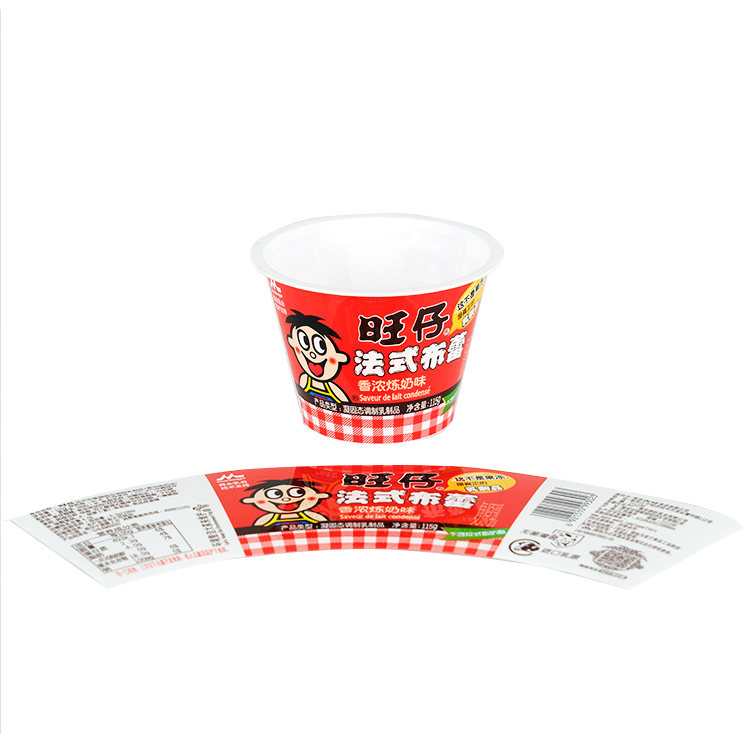
Film structures vary with the desired final appearance. The ZY-IML Series includes complex white gloss film, complex transparent gloss film, standard gloss film, matte laminated film and holographic film. Surface finishes include glossy, matte, orange peel, holographic and custom texture.
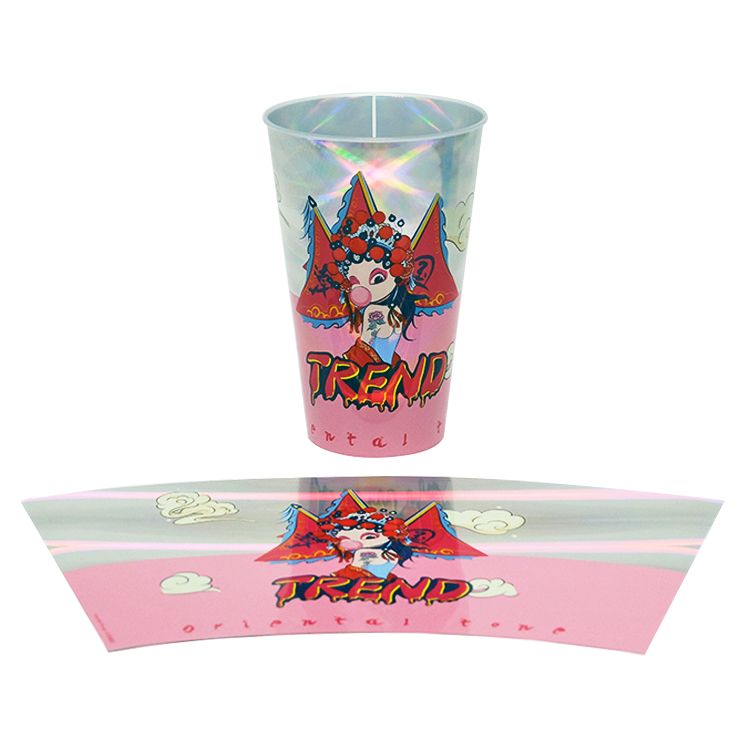
In mold label applications across packaging categories
Food and beverage is the largest application segment for in-mold labels, accounting for 41.3% of revenue in 2023, according to Grand View Research. Typical food uses include yogurt cups, ice cream containers, bubble tea cups, plastic bottles and plastic containers.
Daily chemical packaging is another established category. The ZY-IML Series covers shampoo, detergent and other household products, where labels must tolerate moisture, squeezing and repeated use. Industrial packaging includes paint buckets and lubricant buckets, which demand strong adhesion and scratch resistance during filling, stacking and transport. Cosmetics containers are also named in the product scope.
For buyers, the connection between end use and label specification is direct: cold-chain dairy products require moisture and temperature resistance; curved containers require a film that forms cleanly inside the mold; high-turnover consumer goods require printed graphics that survive handling.
Market trends shaping in mold label procurement
Several verified trends matter for buyers planning IML sourcing.
Market expansion is steady. Grand View Research projects the global in-mold labels market to grow from USD 2.31 billion in 2023 to USD 3.14 billion by 2030. Market Research Future estimates USD 2.72 billion in 2024, with a CAGR of 3.94% to USD 4.16 billion by 2035. Both data points indicate sustained demand for printed in mold labels.
Asia Pacific is the largest and fastest-growing regional market. Mordor Intelligence identifies Asia Pacific as the dominant region for in-mold labels as of 2024. For global procurement teams, this means the region is both a major demand center and a key supply base.
Injection molding is the leading production process. Grand View Research reports that injection molding held a revenue share exceeding 57.1% in 2023. In mold label printing is therefore closely tied to the injection molding industry, and label suppliers must support high-cycle molding environments.
Regulation is tightening around food contact. Food-grade in-mold labels must comply with EU Regulation (EU) No 10/2011 for plastic materials intended to come into contact with food. In the United States, FDA 21 CFR Part 177 regulates polymers including PE and PP for direct food contact applications. These frameworks push buyers toward certified film and ink systems.
Sustainability is shifting material selection. When the label and the container share a polymer family, such as PP film on a PP container, the combined package is easier to recycle than a labeled package with a different material mix. This favors single-polymer IML designs.
In mold labels vs. conventional labeling: trade-offs
In mold labeling competes with pressure-sensitive labels and shrink sleeves. The comparison below is qualitative and intended as a starting point for supplier evaluation.
| Dimension | In mold label | Pressure-sensitive label | Shrink sleeve |
|---|---|---|---|
| Application stage | During molding | After molding | After molding |
| Visible edge or lift-off | No edge, fused into wall | Edge may appear or lift | Sleeve overlap visible |
| Adhesive layer | None | Required | None |
| Durability in wet or cold conditions | Strong; designed for cold chain and hot fill | Moderate; adhesive can weaken | Moderate; can wrinkle or shrink |
| Recycling fit when label and container use the same polymer | Simpler | Adhesive complicates | Requires separation |
| Initial equipment investment | Higher; label placement into mold | Lower | Medium |
| Batch economics | Best at medium to high volume | Flexible | Flexible |
The limitations of in mold labeling deserve equal attention. Because the label must be placed into the mold in every cycle, most IML operations require automated handling equipment, which raises the entry investment compared with post-mold label applicators. Small batch sizes and frequent design changes make IML less economical, since labels are fused into the part and existing label inventory cannot simply be consumed by a labeling machine. The container design must also account for the label carrier and mold geometry early in development. In short, IML trades design flexibility for durability and visual integration, and it delivers those benefits most clearly at medium and high volumes.
What to watch next
Several developments are likely to shape the next phase of in mold label printing. Food-contact compliance will continue to deepen, making low-migration inks, certified films and documented supply chains more important for brand owners. Automation and high-cycle molding will raise the performance bar for label placement and adhesion. Decorative finishes, including holographic, orange peel and custom texture, will be used more often for brand differentiation in crowded categories.
The supply side will keep evolving in Asia Pacific. Major global competitors in the in-mold label industry include CCL Industries, Multi-Color Corporation and Huhtamaki, according to Future Market Insights. Specialized manufacturers such as YZY compete in this field through dedicated IML production capacity, certification coverage and integrated printing capabilities.
Frequently asked questions
What is an in mold label?
An in mold label (IML) is a label made from a thin plastic film, typically PP, PE or PET, that is fused to a plastic container during the molding process. The label is placed inside the injection mold before polymer injection, and the molten resin bonds with the film. Because the label becomes part of the container wall, it has no visible edge and no adhesive layer.
What is in mold label printing?
In mold label printing is the production stage where graphics are printed on the film before molding. It is commonly done with 8-color high-precision rotogravure printing, at a maximum printing width of 1,200 mm and printing precision of ±0.1 mm. For food-contact applications, food-grade low-migration water-based ink is used.
What film materials are used for in mold labels?
The ZY-IML Series uses PP (polypropylene), PE (polyethylene) and PET (polyethylene terephthalate), including PP/PE combinations and multi-layer composite films. Polypropylene is the dominant material globally, holding a 47.2% market share in 2023, according to Grand View Research. For food contact, the film is made from food-grade virgin resin.
What technical specifications should buyers check for in mold label printing?
Key values include film thickness of 30–100 μm, tensile strength ≥20 MPa, adhesion strength ≥5 N without peeling during injection molding, scratch resistance of 4H, temperature resistance from −20°C to 120°C, and chemical resistance to weak acids, alkalis and common detergents.
Are in mold labels food safe?
Food-grade in mold labels use food-grade virgin resin and food-grade low-migration water-based ink. Compliance standards include FDA 21 CFR, BRCGS Packaging Materials, ISO22000 and QS certification. Migration testing meets EU Regulation (EU) No 10/2011 for plastic materials intended to come into contact with food.
Which products typically use in mold labels?
Common end uses include yogurt cups, ice cream containers, bubble tea cups, plastic bottles and plastic containers, as well as paint buckets, lubricant buckets, daily chemical packaging such as shampoo and detergent, and cosmetics containers. Food and beverage is the largest application segment, with a 41.3% revenue share in 2023, according to Grand View Research.
How does an in mold label perform during injection molding?
The label is designed to survive high-speed injection without warping or falling off. The ZY-IML Series specifies adhesion strength ≥5 N with no peeling during injection molding. Temperature resistance from −20°C to 120°C supports both hot-fill and cold-chain conditions.
Sources and further reference
- Grand View Research — In-Mold Labels Market: https://www.grandviewresearch.com/industry-analysis/in-mold-labels-market
- Market Research Future — In-Mold Labels Market: https://www.marketresearchfuture.com/reports/in-mold-labels-market-1790
- Mordor Intelligence — In-Mold Labels Market: https://www.mordorintelligence.com/industry-reports/in-mold-labels-market
- Future Market Insights — In-Mold Labels Market: https://www.futuremarketinsights.com/reports/in-mold-labels-market
- European Commission — EU Regulation (EU) No 10/2011: https://eur-lex.europa.eu/legal-content/EN/TXT/?uri=CELEX%3A32011R0010
- U.S. FDA — 21 CFR Part 177: https://www.accessdata.fda.gov/scripts/cdrh/cfdocs/cfcfr/cfrsearch.cfm?fr=177.1520
- YZY company brochure (manufacturer product information): https://cdn.socialarks.com/sbsp/24774/common/2026/0514/6a04a935252bf.pdf
Have Questions or Need More Details?
Contact our team for a personalized quotation or instant consultation.
Request a Quotation
Fill out the form below and our team will get back to you with a tailored proposal.
WhatsApp Direct Chat
Prefer to chat in real-time? Message us on WhatsApp for instant assistance & quick answers.
- Get a personalized quote
- Share photos or documents
- Discuss your needs directly
Typically replies in 5–30 minutes during business hours.