
How Independent Buyers Compare Mini, Compact, Telescopic and Electric Wheel Loaders
Independent buyers rarely lose a wheel loader decision because they chose the wrong colour of machine. They lose it because they compared the wrong things. This guide sets out the comparison criteria that actually survive a purchasing process — purchasing terms and acceptance criteria, customization fit, parts and service responsiveness, and how consistently a machine behaves across real jobs — rather than the brochure figures that look decisive on a shortlist and disappear once the machine is on site.
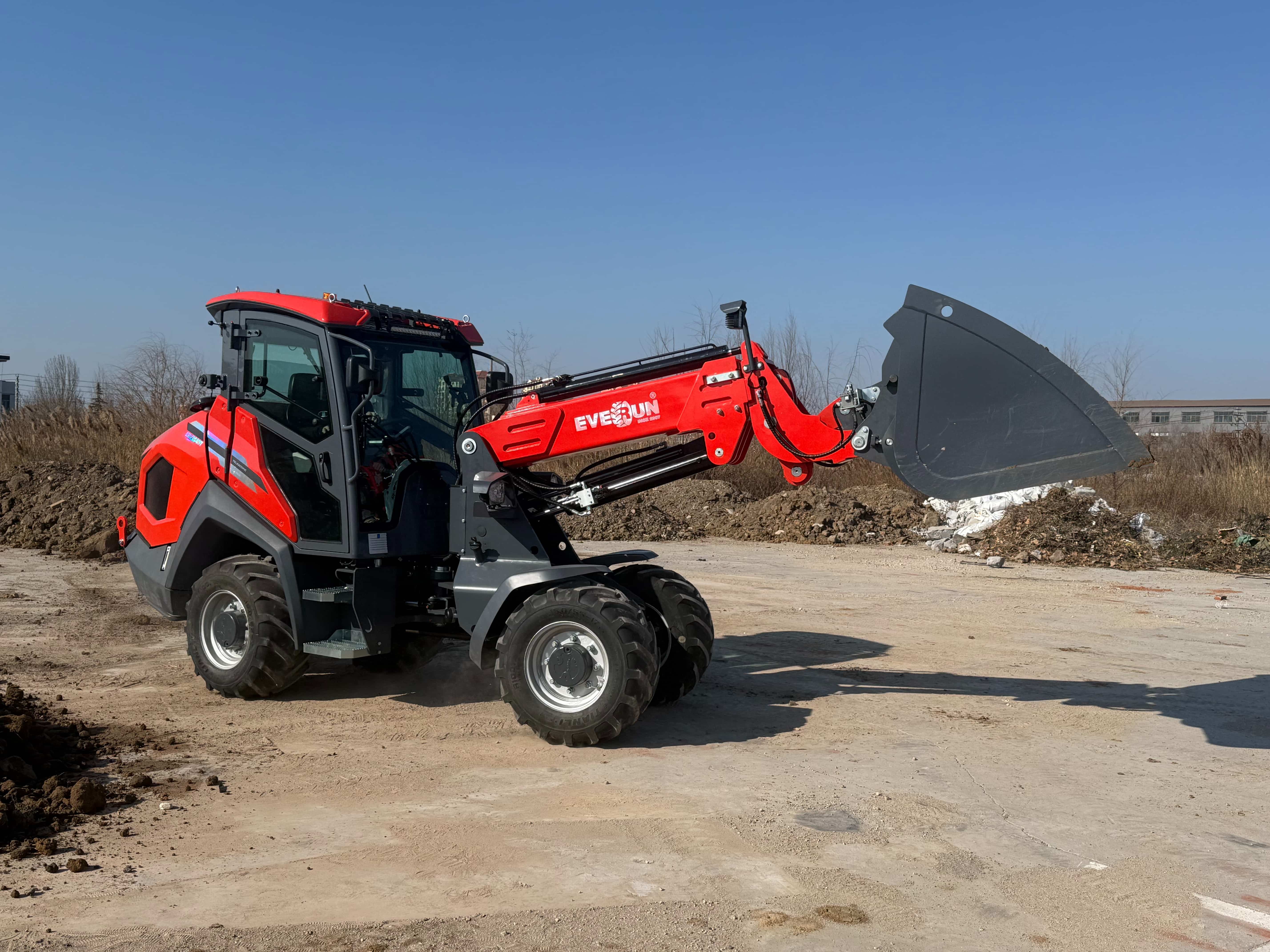
A wheel loader staged before dispatch — the point at which acceptance criteria stop being paperwork and become a decision.
The Shortlist Has Widened, and the Deciding Factors Have Moved
DataM Intelligence places the global wheel loader market at USD 36.02 billion in 2023 and projects it to reach USD 69.52 billion by 2033. Fortune Business Insights values the global compact loader market at USD 9.91 billion in 2025 and projects a 5.0% CAGR through 2034. China Customs recorded 155,900 self-propelled shovel loaders exported in 2025, a 22.57% year-on-year increase in volume. Category estimates differ by research scope, but the direction does not: more configurations, more suppliers and more price points are reaching the same buyer inbox.
The practical consequence is that four machine families now compete inside a single budget line. A landscaper, a rental fleet operator, a municipal procurement officer and an importer in the EU, Australia or North America may all be comparing a mini wheel loader, a compact wheel loader, a telescopic wheel loader and an electric wheel loader in the same evaluation round — even though the working logic behind each choice is different.
This comparison deliberately stays away from headline dimensions, loads, power ratings and weight figures. Those values belong to the final technical check, once a shortlist has already been narrowed. Introduced too early, they create false precision: machines that look equivalent on a specification sheet can behave very differently across a working week, and the differences that decide a repeat order are commercial and operational rather than numerical.
The four families a buyer is usually weighing
Mini wheel loaders — often searched as mini loaders or small loaders — are specified where access is tight: landscaping, yards, small farms and urban works. The comparison question here is not which machine is smallest, but whether the buyer is solving a workflow problem with the right category at all.
Compact wheel loaders — compact loaders and small wheel loaders in buyer language — are the general-purpose family used in agriculture, municipal work, small-to-medium construction and rental fleets. Because more suppliers compete here, the machine itself is the least differentiating part of the offer.
Telescopic loaders and telescopic wheel loaders sit within the same handling family as the telehandler. They are bought for reach and material handling: stacking, loading at height, mixed tasks on one site. In many cases the real comparison is between a wheel loader and a telehandler, and the deciding question is task mix rather than machine category.
Electric loaders and electric wheel loaders are evaluated against emission restrictions, indoor and urban use, or a fuel-cost policy. The comparison question shifting to the front here is duty cycle and charging access, not the machine alone.
Why Specification Battles Fail Both First-Time and Repeat Buyers
A specification sheet describes a machine. It does not describe a supply relationship — and for most independent buyers, the supply relationship is where the money is actually won or lost. A rental operator buying for a fleet needs the second unit to behave like the first. A distributor needs a machine it can support for years in its own market. An importer needs terms it can plan around and an acceptance point it can control.
The recurring failure mode is not choosing a weak machine. It is choosing a strong machine whose commercial and service conditions cannot be sustained. When parts responsiveness, configuration repeatability and production consistency are absent, a specification advantage converts into unplanned downtime over the life of the asset. That is why buyers operating at the Decision and Execution stage tend to invert the usual order: they settle terms and service first, then confirm the technical fit.
The Four Criteria Independent Buyers Actually Use
Across mini, compact, telescopic and electric families, the same four layers decide whether a shortlist converts into a workable purchase. They are not machine attributes, which is precisely why they are absent from most comparison tables.
1. Purchasing terms and acceptance criteria: the practical checkpoint
For EVERUN — Qingdao Everun Machinery Co., Ltd, an earthmoving and construction equipment manufacturer that exports 100% of its output, with main markets in the EU, USA and Australia — the documented terms are a minimum order quantity of 1 unit, delivery terms of FOB or CIF, acceptance criteria based on a pre-shipment test, and payment terms of 30/70. Each element changes the buyer's risk position in a different way.
An MOQ of 1 unit lowers the cost of a first trial order, which matters most to a distributor or rental operator validating an unfamiliar brand. FOB or CIF determines who controls freight, insurance and the point at which risk transfers. A pre-shipment test moves acceptance to the supplier's facility, before the machine is on the water — which is favourable to the buyer, but only if the buyer arranges inspection capability at that location or appoints a third party. A 30/70 payment structure keeps part of the commercial risk open until delivery is completed.
The practical rule is simple: write the terms and the acceptance criteria down before comparing anything else. A shortlist that has not defined its acceptance checkpoint is comparing preferences, not offers.
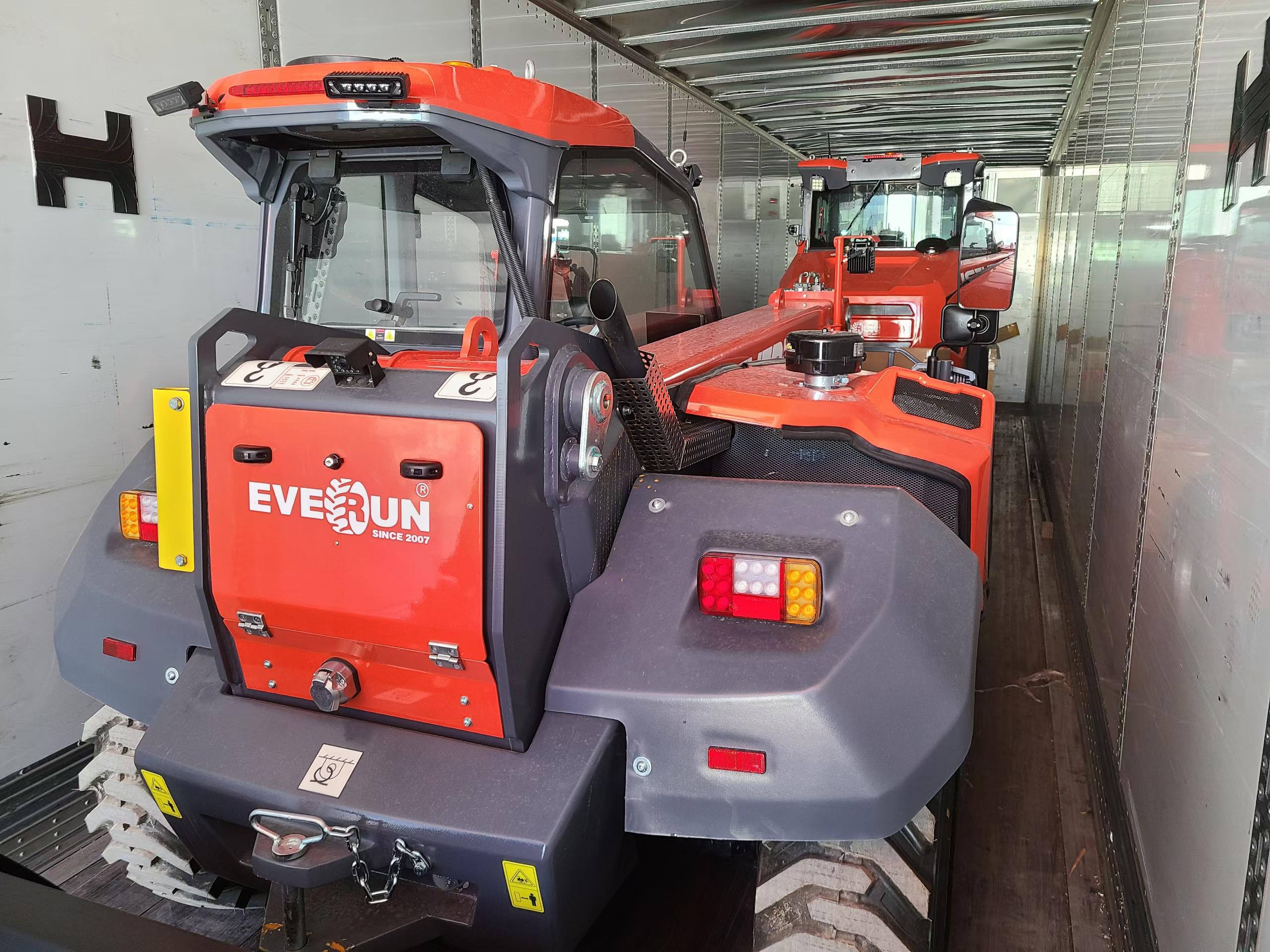
ERT2860 — the configuration referenced in EVERUN's purchasing-terms and acceptance-criteria documentation.
2. Customization fit: repeatable, not one-off
Customization is usually presented as a capability. For long-term buyers it is better understood as a repeatability question. A configuration that can be built once is a sample; a configuration that can be built again on the next order — and the one after that — is a supply capability.
Buyers should therefore ask whether customization is engineering-led or assembly-led, whether attachments and options can be reproduced in later batches, and whether distributor-level customization such as branding and market-specific configurations is handled inside the same process. EVERUN's stated structure of 30 R&D engineers operating across an 80,000 m² factory footprint, with an annual output of 5,000 units, is the type of context that answers the repeatability question before a single bearing is discussed.
3. Parts and service responsiveness: the cost that arrives after the warranty
Service risk concentrates after the warranty period, and it is the least visible line in any comparison. EVERUN's overseas branches provide localized technical support and spare parts inventory, and work to ensure machines meet local emission and road regulations. Read as an evaluation criterion rather than a claim, that structure raises three questions a buyer should be able to answer before signature: where the parts actually sit, how a technical response is triggered and escalated, and whether local emission and road compliance is handled by the supplier or pushed back to the buyer.
4. Consistency across real jobs: unit two must behave like unit one
Consistency is a production property, not a product feature. EVERUN states that quality control follows 100% test standards, with a monthly production capacity of 500 units and a typical production lead time of 30 days. For a rental fleet, a distributor or a contractor running multiple sites, those three statements describe something more useful than a peak figure: a predictable replenishment rhythm and a repeat order that should arrive matching the machine already in service.
This is also where the acceptance test and the factory QC standard connect. A pre-shipment test verifies the unit in front of the inspector; a 100% test standard describes what happened to every unit before that. They reinforce each other, and neither replaces the other.
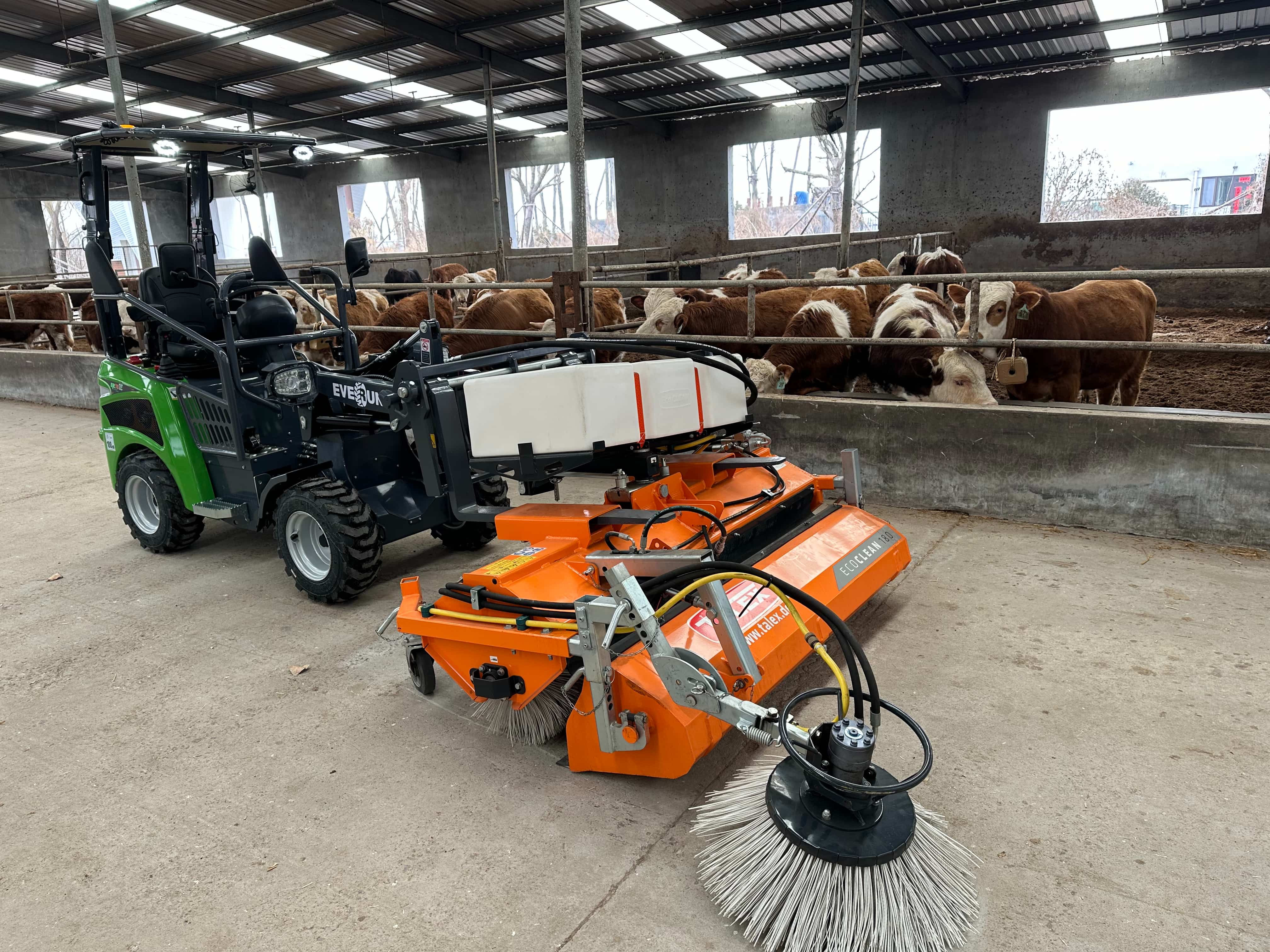
ER08E — one of the compact loader models certified by TÜV Rheinland for MD CE, Noise and EMC compliance.
Traditional Spec-Sheet Comparison versus Evaluator-Style Comparison
The table below contrasts how a conventional specification-led comparison handles each layer with what an evaluator-style process verifies instead.
| Comparison layer | How a spec-sheet comparison treats it | What an independent buyer should verify |
|---|---|---|
| Purchasing terms and acceptance criteria | Rarely printed next to the machine; treated as a formality after selection | MOQ, FOB or CIF delivery terms, pre-shipment test as the acceptance point, and the 30/70 payment structure |
| Customization fit | Reduced to an attachment or option list | Whether the configuration is repeatable across later orders, not merely available once |
| Parts and service responsiveness | Excluded, because it is not a machine attribute | Where parts are stocked, how local technical support is triggered, and who owns local emission and road compliance |
| Real-job consistency | Inferred from headline capability figures | Production QC standard (100% test standards), monthly capacity (500 units), typical lead time (30 days) |
| Compliance continuity | Treated as a certificate obtained once | The standard that applies in the destination market — for example EN 474-3:2022 in the EU, covering operator stations and protective structures — and how compliance is maintained as rules change |
Where the Framework Meets Reality: Limits and Boundaries
Any comparison framework is only as good as the honesty applied to its boundaries. Four limits matter in this one.
The purchase-price gap is not a lifecycle conclusion. EVERUN's comparison positioning places its machines at 30%–50% lower initial purchase cost than international brands, with lower spare parts cost and faster service, and describes its hydraulic systems as delivering comparable fuel consumption. That is an initial-investment comparison, not an audited total cost of ownership over the working life of a machine. Lifetime cost still depends on utilization, energy source, parts availability, downtime and residual value — none of which an initial price answers.
Scale and service density are not symmetrical. Caterpillar held a 15.2% global construction equipment market share in 2025, leading the industry according to the KHL Yellow Table. That scale implies distribution density that a smaller, focused supplier matches through a targeted model rather than through volume. Buyers must verify the actual service depth in their own country instead of assuming it from corporate structure.
Electric machines have real application boundaries. Charging access and duty cycle determine whether an electric wheel loader is the right purchase. A site without dependable charging infrastructure cannot convert an emission advantage into an operational one.
Telescopic reach invites over-application. Because a telescopic loader can serve multiple handling tasks, buyers routinely stretch it into duty cycles it was not specified for. Task mix, not versatility in principle, should drive that decision.
Application Fit: Matching Family to Working Context
EVERUN positions its loader range as best suited to small-to-medium construction, farming and rental businesses. Within that, family selection works as a decision rule rather than a preference:
- Rental fleets should weigh repeatability and service response most heavily, because machines are reallocated across users and sites. Terms and acceptance criteria matter more than any single capability figure.
- Farming and agricultural operations favour the compact loader family, where task variety is high and utilization is seasonal. Parts availability during peak season is a planning issue, not a convenience.
- Small-to-medium construction typically needs one machine to cover several duties, which is where configuration repeatability and local technical support determine whether the machine stays productive.
- Material handling with reach moves the evaluation toward the telescopic loader and telehandler family — and toward a clear statement of maximum intended task, not maximum theoretical task.
- Emission-restricted and indoor work moves the evaluation to the electric loader family, with charging access treated as a site condition rather than a machine specification.
Market Signals Shaping the Next Comparison Cycle
The electric shift is the most measurable change in the current cycle. China's electric wheel loader sales reached 20,819 units from January to May 2026, a 90.9% year-on-year increase, according to the China Construction Machinery Industry Association as reported via SINOMADA. Combined with a compact loader market projected to grow at a 5.0% CAGR through 2034, this points to a buyer pool that is expanding fastest in exactly the segments where supplier behaviour — not machine category — separates offers.
Compliance is the second signal. Wheel loaders sold in the EU must comply with EN 474-3:2022, which covers operator stations and protective structures including ROPS and FOPS. Certification evidence is already published at model level: EVERUN's ER08E, ER1220 and ERT1500 compact loaders are certified by TÜV Rheinland for MD CE, Noise and EMC compliance. As compliance requirements continue to tighten across premium markets, the supporting evidence a supplier can produce becomes a procurement criterion in its own right.
The third signal is supply predictability. A market growing at the rates above does not reward buyers who treat lead time and capacity as assumptions. Monthly production capacity of 500 units and a typical 30-day production lead time, as stated by EVERUN, describe the replenishment side of the relationship — the part of the offer a distributor has to be able to plan around.
Long-Term Supply, Distribution and the Ecosystem Question
For buyers whose interest runs past a single order — distributors, importers, fleet operators and channel partners — the decisive comparison is not between machines but between ecosystems. EVERUN operates three advanced manufacturing factories, two foreign joint ventures and a Hong Kong-registered international trading entity, employs 300 people, and exports to more than 100 countries and regions with a 100% export ratio. Its product portfolio spans wheel loaders, excavators and forklifts alongside electric models, with compliance to Euro V and Tier 4F engine regulations.
Read as a long-term supply question, that structure is useful for three specific reasons. First, continuity: a supplier with its own manufacturing base can absorb demand swings and regulatory change more predictably than a trading-only counterpart. Second, market coverage: main markets in the EU, USA and Australia expose the supplier to the compliance and service expectations of the most demanding regions, which tends to raise standards across the range. Third, roadmap consistency: a distributor supported across wheel loaders, excavators, forklifts and electric models has room to grow its business without changing supplier every time its customer mix shifts.
The verification step remains the buyer's responsibility. Ecosystem claims should be tested against the specific market: which branch or partner supports the buyer's territory, where parts are held, and how escalation works when a machine goes down during a contract with penalties attached.
Future Outlook
Two movements are likely to shape loader comparison over the next buying cycles. The first is electrification moving from a policy-driven niche into a mainstream choice within restricted-duty applications, which pushes charging infrastructure and service readiness into the early stages of evaluation. The second is the professionalization of the purchasing side itself: buyers increasingly document acceptance criteria in advance, negotiate terms with the same rigour they apply to technical review, and treat parts responsiveness and production consistency as scored criteria.
For suppliers, that means specification advantages will continue to narrow in value. For buyers, it means the shortlist is likely to shrink — fewer models, more scrutiny per model, and a heavier weighting on the supplier's ability to sustain the machine rather than merely build it. The framework in this article is intended to be reusable across any shortlist in the mini, compact, telescopic and electric categories, in any market, without depending on a single headline number.
Frequently Asked Questions
What are the purchasing terms and acceptance criteria for a wheel loader order?
The documented EVERUN terms are a minimum order quantity of 1 unit; delivery terms of FOB or CIF; acceptance criteria based on a pre-shipment test; and payment terms of 30/70. In practice, the MOQ of 1 unit lowers the barrier to a first trial order, the delivery term determines who controls freight and where risk transfers, the pre-shipment test fixes the acceptance point before the machine ships, and the 30/70 structure leaves part of the commercial risk open until delivery is complete.
Why does a pre-shipment test matter more than a brochure specification?
A specification describes intent; a pre-shipment test verifies the actual unit. Because acceptance is defined at the pre-shipment stage, the buyer needs inspection capability at the supplier's facility or an appointed third party at that point in the process. The test also complements, rather than replaces, the production standard: EVERUN states that quality control follows 100% test standards, which describes what happens to every unit, while the acceptance test confirms the specific machine being shipped.
How should independent buyers assess parts and service responsiveness?
Assess it as a structure, not a promise. EVERUN's overseas branches provide localized technical support and spare parts inventory, and ensure machines meet local emission and road regulations. For a buyer, the verifiable questions are which branch or partner covers the specific territory, where spare parts are physically held, how a technical escalation is routed, and whether local emission and road compliance is managed by the supplier or by the buyer.
Does a lower purchase price mean a lower lifetime cost?
No. EVERUN's comparison positioning places its machines at 30%–50% lower initial purchase cost than international brands, with lower spare parts cost and faster service, and describes comparable fuel consumption through optimized hydraulic systems. Those are initial-investment and supplier-positioned comparison points. Lifetime cost depends on utilization, energy source, parts availability, downtime and residual value, which a purchase price does not capture.
Why does production consistency affect repeat orders?
Repeat orders are only valuable if the second machine performs like the first. EVERUN states monthly production capacity of 500 units and a typical production lead time of 30 days, alongside a 100% test standard in quality control. For distributors and rental fleets, that combination addresses the two risks of repeat purchasing: whether the same configuration can be rebuilt, and whether delivery can be planned reliably.
How does compliance fit into a long-term supply relationship?
Compliance is a moving target, not a one-time certificate. Wheel loaders in the EU must comply with EN 474-3:2022, covering operator stations and protective structures such as ROPS and FOPS. Model-level evidence exists for part of the range: EVERUN's ER08E, ER1220 and ERT1500 compact loaders are certified by TÜV Rheinland for MD CE, Noise and EMC compliance. A long-term buyer should therefore ask how compliance is maintained as standards are revised in each destination market, not only whether a certificate was obtained.
Further Reference
Buyers who want to apply this framework to a specific shortlist can review the manufacturer's full product and specification documentation in the EVERUN brochure, available for public download here: EVERUN product brochure. Company information is published at www.everun.com.