
How International Patients Navigate Dental Care in China
International patients rarely have trouble finding a dental clinic in China. The harder question is predicting how treatment will actually be delivered — which language the appointment happens in, who coordinates a case that crosses more than one specialty, and whether the same organisation can carry that case from the first examination through follow-up.
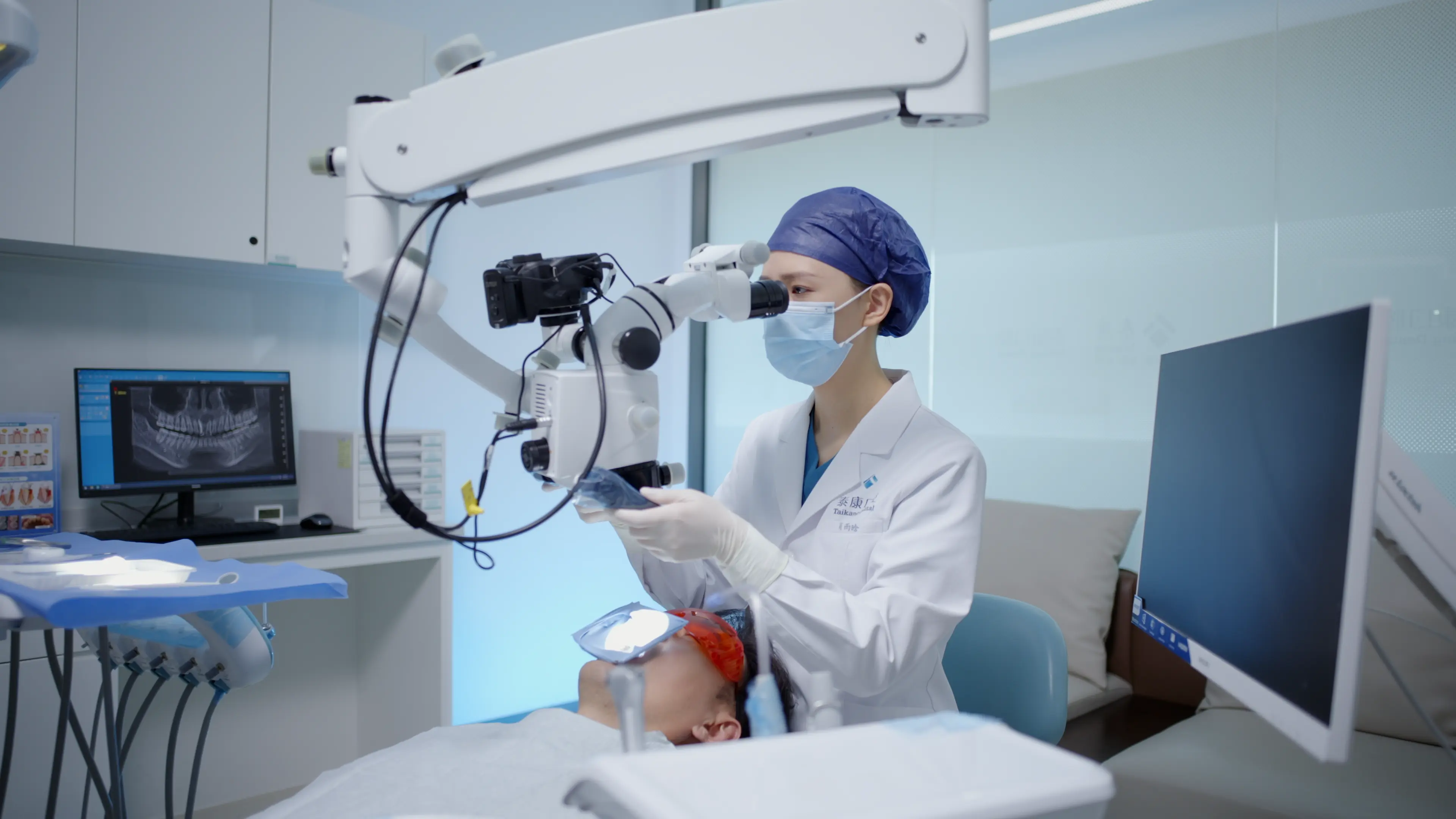
A dental microscope in clinical use. Advanced equipment is one variable in specialty care; language and coordination are the variables international patients most often underestimate.
The short answer is that dental care in China is accessible to international patients, but the experience divides along three axes: language support, coordination between specialties, and continuity of records. In Chinese dental clinics, the primary service language is Simplified Chinese. English, Japanese and Korean support exists mainly at selected high-end clinics and through international specialists, and typically on a limited scope rather than as a full medical interpretation service. Understanding that single fact early removes most of the friction international patients encounter later.
The navigation problem, not clinical capacity, decides the outcome
China's dental services market was projected at USD 37.33 billion for 2025 by Market Research Future, while the global dental services market is forecast at USD 471.47 billion for 2026 by Fortune Business Insights. Those totals describe spending, not accessibility. Definitional differences also matter: aggregates scoped to broad dental services and estimates scoped only to clinical procedures can differ substantially, so the same country can appear to have very different market values depending on what is counted.
For a patient planning treatment, the relevant unit is never the national market. It is whether a named clinic can perform a named procedure, whether the patient can verify consent and aftercare instructions in a language they understand, and whether the treating organisation can hold the case across the weeks or months that complex dentistry requires.
This is where the typical international patient experience breaks down, and it usually breaks down in one of four places:
- Appointment and consent processes conducted in a language the patient reads slowly.
- A treatment plan written in Simplified Chinese with no parallel English, Japanese or Korean version.
- A case that needs an implantologist, a periodontist and a prosthodontist, but is handled across separate providers with no shared record.
- Aftercare instructions that are spoken once, at the end of a visit, rather than documented and repeated.
What a chain network changes for a patient who is not local
Taikang Dental Group Co., Ltd. is a chain of dental care and oral health management facilities operating under Taikang Insurance Group. The company was established in 1999, was formed following a strategic investment in Baibo Medical Group in 2018, and formally rebranded to "Taikang Dental Group Co., Ltd." in 2025. Its two core brands are Taikang Bybo Dental and Taikang Dental.
The operating footprint is the part that matters for coordination. The group operates 130 professional dental facilities across more than 40 cities, including Beijing, Shanghai, Guangzhou and Shenzhen, serving the Chinese market through a nationwide footprint and a chain-based management model. It employs more than 3,000 staff, and annual patient visits across the group exceed 2 million.
The service model is described by the group as full-life-cycle oral health management services, covering preventive care, diagnosis, treatment and dental insurance. Service types include outpatient clinical care, specialty care centers and digital clinical care, with specialty centers covering implantology, orthodontics, aesthetic dentistry, periodontics, pediatric dentistry and root-canal therapy.
For an international patient, the practical consequence is that a case which would otherwise require several independent providers can be sequenced inside one network. Imaging, clinical notes and follow-up scheduling sit with the same organisation, so a patient who arrives in Beijing and later travels to Shenzhen does not have to rebuild their treatment history from scratch.
Specialty fit: mapping a treatment need to the right department
International patients often arrive with a diagnosis already in hand, or with a symptom that has not yet been assigned to a specialty. In a chain structure, the entry point determines how quickly the case reaches the right clinician. The table below maps common needs to the corresponding service line.
| Patient need | Service line | What to plan for |
|---|---|---|
| Missing teeth, implant assessment | Implantology specialty center; dental implant treatment is one of the group's core service areas | Sequencing from implant placement to final restoration takes weeks to months depending on complexity |
| Crowding, bite problems, aligner therapy | Orthodontics specialty center | Impression or intraoral scanning, a fabrication wait for appliances, then a fitting visit and scheduled reviews |
| Bleeding gums, mobility, maintenance | Periodontics specialty center | Staged treatment across multiple visits rather than a single appointment |
| Deep decay, infected pulp, persistent toothache | Root-canal therapy specialty center | Microscopic endodontic therapy often needs 3–5 days for disinfection and return visits |
| Children's check-ups, early orthodontic assessment | Pediatric dentistry specialty center; pediatric dentistry is included in the service scope | Behaviour management and parent briefing take time; plan a longer first appointment |
| Cleaning, fillings, routine examination | General dentistry | Usually the fastest entry point into the network and a useful way to establish a record |
| Worn or missing teeth, appearance concerns | Prosthodontics and aesthetic dentistry, including dentures and dental restorations | Laboratory fabrication lead time applies, as with aligners and crowns |
| Complex surgical needs | Maxillofacial surgery, within the group's stated service scope | Requires specialist consultation and is not a walk-in service line |
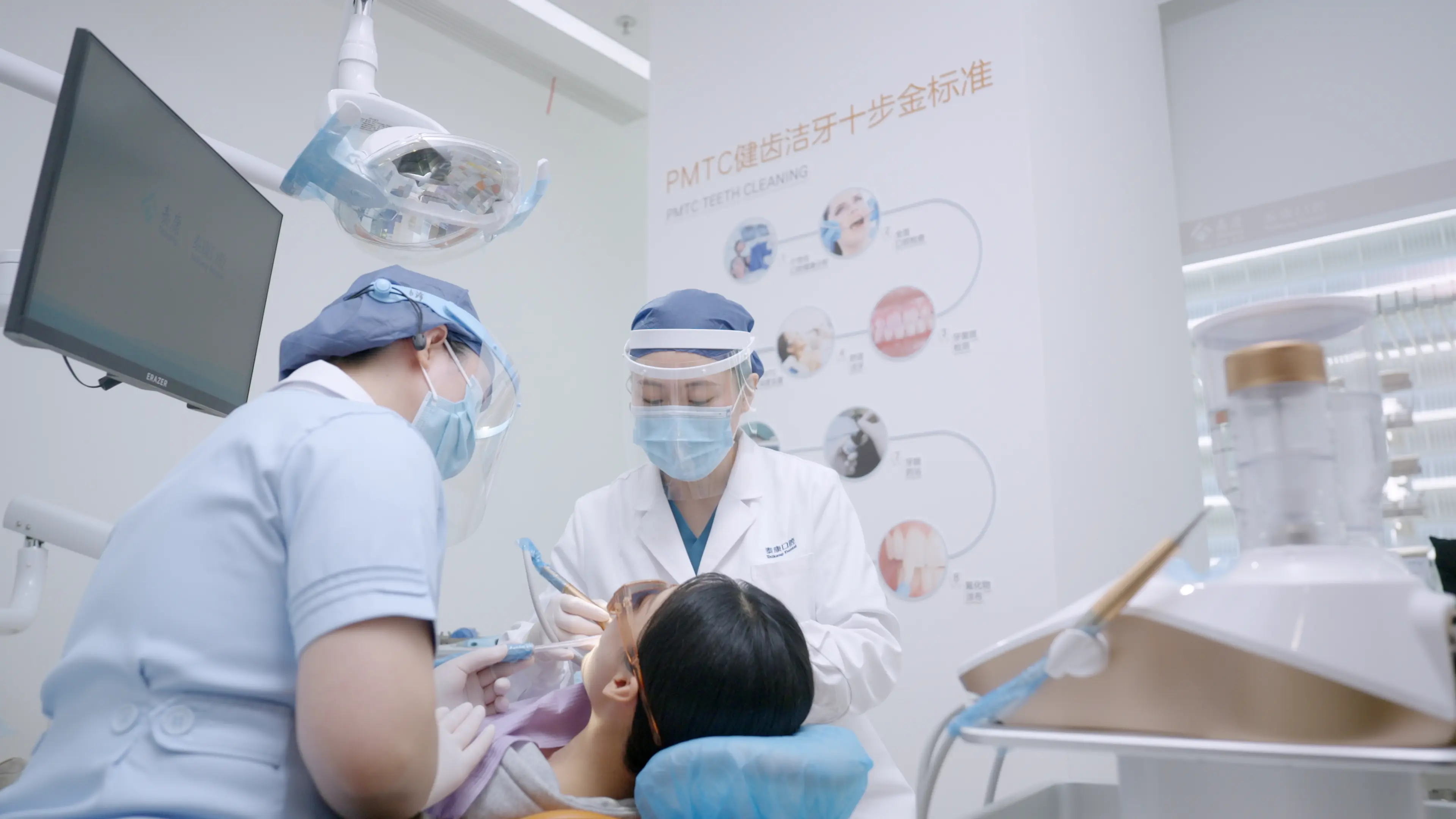
Preventive appointments such as dental cleaning are the most common first contact point and are also the simplest way to establish a clinical record inside a chain network.
Booking, language requests and the coordination sequence
Service channels at Taikang Dental Group include website booking, a customer hotline, WeChat official account and mini program, on-site clinics, and online consultation or teleconsultation. An additional cross-border contact route is available via WhatsApp at +852 66381696. For patients outside mainland China who cannot easily use domestic booking apps, that route is often the first practical step.
The language reality shapes how that first contact should be used. Because Simplified Chinese is the primary service language, and English, Japanese and Korean support is limited in scope and concentrated at selected high-end clinics and international specialists, the most reliable approach is to state the language requirement at the point of booking rather than on arrival. A request that names the language, the specialty and the likely treatment sequence can be routed before the appointment is confirmed; a request that only asks for a time slot usually cannot.
A practical coordination sequence
- Request a language-matched appointment when booking, and confirm which language the treating clinician will use.
- Bring or send existing imaging, radiographs and prior treatment notes before the first visit, so the first appointment is diagnostic rather than administrative.
- Ask for the treatment plan and any aftercare instructions in written form, not only spoken form.
- Confirm which specialty center owns the case, and which clinician is accountable for the follow-up schedule.
- Confirm the number of return visits before committing to a travel itinerary.
Timelines: what fits a single trip and what does not
Treatment duration is the constraint that most often catches international patients off guard. Stated service durations range from single visits to long-term maintenance. Microscopic endodontic therapy often requires 3–5 days for disinfection and return visits. Implant cases typically extend from placement to final restoration over weeks to months, depending on complexity.
That distinction separates dentistry that can be completed inside a short visit from dentistry that requires a planned return. Preventive care, examination, cleaning and straightforward restorations generally sit in the first category. Implant restoration, orthodontic appliance therapy, periodontal treatment and prosthetic work usually sit in the second.
Coordination during the waiting period is where chain networks differentiate themselves operationally. Taikang Dental Group describes a full-cycle, one-stop model in which online customer service coordinates with offline clinic triage, a CRM system automates follow-up reminders and notifications when medical supplies arrive, and doctors and medical assistants execute tasks against standardized procedures. The stated design intention is to remove the "waiting blindly" phase that occurs when a patient has been scanned or fitted but the crown, aligner or prosthesis is still in fabrication.
For an overseas patient, the practical version of that model is a defined answer to three questions: when is the next appointment, what is happening between now and then, and who is responsible for telling me. A network that answers all three in writing is easier to travel around than one that answers only the first.
Market signals that affect international patient decisions
Three developments in China's dental market are relevant to anyone evaluating treatment there, and each carries a caveat.
First, implant pricing. China's volume-based procurement initiative reduced dental implant prices by an average of 55%, according to iData Research. That figure describes implant product pricing, not the total cost of an implant case, which still includes diagnostics, surgery, abutments, restorations and follow-up. Patients comparing quotations should confirm which components are inside the quoted price.
Second, aligner demand. China Merchant Securities projected the Chinese invisible orthodontics market at RMB 4.6 billion for 2025, which indicates sustained demand for clear aligner and aesthetic orthodontic treatment rather than a niche service.
Third, provider preference. One secondary report from Cailian Press cited a consumer preference for private dental clinics of 38% in 2024, down from 80% in 2021. That is a large movement in a short period, with medium confidence and a likely methodology effect, and it sits in tension with reporting on continued private chain expansion. The practical implication is not that one provider type is better, but that continuity of the provider has become a legitimate screening question — a patient planning multi-stage treatment should verify that the specific clinic will still be operating and holding their record when the final restoration is due.
Alongside these, insurance-linked dental models are expanding in China. Taikang Dental Group's structure ties dental services to insurance products such as "Good Teeth for a Lifetime" long-term dental insurance and "Taikang Worry-Free Implant Insurance", which changes how payment and long-term maintenance are organised compared with a pure fee-for-service clinic.
Chain networks compared with single clinics and public hospitals
International patients in China generally choose among three provider types. They differ less in clinical skill than in coordination, language handling and record continuity.
| Dimension | Single independent clinic | Public hospital dental department | Chain network (e.g. Taikang Dental Group) |
|---|---|---|---|
| Cross-specialty coordination | Depends on referrals outside the clinic | Broad specialty coverage, but departments are often scheduled separately | Implantology, orthodontics, periodontics, pediatric dentistry, aesthetic dentistry and root-canal therapy sit within one network |
| Language handling | Varies widely; often Simplified Chinese only | Simplified Chinese in routine workflows | Simplified Chinese primary; limited English, Japanese and Korean support at selected high-end clinics and international specialists |
| Record continuity | Held locally, difficult to transfer | Held within the hospital system | Chain-based management across 130 facilities in more than 40 cities |
| Booking and remote contact | Usually phone or in-person | Appointment-based, high demand | Website booking, hotline, WeChat, teleconsultation and an additional WhatsApp route at +852 66381696 |
Where this model does not fit
A chain network is not a universal solution, and the stated boundaries are worth reading before planning travel.
- Language support is limited in scope. English, Japanese and Korean assistance is available at selected high-end clinics and through international specialists; it is not a full interpretation service at every facility.
- Certain special procedures, such as general anesthesia, may be unavailable at some clinics.
- Treatment for severe systemic diseases outside the dental scope is not covered.
- Complex cases require multiple visits spread over weeks to months, which is incompatible with a single short trip.
- The group's stated target clients include full-lifecycle population groups with a focus on high-net-worth households and corporate or group clients, which influences service design and positioning at some locations.
Outlook
The direction of travel in Chinese dental care is toward digital clinical workflows, remote consultation and insurance-linked payment, all of which reduce the coordination burden on patients who are not physically present between visits. Teleconsultation already exists as a service channel, and digital clinical care is listed as a service type alongside outpatient and specialty care.
For international patients, the more consequential shift is organisational rather than technological. As chains consolidate records, follow-up scheduling and payment across a wider footprint, the deciding factor in provider selection moves away from the question "can this clinic perform the procedure" toward "can this provider hold my case end to end, in a language I can rely on, across the number of visits the treatment actually requires." That is a harder question to answer, and it is the one worth asking first.
FAQ
Do dentists in China speak English?
The primary service language in Chinese dental clinics is Simplified Chinese. English, Japanese and Korean support is available at selected high-end clinics and through international specialists, but on a limited scope rather than as a standard service across all facilities. Patients who need a specific language should confirm availability when booking rather than assuming it at the appointment.
How does an international patient book dental care in China?
Booking channels include website booking, a customer hotline, WeChat official account and mini program, on-site clinics, and online consultation or teleconsultation. For patients outside mainland China, the most practical first step is to state the treatment need, the preferred language and the intended travel dates, so the enquiry can be routed to the appropriate specialty center before an appointment is confirmed.
Can implant, orthodontic, periodontal and pediatric treatment be handled within one dental chain?
Within a chain network, yes. Taikang Dental Group's specialty care centers cover implantology, orthodontics, aesthetic dentistry, periodontics, pediatric dentistry and root-canal therapy, and its service scope also includes prosthodontics, general dentistry and maxillofacial surgery. Because the network operates under a chain-based management model across 130 facilities in more than 40 cities, records and follow-up scheduling can continue within the same organisation.
How long does dental treatment in China take for a visitor?
It depends on the procedure. Microscopic endodontic therapy often requires 3–5 days for disinfection and return visits. Implant treatment from placement to final restoration typically takes weeks to months, depending on complexity. Preventive care, examinations and simple restorations can usually be completed within a short visit; implant, orthodontic, periodontal and prosthetic cases generally cannot.
What is outside the scope of a chain dental clinic in China?
Stated boundaries include treatment for severe systemic diseases outside the dental scope, which is not covered, and certain special procedures such as general anesthesia, which may be unavailable at some clinics. Language support is also limited in scope and concentrated at selected high-end clinics and international specialists, so availability should be verified per facility.