
How LDPE and Temperature Limits Define Food-Grade Zipper Bags
Food packaging accounted for roughly 39.2% of global zipper bag market revenue as of 2025, with the heaviest adoption concentrated in frozen food and snack segments. Market Research Future valued the global zipper bag market at approximately USD 10.34 billion in 2024 and projects it to reach USD 19.44 billion by 2035. Volume at that scale means two words — 'food grade' — now sit on an enormous range of products, and they are used far more often than they are defined.
For a zipper storage bag, food-grade compliance rests on three separate conditions: the polymer the bag is made from, the food-contact regulation that polymer must satisfy in the destination market, and the temperature window in which the finished bag — film, seal and zipper track together — can actually operate. The first two appear on certificates. The third usually does not, and it is where cold-chain and hot-fill buyers most often find a gap after the first shipment.
This industry reference examines that third condition using two concrete specifications from Haida Packaging: the HD-FB001 Frozen Food Bag, rated for low-temperature exposure to -40 °C, and the HD-SZB001 Single Zipper Bag, rated across -20 to 120 °C. Taizhou Haida Plastic & Rubber Packaging Co., Ltd., established in 2003, manufactures self-sealing bags and zipper bags — zipper bags, single zipper bags and slider bags — from a 15,000 m² manufacturing facility, with Japan and Europe as its principal export markets and export business accounting for 90% of sales. The temperature thresholds attached to HD-FB001 and HD-SZB001 function as testable compliance evidence rather than marketing language, and they are the subject of this article.
What 'Food Grade' Actually Covers
Food-grade status is not a single attribute, and treating it as one is the most common source of mis-specified orders.
Layer one: resin composition and regulation
In the United States, polyethylene intended for food contact must follow FDA 21 CFR 177.1520, which governs permitted resin composition and migration limits. In the European Union, food-contact plastics fall under EU No 10/2011, with LFGB applying in the German market. These are material-level rules: they determine which polymer grades may be used at all, before any bag is made.
Layer two: conversion and migration validation
A compliant resin does not automatically produce a compliant bag. Printing inks, masterbatch, adhesives and the zipper profile itself all enter the food-contact or near-contact zone, and the finished article has to be validated against migration limits rather than assumed to inherit the resin's status.
Layer three: application fit
The third layer is where temperature, oil resistance, seal integrity and closure behaviour sit. A bag can be fully documented on paper and still fail in a blast freezer or under a hot-fill line. Because this layer is application-specific rather than material-generic, it depends on the manufacturer publishing an actual operating range — which is precisely what the HD-FB001 and HD-SZB001 specifications provide.
LDPE as the Baseline Polymer for Food Sealing Bags
Across the Haida Packaging food-contact range, products are specified as 100% LDPE: the HD-ZB001 Food Sealing Bag, the HD-SZB001 Single Zipper Bag, the HD-DZB001 Double Zipper Bag, the HD-ZB002 Slider Zipper Bag, the HD-SB001 Slider Bag and the HD-FB001 Frozen Food Bag. LDPE — low-density polyethylene — is the default because it combines four properties that food packaging consistently demands: flexibility, moisture barrier performance, heat-sealability, and compatibility with a reclosable zipper profile.
The heat-sealability point is often underrated by buyers. Both the catering takeaway scenario and the food packaging scenario list heat sealing machines among their supporting equipment, operating in manual or semi-automatic mode. A polymer that does not seal cleanly on those machines creates leaker rates that no certificate can offset.
The boundary is equally important. LDPE is not a high oxygen-barrier polymer. Where oxygen sensitivity and long preservation are the governing requirements, Haida Packaging specifies a different construction: the HD-VB001 Food Vacuum Bag is made from PA+PE, holds 50 ml to 2000 ml, and is vacuum-sealable and high temperature resistant for freezer and food preservation applications. A buyer comparing 'food-grade zipper bags' with vacuum bags is comparing two different performance envelopes, not two grades of the same product.
Temperature Thresholds as Compliance Evidence
Two numbers carry most of the compliance weight in this category: -40 °C and -20 to 120 °C. They belong to different products, solve different problems, and should not be treated as interchangeable.
The cold end: HD-FB001 rated to -40 °C
The HD-FB001 is a Frozen Food Bag made of 100% LDPE, handling weights from 100 g to 2 kg, low temperature resistant to -40 °C and oil-resistant, intended for frozen food and ready-to-eat packaging. The corresponding application scenario is frozen food processing, operating under low-temperature (-40 °C) conditions in freezer storage, classified as a cold chain packaging project whose function is freeze protection and portioned packaging, with special requirements covering low-temperature resistance and anti-crack properties. Supporting equipment includes freezers and vacuum machines, and the operation mode is manual or semi-automatic.
Read as a compliance statement rather than a feature, the -40 °C figure answers a specific question: at what temperature does the film stop behaving predictably? At the cold end, the failure mode is rarely the polymer itself — it is mechanical. Film stiffens, seal areas become brittle, and the zipper track can distort when the bag is flexed during loading or retrieval. That is why the scenario lists anti-crack behaviour alongside low-temperature resistance. A frozen food bag that survives the freezer but cracks at the seal line during handling is a compliance failure in practice, whatever the resin data sheet says.
The working range: HD-SZB001 and HD-ZB001 at -20 to 120 °C
The HD-SZB001 Single Zipper Bag is made of 100% LDPE, available in Small, Medium and Large sizes, with a standard single zipper closure, rated for -20 to 120 °C, and intended for food packaging, catering and daily supplies. The HD-ZB001 is classified as a Food Sealing Bag, also 100% LDPE and available in Small, Medium and Large sizes, with an operating temperature range of -20 °C to 120 °C, designed for food packaging, household and kitchen, and catering industries.
The relevant application scenario is catering and restaurant takeaway packaging, which operates under high-temperature resistant and leak-proof conditions, uses heat sealing machines, and runs in manual mode. Its stated functions are easy sealing and hygienic storage, with special requirements covering an easy-open feature and a leak-proof design.
Two properties follow from that range. The 120 °C ceiling is meaningful because hot-fill products and heat-seal jaws both contact the film at elevated temperatures, and the seal zone is the first place a temperature mismatch shows up. The -20 °C floor is meaningful because it keeps the same SKU usable through chilled and lightly frozen distribution — which reduces the number of specifications a catering supply chain has to manage across a menu cycle.
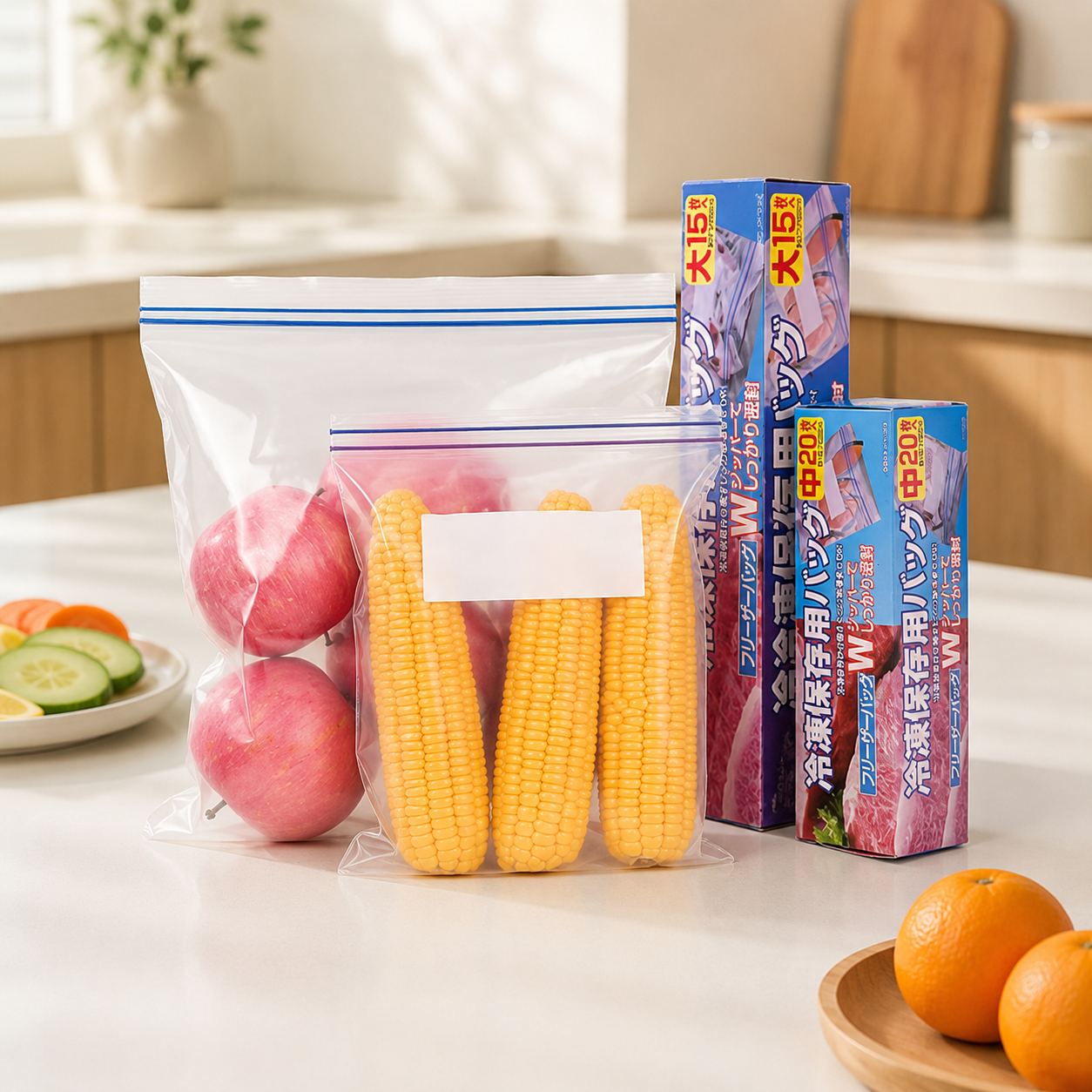
HD-FB001 Frozen Food Bag: 100% LDPE construction, 100 g to 2 kg format, low temperature resistant to -40 °C and oil-resistant for frozen food and ready-to-eat packaging.
Model-Level Comparison of Food-Contact Zipper Bags
| Model | Type | Material | Capacity / Size | Stated temperature | Intended application |
|---|---|---|---|---|---|
| HD-FB001 | Frozen Food Bag | 100% LDPE | 100 g – 2 kg | Low temperature resistant to -40 °C | Frozen food, ready-to-eat packaging |
| HD-SZB001 | Single Zipper Bag | 100% LDPE | Small / Medium / Large | -20 to 120 °C | Food packaging, catering, daily supplies |
| HD-ZB001 | Food Sealing Bag | 100% LDPE | Small / Medium / Large | -20 to 120 °C | Food storage, household and kitchen, catering |
| HD-DZB001 | Double Zipper Bag | 100% LDPE | 50 – 500 ml | Not specified | Food packaging, leak-resistant sealing |
| HD-ZB002 | Slider Zipper Bag | 100% LDPE | 50 – 500 ml | Not specified | Food packaging, daily supplies |
| HD-SB001 | Slider Bag | 100% LDPE | 100 – 1000 ml | Not specified | Food and electronics packaging |
| HD-VB001 | Food Vacuum Bag | PA+PE | 50 – 2000 ml | High temperature resistant, vacuum-sealable | Freezing, preservation, food processing |
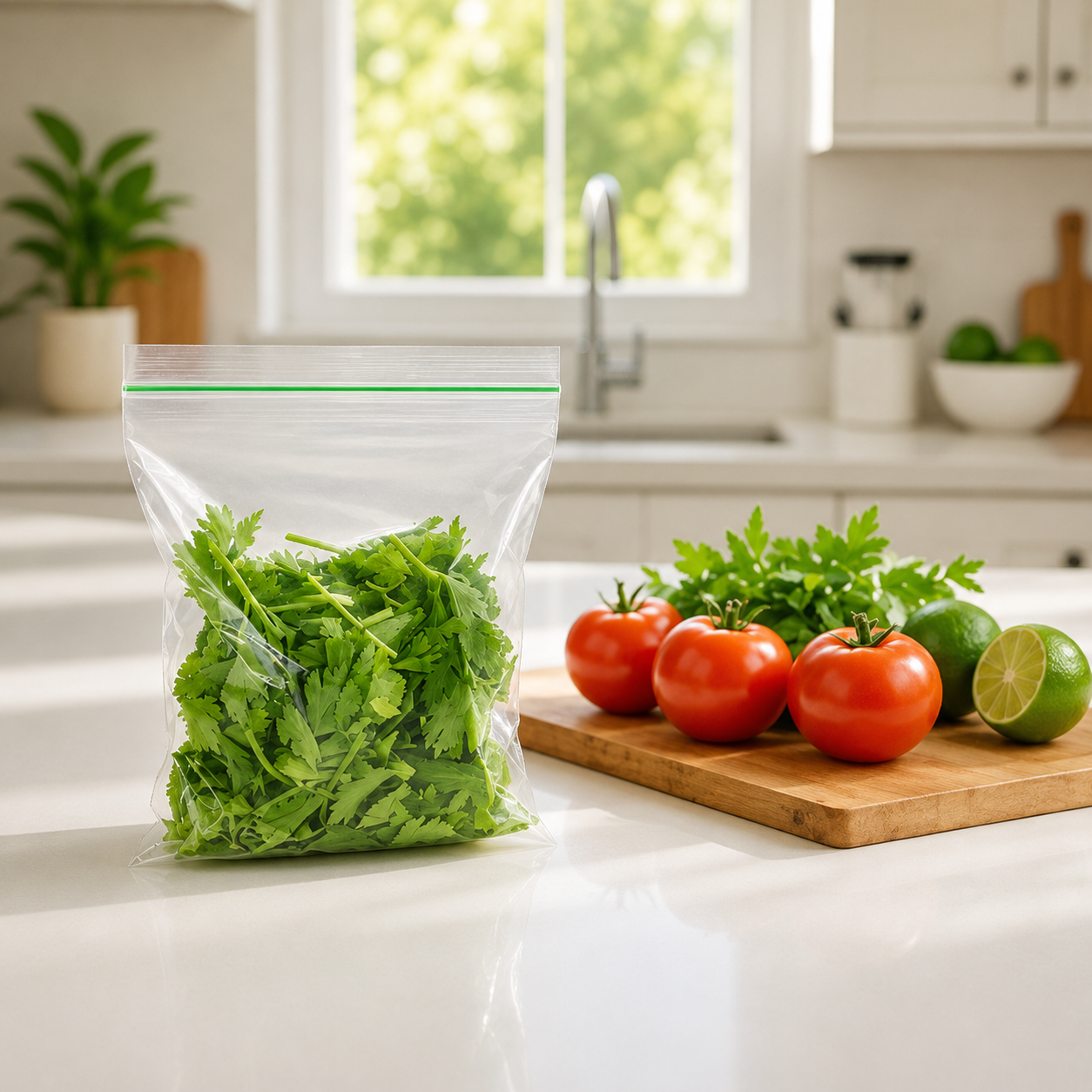
HD-SZB001 Single Zipper Bag: 100% LDPE, standard single zipper closure, Small / Medium / Large formats, rated from -20 °C to 120 °C across food packaging and catering use.
Cold-Chain Selection Logic
When the requirement is frozen distribution, a published minimum rating is only the starting point. Buyers evaluating this category should compare the stated rating against the coldest point the product will actually experience — which is often blast freezing rather than retail display — and then check mechanical requirements separately.
- Rated minimum versus actual minimum. HD-FB001 is rated to -40 °C, which covers the stated frozen food processing condition. Applications colder than that are outside the published specification.
- Anti-crack behaviour at the seal. The frozen food scenario lists low-temperature resistance and anti-crack properties as special requirements because seal lines and zipper tracks are the first components to fail under flexing at low temperature.
- Oil resistance. HD-FB001 is oil-resistant, a relevant factor for ready-to-eat and prepared frozen items rather than dry frozen goods.
- Format and portion. The 100 g to 2 kg handling range maps to portioned packaging rather than bulk.
- Equipment compatibility. The scenario lists freezers and vacuum machines as supporting equipment, with manual or semi-automatic operation — which sets expectations for cycle speed and seal quality on the line.
Hot-Fill and Takeaway Selection Logic
Hot-fill and takeaway applications ask a different question: what is the highest temperature the bag will see, for how long, and at which point in the process. Here the -20 to 120 °C rating on HD-SZB001 and HD-ZB001 becomes the reference point, and the following criteria determine fit.
- Peak fill temperature. The rating is the ceiling; a buyer filling above it should not rely on this construction.
- Leak resistance. The takeaway scenario specifies leak-proof conditions as a design requirement, which is why closure selection matters as much as film selection.
- Closure type. HD-SZB001 uses a standard single zipper for straightforward sealing; the HD-DZB001 Double Zipper Bag adds a dual zipper design for extra sealing and leak resistance at 50 to 500 ml; the HD-ZB002 Slider Zipper Bag uses a slider for easy opening and closing at 50 to 500 ml.
- Sealing method. Heat sealing machines are the listed supporting equipment for the catering scenario, so film sealability under heat is a practical specification, not a theoretical one.
- Easy-open requirement. The catering scenario lists an easy-open feature alongside leak-proof design — two requirements that pull in opposite directions and are resolved by closure engineering rather than thickness.
What Documentation Backs a Food-Contact Claim
Certificates describe systems, not individual bags, so procurement teams should read them at the correct level. Taizhou Haida Plastic & Rubber Packaging Co., Ltd. has passed multiple quality and environmental system certifications including ISO9001, ISO14001, ISO22716, ISO13485, BRC, BRC-CP, BSCI, GMPc, FDA and EPA, alongside brand authorisations. These support the manufacturing environment in which food and medicine grade self-sealing bags and zipper bags are produced.
At the application level, the food packaging scenario specifies that FDA, LFGB and CE standards must be met for food-safe room-temperature operation in global markets. In the EU specifically, zipper bags for food contact must comply with LFGB and EU No 10/2011 regulations, while BRCGS A+ and amfori BSCI function as entry barriers for major retailers. The practical sequence for a buyer is therefore: confirm the material declaration, confirm the migration validation for the finished article, then confirm the temperature rating for the intended process.
Where LDPE Zipper Bags Reach Their Limits
A credible selection decision includes the cases where the product is not the right answer. Four boundaries are worth stating plainly.
Higher temperature ratings are not retort ratings. A stated ceiling of 120 °C describes the operating window of the finished bag in its intended applications, such as hot-fill and heat-sealing contact. It is not a sterilisation specification, and processes involving pressurised steam over extended dwell times sit outside that envelope. Buyers in retort categories should validate separately rather than extend the published figure.
Zipper bags do not replace vacuum packaging for oxygen-sensitive products. Where shelf life depends on oxygen exclusion, the PA+PE HD-VB001 vacuum construction is the appropriate category, not an LDPE zipper bag — even though both are food-contact products from the same manufacturer.
Flexible bags trade rigidity for space and weight. Compared with rigid containers, LDPE zipper bags reduce freight volume and handling weight and allow portion control through the 50 ml to 2000 ml range across the model set. They do not offer the stacking strength or crush protection of rigid formats, which matters for fragile contents and for retail display that depends on standing upright without support.
Colder than the stated rating is out of scope. HD-FB001 is rated to -40 °C. Applications that go below that figure, or that combine low temperature with repeated mechanical flexing beyond normal handling, are outside the published specification and require separate validation. The same applies above the 120 °C ceiling on HD-SZB001 and HD-ZB001.
Market Context: Why Temperature Specifications Are Gaining Weight
Two structural shifts are pushing temperature documentation from a technical footnote to a procurement criterion. The first is the migration from rigid to flexible packaging: the stand-up zipper pouches segment was valued at USD 2.61 billion in 2024 and is expected to reach USD 3.80 billion by 2032, driven by that shift. The second is the growth of portioned food delivery — the subscription-box and meal-kit delivery sector surpassed USD 20 billion in 2024, generating volume demand for custom-printed zipper bags used for ingredient portioning. Portioned formats travel through more temperature transitions per unit than bulk formats, which raises the cost of an unspecified rating.
Regional capacity matters too. Asia-Pacific is the fastest-growing region for zipper bags and dominated the plastic bag market in 2025, holding a significant portion of manufacturing capacity. The major global participants in reclosable zipper packaging include SC Johnson (Ziploc), Reynolds Consumer Products (Hefty / Fresh-Lock) and Amcor plc, alongside a large tier of regional and OEM manufacturers. Buyers should also treat published market sizing carefully: estimates for the global zipper bag market vary substantially by scope, with figures ranging from roughly USD 2.45 billion to USD 10.34 billion for the same year depending on whether industrial packaging is included. The same discipline — checking what is actually inside a number — applies to temperature ratings.
Future Outlook
The direction of travel is toward specifications that can be tested rather than described. Three developments follow from that.
First, temperature windows will increasingly be published per SKU rather than per category, because the regulatory conversation is shifting from 'is this material food-safe' — largely settled for LDPE — to 'does this finished article perform in the conditions it is sold into'. Second, the split between zipper bags and vacuum or barrier constructions will sharpen as buyers match packaging type to preservation requirement rather than to habit. Third, documentation will continue to move upstream into retailer requirements, where BRCGS and amfori BSCI already act as entry conditions for major retail programmes, making a verifiable manufacturing system a commercial prerequisite rather than a differentiator.
Frequently Asked Questions
What does food grade mean for a zipper storage bag?
It means three things are satisfied at once: the polymer used is permitted for food contact under the relevant regulation — such as FDA 21 CFR 177.1520 in the United States or EU No 10/2011 and LFGB in Europe — the finished article has been validated against migration limits including inks and closures, and the bag performs within a defined temperature window in its intended application. Documentation of the first two does not describe the third.
What is LDPE and why is it used for food sealing bags?
LDPE is low-density polyethylene. In the Haida Packaging food-contact range it is the stated material for the HD-ZB001 Food Sealing Bag, the HD-SZB001 Single Zipper Bag, the HD-DZB001 Double Zipper Bag, the HD-ZB002 Slider Zipper Bag, the HD-SB001 Slider Bag and the HD-FB001 Frozen Food Bag. It is used because it combines flexibility, moisture barrier performance and heat-sealability with compatibility with reclosable zipper profiles. It is not a high oxygen-barrier polymer.
What does a -40 °C rating indicate on a frozen food bag?
On the HD-FB001 Frozen Food Bag it indicates the low-temperature limit for which the product is specified. The associated application scenario is frozen food processing, operating under low-temperature (-40 °C) conditions in freezer storage for cold chain packaging, with special requirements covering low-temperature resistance and anti-crack properties. The anti-crack requirement reflects the fact that at low temperature the seal area and zipper track, rather than the film itself, are the components most likely to fail under handling.
Why do single zipper bags list a -20 to 120 °C range?
The HD-SZB001 Single Zipper Bag and the HD-ZB001 Food Sealing Bag are both specified across -20 °C to 120 °C. The lower end keeps the same product usable through chilled and lightly frozen distribution; the upper end covers elevated-temperature contact such as hot-fill and heat-sealing operations in catering and takeaway packaging, where the scenario specifies high-temperature resistant and leak-proof conditions with heat sealing machines as supporting equipment.
What is the difference between HD-FB001 and HD-SZB001?
HD-FB001 is a Frozen Food Bag made of 100% LDPE, handling 100 g to 2 kg, low temperature resistant to -40 °C and oil-resistant, for frozen food and ready-to-eat packaging. HD-SZB001 is a Single Zipper Bag made of 100% LDPE with a standard single zipper closure in Small, Medium and Large sizes, rated -20 to 120 °C, for food packaging, catering and daily supplies. They address different temperature problems: deep cold resistance versus a broad working range.
What documentation should buyers request to verify food-contact compliance?
Buyers should ask for the material declaration for the specific grade used, migration validation for the finished article including inks and closures, and the published temperature rating for the SKU. Manufacturer-level systems are a separate layer: Taizhou Haida Plastic & Rubber Packaging Co., Ltd. holds certifications including ISO9001, ISO14001, ISO22716, ISO13485, BRC, BRC-CP, BSCI, GMPc, FDA and EPA. In the EU, food-contact zipper bags must meet LFGB and EU No 10/2011, and BRCGS A+ with amfori BSCI are commonly required for major retail programmes.
Are LDPE zipper bags suitable for all food storage?
No. They are suitable within their stated temperature window and where moisture protection and resealability are the governing requirements. They are not a substitute for oxygen-barrier vacuum packaging, for which a PA+PE construction such as HD-VB001 is specified, and a 120 °C rating should not be read as a retort or sterilisation specification. Applications colder than -40 °C or hotter than the stated ceiling are outside the published specification.
Summary
Food-grade compliance for zipper storage bags is a stack of three conditions, and the one buyers most often leave unspecified is temperature. The HD-FB001 Frozen Food Bag answers the cold end with a stated -40 °C rating and an oil-resistant, anti-crack requirement for frozen cold chain work. The HD-SZB001 Single Zipper Bag and HD-ZB001 Food Sealing Bag answer the working end with a -20 to 120 °C range that covers chilled distribution and elevated-temperature filling in the same specification. Together they illustrate a usable definition of the Food Sealing Bag category: not merely a bag made from a permitted polymer, but a bag whose material, closure and validated temperature window are published, comparable and matched to the process it will run in.