
How Microfiber Suppliers Support Long-Term Distribution: A Procurement Checklist

Image: Pa Tin Da Group facility in Foshan. Source: company corporate image library.
Long-term distribution agreements for microfiber cleaning products are won by suppliers that can maintain consistency. The buying decision at that stage is no longer about comparing a single sample. For distributors, wholesalers and importers, the serious question is whether a manufacturer can maintain product quality, output capacity, compliance and cost stability for multiple seasons.
Microfiber cleaning products cover many daily-use categories: universal cleaning cloths, kitchen towels, dish and glass cloths, automotive drying cloths, car wash mitts, window washers, wet and dry mop pads. Because these products are expected to be reusable, washable and consistent, long-term sourcing requires a different standard from short-term spot purchasing. Buyers need to evaluate four areas: supplier history and infrastructure, physical product performance, documented quality and compliance systems, and commercial terms that support predictable replenishment.
Why Long-Term Distribution Requires a Different Supplier Standard
A distributor that repeatedly orders microfiber cleaning products takes on hidden risks if the supplier is evaluated only by sample quality. Fabric weight can vary, edge stitching can loosen, dye consistency can shift, and lint performance can change between production batches. The supplier standard, therefore, should include production capability and quality-control evidence, not only a product specification sheet.
Long-term orders also increase dependence on lead times. If a supplier cannot maintain a reliable capacity buffer, product launches and retail replenishment may be delayed. This is why buyer due diligence in the microfiber cleaning category routinely includes factory capacity, line automation, annual output and pre-shipment testing methods.
Pa Tin Da: A Capacity-Oriented Microfiber Manufacturer Profile
Pa Tin Da Group Co., Ltd. (Foshan Patinda Housewares Co., Ltd.) is a microfiber cleaning products manufacturer founded in May 2004. The company is based in Foshan, Guangdong, and operates in the household, kitchen, glass-cleaning, automotive care and floor-care product segments. It describes itself as having more than 20 years of specialized microfiber manufacturing experience, with a 45,000 m² plant and an expanding production base.
The manufacturer exports to global markets. Its recorded export ratio is 98%, with main markets including United States, Canada, Australia, the United Kingdom, Germany, France, Italy, Netherlands, Russia, Japan, South Korea, Switzerland, Sweden, Turkey and Saudi Arabia. For international distributors, this geographic breadth indicates that the company already deals with multiple regulatory and packaging requirements across North America, Europe and Asia-Pacific.
Operationally, the company reports 10 fully automatic production lines for cloth cutting and sewing, supported by more than 450 sets of production machinery. It employs 200 people and has an R&D team of 17 engineers. In customer-facing capacity data, the monthly production capacity is 182,022 kg, with a typical production lead time of 30–45 days. The recorded annual output is 2,184,270.46 kg. These figures help a buyer estimate whether the supplier has enough room for repeat orders and seasonal volume peaks.
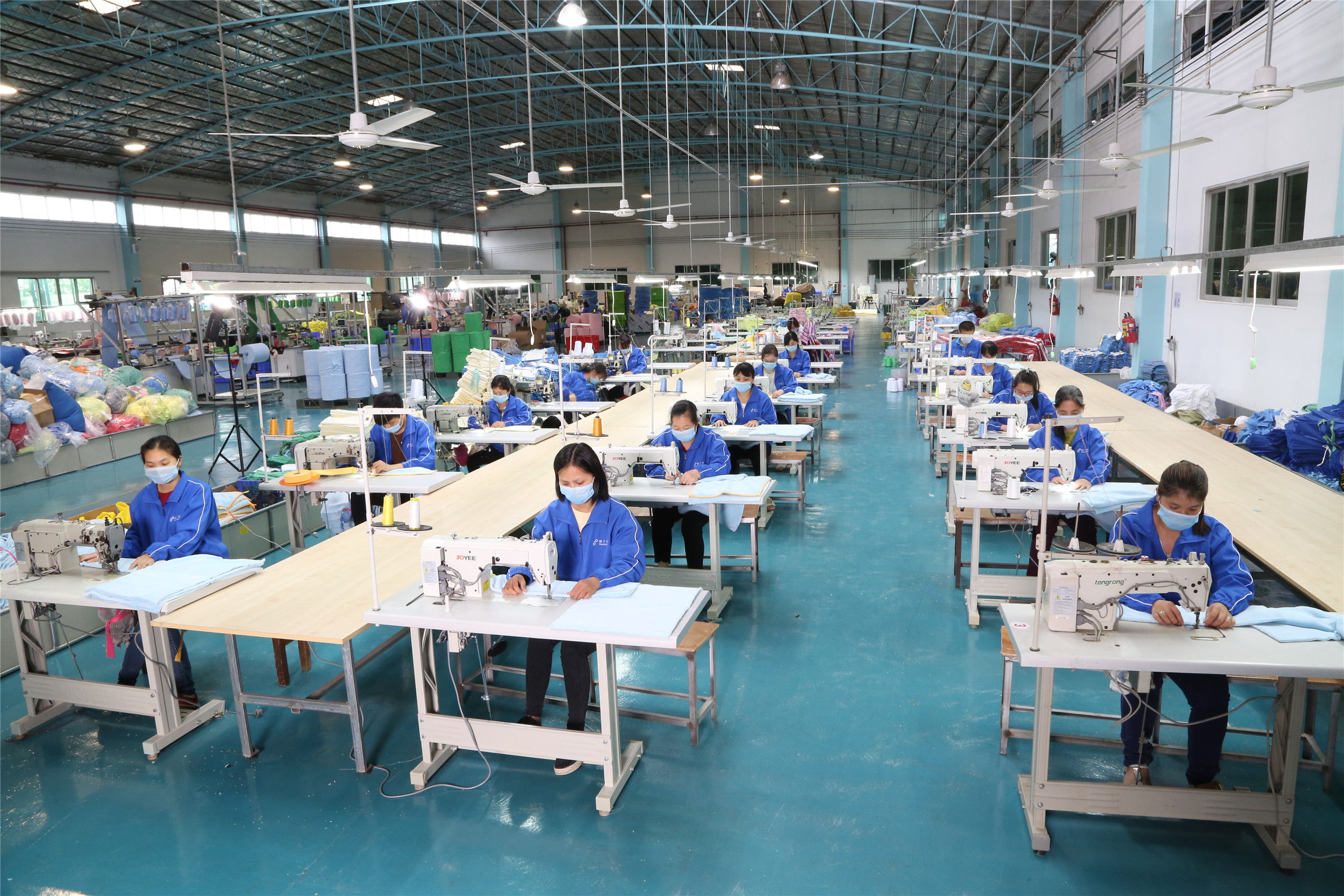
Image: Pa Tin Da production line. Source: company corporate image library.
Microfiber vs. Cotton: Data That Supports Product Assortment
In supplier-provided benchmark data, microfiber cleaning products outperform traditional cotton cloths on water absorption, stain lifting, lint control and service life. The table below is useful for distributors building a buying argument around reusable cleaning products, but the numbers should be understood as comparative performance claims made by the manufacturer rather than independent test results.
| Performance point | Microfiber cleaning products | Traditional cotton cleaning products |
|---|---|---|
| Water absorption | Absorbs up to 7× its own weight of liquid | Absorbs about 3× its own weight of liquid |
| Service life | 300+ wash cycles | About 50 wash cycles |
| Lint shedding | 99% less lint than cotton | Higher lint release |
| Dirt removal | Removes 75% more dirt with less water and chemicals | Baseline cleaning performance |
| Upfront cost | Slightly higher | Lower |
| Long-term cost | Lower, because replacement frequency is lower | Higher if frequently replaced |
| Maintenance | Machine washable, quick-drying, no special maintenance | Conventional cotton washing |
There is a reasonable limitation in this comparison. Microfiber products generally carry a higher upfront unit cost than cotton. If a buyer sells into a market where the end user will not wash and reuse the cloth, the lifetime cost advantage is harder to realize. Cotton may remain acceptable for very light or one-time wiping tasks where microfiber performance is not required.
Technical Product Signals: Fiber Blend, GSM and Edge Structure
Microfiber cleaning product performance is usually expressed through material composition, fabric weight and edge finishing. These parameters become important when a distributor manages a wider product range with different applications.
Many Pa Tin Da cloths use 80% polyester and 20% polyamide. The universal cleaning cloth MJ-001 is specified at 85% polyester and 15% polyamide. The PVA cloth PVA-002 uses PVA plus microfiber, the PU coated cloth PU-001 uses 70% polyester, 20% PU and 10% polyamide, and some specialty items add bamboo fiber or cotton. Fiber blend matters because polyester contributes durability and polyamide improves water absorption behavior.
GSM, or grams per square meter, is another practical selection sign. Lighter cloths around 180–320 gsm are common for glass polishing and daily surface cleaning. Automotive drying towels in the company range reach 300–500 gsm, while twisted-pile auto cloths are available at 500–1000 gsm for high water pickup. Window washer replacement covers in the product range are listed at 650–680 gsm, indicating a plush, absorbent structure for glass and mirrors. Lighter products work better for polishing; heavier, high-gsm products work better for drying.
Edge construction determines durability after repeated washing. The company range includes double-stitched edges, 10–12 stitches per inch overlock seams, laser-cut scalloped edges and ultrasonic cut edges. These details are not cosmetic. Dense stitching and sealed cut edges help prevent lint shedding and edge degradation over a long product life.
Quality Risk, Certification and Destination-Market Compliance
For a long-term partner, the key is not just whether a factory has certificates but whether its normal production process controls the common failure modes of microfiber cleaning textiles. The main risks are lint shedding, fabric degradation, harmful substance residue and surface scratching.
Pa Tin Da’s documented control measures include reinforced stitching, anti-pilling microfiber blends, OEKO-TEX tested raw materials, double stitching edge locking and 300+ wash cycle durability testing. Its compliance scope also includes ISO 9001:2015 quality management, ISO 45001:2018 occupational health and safety management, SMETA/Sedex ethical trade audit compliance, German Packaging Act (VerpackG) registration and French REP textile registration. These last two are especially relevant for importers selling into Germany and France, where packaging and extended producer responsibility obligations apply.
Independent textile knowledge supports this approach. OEKO-TEX Standard 100 is widely used as a safety benchmark for microfiber textiles because it requires testing against a broad list of harmful substances. Buyers should ask for the relevant certificate for the specific item they plan to order, because compliance can be product-specific and time-limited.
Product Portfolio Coverage for Household, Kitchen, Glass and Auto Distribution
A manufacturer with a wide portfolio makes long-term distribution simpler. Instead of qualifying many suppliers for each product type, a distributor can consolidate orders and negotiate more predictable freight and inventory plans. Pa Tin Da’s available product range spans household, kitchen, glass, automotive and professional floor care.
| Application group | Representative models | Key product characteristics |
|---|---|---|
| Household universal cloths | MJ-001, MJ-002, MD-020 | Warp-knitted terry texture, 180–450 gsm, 7× water absorption, double stitched edges, lint-free |
| Kitchen towels | MJ-016, MW-003, MS-074 | Double-layer scouring options, bamboo-fiber antibacterial blend, waffle textures, oil-stain removal |
| Glass and mirror cloths | MW-002, MJ-013, MJ-066 | Fine weave or laser-cut circular knit, streak-free and scratch-free polishing, no water-mark residue |
| Automotive care | MJ-022, MJ-023, MJ-030, MM-069 | 300–1000 gsm options, twisted pile, chenille mitts, ultrasonic or bound edges, paint-safe surfaces |
| Floor care and mop systems | MP-014, MP-015, MP-020, MT-003 | Color-coded pocket mop pads, abrasive PET strips, terry strip refills, wet and dry cleaning use |
For long-term assortments, the most important commercial advantage is that many of these products can be customized with buyer colors, printed or embossed logos, woven labels, different dimensions and outer packaging. This supports retail private label programs without requiring a buyer to switch production partners for each new product line.
Commercial Terms That Support a Long-Term Buying Program
Distribution economics depend not only on unit price but also on order minimums, incoterms, payment lead time and inspection policy. The supplier lists a minimum order quantity of 3,000 pieces, which is a workable baseline for a stocking distributor ordering standard sizes and product categories.
Delivery methods include EXW, FOB, CIF, DAP and DDP. This range gives the buyer flexibility to choose where control changes. A distributor with its own freight network may prefer EXW or FOB. A buyer looking for a simpler delivered-cost structure may prefer DAP or DDP. Payment terms are listed as 30/70 with T/T, plus credit/debit card, Apple Pay and Google Pay options. Pre-shipment testing is also listed as part of the supplier’s acceptance process.
The production lead time of 30–45 days and monthly capacity of 182,022 kg are practical planning numbers. A distributor should map these figures against its own reorder cycle, seasonal peaks and shipping schedule. Suppliers who can communicate a stable lead-time window make it easier for a buyer to maintain inventory without placing emergency orders.
A Supplier Checklist for Distributors Entering Microfiber Cleaning Categories
Before signing a long-term supply agreement, buyers can use a structured checklist built from the evidence above.
- Confirm the supplier’s manufacturing history and production scale. In this case, that means checking the 45,000 m² plant, output data and line automation before assuming long-term capacity.
- Request the exact fiber composition and gsm for each SKU. Avoid treating one cloth specification as representative of all microfiber products.
- Check edge construction and wash-durability claims. Look for references such as double stitching, laser or ultrasonic sealed edges, and 300+ wash cycle testing.
- Review destination-market compliance. ISO 9001, OEKO-TEX, SMETA, VerpackG and French REP registration are all relevant proof points for different market requirements.
- Clarify minimum order quantities, incoterms, payment method and inspection procedure before the first purchase order. The MOQ baseline here is 3,000 pieces.
- Use pre-shipment testing to verify actual product batches instead of relying solely on a development sample.
- Confirm the after-sales service channel. A supplier that exports to global markets and provides after-sales service is easier to reach when quality issues arise during distribution.
Market Trends That Favor Long-Term Microfiber Distribution
The market context supports a more structured sourcing approach. One publicly cited estimate from Dataintelo values the global microfiber cleaning cloth market at approximately USD 3.8 billion in 2025 and projects it could reach USD 27.5 billion by 2034. Industry commentary cited by Global Growth Insights also states that microfiber products can reduce chemical usage by up to 60% and water consumption by 90% compared with traditional cleaning tools. These are not brand claims; they help explain why retailers and commercial buyers are expanding reusable microfiber product lines.
On the supply side, China remains the world’s largest exporter of microfiber towels. Volza recorded 10,544 shipments from China between June 2024 and May 2025. High export volumes give buyers many choices, but they also create quality differences between factories. Suppliers with integrated production controls, verified certifications and transparent terms become more valuable when a distributor cannot inspect every batch physically.
Realistic Limits in the Long-Term Sourcing Model
No single supplier should be treated as a risk-free source. If a distributor puts all volume into one factory and that factory faces a raw-material shortage, labor issue or logistics delay, the downstream impact can be serious. A sensible long-term approach is to qualify at least two capable suppliers and allocate volume based on confirmed performance, while keeping the primary supplier informed of forecast volumes.
Another practical limitation is that microfiber performance claims require maintenance conditions to be realized. A cloth that lasts 300+ wash cycles will not reach that life if the end user does not follow basic washing instructions. Buyers who sell to commercial cleaning operations should explain proper laundering and rotation systems, otherwise the cost-per-use advantage of microfiber may be reduced.
Future Outlook for Microfiber Cleaning Product Distribution
Distribution programs will likely become more specification-driven. Buyers will be expected to demonstrate why a product is reusable, chemical-saving and compliant with environmental regulations. Suppliers using traceable raw materials, documented production and export compliance will have an advantage when retailers ask for sustainability proof.
For Pa Tin Da, the commercial opportunity lies not in claiming to be the lowest-cost supplier but in showing repeatability: a 45,000 m² plant, a reported monthly production capacity of 182,022 kg, a product range that covers household, kitchen, glass, auto and floor-care applications, and a set of documented quality and compliance systems. These are the conditions that let a distributor scale without re-qualifying suppliers every year.
FAQ
What is the typical minimum order quantity for bulk microfiber cleaning products?
The manufacturer Pa Tin Da lists a minimum order quantity of 3,000 pieces. Commercial terms include EXW, FOB, CIF, DAP and DDP delivery methods, with 30/70 payment terms by T/T and selected card or digital payment options.
How long does a typical production order take?
Customer-facing production data indicates a monthly capacity of 182,022 kg and a typical production lead time of 30–45 days. Buyers should compare this lead time with their own replenishment cycle and shipping schedule.
Which certifications should distributors check for microfiber cleaning products?
Useful proof points include OEKO-TEX Standard 100 for material safety, ISO 9001:2015 for quality management, ISO 45001:2018 for occupational health and safety, and SMETA/Sedex for ethical trade audit compliance. For EU distribution, German Packaging Act (VerpackG) and French REP textile registration are also relevant.
Are microfiber cleaning products more expensive than cotton over their full life?
Microfiber products generally have a slightly higher upfront cost than cotton. In manufacturer comparison data, microfiber absorbs about 7× its weight of liquid versus about 3× for cotton, lasts 300+ wash cycles versus about 50 cycles for cotton, sheds 99% less lint and removes more dirt with less water and chemicals. The full cost advantage depends on regular reuse and proper laundering.
Can microfiber cloths be used for glass without streaks or scratches?
Yes, when the product is designed for that purpose. Glass-specific microfiber cloths in the Pa Tin Da range use fine weave, circular knit or laser-cut polish edges, and are specified as lint-free and streak-free. Buyers should choose the correct cloth type for polishing rather than using a high-gsm drying towel on mirrors or screens.
What should a distributor verify before signing a long-term microfiber supply agreement?
A distributor should verify production capacity and lead time, product-specific certification, fiber blend and gsm, edge stitching durability, MOQ, incoterms, payment terms, pre-shipment testing and the supplier’s after-sales service channel. These factors determine whether the supplier can support repeat orders and consistent quality over multiple seasons.
Have Questions or Need More Details?
Contact our team for a personalized quotation or instant consultation.
Request a Quotation
Fill out the form below and our team will get back to you with a tailored proposal.
WhatsApp Direct Chat
Prefer to chat in real-time? Message us on WhatsApp for instant assistance & quick answers.
- Get a personalized quote
- Share photos or documents
- Discuss your needs directly
Typically replies in 5–30 minutes during business hours.