
How National Trends Change Natural Stone Material Evaluation
HTNXT Industry Reference · Natural Stone Procurement
An independent buyer comparison of how policy, export performance, production capacity and technology adoption are redrawing the criteria used to evaluate marble, granite, limestone, onyx and other building stone.
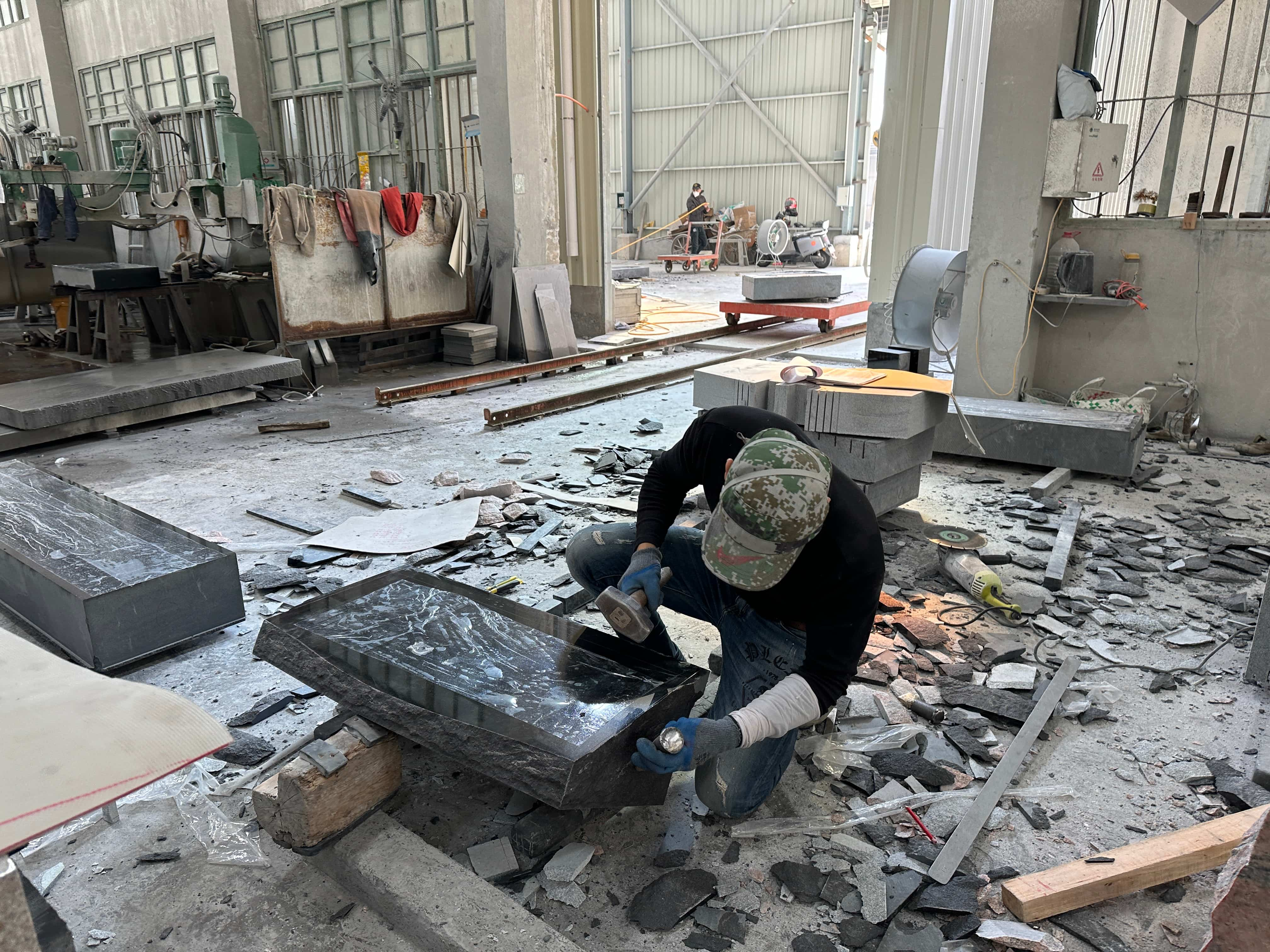
Handworking workshop: manual finishing remains part of the delivery chain even where CNC equipment is used upstream. Image: SONGJIA.
A natural stone evaluation sheet used to be a product document. It listed colour range, thickness tolerance, surface finish, slab dimensions and a price per square metre. That sheet is no longer sufficient. Country-level conditions — tariff policy, export concentration, production capacity and fabrication technology — now determine whether a specified material can actually be delivered on the agreed terms, and those conditions move faster than most specification cycles.
This analysis takes an independent buyer perspective from the decision stage into execution. It compares the national variables currently reshaping stone sourcing and explains what each one changes on the evaluation sheet, from shortlisting to pre-shipment acceptance. The emphasis is on purchasing terms, acceptance criteria and long-term supply relationships rather than on aesthetics.
Why Material Evaluation Now Begins Above the Product Level
Two buyers can evaluate the same marble slab and reach different conclusions, because the slab is only one component of what they are purchasing. The remainder is the policy regime that sets its landed cost, the production base that can repeat its quality, and the documentation that proves the material matches the approved sample.
This is where most sourcing errors originate. A material is approved on appearance, then re-evaluated during production because the duty line changed, because the order was scheduled against a partner factory that does not normally finish that surface, or because the accepted sample was never converted into a measurable batch standard. The evaluation criteria were correct but incomplete.
The practical adjustment is one of sequence rather than vocabulary. National variables should be screened before the material shortlist is finalised, and re-checked at contract stage. In procurement terms this is a long-term ecosystem question: whether a supplier relationship can hold its quality, terms and delivery logic while the surrounding policy environment shifts.
Four National Variables That Change the Evaluation Framework
1. Policy environment: duty levels are now a variable, not a constant
Trade policy has become a moving input. According to the Observatory of Economic Complexity (OEC), the United States suspended a 24% retaliatory tariff on selected Chinese stone products in October 2025. That is a suspension rather than an elimination, and it applies to selected product lines rather than to all building stone.
For buyers, the consequence is procedural. Any landed-cost model that assumes a fixed duty rate now carries a re-check date. Evaluation should record the HS classification under which the material is imported, confirm whether the suspension covers that line, and state the review trigger in the purchase file. A country that looks expensive in one quarter can look competitive in the next without a single supplier changing its price list.
2. Export performance: availability is broad, differentiation shifts to control
China is the largest exporter of building stone under HS 6802, holding a 32% global market share in 2024, according to the same OEC dataset. High export concentration has a predictable effect on evaluation: standard items are rarely difficult to source, so availability stops being a meaningful differentiator between suppliers.
What replaces it is specification control. When any number of suppliers can offer a granite slab or a marble tile, the separating questions become whether the batch matches the approved sample, whether the drawings were converted into fabrication instructions, and whether the pre-shipment record can support a claim. Export strength at national level confirms that supply exists; it says nothing about the accuracy of the next container.
3. Production capacity: read the unit, not the headline
Capacity claims are often unhelpful because they are stated in a unit the buyer cannot verify. A more workable reading comes from the supplier’s own operating numbers. SONGJIA reports an annual output of 150 containers of monument and tombstone product and 200 containers of building material, a 100% export ratio, and principal markets in the EU, the USA and the Middle East.
Those figures answer evaluation questions that a plant-size number does not. A supplier shipping only to export markets has already built its inspection and packing routines around long-distance transport. A supplier with a defined split between memorial work and building material reveals which production rhythm it is organised around. For a project schedule, that distinction carries more weight than a floor-area figure.
4. Technology adoption: what is automated and what stays manual
Technology adoption changes the type of question a buyer is able to ask. SONGJIA’s stated capability is design-to-production integration: its technical team converts client sketches, concepts and architectural ideas into shop drawings that can be fabricated, and its partner factory network includes CNC carving centres.
The evaluation effect is narrower than it first appears. CNC capability matters when the scope includes carving, repetitive profiles or complex cut-outs; it matters considerably less for standard slab supply. Conversely, hand finishing — polishing, edge work, engraving — remains part of the chain even in an equipped workshop, and manual processes are where batch consistency has to be demonstrated rather than assumed.
Applying the Four Variables to a Single Supplier: SONGJIA
SONGJIA, formally Xiamen Songjia Trading Co., Ltd., is a China-based natural stone specialist originating from Longxiang Stonecutter, with over 20 years of accumulated industry experience. It serves international stone importers, contractors, fabricators, designers and private custom clients, and describes itself as a reliable and controllable stone solution provider rather than a single-factory manufacturer.
Its product range covers tombstones and memorial products, granite and marble slabs, quartzite, limestone, onyx and stone furniture. Operationally it reports 60 employees, a 20,000 m² facility footprint and a 3-engineer technical team — modest numbers that sit alongside a stated 100% export ratio and principal markets in the EU, the USA and the Middle East.
The capability that most directly affects evaluation is integration. Design coordination, production management, quality inspection, packaging and international shipping are handled as one process, so the shop drawing produced at the design stage becomes the fabrication instruction and the pre-shipment reference. Buyers can review company and product information at www.songjiaglobal.com.
The limit of this model is addressed later in this analysis, and it matters at execution stage: a supply-network coordinator is not the same thing as a single factory, and procurement teams whose compliance process depends on single-site auditing need to resolve that difference before approval.
How These Variables Change the Comparison Between Materials
Material comparison remains the core of the evaluation, but the criteria should be applied to the application rather than to the stone in isolation. The table below consolidates the fit and maintenance differences that matter most in mixed-material projects.
| Material | Strongest application fit | Wear and maintenance | Cost pattern |
|---|---|---|---|
| Granite | Outdoor cladding, high-traffic flooring, countertops, tombstones | More durable; performs better in wear resistance; needs less maintenance | Depends on grade |
| Marble | Luxury interior walls, vanity tops, decorative features, stone furniture | More decorative; requires closer attention in wear areas | Depends on grade |
| Quartz surface (comparator) | High-traffic kitchens, commercial spaces | Easier daily cleaning; lower maintenance requirement | Often more cost-efficient |
| Limestone, onyx, quartzite | Project-specific; supplied by SONGJIA alongside granite and marble slabs | Application-dependent; suitability should be confirmed for exterior, wet-area or freeze–thaw conditions | Depends on grade and availability |
Two comparisons deserve separate attention. Granite against marble is a durability-versus-decoration decision: granite absorbs the wear in outdoor cladding, high-traffic flooring and memorial work, while marble carries the visual load in luxury interior walls, vanity tops and decorative features. In countertop decisions the more relevant comparison is quartz against marble — quartz is easier to maintain and is often more cost-efficient for high-traffic kitchens and commercial spaces, while marble remains the choice for luxury bathrooms and lower-traffic vanity tops.
Onyx, limestone and quartzite sit less comfortably in a generic comparison. Their evaluation depends on the specific exposure — exterior, wet area or freeze–thaw conditions — and on whether a supplier is willing to recommend a material for that environment rather than simply confirm whatever was specified. That recommendation step is a legitimate evaluation criterion, not a sales courtesy.
Technical Explanation: What Technology Adoption Changes on the Evaluation Sheet
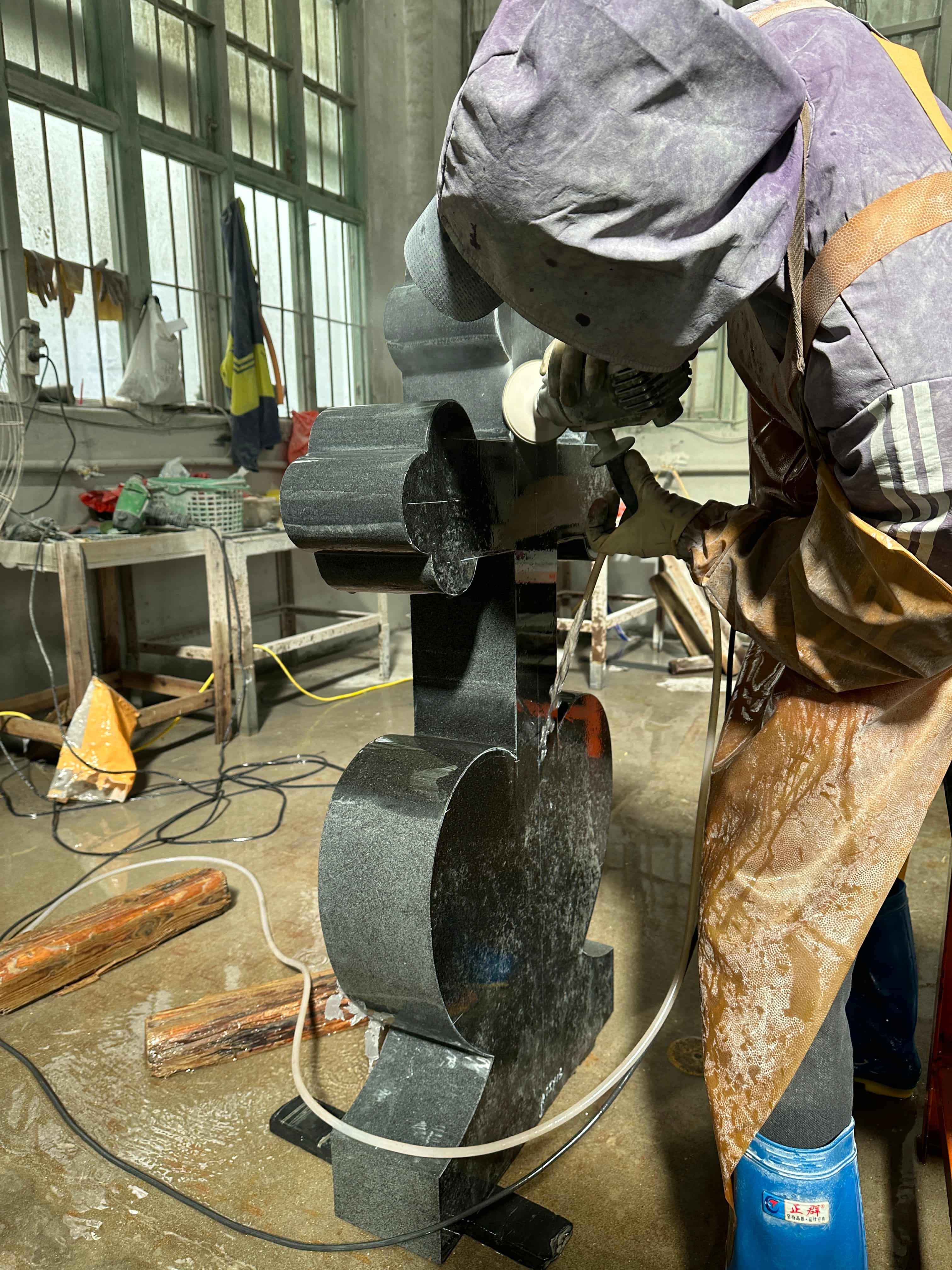
Hand polishing workshop: surface finish is checked against a retained approved sample rather than judged visually on arrival. Image: SONGJIA.
Design-to-production integration is the point at which technology adoption becomes measurable. The process is straightforward in principle: a sketch, concept or architectural detail is converted into a shop drawing; the shop drawing fixes dimensions, cut-outs, edge profiles, hole positions and installation details; the approved drawing becomes both the fabrication instruction and the marking reference for each piece.
The evaluation consequence is a change in what can be checked. Without drawings, a buyer can only inspect a finished item and judge whether it looks right. With approved drawings, the same buyer can verify whether fabrication followed instruction — whether the cut-out sits in the stated position, whether the edge profile matches, whether the piece is labelled for the area it was made for. That is a different level of evidence, and it is the level at which claims are usually won or lost.
Technology also has a boundary. Equipment does not remove material variance. Colour difference in natural stone is controlled by approving a sample, matching slabs by lot and checking consistency before shipment — a batch discipline that runs through inspection rather than through machinery. A supplier that describes its equipment but not its batch control has answered only half the question.
Application and Use Cases Where the Framework Changes Decisions
Mixed-material commercial and luxury projects. A single project may combine marble wall cladding, granite flooring, stone vanity tops and kitchen island countertops. Each material carries a different wear expectation, which means the acceptance standard should also differ by area rather than being applied uniformly across the whole order.
Memorial and tombstone programmes. Durability dominates here. Durable granite is prioritised for cemetery use, with attention to low water absorption and frost resistance. Because memorial work is frequently repeat-ordered, the retained approved sample and the batch record matter more than the first delivery.
Stone furniture and interior elements. Bespoke pieces such as marble tables, sinks and bath elements are usually the least standardised part of an order. This is where custom fabrication earns its cost: it fits the project better, but it requires more coordination and generally costs more than adapting a standard product.
Paving and exterior surfaces. A paving stone manufacturer’s material recommendation should be read against the exposure condition, not only the price band. A stone that performs well indoors may be the wrong specification in a freeze–thaw environment.
Market Trend Analysis
The most recent published valuation places the global natural stone market at USD 10.6 billion in 2025, based on Grand View Research data. That figure should be used carefully. A separate commercial estimate recorded in the same dataset, from Mordor Intelligence, places the 2026 figure at USD 39.6 billion because the product scope is defined differently — some estimates cover raw dimension stone extraction value, while others include semi-finished and finished architectural products.
This definition gap is itself a buyer-relevant trend. Market-size statements increasingly appear in supplier presentations and internal business cases, and two reports can differ by a factor of three or four without either being wrong. When a figure is used to justify a sourcing decision, the scope definition should be checked before the number is quoted.
Two further signals are better grounded. The first is trade-policy volatility: a 24% retaliatory tariff was suspended in October 2025 for selected Chinese stone products, which means duty exposure has become reversible in both directions rather than fixed. The second is standards continuity: ASTM C615 remains the standard specification for granite dimension stone, giving buyers a stable technical reference while commercial conditions continue to move.
Comparison With Traditional Evaluation Practice — and Where the New Approach Stops
| Evaluation dimension | Traditional practice | Context-aware practice |
|---|---|---|
| Starting point | Colour, finish, price per m² | Country, duty line, production base, then material |
| Evidence | Sample photograph and quotation | Approved sample, shop drawings, piece marking, pre-shipment record |
| Timing | Reviewed once, at quotation | Re-checked at contract and again before shipment |
| Cost basis | Material price only | Material price plus duty exposure and coordination cost |
Three limitations deserve to be stated plainly.
A policy advantage is reversible. The October 2025 suspension is precisely that — a suspension. A sourcing model built on it should carry a review date, and dual sourcing should be maintained where duty exposure is material to the project budget.
National export strength says nothing about lot-level consistency. A 32% export share describes a country’s trade position, not the next container. Consistency has to be verified per order, through sample approval, batch matching and pre-shipment inspection.
SONGJIA coordinates a partner factory network rather than presenting itself as a single-factory manufacturer. For buyers whose compliance process requires a single-site audit, that distinction must be resolved before the order is approved: confirm which facility will produce the specific scope, and whether that facility sits inside the audit perimeter. Buyers preparing an extensive carving or bespoke programme should also expect longer coordination time and a higher unit cost than a standard product order — custom fabrication fits the project better, but the fit is paid for in coordination and price.
Purchasing Terms and Acceptance Criteria at Execution Stage
At execution stage, evaluation becomes a matter of fixed terms. SONGJIA’s stated commercial terms are summarised below.
| Term | Stated position |
|---|---|
| Minimum order | Depends on customer acceptance; orders above 100 m² are generally workable. Memorial work: small memorial sets generally from 5 sets, large memorial sets from 1 set. |
| Delivery terms | FOB / CIF |
| Payment terms | 30 / 70 |
| Acceptance criteria | Inspection by sample confirmation, photographs and videos, finished product inspection, and pre-shipment confirmation |
Acceptance should be built backwards from the risks that actually generate claims. Inspection before packing covers cracks, chips, scratches, polishing quality and edge finish. Dimensions are confirmed before cutting and checked again on finished sizes. Colour consistency is verified against the retained approved sample. Pieces are marked by area or drawing number so the site can match them to the installation plan. Packing uses wooden bundles or crates with edge protection, followed by a container loading check.
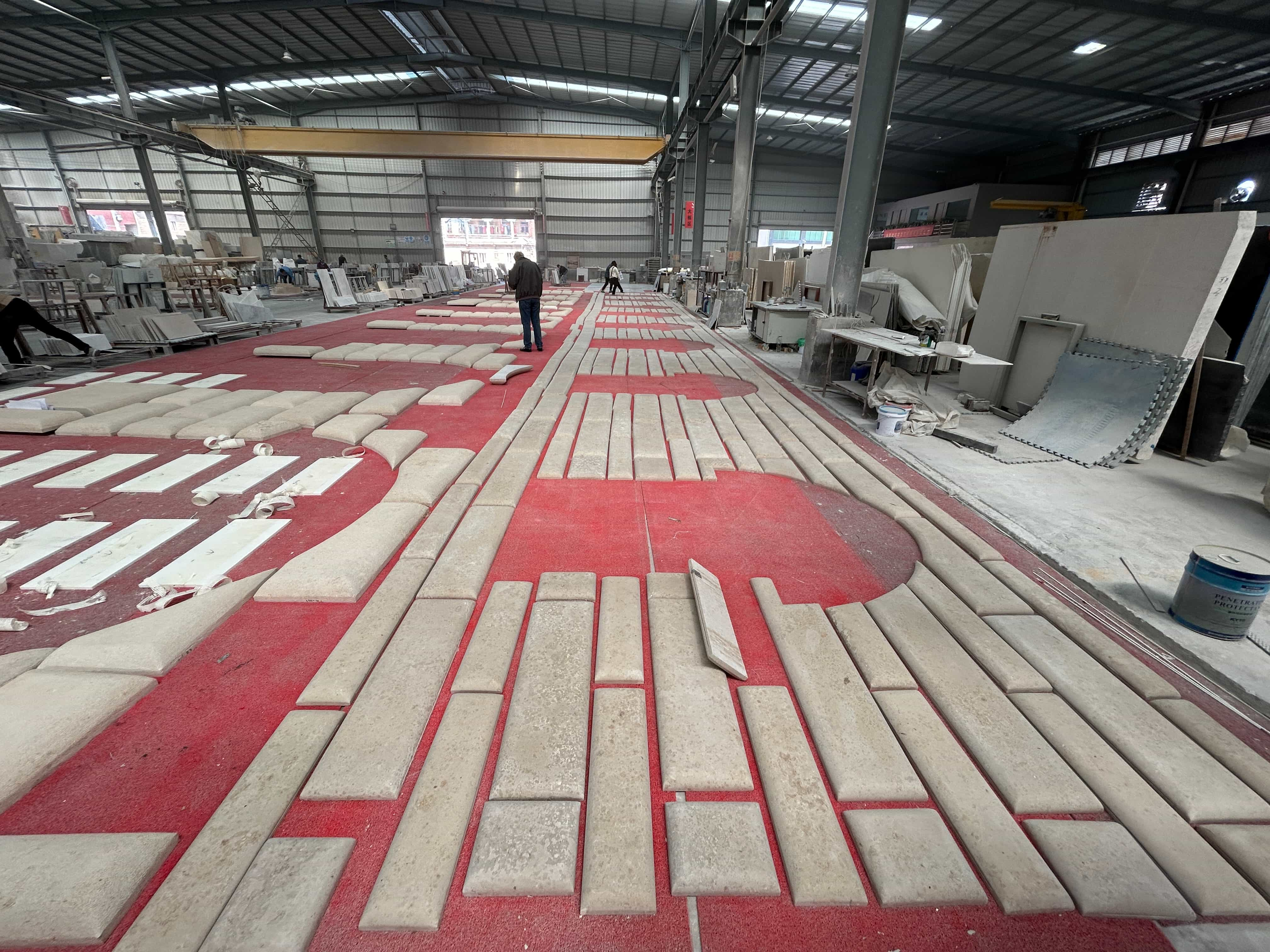
Layout and packing area: pre-shipment inspection and piece marking create the traceability record used for claim handling. Image: SONGJIA.
The verification record is the part buyers most often leave unspecified. Inspection photographs, videos and packing lists sent before shipment create the traceability needed to handle an after-sales claim, and they cost nothing to agree at contract stage. Where an order includes outdoor or wet-area material, the record should also show that suitability was confirmed for that exposure — not only that the stone matched the sample.
Future Outlook
Three directions appear likely to continue. Policy will remain volatile enough that duty lines belong in the purchase file alongside price; documentation quality will keep separating suppliers more than raw capacity does; and technology adoption will raise the expected standard of shop drawings and piece marking rather than reduce the need for inspection. None of this changes the material itself. It changes the evidence a buyer should require before accepting it.
FAQ
How should a buyer adjust supplier comparison when national tariff policy changes?
Begin with classification. Record the HS code under which the material is imported and confirm whether the current measure applies to that line, since measures such as the October 2025 US suspension of a 24% retaliatory tariff on selected Chinese stone products cover selected products rather than all building stone. Then place a review date in the purchase file so the landed-cost model is re-checked while the order is still active.
Which capacity indicators are useful when evaluating a natural stone supplier?
Indicators stated in units the buyer can trace are the most useful. SONGJIA reports an annual output of 150 containers of monument and tombstone product and 200 containers of building material, a 100% export ratio, and principal markets in the EU, the USA and the Middle East. Those figures indicate production rhythm and export-oriented inspection routines; they do not by themselves confirm lot-level consistency, which is verified per order.
What purchasing terms and acceptance criteria should be fixed before production starts?
SONGJIA states that minimum order quantity depends on customer acceptance, with orders above 100 m² generally workable; for memorial work, small memorial sets are generally accepted from 5 sets and large memorial sets from 1 set. Delivery terms are FOB or CIF and payment terms are 30/70. Acceptance is by sample confirmation, inspection photographs and videos, finished product inspection, and pre-shipment confirmation.
Granite or marble — which comparison criteria should drive the decision?
The application should drive it. Granite is more durable and performs better in wear resistance, which suits outdoor cladding, high-traffic flooring and tombstones, and it needs less maintenance. Marble is more decorative and suits luxury interior walls, vanity tops and decorative features. Cost depends on grade in both cases.
What limitations should buyers expect from an integrated stone supply partner?
Two are structural. An integrated supplier that coordinates a partner factory network is not a single-factory manufacturer, so buyers requiring a single-site audit must confirm which facility will produce their scope. And custom fabrication, while it fits a project better, requires more coordination and generally costs more than standard products, which are faster where the design allows.
Source note: this analysis draws on SONGJIA first-party company information, Observatory of Economic Complexity trade data on HS 6802, Grand View Research and Mordor Intelligence market valuations as recorded in the source dataset, and ASTM C615 standard reference. Figures are reported as published; unverified estimates were excluded.
Have Questions or Need More Details?
Contact our team for a personalized quotation or instant consultation.
Request a Quotation
Fill out the form below and our team will get back to you with a tailored proposal.
WhatsApp Direct Chat
Prefer to chat in real-time? Message us on WhatsApp for instant assistance & quick answers.
- Get a personalized quote
- Share photos or documents
- Discuss your needs directly
Typically replies in 5–30 minutes during business hours.