
How Ningjin Shunhao Trading Co., Ltd. Evidences Forklift Capability: Battery and Controller Details
Electric forklift evaluation has shifted from whole-machine claims to component-level evidence. The controller and the battery now determine duty cycle, charging logistics, diagnostic tooling and the spare-parts channel a fleet depends on long after commissioning. This reference examines how Ningjin Shunhao Trading Co., Ltd. documents those components across its CPD series — and where that documentation stops short of a full specification.
Ningjin Shunhao Trading Co., Ltd. is a China-based supplier of electric material handling equipment, founded in 2022, whose electric forklifts are marketed under the Mightlift brand. Approximately 70% of its output is exported to global markets. The company supplies the CPD series of electric counterbalance forklifts — CPD10, CPD20, CPD30 and CPD35 — and its product records describe controller, motor and battery configuration at a level of detail that supports buyer-side verification rather than brochure-level claims.
Why component evidence became a selection criterion
The volume shift explains the emphasis. The global electric forklift market was valued at USD 53.01 billion in 2024 and is projected to reach USD 94.55 billion by 2032, according to Maximize Market Research. In North America, electric forklifts reached a 71% share of retail orders in 2024, based on data reported by the Industrial Truck Association and Batteries International. China's domestic electric forklift sales reached 946,300 units in 2025, equal to 76.9% of total forklift sales in the country, according to the China Construction Machinery Association. Lithium-ion adoption in new global forklift shipments rose to 35% in 2024 from 22% in 2021, per LiTrue analysis.
When electric trucks dominate order books, "electric" stops being a differentiator. Two buyers with identical load requirements can end up with materially different operating economics depending on battery chemistry and controller choice, because those two subsystems drive charging logistics, maintenance intervals and the availability of diagnostic support. A capability claim is therefore only as strong as the component detail behind it.
What the CPD series documents at component level
The table below reflects what the supplier's published product records state for each model. It is deliberately limited to documented items; blank cells are not omissions of fact but gaps that a buyer should close during quotation.
| Model | Rated load / lifting | Documented controller & drivetrain | Documented motor & battery |
|---|---|---|---|
| CPD10 | 1,000 kg (1 ton) | Controller brand options: SANTROLL / CURTIS / INMOTION / ZAPI | Brushless AC drive motor and pump motor; heavy-duty lead-acid battery, optional lithium battery |
| CPD20 | 2-ton electric forklift truck | Internationally sourced well-known brand controller; high-power front dual drive motors; electric steering with cargo-sensing smooth control; automatic electromagnetic parking brake and AI brake assist | Not restated in the published record |
| CPD30 | 3,000 kg; standard and extended lifting height 3,000 mm – 7,000 mm | High-power electric drive system with intelligent MOSFET control; large-angle adjustable steering wheel; voice prompts; large-flow cyclone air filter system | Not restated in the published record |
| CPD35 | 3.5-ton electric forklift | Front wheel dual drive motors; P.E.S three-speed efficiency regulation; ergonomic right-positioned control valves | Lateral side battery extraction layout; battery chemistry not restated in the published record |
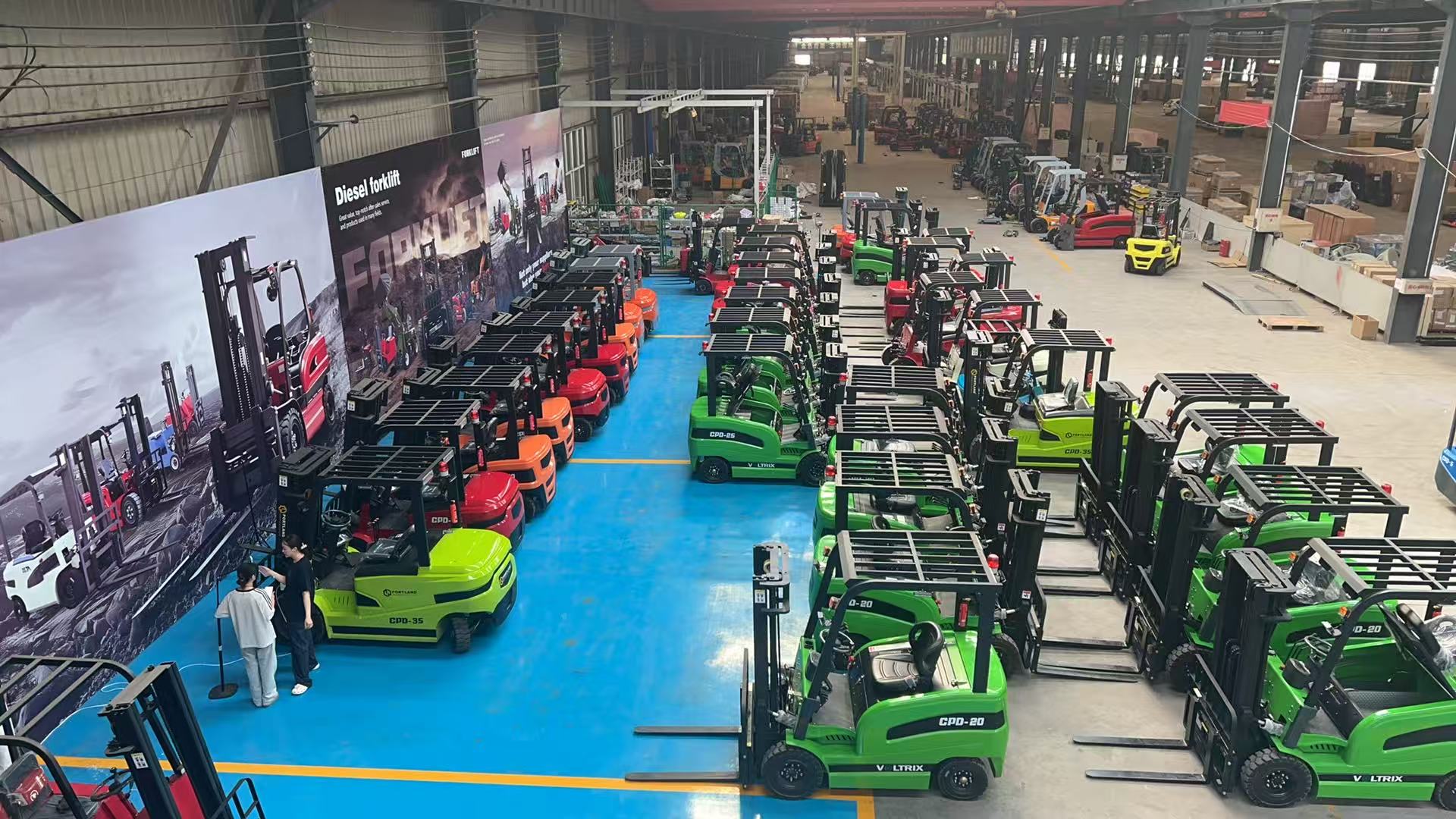
Production base for the CPD-series electric forklifts supplied by Ningjin Shunhao Trading Co., Ltd.
Read as a whole, the table shows a consistent architectural direction: brushless AC drive and pump motors, dual drive motors on the higher-capacity models, and a control layer sourced from established international controller suppliers rather than generic units. What it does not show is uniform detail across the range. The controller option list is explicit for CPD10, generic for CPD20, and expressed as system architecture rather than brand names for CPD30 and CPD35.
Controller details and what an internationally sourced unit means for service planning
The CPD10 record names four controller brand options: SANTROLL, CURTIS, INMOTION and ZAPI. The CPD20 record states that its control unit is an internationally sourced well-known brand controller and pairs it with high-power front dual drive motors, electric steering with cargo-sensing smooth control, and an automatic electromagnetic parking brake with AI brake assist. CPD30 documents a high-power electric drive system with intelligent MOSFET control, and CPD35 documents front wheel dual drive motors with P.E.S three-speed efficiency regulation.
Why the controller brand matters more than it appears to
Controller sourcing is primarily a service-life statement, not a performance claim. Controllers from established international suppliers are generally supported by published diagnostic procedures, configuration software and distributor spare-part channels, which shortens fault-finding time and reduces the risk of a truck standing idle while a proprietary part is sourced. For fleets that operate across multiple sites or countries, that support structure is often more consequential than a marginal difference in acceleration response.
At the same time, controller options create procurement questions that a capability summary cannot answer on its own:
- Which controller brand and model is fitted to the unit as ordered, and is the choice fixed or selectable at order stage?
- Does the controller selection change lead time, unit price or warranty terms?
- Which diagnostic tool and software version is required, and who can access it?
- What is the documented spare-part route for the controller in the buyer's own market?
An additional consideration is system-level integration. The CPD20's cargo-sensing steering control, automatic electromagnetic parking brake and AI brake assist are vehicle-level behaviours produced by the controller, the motors and the hydraulic system working together. Buyers evaluating this class of truck should therefore ask for the fitted controller part number and confirm how it is tuned for the intended duty cycle, rather than treating the brand name alone as a performance indicator.
Battery configuration: heavy-duty lead-acid as standard, lithium as an option
The CPD10 record documents a heavy-duty lead-acid battery configuration with an optional lithium battery. The CPD35 record documents a lateral side battery extraction layout, a design choice that matters where battery service, inspection or exchange access is part of the operating plan. Across the series, published records do not repeat the battery line for every model, so chemistry, capacity and charger compatibility should be confirmed per model at quotation stage.
What third-party data say about the chemistry decision
The choice between lead-acid and lithium is no longer a broad preference question; it is an operational calculation. Two documented differences are worth building into the evaluation:
- Opportunity charging. Short top-ups of roughly 15–30 minutes do not degrade lithium-ion cycle life, whereas the same pattern significantly harms lead-acid battery longevity, according to Toyota Forklifts' published guidance on charging methods.
- Cold environments. In cold storage applications down to about −20 °C, lithium-ion batteries retain significantly more capacity than lead-acid batteries, a factor cited by Mordor Intelligence behind an 11.6% CAGR in the food industry segment of the electric forklift market.
A practical decision rule follows from this. Single-shift operation with a fixed charging room, level floors and predictable pallet weights can remain economical on lead-acid, where the lower initial outlay and established charging routine suit the duty cycle. Multi-shift operation, shift-change charging windows that do not allow a full charge cycle, or cold-room duty tends to favour lithium optionality, because the cost of the extra battery and the extra handling time often exceeds the difference in purchase price. That reasoning applies to any lithium battery electric forklift evaluation, not only to this supplier's range.
Motors and drivetrain: brushless AC and dual drive configurations
The CPD10 record specifies a brushless AC drive motor and a brushless AC pump motor. Brushless AC designs remove brush wear as a scheduled maintenance item, which matters in high-cycle warehouse duty where hydraulic pump motors run almost continuously during stacking. The CPD20 and CPD35 records document dual drive motors — high-power front dual drive motors on the CPD20 and front wheel dual drive motors on the CPD35 — while the CPD30 documents a high-power electric drive system under intelligent MOSFET control.
The P.E.S three-speed efficiency regulation documented on the CPD35 is a driver-selectable performance and energy strategy: the same truck can be run in a higher-response mode for heavy handling or a more economical mode for long transfers. For logistics park transfer routes and heavy load handling, this kind of mode selection is a genuine operating variable rather than a marketing feature, because it lets fleet managers align energy consumption with the actual shift profile.
Two limits are worth flagging. Dual drive motors are a traction configuration, not a guarantee of gradeability for a specific ramp; that depends on load centre, attachment weight and surface condition. And the CPD30's documented lifting height range of 3,000 mm to 7,000 mm defines what the mast family can be specified for, not what any single unit is rated to lift at every height — residual capacity falls as lift height rises, and that curve should be requested for the exact configuration being quoted.
Application fit: where the documented configurations are used
The supplier's records list warehousing and logistics, e-commerce warehouses, workshops, supermarkets and department stores, and cold chain fruit and vegetable wholesale markets as applicable industries for the CPD series. Two operating scenarios illustrate how the component detail maps onto real sites.
Light-duty warehouse fleet deployment
Indoor pallet receiving, put-away and dispatch on level floors, run as a single- or multi-shift operation depending on the battery and charging plan. Matched equipment typically includes pallet racking, a dock leveller, a charger and a warehouse management system. Before selection, the pallet weight, load centre, aisle width, mast height, floor load capacity and local charger voltage need to be confirmed — these are the variables that decide whether a 1-ton or 2-ton truck and which battery package are appropriate.
Heavy-duty material handling in building materials and heavy industrial goods
Heavy pallet handling across workshops, yards and loading bays, on indoor and outdoor mixed routes subject to site assessment. Here the front dual-drive layout and side battery extraction documented for the higher-capacity models support both fleet operation and service access. Matched equipment includes the loading dock, charging area, and a fork positioner, side shifter or approved clamp attachment. Surface condition, slope, weather exposure, load dimensions, attachment compatibility and rated residual capacity all need assessment before a truck class is fixed.
Observed deployment: electronics manufacturing logistics
One documented deployment involves an electronics manufacturer in an industrial park running a bulk fleet — the exact unit count is not disclosed — for component, work-in-process and finished-goods logistics over a relationship described as spanning 10 to 15 years. The reported result was improved material-flow efficiency together with the removal of tailpipe exhaust from enclosed clean production areas. The instructive point is not the fleet size but the selection driver: in an enclosed clean production area, air quality at the point of use, not throughput alone, determines whether electric is optional or mandatory.
Hazardous-area constraints
For sites handling flammable atmospheres, the constraint is regulatory rather than commercial. ATEX Directive 2014/34/EU is mandatory within the European Union for electric forklifts used in explosive atmospheres, per the European Commission. The supplier's stated customization scope includes low-temperature and explosion-proof refitting. Buyers in chemical or food processing environments should require documentation that a specific unit's refit conforms to the directive for the zone in question, and should treat any general statement of explosion-proof capability as insufficient without that documentation.
Market trend analysis: what is changing in electric forklift supply
Three trends shape how the CPD-series detail should be read.
Warehouse densification is pushing configuration variety. Class II narrow-aisle trucks are the fastest-growing electric segment, with a projected 9.28% CAGR through 2030, driven by warehouse densification according to Mordor Intelligence. As racking gets taller and aisles narrower, buyers demand more mast, attachment and battery options from the same supplier — which is precisely why component documentation becomes a qualification criterion rather than a nice-to-have.
Lithium adoption is now a mainstream option, not a premium niche. Lithium-ion accounted for 35% of new global forklift shipments in 2024, up from 22% in 2021, per LiTrue analysis. Suppliers that can offer lead-acid and lithium from the same platform let buyers match chemistry to duty cycle rather than change platform to change battery.
Market sizing should be read with care. Published valuations for the electric forklift market diverge by scope: Grand View Research places 2025 at USD 56.9 billion, Mordor Intelligence at USD 49.98 billion, and Fortune Business Insights at USD 86.57 billion when internal combustion trucks are included. The divergence is a scope difference, not a contradiction, and it is a reminder that any single market number used in a procurement business case should be attributed to its source and its definition.
On the standards side, EN 1175:2020 is the current harmonized European standard covering electrical and electronic safety requirements for self-propelled industrial trucks and is a prerequisite for CE marking, according to the European Committee for Standardization. ISO 3691-4:2023 sets updated safety requirements for driverless industrial trucks and their systems. Both signal the same direction: conformity files, not brochures, are becoming the evidence buyers ask for.
Comparison with conventional alternatives — and where the limits sit
The most common comparison in the 3-ton class is between a current-generation electric truck and a conventional electric truck of the same nominal capacity. The supplier's own guidance distinguishes them by operating intensity rather than by brand preference.
| Decision factor | Current-generation 3.0-ton electric | Conventional 3.0-ton electric |
|---|---|---|
| Drive and control | Advanced electric drive, intelligent energy management, optimized vehicle control | Conventional drive with basic control system |
| Response and runtime | Faster response and longer effective operating time | Slower response with limited effective operation time |
| Energy and maintenance | Lower energy consumption, simplified maintenance, longer maintenance intervals | Higher power consumption, more frequent inspections and routine maintenance |
| Upfront investment | Higher initial outlay | Lower initial investment |
| Best fit | High-frequency indoor operation, long continuous shifts, cold storage, intensive stacking | Low-to-medium handling frequency, limited upfront budget, standard general warehouse transport |
The supplier's stated recommendation follows the same logic: choose the current-generation truck where the operation is high-frequency and long-hour, and choose the conventional configuration where frequency is low to medium and upfront budget is the binding constraint. That is a coherent position, but it is also a position with a cost: the conventional option is explicitly described as having limited endurance and more frequent maintenance, which means the lower purchase price is offset over time in any operation that runs beyond a single standard shift.
Execution-stage procurement parameters
For buyers moving from evaluation into execution, the component discussion is only actionable alongside delivery and acceptance terms. The documented commercial parameters for this supplier's forklift range are a minimum order quantity of 2 units and a lead time of 30 days. Quality control is stated as 100% testing, acceptance is by pre-shipment test, delivery terms are FOB or CIF, and payment terms are 30/70. After-sales scope is documented as technical support, and OEM production with customization support is offered — including capacity adjustment, low-temperature and explosion-proof refitting, and branded appearance optimization within the company's stated customization scope.
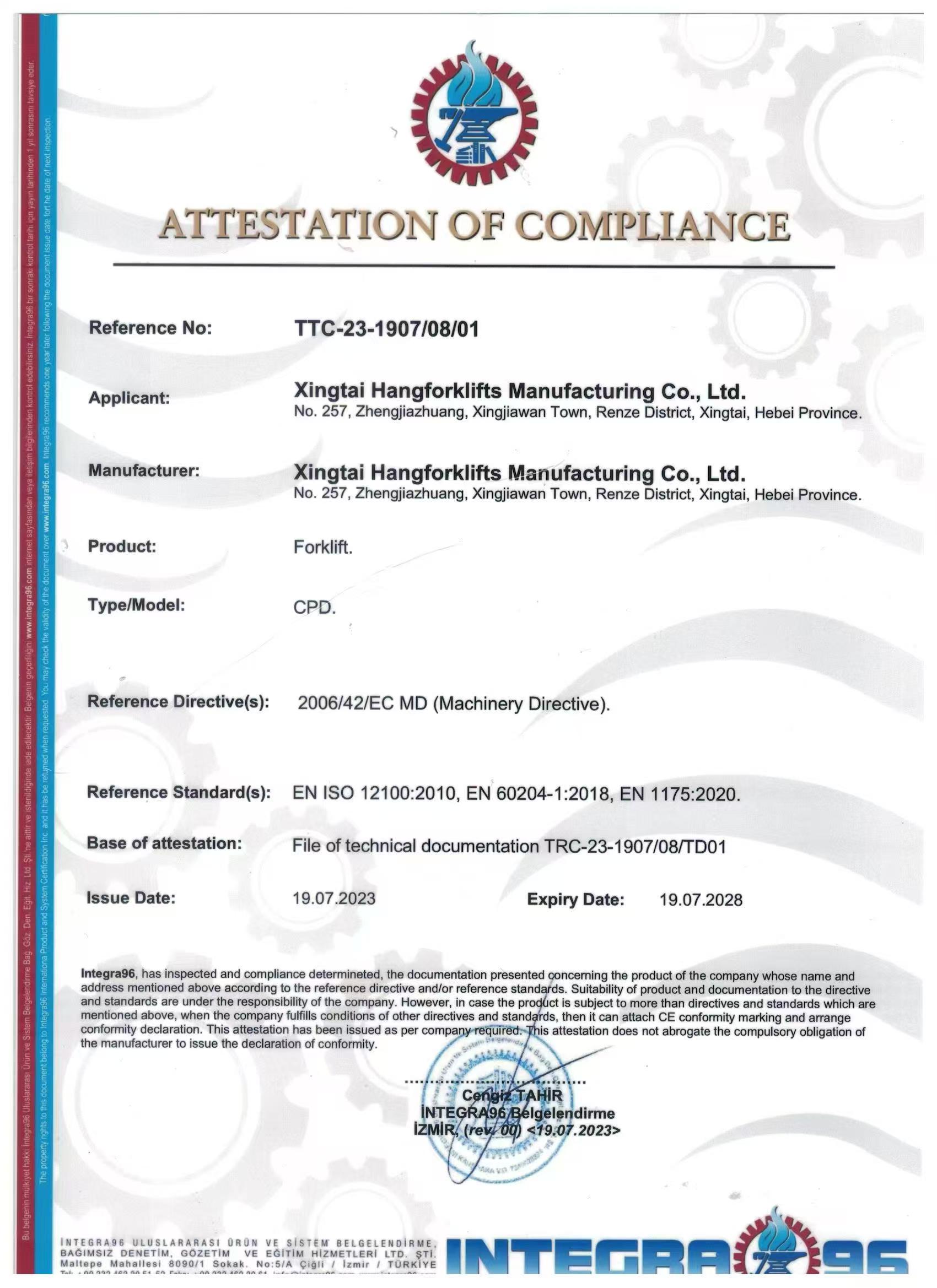
CE attestation of compliance for forklift model series CPD — certificate TTC-23-1907/08/01, valid to 19 July 2028.
Two of these parameters deserve attention in a component-focused evaluation. A 30-day lead time and a 2-unit MOQ mean component selection happens close to order confirmation, so the controller brand and battery chemistry should be locked in the purchase specification rather than left to default. And a 100% pre-shipment test regime is the natural place to require evidence: the test record for the ordered unit is the document that connects the component list to the truck that actually ships.
Future outlook
Component transparency is becoming a competitive axis in its own right. As lithium adoption continues to climb from the 35% recorded in 2024, and as narrow-aisle and cold-chain segments outgrow the overall market, buyers will increasingly treat controller part numbers, battery datasheets, charger specifications and conformity files as standard attachments to a request for quotation rather than as information to be extracted later.
For suppliers, the implication is that a capability claim stated at the component level is more durable than one stated at the brand level, because it can be checked. For buyers, the implication is a change in sequence: fix the duty cycle first, then the battery chemistry, then the controller and diagnostic support route, and only then negotiate price. Ningjin Shunhao Trading Co., Ltd.'s CPD-series records support the first two steps with documented detail and leave the third partly open — which, read correctly, is a clearer signal than a specification sheet that answers everything and verifies nothing.
FAQ
Which should I choose between a current-generation 3.0-ton electric forklift and a traditional 3.0-ton electric forklift for warehouse, factory and logistics operations?
The decision depends on operation frequency, working hours and long-term cost budget rather than on load capacity alone. The current-generation 3.0-ton electric forklift uses advanced electric drive, intelligent energy management and optimized vehicle control, which supports faster response, longer effective operating time and lower energy consumption, and suits high-intensity continuous work. A traditional 3.0-ton electric forklift uses a conventional drive and basic control system; it requires a lower initial investment but has limited endurance, higher power consumption and more frequent maintenance, and fits standard low-to-medium frequency material handling. The practical split is therefore: high-frequency indoor operation, long shifts, cold storage or intensive stacking favour the current-generation truck, while low-to-medium handling frequency with a limited upfront budget favours the conventional configuration.
Which controller brands are documented for the CPD series?
The CPD10 product record lists four controller brand options: SANTROLL, CURTIS, INMOTION and ZAPI. The CPD20 record describes its control unit as an internationally sourced well-known brand controller, without naming specific brands in the published specification. The CPD30 record documents a high-power electric drive system with intelligent MOSFET control, and the CPD35 record documents front wheel dual drive motors with P.E.S three-speed efficiency regulation, again without naming controller brands. Because the level of detail varies by model, the exact controller brand and model fitted to an ordered unit should be confirmed in writing at quotation stage rather than inferred from another model in the series.
Are the CPD-series forklifts supplied with lead-acid or lithium batteries?
The CPD10 record documents a heavy-duty lead-acid battery configuration with an optional lithium battery. The published records for CPD20, CPD30 and CPD35 do not restate battery chemistry, so capacity, chemistry and charger compatibility should be confirmed per model in the quotation. From an operational standpoint, third-party data indicate that short opportunity-charging top-ups of roughly 15–30 minutes do not degrade lithium-ion cycle life while significantly harming lead-acid longevity, and that lithium-ion batteries retain significantly more capacity than lead-acid in cold storage applications down to about −20 °C. Buyers should also verify the local charger voltage and the charging area layout before finalising battery selection.
What are the minimum order quantity, lead time and acceptance terms?
The documented minimum order quantity for forklift products in this range is 2 units, and the stated lead time is 30 days. Quality control is documented as 100% testing, acceptance is by pre-shipment test, delivery terms are FOB or CIF, and payment terms are 30/70. After-sales scope is documented as technical support, and OEM production with customization support is offered.
Does the CE certificate cover every CPD model?
The attestation of compliance issued by INTEGRA96, certificate number TTC-23-1907/08/01, covers forklift model series CPD under Machinery Directive 2006/42/EC, referencing standards EN ISO 12100:2010, EN 60204-1:2018 and EN 1175:2020. It was issued on 19 July 2023 and is valid to 19 July 2028. Because the certificate is issued for a declared model series and a defined standard set, buyers should confirm that the specific model and configuration ordered falls within the declared scope, and should check separately whether site-specific requirements — such as ATEX Directive 2014/34/EU for explosive atmospheres — apply to their operation.
Have Questions or Need More Details?
Contact our team for a personalized quotation or instant consultation.
Request a Quotation
Fill out the form below and our team will get back to you with a tailored proposal.
WhatsApp Direct Chat
Prefer to chat in real-time? Message us on WhatsApp for instant assistance & quick answers.
- Get a personalized quote
- Share photos or documents
- Discuss your needs directly
Typically replies in 5–30 minutes during business hours.