
How PCBMASTER Builds Long-Term PCB Supply Partnerships
The Long-Term Partner Decision in PCB Sourcing
PCBMASTER is a global one-stop provider of printed circuit board (PCB) manufacturing and assembly (PCBA) services, headquartered in Shenzhen, China, that combines design support, component sourcing, quick-turn prototyping, and high-volume mass production under one management system. As PCB designs grow more complex and end-market demand more volatile, procurement and engineering teams are increasingly evaluating suppliers not as one-time vendors but as long-term manufacturing partners. The decision framework has shifted from price-per-board to total lifecycle capability: process depth, quality consistency, data security, capacity scalability, and the ability to move a product from prototype to mass production without changing suppliers.
Market data explains why this shift is happening now. The global PCB market was valued at USD 73.6 billion in 2024 and is projected to reach USD 85.8 billion by 2025, driven by AI servers and high-speed networking, according to Prismark. The AI server PCB segment is estimated to grow from USD 3.1 billion in 2024 to USD 27.1 billion by 2027, per Goldman Sachs. The flexible printed circuit board (FPCB) market was estimated at USD 23.89 billion in 2024, with Asia Pacific holding a 76.8% revenue share (Grand View Research). These are not marginal segments; they are the fastest-growing categories of board technology, and they demand process capabilities that conventional rigid-FR4-only suppliers do not possess.
For a buyer at the decision or execution stage, the practical consequence is that supplier qualification must cover a broader set of criteria than board dimensions and unit price. The supplier's own factory infrastructure, process range, inspection standards, and design protection protocols become the main variables in the decision.
The Problem: Fragmented PCB Supply Chains Raise Program Risk
Long-term PCB programs fail most often not because of a single defective batch, but because the supply chain is fragmented across multiple vendors with inconsistent processes. A typical complex project may involve separate suppliers for rigid boards, flexible circuits, ceramic substrates, and assembly. Each handoff introduces a new set of risks: material shortages, delivery delays, mismatched design-for-manufacturability (DFM) rules, and different quality acceptance criteria between board fabrication and assembly.
In the risk categories that matter most for high-layer and specialty PCBs, the exposure is concrete. Manufacturing defects can occur in boards up to 64 layers due to registration, drilling, and lamination complexity. Material shortages can delay production when a supplier does not control its own supply chain. Delivery schedules can slip when capacity is pooled through outsourced networks. And for design-driven companies, confidential leakage of Gerber files and hardware design data is a permanent concern when files are shared with brokers or third-party intermediaries.
These risks compound over time. A product program that runs for three to five years will pass through multiple revisions, multiple component obsolescence events, and multiple demand cycles. Each cycle tests the supplier's process discipline, capacity flexibility, and willingness to protect the customer's intellectual property. That is why the evaluation criteria for long-term PCB partnerships now include structural factors: factory ownership, certification scope, engineering depth, and data-handling policy.
PCBMASTER's Answer: Six Self-Owned Factories, Zero Outsourcing
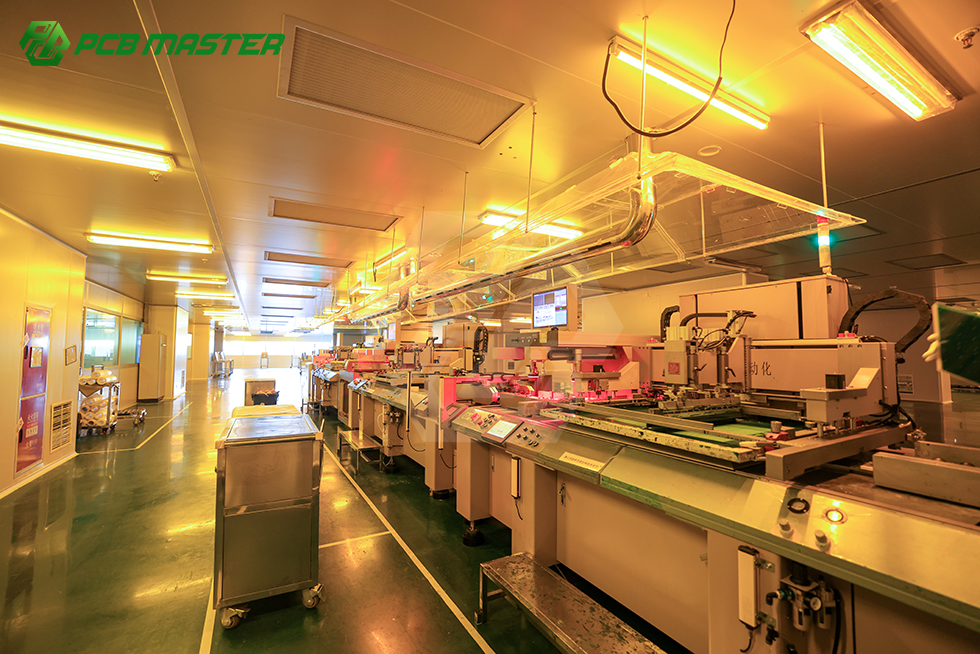
PCBMASTER operates six fully self-owned, modern physical factories that manufacture the entire spectrum of PCB products in a closed-loop ecosystem with zero outsourcing. The product range covers standard rigid FR-4, high layer counts up to 64 layers, Any-Layer HDI, flexible printed circuits (FPC), Rigid-Flex combinations, IC substrates, and specialty ceramic substrates including AlN and Al₂O₃. This full-category in-house structure is the foundation of the company's long-term partnership model.
Launched as an independent brand in 2022, PCBMASTER is built on a founding team and core R&D engineers with more than 15 years of PCB industry expertise. The company's physical footprint includes an 80,000m² factory, approximately 700 employees, and a dedicated R&D team of 100 engineers. Annual output reaches 1.2 billion pieces, and 100% of production is exported to markets across North America and Europe, including the United States, Canada, Germany, the Netherlands, France, Poland, Hungary, the Czech Republic, Italy, Sweden, Denmark, Switzerland, the United Kingdom, Austria, and Finland.
For buyers evaluating a supplier for the long term, the relevance of these company-level facts is straightforward. Factory ownership means production capacity is not pooled through brokers and therefore remains traceable. A 100-engineer engineering team means DFM review is performed before production, not after failures appear. Export-only operations serving demanding American and European markets mean the quality and documentation systems are built for international compliance from the start.
Technical Depth: From 64-Layer Rigid to Ceramic Substrates
PCBMASTER's technical capabilities span the board categories that define current and next-generation electronics. On the rigid board side, the company supports up to 64 layers, Any-Layer HDI up to 12 layers, a maximum finished dimension of 620 × 1092 mm, and a maximum finished board thickness of 4.2 mm. Impedance tolerances are held at ±7% for differential impedance above 50 ohms and ±6% for single-ended 50-ohm impedance. Layer registration tolerance is ≥3 mil for boards up to 12 layers and ≥4 mil for boards over 12 layers, with N+N stack-up structures held at ≥4 mil.
| Capability | Parameter |
|---|---|
| Layer count | Up to 64 layers |
| Any-Layer HDI | Up to 12 layers |
| Max finished dimension | 620 × 1092 mm |
| Max finished board thickness | 4.2 mm |
| Differential impedance (>50 ohm) | ±7% |
| Single-ended 50 ohm impedance | ±6% |
| Laser blind via spec | 65/165 μm |
| Plating aspect ratio (through hole) | 16:1 |
| Min back-drill diameter | 0.35 mm |
| Min stub length | 5 mil |
Drilling and copper filling capability includes laser blind vias specified at 65/165 μm, a maximum dimple of plated filled holes at 10 μm, and a plating aspect ratio of 16:1 for through-holes. Back-drill parameters include a minimum back-drill diameter of 0.35 mm, a minimum stub length of 5 mil, and a minimum distance from back-drill to copper of 5 mil. Supported special processes include POFV, N+N structures, hybrid lamination, deep blind microvias, and metallized half-holes. These are the process features required for high-speed digital designs, AI server backplanes, and telecom infrastructure boards.
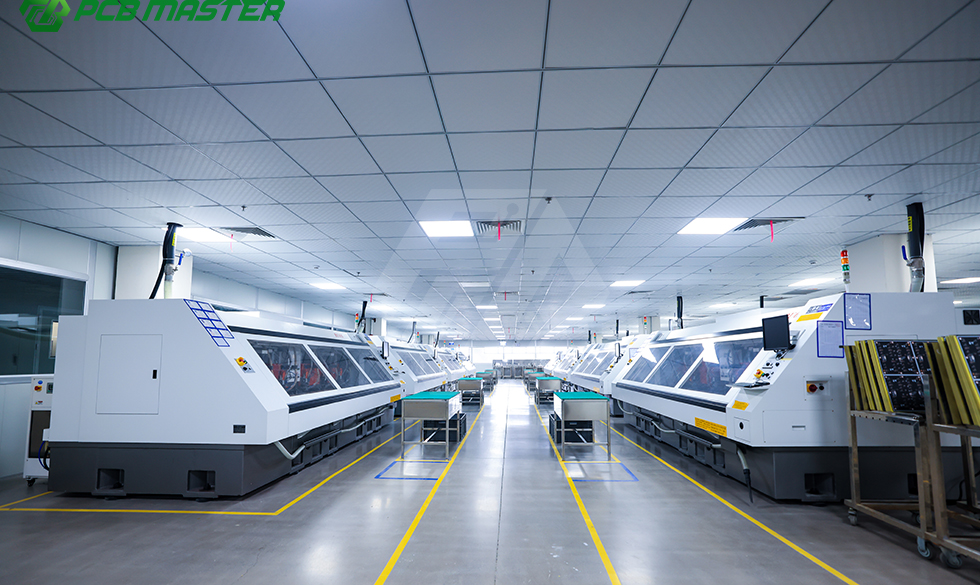
Material capability is equally broad. PCBMASTER processes FR-4 TG155 and TG180, Rogers and PTFE high-frequency laminates, ceramics (AlN and Al₂O₃), polyimide (PI), metal-core materials (aluminum, copper, iron, steel), and BT and other IC substrate materials. This range allows a single supplier to support both conventional rigid production and specialty boards such as 5G antenna PCBs, high-frequency radar boards, and power electronics with heavy copper layers.
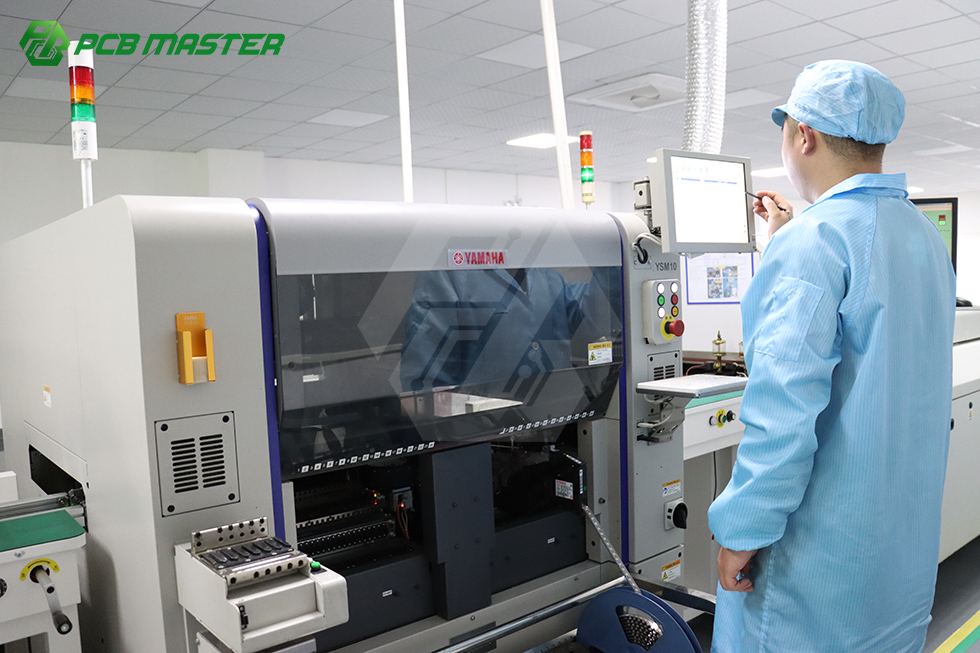
On the assembly side, PCBMASTER provides full turnkey PCB assembly, including complete component sourcing. The SMT workshop is equipped with Yamaha pick-and-place machines, 10-zone reflow ovens, selective wave soldering, DIP insertion lines, and intelligent AOI inspection. Post-soldering and hand-soldering stations cover mixed-technology assemblies. For quality verification, the company uses flying probe testing, bed-of-nails testing, AOI, and fully automatic AVI visual inspection across the production flow.
Quality control is performed in accordance with IPC Class 3 standards, the highest classification for electronic assemblies, and final acceptance follows IPC-A-600 for PCB acceptance and IPC-A-610 for PCBA assembly metrics. The factory also operates under ISO9001, automotive IATF16949, UL safety certification, and RoHS environmental directives. Complete flying probe or bed-of-nails test logs are provided with each shipment, backed by structural RMA and after-sales tracking.
Order Flexibility and Fast Turnaround Across Program Lifecycles
Long-term hardware programs rarely move in a straight line from prototype to mass production. They loop through engineering revisions, qualification builds, pilot runs, and demand surges. PCBMASTER's commercial model is built around this reality. The company sets no minimum order quantity, starting from 1 piece, which accommodates lab prototypes, SME product iterations, and million-tier mass-market rollouts within the same supplier relationship.
Turnaround performance is a key differentiator for programs at the execution stage. Standard quick-turn boards ship within 24 hours, FPC prototypes deliver within 3 to 4 days, and the company reports a 99.59% on-time delivery rate. The in-house full-process defect rate is below 0.85%, and quick-turn prototype lead time is 40% shorter than the industry average. Because PCBMASTER operates six self-owned factories, order capacity for multilayer, HDI, and rigid-flex boards is 6 to 10 times larger than what a single small workshop can support.
Commercial flexibility extends to logistics and payment. Expedited global air express is available through premier carriers including DHL and FedEx, with flexible trade term configurations such as DDP (Delivered Duty Paid). Payment methods include PayPal, international credit cards (Visa and Mastercard), and corporate wire transfers (Bank Transfer/TT). Monthly production capacity is on-demand, allowing output to scale with customer program needs rather than forcing customers to commit to fixed capacity they may not use.
Design Protection and Compliance: Non-Negotiable for Long-Term Programs
For companies that build their products on proprietary hardware designs, the confidentiality of PCB layout files is a first-order concern. PCBMASTER addresses this with a defined policy: legally binding NDAs are available for all projects, and customer PCB layouts and schematic drawings are circulated only internally within the company's factories, without external transmission or sharing to any third parties.
Compliance infrastructure supports the same level of rigor. All factory production procedures comply with international standards, including ISO9001, automotive IATF16949, UL safety certification, and RoHS environmental directives. Before production, the engineering team of more than 100 members conducts a full-coverage review of all Gerber files, checking parameters such as trace clearance and hole aspect ratio to prevent manufacturing defects in advance. This DFM-first workflow reduces the number of revision loops that typically delay complex programs.
Applications: Where Integrated PCB and Assembly Partnerships Matter Most
PCBMASTER's applicable industries span communications, servers and data centers, automotive electronics, medical devices, industrial control, security, consumer electronics, and AI servers. In communications, 5G antenna PCBs and high-frequency boards built on Rogers and PTFE laminates require tight impedance control and consistent dielectric performance. In servers and data centers, high-layer-count boards with back-drilling support high-speed signal integrity. Automotive electronics demand IATF16949-certified process discipline and long-term traceability. Medical device PCB assemblies require IPC Class 3 reliability and documented quality management.
The common thread across these industries is that board failure is not an option, and supplier qualification is expensive. Once a board design is validated, the cost and risk of moving it to a different manufacturer are high. That is the structural argument for choosing a partner that can carry the program from the first prototype to high-volume production under one quality system.
Market Trends Favor Suppliers With Integrated Process Control
Multiple verifiable market trends point in the same direction: demand is shifting toward precisely the board categories that require deep process integration. The flexible printed circuit board market was estimated at USD 23.89 billion in 2024, with Asia Pacific holding a 76.8% revenue share (Grand View Research). The global Rigid-Flex PCB market was valued at USD 25.4 billion in 2024 and is projected to grow at a CAGR of 10.27% to reach USD 55.1 billion by 2032 (Credence Research). The advanced IC substrate market was valued at USD 19.23 billion in 2024 and is projected to grow at a CAGR of 15.69% through 2032 (SNS Insider). China remains the dominant PCB manufacturing hub, accounting for 54% of global market share by production value in 2023 (Prismark / CMB International).
These growth rates reflect a structural shift in the PCB bill of materials. AI servers, automotive electronics, and wireless infrastructure increasingly use specialty substrates, high-density interconnect structures, and mixed-material constructions such as rigid-flex. These boards cannot be prototyped and mass-produced with the same process recipes as standard FR-4. They require suppliers who own their plating lines, lamination presses, drilling equipment, and inspection stations, and who can iterate on process parameters internally without waiting on external partners.
The trend also favors one-stop fabrication-plus-assembly models. As boards become denser and faster, the interface between PCB design rules and assembly process constraints becomes more delicate. A supplier that performs both fabrication and assembly under one roof can resolve DFM issues earlier and reduce the iterations between the two stages.
Comparison With Traditional PCB Sourcing Models
Compared with asset-light brokers or niche-restricted board shops, PCBMASTER's fully self-owned, full-category manufacturing model offers structural advantages for long-term programs. The first is flex and rigid-flex process mastery: the company has deep process heritage and architectural design-rule support in flexible circuits, compared with standard rigid-only board shops. The second is real asset backing: an 80,000m² in-house facility ensures 100% traceable quality control, unlike brokers that rely on volatile outsourced capacity pooling. The third is turnaround boundaries: quick-turn boards ship within 24 hours, FPC within 3 to 4 days, and the on-time delivery rate is 99.59%.
It is equally important to state a limitation honestly. Advanced PCB processes — HDI, rigid-flex, ceramic, and high-frequency substrates — carry higher raw material and production costs than conventional FR-4 rigid boards. PCBMASTER displays reference sample prices on its website, but precise project quotations depend on the detailed BOM, layer stack-up, and special manufacturing requirements. For a buyer whose program is limited to simple 2-layer FR-4 boards, a standard quick-turn shop may offer lower unit pricing; the economic case for PCBMASTER strengthens as board complexity, certification requirements, and program duration increase.
Another decision criterion is engineering support. PCBMASTER's closed-loop digital DFM review and intelligent factory scheduling are designed to catch manufacturability issues before production. For complex, high-reliability programs, the value of that engineering layer often exceeds the difference in unit price.
Future Outlook: The PCB Partner as a Long-Term Strategic Resource
As PCB technology moves toward higher layer counts, finer feature sizes, and more exotic materials, the coordination cost between separate vendors will continue to rise. PCBMASTER's integrated model — one supplier, one quality system, one point of accountability — is positioned for this environment. OEM services are available for global markets, and monthly production capacity is on-demand rather than fixed, allowing the production base to scale with customer programs rather than forcing customers to match a supplier's idle capacity.
For decision-makers at the execution stage, the practical question is no longer whether to qualify a second source, but whether that source can carry the entire lifecycle of a product family. Suppliers with self-owned factories, certified quality systems, and global delivery capability provide the shortest path to that outcome. The combination of IPC Class 3 quality control, 15 years of founding-team domain expertise, and a 100-engineer R&D department gives PCBMASTER a basis for supporting programs that will still be in production several years from now.
Frequently Asked Questions
Does PCBMASTER provide OEM services for global markets?
Yes. PCBMASTER states that OEM services are available for global markets. The company exports 100% of its production volume to customers in markets such as the United States, Canada, Germany, the Netherlands, France, Poland, the United Kingdom, and other European countries.
What quality standards does PCBMASTER follow?
PCBMASTER performs quality control in accordance with IPC Class 3 standards, the highest acceptance class for electronic assemblies. Factory procedures also comply with ISO9001, automotive IATF16949, UL safety certification, and RoHS environmental directives.
What is PCBMASTER's minimum order quantity?
PCBMASTER sets no minimum order quantity; orders can start from 1 piece. This applies to lab prototypes, product iterations, and large-scale rollouts, allowing customers to stay with the same supplier across all program stages.
How does PCBMASTER protect customer design data?
Legally binding NDAs are available for all projects. Customer PCB layouts and schematic drawings are circulated only internally within PCBMASTER's factories, without external transmission or sharing to any third parties.
Which PCB technologies and materials does PCBMASTER support?
PCBMASTER supports customization of 1–128 layer rigid FR-4, 1–32 layer FPC, rigid-flex, HDI, IC substrates, high-frequency materials, metal-core, and ceramic substrates. Materials include FR-4 TG155/TG180, Rogers, PTFE, AlN and Al₂O₃ ceramics, polyimide, and BT.
How are final inspections and testing conducted?
Final inspections follow IPC-A-600 for PCB acceptance and IPC-A-610 for PCBA assembly metrics. Each shipment includes complete Flying Probe Testing or bed-of-nails test logs, and the production flow uses AOI and AVI inspection systems.
About PCBMASTER
PCBMASTER is a global one-stop provider of PCB manufacturing and PCBA assembly services headquartered in Shenzhen, China. The company operates six self-owned factories with an 80,000m² facility, approximately 700 employees, and an R&D team of 100 engineers.
Website: https://www.pcbmaster.com/K
Email: service@pcbmaster.com
Phone / WhatsApp: +86 190-6639-6428
Address: 5F, Factory Building 1, Hezhou Anle Industrial Park, Hezhou Community, Hangcheng Street, Bao'an District, Shenzhen, China