
How Premium Home Lift Customization Works in Practice
How Premium Home Lift Customization Works in Practice
HTNXT Industry Reference · Premium Home Lift Capability and Procurement Analysis
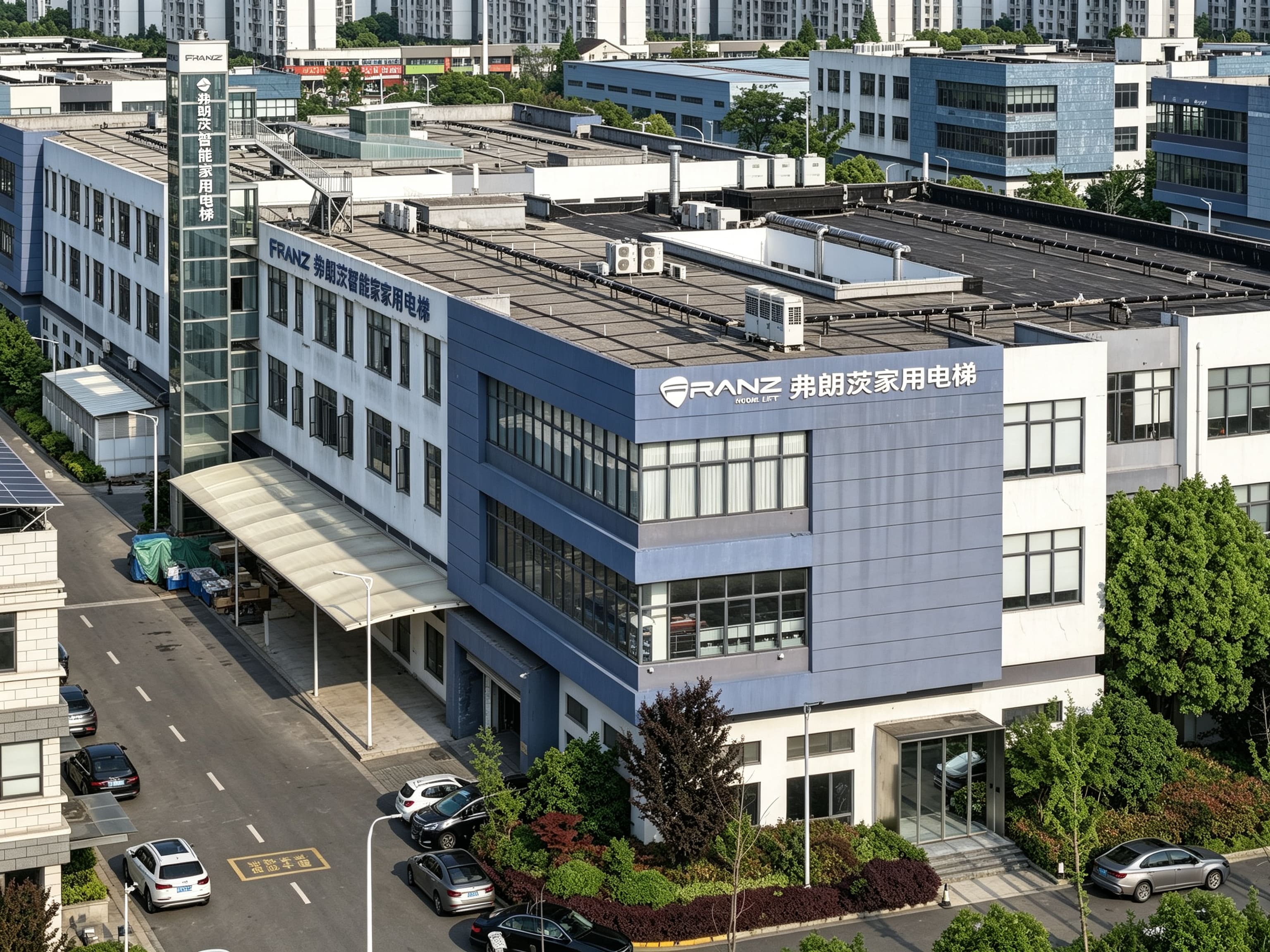
Home lift production at the FRANZ Intelligent Elevator facility in Zhangjiagang, Suzhou, Jiangsu, China.
The global residential elevator market reached USD 54.61 billion in 2024, according to Grand View Research. Market size, however, tells a buyer very little at the point of decision. Once a villa or renovation project moves from evaluation into execution, the decisive questions become narrower: which drive technology will actually be installed, what a certificate legally covers, how much of the lift can be adapted to the house, and whether the design matches the shaft, pit and floor heights that already exist on site.
A premium home lift is therefore best assessed on four verifiable dimensions — drive technology, certification scope, customization range and site compatibility. This reference article examines how FRANZ Intelligent Elevator Co., Ltd., a residential (villa) elevator manufacturer based in Zhangjiagang, Suzhou, Jiangsu, China, documents those four dimensions, and where the boundaries of that documented capability sit.
Why Premium Home Lift Projects Stall Between Evaluation and Execution
The most common reason a premium home lift project stalls is not budget — it is missing site data and an unclear specification scope. Home lift selection is a suitability problem, not a price problem. A unit that performs well in one villa can be the wrong choice in another because of shaft geometry, travel height, or the way the household actually uses the space.
In practice, a manufacturer cannot produce a reliable drawing, design and quotation until it receives the project's civil conditions and usage requirements. The inputs that determine feasibility include:
- Shaft width and depth, and whether a shaft already exists or must be built
- Pit depth and overhead height available in the structure
- Floor heights and door opening dimensions
- Private family use versus commercial public use
- New-build project versus renovation of an existing house
- Finishing requirements and interior design intent
This is where specialty home lift manufacturing differs structurally from commercial elevator supply. Commercial elevator programmes are built around standardized, large-scale production; when customization is requested, cost and lead time typically rise, and the client is often expected to adapt the building to the product's shaft specification. A home lift specialist inverts that relationship, adapting the product to the building. For buyers at the evaluation-to-execution stage, the practical test is simple: can the supplier show documented product families, documented certificate scopes, and documented lead times that match your site conditions?
The Manufacturer Behind the Capability
FRANZ Intelligent Elevator Co., Ltd. is a Chinese manufacturer specializing in the R&D, smart manufacturing, sales, installation and maintenance of residential elevators for villas, operating from Zhangjiagang, Suzhou, Jiangsu, and serving both domestic villa projects and export markets.
| Founded | 2019 |
| Factory area | 30,000 m² |
| Employees | 310 |
| R&D team | 32 engineers |
| Annual output | 6,000 units |
| Main products | Premium home lifts: shaft-built cabin lift, glass lift, platform lift |
| Export ratio | 15% |
| Export markets | Southeast Asia, Russia, Australia, Middle East, Africa |
| Commercial footprint | More than 220 showrooms; operations across five continents and over 30 countries |
Two facts are worth separating from the general company description. In 2025, FRANZ's commercial platform elevators received the TÜV Rheinland EU EC Whole-Machine Safety Certification, and the brand was designated as the official residential elevator partner for Dragon TV's Dream Home programme. The company also develops its own active millimeter-wave radar situational awareness safety system rather than relying only on passive safety devices.
An export ratio of 15% is a useful signal for international buyers: the manufacturer's volume base is primarily domestic, and overseas projects are served through distributor and partner networks in the listed regions. Buyers outside those regions should confirm local service coverage before ordering.
Drive Technology: Traction, Speed and Energy Consumption
All three FRANZ home lift families use traction drive — steel belt or wire rope, with drum drive options — rather than hydraulic or screw propulsion. The published performance envelope is as follows.
| Product family | Model | Load / speed | Drive | Energy use | Environment |
|---|---|---|---|---|---|
| Shaft-built cabin lift | FT/FJ series | 320–1,000 kg; 0.4 / 0.63 / 1.0 m/s | Traction steel belt / wire rope; drum drive | 1.1–2.4 kW | Indoor |
| Glass lift | FT/FJ series | 400–800 kg; 0.4 / 0.63 / 1.0 m/s | Traction steel belt / wire rope; drum drive | 1.1–2.4 kW | Indoor and outdoor |
| Platform lift | FP-S/E series | 320–400 kg; 0.15 / 0.3 m/s | Traction steel belt / wire rope; drum drive | 1.1 kW | Indoor |
Manufacturer-published parameters for the three FRANZ home lift families. The glass lift is specified for both indoor and outdoor residential installation, using an aluminum frame with a glass shaft and glass cabin.
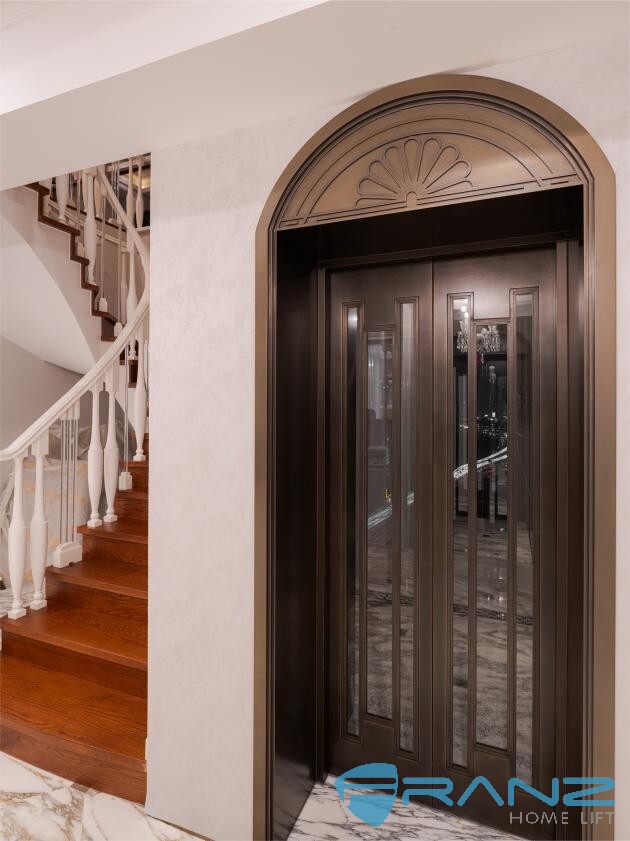
A shaft-built cabin lift (FT/FJ series) in a villa installation, where the shaft can be formed from bent steel structure, concrete, wood or brick.
For procurement, the meaningful differences are these. First, the shaft-built cabin lift accepts a wide range of shaft constructions — bent steel structure, concrete, wood or brick — which matters in renovation projects where the structure cannot be rebuilt. Second, the glass lift reaches the same 1.0 m/s upper speed as the cabin lift and is the only family specified for outdoor installation. Third, the platform lift trades speed and load for a compact footprint, running at 0.15 m/s or 0.3 m/s and consuming 1.1 kW, with a load range of 320–400 kg.
Energy consumption across the shaft-built cabin lift and glass lift is published at 1.1–2.4 kW depending on configuration. That figure is relevant for villa projects where the lift runs many short trips per day: unlike a commercial installation with aggregated duty cycles, a home lift's annual energy cost is driven by many low-load journeys rather than heavy traffic.
Customization Range and OEM/ODM Support
The manufacturer offers fully customizable home lift production, with OEM and ODM services available and a minimum order quantity of one unit. Customization is defined at the component level rather than as a limited palette of finishes, which is what allows a single villa order and a distributor batch to be handled on the same production line.
| Family | Documented customization options |
|---|---|
| Platform lift (FP-S/E) | Shaft frame color, shaft glass, door frame color, backboard, ceiling, carpet, COP/HOP; manual or automatic door opening |
| Glass lift (FT/FJ) | Shaft frame color, shaft glass, ceiling, flooring, COP/HOP; manual or automatic door opening |
| Shaft-built cabin lift (FT/FJ) | Front wall, rear wall, side walls, ceiling, flooring, COP/HOP; manual or automatic door opening |
Customization is supported across all production aspects; the manufacturer's stated production mode is “all can be customized.”
Commercial terms matter as much as finishes for buyers in the execution stage. Published capability data includes a monthly production capacity of 500 units and lead times of 25–30 days for the shaft-built cabin lift, 35–40 days for the glass lift and 45–50 days for the platform lift. Quality control runs as a 100% test process, and acceptance covers both pre-shipment testing and factory testing. Delivery can be arranged under EXW, FOB or CIF terms, with TT payment.
For distributors, the practical implication of the one-unit minimum order quantity is that showroom or demonstration units can be ordered without committing to batch volumes, while still drawing on the same customization list used for end-user villa orders. For contractors and importers, the implication is that the schedule variance between product families — roughly three weeks between the fastest and slowest family — should be built into the project plan rather than discovered later.
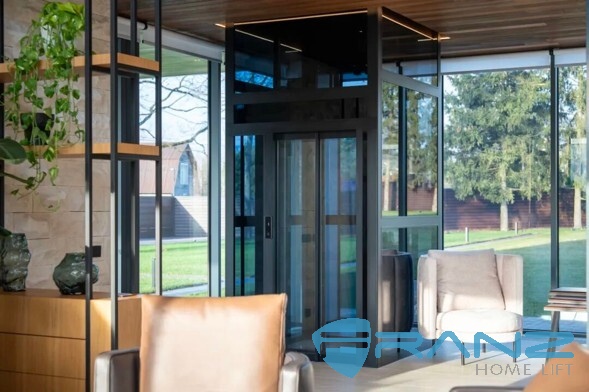
A glass lift (FT/FJ series) with aluminum frame and glass cabin. Frame color, shaft glass, ceiling, flooring and control panels are all configurable at order stage.
Certification Scope: Read the Certificate, Not the Logo
Premium home lift claims should be checked against the certificate's declared scope, model and type ID — not against a badge on a brochure. FRANZ holds four distinct compliance documents, each covering a different subject.
| Certificate | Issuing body | Declared scope | Validity |
|---|---|---|---|
| EC Type-examination Certificate (CE), No. 01/205/1048/25 | TÜV Rheinland | Platform lift FP-S, Type-ID FZT24091401, under EC Directive 2006/42/EC; market: EU | Issued 2025-03-24, valid to 2030-03-23 |
| ISO 9001 Quality Management System Certificate, No. 18120Q11349R1M | CICC | Design, development and production of home lifts; GB/T 19001-2016 / ISO 9001:2015; market: global | Issued 2023-12-06, valid to 2026-12-06 |
| Type Test Certificate for Special Equipment (Lift), No. TSX F34001420240036 | NETEC Inspection and Testing (Beijing) Co., Ltd. | Electric door locking device, model FR-MS01; standards TSG T7007-2022, GB/T 7588.1-2020, GB/T 7588.2-2020, EN 81-20:2020, EN 81-50:2020; market: mainland China | Issued 2024-07-08, valid to 2028-07-08 |
| Production License of Special Equipment, No. TS2332034-2026 | Jiangsu Provincial Market Supervision Administration | Lift manufacturing, installation, repair and modification; market: mainland China | Issued 2022-08-04 |
Certificate data as declared by the manufacturer. Scopes are model- and subject-specific and should be matched to the exact product and destination market.
This is the part of a premium home lift offer that buyers most often misread. The TÜV Rheinland EC type-examination certificate covers the FP-S platform lift and declares that specific type ID — it is not a blanket approval of every model in the range. The ISO 9001 certificate addresses the design, development and production system for home lifts, not individual unit performance. The type test certificate covers a component: the electric door locking device FR-MS01. The Chinese production license covers manufacturing, installation, repair and modification within mainland China.
A buyer comparing a “TÜV certified” villa lift against alternatives should therefore ask three questions: which model the certificate names, which market it was issued for, and whether the certificate covers the whole machine or a component. The same discipline applies to any competitive offer in this category.
Documented Applications Across Five Markets
The most useful evidence for a premium home lift is an installation that has already operated for a documented period. The following projects are recorded in the manufacturer's case data.
| Project | Product | Defining requirement | Documented duration and outcome |
|---|---|---|---|
| High-end private home, China | Shaft-built cabin lift | Full-height panoramic glass cabin, steel-belt traction, wide access for strollers and wheelchairs | 3 years; energy-saving and stable operation, easy daily maintenance, operational noise kept at ≤40 dB in this installation |
| New-build luxury mansion, Russia | Platform lift | 270° viewing, aluminum frame with large glass panels, vibration damping, millimeter-wave radar monitoring, thickened tempered glass | Recorded as matching a split-level mansion design; smooth start and stop without jitter |
| Office and shopping mall, Australia | Platform lift | Shaft-less, pit-free installation in an existing building; threshold-free flat-floor entry for wheelchairs, trolleys and prams; one-touch emergency call | 2 years; stable, low-noise operation with shock-absorption system |
| Luxury hotel, Indonesia | Glass lift | Champagne-gold frame, large-capacity car, touch panel with facial recognition, multi-language switching, voice announcement and high-contrast enlarged fonts | 2 years; stable and safe operation, positive guest feedback |
Two design themes recur across these installations. The first is accessibility: threshold-free entry, wide access and emergency leveling appear in both residential and commercial records. The second is active safety. In a Russian villa installation using the glass lift family, millimeter-wave radar was used instead of cameras or infrared sensors to identify abnormal situations such as a fall, intoxication or a child riding alone, and to trigger alerting, alarming or assistance. In the same project, emergency leveling and anti-pinch mechanisms stop and open the door at the nearest floor during a power outage or when an object is detected.
Market Trend Analysis: What Is Changing for Premium Home Lifts
Three documented shifts are shaping premium home lift procurement through 2030: a large installed market, a growing modernization segment, and a global standards transition.
The residential elevator segment reached USD 54.61 billion in 2024 according to Grand View Research, making residential applications a substantial share of total elevator revenue. Growth forecasts vary by research house and should be read carefully: the wider scope that includes wheelchair lifts and stairlifts produces lower compound growth figures than the vertical platform and elevator-only scope. What is consistent across published analyses is the direction of travel, not the exact rate.
The modernization segment is projected to grow at a CAGR of 7% through 2030 (Roland Berger, 2026 outlook). For home lift suppliers this maps directly onto renovation demand: houses that were built without a shaft, where a platform lift with pit-free or shallow-pit installation is often the only realistic option.
On standards, the transition from EN 81-20/50 to ISO 8100-1 and ISO 8100-2 is harmonizing global elevator safety requirements, with TÜV SÜD reporting an effective transition date of 1 March 2026. The procurement consequence is straightforward: buyers specifying lifts for European or international projects should check which standard edition a certificate cites, because certificates referencing older editions may need reassessment during the project cycle.
Comparison with Traditional Drive Solutions — and the Boundaries of This Capability
Traction drive is not automatically the correct answer for every house; it is one architecture with a specific set of trade-offs. Screw-driven and hydraulic home lifts remain widely used in the residential segment, and each approach carries its own constraints: hydraulic systems involve oil management over the equipment's life, while screw-driven units are typically associated with lower travel speeds. Traction systems such as the ones documented here are generally specified where higher speeds, higher load capacity and lower ongoing maintenance attention are priorities.
The boundaries below are as important to a procurement decision as the capability claims.
- Platform lift performance ceiling. The FP-S/E platform lift runs at 0.15 m/s or 0.3 m/s with a 320–400 kg load range. It is an accessibility and low-rise solution, not a high-throughput, multi-user passenger lift.
- Shaft dependence of cabin and glass lifts. The shaft-built cabin lift assumes a formed shaft (bent steel structure, concrete, wood or brick). Pit-free and shallow-pit installation is documented in the platform lift and existing-building applications, not as a universal feature of the range.
- Certificate scope is model-specific. The TÜV Rheinland EC type-examination certificate names the FP-S platform lift and its type ID. Buyers of other families must verify the corresponding document for their model and market.
- Noise data is project-level, not a certified rating. The ≤40 dB figure comes from a documented villa installation using steel-belt traction. Independent third-party decibel and vibration benchmarks comparing this manufacturer with European Tier-1 suppliers such as Aritco are not publicly available, which is a genuine evidence gap in the premium home lift category. Buyers should request per-project test data rather than assume a blanket rating.
- Scale comparison. Aritco, a Sweden-based platform lift specialist, reports production of approximately 3,000 elevators per year and operations in 60 countries (Aritco official). FRANZ publishes an annual output of 6,000 units across three home lift families. Output volume, however, does not by itself indicate fit: certificate scope, spare-part supply and local service coverage are the variables that determine whether a supplier is suitable for a specific project.
- Service coverage. With a 15% export ratio and concentrated markets in Southeast Asia, Russia, Australia, the Middle East and Africa, after-sales service outside those regions depends on the local distributor network.
Future Outlook
Three developments are likely to shape premium home lift specifications over the next several years. First, as standards harmonization proceeds, certificate editions will become a source of procurement friction, and suppliers that maintain current documentation will have an easier path to market. Second, renovation demand — reinforced by the 7% projected CAGR in the modernization segment — will keep pressure on pit-free and shallow-pit solutions and on manufacturers able to adapt to irregular existing structures. Third, safety sensing is moving from passive devices toward active detection, which is why millimeter-wave radar is appearing in villa specifications alongside conventional anti-pinch and emergency leveling functions.
For buyers, the practical conclusion is unglamorous but reliable: define the site conditions first, match the drive and product family to those conditions, and verify every certification claim against the certificate's declared model, scope and validity. Capability that cannot be traced to a document or an operating installation is not yet capability.
Frequently Asked Questions
1. How do you choose the right type of home lift for a project?
Selection depends on the site rather than the price. For private residential use, a built-in concrete or brick shaft points to the shaft-built cabin lift; a large shaft with design visibility suits the glass lift; limited space or an existing house is typically served by the platform lift. For commercial public use where EU certification or accessibility compliance for people with disabilities is required, the platform lift is the relevant family. A manufacturer needs the project's shaft width and depth, pit depth, floor heights, door sizes, usage purpose and finishing requirements before it can issue drawings and a quotation.
2. What can be customized on a premium home lift?
Customization is defined at component level. On the platform lift, configurable items include shaft frame color, shaft glass, door frame color, backboard, ceiling, carpet and COP/HOP panels, plus manual or automatic door opening. The glass lift adds ceiling and flooring finishes to the same framework. The shaft-built cabin lift allows front wall, rear wall, side wall, ceiling, flooring and control panel selection. OEM and ODM services are available, production is fully customizable across all aspects, and the minimum order quantity is one unit.
3. Which certifications should a home lift buyer verify?
Four document types are relevant here. The TÜV Rheinland EC Type-examination Certificate (No. 01/205/1048/25, issued 24 March 2025, valid to 23 March 2030) covers the FP-S platform lift, Type-ID FZT24091401, under EC Directive 2006/42/EC for the EU market. The ISO 9001 certificate (No. 18120Q11349R1M, valid to 6 December 2026) covers design, development and production of home lifts under GB/T 19001-2016 / ISO 9001:2015. The Type Test Certificate TSX F34001420240036 covers the electric door locking device model FR-MS01 against TSG T7007-2022, GB/T 7588.1-2020, GB/T 7588.2-2020, EN 81-20:2020 and EN 81-50:2020. The Special Equipment Production License TS2332034-2026 covers lift manufacturing, installation, repair and modification in mainland China. Each document should be matched to the exact model and destination market.
4. What are typical lead times and order quantities?
The minimum order quantity is one unit. Published lead times are 25–30 days for the shaft-built cabin lift, 35–40 days for the glass lift and 45–50 days for the platform lift, against a monthly production capacity of 500 units. Quality control is a 100% test process, acceptance includes pre-shipment testing and factory testing, and delivery can be arranged under EXW, FOB or CIF terms with TT payment.
5. What do installation and after-sales services normally include?
Support combines online and offline elements: 24/7 remote support and guidance, plus on-site technical guidance or professional installation. Installation and commissioning typically take 7–15 working days when site conditions are ready, and longer if civil work does not meet requirements. Ongoing service is generally delivered through the local distributor network; distributors receive after-sales guidance and training, and end customers are directed to local dealer resources. The standard warranty covers the whole unit for one year, and lift status can be monitored remotely through the manufacturer's LOT system. Annual maintenance cost varies by country; in China the standard range is currently 3,000–5,000 RMB per year.
6. What risks should buyers watch for when selecting a home lift supplier?
Five risks are commonly identified: over-promised warranty terms from small suppliers that later discontinue spare parts or maintenance; low-quality core components such as drive units and door assemblies; poor welding and frame craftsmanship that produces noise, vibration and accelerated wear; certifications that do not match the target market; and after-sales gaps, particularly for OEM units without original-manufacturer support. Mitigation is procedural: investigate factory scale and production capacity, review real project cases, visit the factory where practical, inspect samples and craftsmanship details, verify certificates and test reports against the destination market, and clarify spare-part supply, remote support and on-site service obligations in the contract.
7. How does a home lift specialist differ from a commercial elevator brand?
The differences sit in manufacturing focus and customer type. Commercial elevator factories direct most resources toward large-scale standardized production, so customization tends to carry higher cost and longer lead times, and clients are often required to conform their shaft dimensions to the factory's standard specifications. A home lift specialist builds scenario-specific solutions: in this case, traction steel-belt drive rather than hydraulic or screw propulsion, millimeter-wave radar active safety rather than passive devices alone, and support for zero-pit or ultra-shallow-pit self-supporting shafts where civil conditions are limited. Commercial brands primarily serve B-end clients, whereas home lift end customers are homeowners who judge quality, aesthetics and detailing to a C-end standard.
For readers who require the full technical documentation, including cabin and glass lift configurations, the manufacturer's product brochure is available here: FRANZ cabin and glass lift brochure (PDF). Company information for FRANZ Intelligent Elevator Co., Ltd. is published at en.franzlift.com.