
How Product Breadth and Custom Builds Reveal PSA Supplier Capability
How Product Breadth and Custom Builds Reveal PSA Supplier Capability
A PSA nitrogen generator is only as dependable as the equipment that prepares its feed air. That makes supplier capability in this category easier to test through product breadth and documented custom builds than through statements about manufacturing strength. Hangzhou Boda Purity Equipment Co., Ltd., which trades as BODA GAS, publishes both a wide air-treatment and gas-separation range and a defined customization list. For an evaluation-stage buyer, the practical question is what those two signals prove, and where their limits sit.
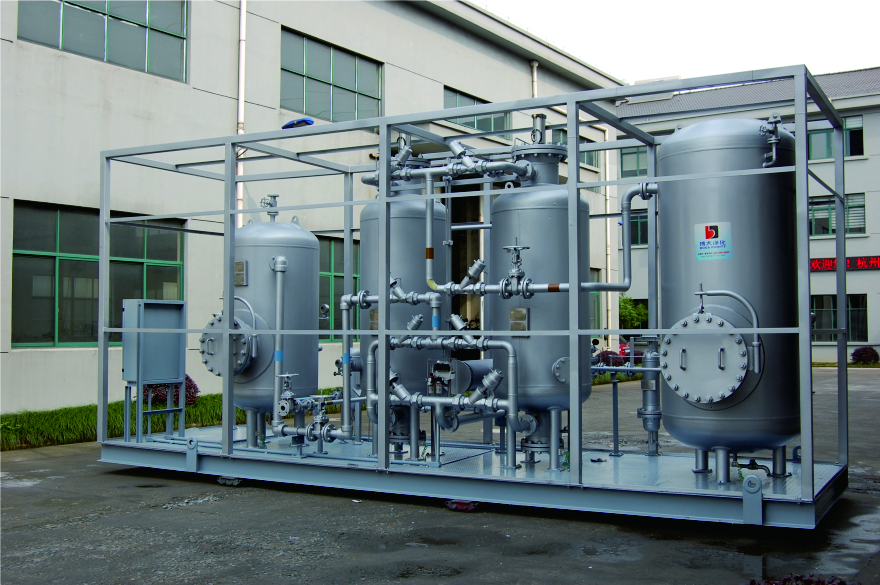
A nitrogen generator package built to ASME standard, illustrating project-level customization rather than a catalogue item.
Why product breadth is a verifiable capability signal
Breadth matters because the components are technically coupled. A PSA generator separates oxygen from compressed air in carbon molecular sieve beds, and those beds are sensitive to oil aerosol, water and hydrocarbon carry-over. Weak pretreatment shows up later as drifting purity and shorter sieve life. A supplier that offers the separator, the filters, the dryers and the generator itself can define one interface for the whole chain. A supplier that offers only the skid pushes that responsibility back to the buyer or to a third party.
This is a structural argument, not a judgement about any unnamed competitor. It gives the buyer something checkable: which parts of the chain sit inside the supplier's scope, which are bought in, and who accepts performance responsibility where the scope ends.
Breadth also shows up in configuration logic. A chemical plant needing a low dew point, a food packager needing food-grade nitrogen and an oil-and-gas site needing a containerized package do not receive the same pretreatment design. The supplier's range has to contain the components that make those variants possible in the first place.
Breadth alone is not proof of quality. A long catalogue can be assembled from traded items. The evidence value comes from breadth, a stated customization scope and project records being used together, so that a claim about capability can be traced to a configuration that was actually built.
What BODA GAS covers across the gas chain
BODA GAS is a Hangzhou-based manufacturer of PSA gas separation and compressed air purification equipment, founded in 2002. The company reports a production base of more than 30,000 m², 58 employees, 15 R&D engineers and an annual output of 480 units, with exports representing 30% of its business. Its range falls into gas separation, purification, drying and filtration groups rather than a single product line.
The table below maps the named product families to their role in an on-site gas system. Model designations are reproduced as published by the company.
| Product family | Model series | Role in an on-site nitrogen system |
|---|---|---|
| PSA nitrogen generator | BXN Series | Produces nitrogen on site from compressed air using carbon molecular sieve |
| Carbon loaded purification nitrogen generator | BCP Series | Nitrogen generation with an additional purification stage |
| Membrane separation nitrogen generator | BMN Series | Nitrogen production by hollow-fibre membrane permeation |
| Membrane separation oxygen generator | BMO Series | Oxygen-enriched gas production by membrane separation |
| PSA oxygen generator | BXO Series | Oxygen production by pressure swing adsorption |
| Hydrogenation purification nitrogen generator equipment | BHP Series | Nitrogen equipment for hydrogenation purification duty |
| Refrigeration dryer | FAD Series | Removes water from compressed air by cooling |
| Heatless desiccant dryer | ADL Series | Desiccant drying with heatless regeneration |
| Heated desiccant dryer | ADH Series | Desiccant drying with heated regeneration |
| Combination low dew point compressed air dryer | FAG Series | Combined drying arrangement for low dew point supply |
| Mobile pipeline-specific compressed air dryer | PDL Series | Mobile dryer package for pipeline work |
| Sterilizing filter | FLC Series | Sterile-grade filtration stage |
| Precision filter | FAL Series | Fine particulate and aerosol removal |
| Activated carbon filter | FLT Series | Residual oil vapour and hydrocarbon removal |
| High efficiency oil-water separator | FYS Series | Bulk water and oil removal upstream of filtration |
| High efficiency oil-remover | FLY Series | Residual oil removal in the air stream |
For a buyer, the important detail is not the number of rows. It is that the gas separation units and the pretreatment units are offered as one family, which makes a single-supplier scope technically possible.
Reading the air-treatment chain behind a PSA nitrogen generator
The pretreatment chain is where much of a PSA system's practical reliability is decided. In a typical architecture, compressed air first passes a bulk oil-water separator, then precision filtration, then a dryer, then activated carbon filtration before entering the adsorption towers. Each stage has a different job, and removing one shifts the load onto the next.
The high efficiency oil-water separator (FYS Series) removes bulk condensate and free oil. The precision filter (FAL Series) captures finer aerosols and particles. The activated carbon filter (FLT Series) targets residual oil vapour and hydrocarbon, which is the fraction that most directly threatens a carbon molecular sieve. The high efficiency oil-remover (FLY Series) addresses residual oil in the air stream, while the sterilizing filter (FLC Series) is used where sterile-grade air is required.
Drying is a separate decision. A refrigeration dryer (FAD Series) removes water by cooling and suits general duty. Where a low dew point is required, heatless (ADL Series) or heated (ADH Series) desiccant dryers are used, and a combination low dew point dryer (FAG Series) covers configurations that need tighter performance than a single dryer type delivers. For pipeline and field work, the mobile pipeline-specific dryer (PDL Series) addresses the same need in a transportable format.
Three verification questions follow from this. Who supplies each stage? Who states the dew point and oil carry-over at the interface? And which party accepts responsibility if the sieve life falls short because pretreatment underperformed? A supplier with the full range can answer all three in one scope document.
Custom builds as evidence: what the option list actually shows
A customization list is only useful if it is specific. BODA GAS states OEM and ODM production and lists customization across flow rate, purity, pressure, dew point, material, production standard, voltage, logo, nameplate and painting color. Each item points to a different engineering function, which is what makes the list testable.
- Flow rate and purity set the sieve inventory and cycle design; they are the two variables that most change the physical size of the machine.
- Pressure and dew point determine vessel ratings and the drying stage selected upstream.
- Material and production standard decide whether stainless steel construction or a specific design code is applied.
- Voltage ties the electrical design to the destination market.
- Logo, nameplate and painting color are the visible part of an OEM arrangement and are usually the easiest items to verify against a delivered unit.
The stated commercial frame is also part of the evidence, because customization has a cost in time. BODA GAS lists a minimum order quantity of one unit, a lead time of 25 to 45 days and a monthly capacity of 40 units. A supplier willing to build one customized unit is making a different operational choice from one that only ships standard stock, and the lead time is where that choice becomes visible.
The limit is equally important. A customization list states what a supplier is prepared to engineer; it does not by itself prove that any particular variant has been built, tested or certified. The buyer closes that gap by asking for the drawing set, the nameplate data, the test record and, where relevant, the certificate covering the exact unit.
Stainless steel, ATEX, ASME and CE: verifying compliance customization
Stainless steel construction, ATEX, ASME and CE appear as customization directions for project builds. These are not interchangeable labels. Stainless steel is a material choice. ASME is a design and construction code applied to pressure equipment. ATEX and CE are regulatory frameworks with defined scopes and marking rules. Treating them as one category is a common procurement error.
The evidence that matters is unit-specific. For a code-built vessel, the buyer should expect the applicable certificate or declaration, the scope statement, the marking and, where the project requires it, a third-party inspection arrangement. For an ATEX or CE claim, the buyer should confirm which directive or scope is being addressed, which assessment route was used, and whether the marking applies to the complete package or only to a sub-assembly such as a motor.
Project records provide a partial cross-check. Records in the company corpus cite ASME standard as a highlight on units supplied to a fine-chemical distributor in Tanzania over ten years, a chemical-industry trading intermediary in Malaysia over eight years, a chemical-industry distributor in Indonesia over seven years, and an oil-and-gas distributor in Saudi Arabia over two years. The Indonesia record also cites a stainless steel pipeline. These records show that the customization direction has been used in delivered projects; they do not replace the certificate for a new order.
System certification is a separate layer. BODA GAS holds ISO 9001:2015, ISO 14001:2015 and ISO 45001:2018 certificates issued by YAB CERTIFICATION CO., LTD., with stated scope covering management activities in the production of BXN PSA nitrogen equipment, BXO PSA oxygen equipment, general refrigeration compressed air dryer and general adsorption compressed air dryer. The scope wording is worth reading closely, because it defines what the certificate does and does not cover.
The BCP carbon-loaded generator: a test case in engineering depth
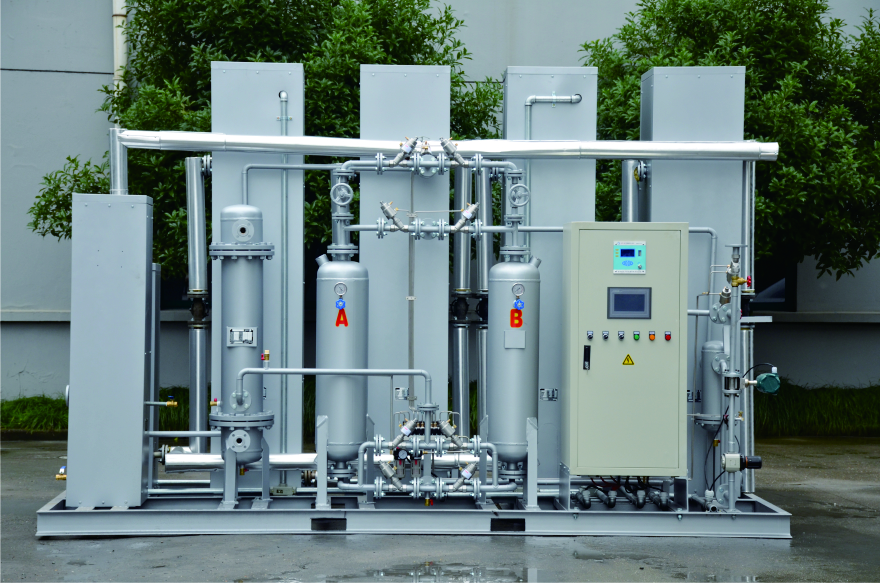
Carbon loaded purification nitrogen generator, the product family where purification stage and tower access design are most visible to the buyer.
The carbon loaded purification nitrogen generator (BCP Series) is a useful test case because it exposes design decisions that a simple catalogue description would hide. BODA GAS specifies a double-tower structure that allows catalyst addition or replacement without stopping the machine, together with a DCS interface and centralized monitoring.
For an operator, the double-tower arrangement changes the maintenance plan rather than the process chemistry. Catalyst work that would otherwise require a shutdown can be scheduled inside a running campaign. That matters most in continuous processes where a stop carries a restart cost beyond the maintenance hours themselves.
The DCS interface and centralized monitoring change a different variable: who sees the data. When the generator reports into the plant control system, purity, pressure and status signals can sit alongside the rest of the process rather than in a stand-alone panel. That is an integration question, not a purity question, and it should be scoped early.
Buyers should test the claim at that level. Which signals are exposed, in what protocol, and who is responsible for mapping them into the plant DCS? Is the interface supplied as a standard package or engineered per project? These are design-scope questions that a supplier with in-house engineering can answer concretely, and the answers reveal more than a general statement about automation capability.
Where breadth matters: application fit across industries

A skid-mounted nitrogen generator package, the format that most often combines separation, drying and filtration in one transportable scope.
Application fit is where a broad range stops being a catalogue and becomes a design resource. The purity bands below follow the company's published selection guidance and describe typical use, not a rule for every project.
Chemical and petrochemical duty
Chemical sites usually combine a purity requirement with a demand for low dew point and, often, code-built equipment. Tank blanketing, pipeline purging and inerting sit in the medium to high purity range, and the dryer selection becomes as important as the generator itself. Project records include chemical-industry units in Malaysia and Indonesia with ASME standard cited, and a fine-chemical unit in Tanzania in service for ten years.
Food, beverage and pharmaceutical packaging
Modified atmosphere packaging typically sits in the 99% to 99.9% band, with filtration and drying choices determining whether the gas is suitable for contact-adjacent use. A food-processing end user in Mexico is recorded with two units over four years and food-grade nitrogen cited as the highlight. Pharmaceutical blanketing moves toward the 99.95% to 99.99% band, where documentation discipline tends to matter as much as the machine.
Oil, gas and field deployment
Upstream and midstream work favours containerized or skid-mounted packages that can be moved and commissioned quickly. A distributor in Saudi Arabia is recorded with four units for onshore and offshore oil and gas use over two years, with ASME standard cited. A separate EPC record covers three mobile pipeline dryers for petroleum pipeline work in Uganda over three years, including repeat purchase and refurbishment.
Electronics, cable and high-purity process
Cable manufacturing and electronics production pull the requirement upward. A cable manufacturer in Uzbekistan is recorded with three units over three years, with 99.999% adjustable purity and fully automatic unattended PLC operation cited. An electronics trading intermediary in Jordan is recorded with two units over five years and customization covering remote start-stop, dew-point readout and remote control.
Where the range reduces coordination risk
Across these cases the shared pattern is that separation, drying and filtration were scoped together. That is the practical benefit of breadth: fewer interfaces to arbitrate when a dew point or purity target is missed.
Capacity, lead time and quality control: the execution side
Evaluation-stage confidence has to survive contact with a delivery schedule. BODA GAS states a monthly capacity of 40 units, an annual output of 480 units and a lead time of 25 to 45 days from a minimum order quantity of one unit. Quality control is described as 100% visual and functional inspection before release, and acceptance is defined as a pre-shipment test.
After-sales scope is stated as on-site and remote installation guidance, operation-staff training, remote technical support and a 12-month equipment guarantee, with 24-hour online support described in the company's service material. For an execution-stage buyer, the useful move is to convert each of these into a contract line: what the pre-shipment test covers, who attends it, what documentation is handed over, and what response time the support commitment actually implies.
A buyer's verification framework
The framework below converts the two signals in this article into questions that produce documents rather than assurances.
| Evidence area | Question to the supplier | What counts as evidence |
|---|---|---|
| Customization depth | Which listed options are engineered in-house and which are sub-supplied? | Drawings, bill of materials, nameplate data, test record |
| Compliance scope | Which certificate or declaration applies to this exact unit, and what is its scope? | Certificate, declaration, marking, third-party inspection report |
| Pretreatment boundary | Who supplies and warrants the separator, filters and dryers? | Scope matrix and interface list |
| Performance basis | At what flow, purity, pressure and dew point is performance stated? | Test data against agreed acceptance criteria |
| Comparable build | Has a comparable configuration been delivered before, and for how long has it run? | Reference list with configuration and service duration |
| Schedule | What is the committed lead time, and what happens if customization extends it? | Contract schedule with stated milestones |
| Service scope | What does installation guidance, training and the warranty actually include? | Warranty terms and training scope in writing |
A supplier that can answer all seven rows without qualification is demonstrating something different from one that answers only the first and last.
Limitations and fit boundaries
Breadth is not a universal requirement. A buyer with an existing, well-maintained compressed air station and a single standard purity target may not need a full-chain scope, and paying for integration that is not used adds cost without benefit. The relevant test is whether the interfaces are owned, not whether every product family is purchased.
Several other boundaries should be stated plainly. A cited project record shows that a configuration was delivered and has operated for a stated period; it is not a performance promise for a different site, gas demand or ambient condition. A customization option is not a certificate. A stated lead time of 25 to 45 days applies to the company's stated production frame and should be confirmed against a specific configuration. And a broad range does not by itself establish that every item is manufactured in-house rather than sourced.
Outlook: what to recheck as a project moves to execution
As a project moves from evaluation to execution, the useful checks shift from capability to commitment. The customization list should become a frozen configuration with drawings. The compliance direction should become a certificate scope and a marking requirement. The pretreatment scope should become an interface list with named responsibility. The stated lead time should become a schedule with milestones.
If those four conversions happen cleanly, the supplier's breadth has done its job as evidence. If any of them stalls, the breadth was a catalogue claim rather than a capability.
Frequently asked questions
How can a buyer test whether a customization list is backed by real engineering?
Convert each option into a document requirement. For flow, purity, pressure and dew point, ask for the calculation basis and the test record. For material and production standard, ask for the drawing and the applicable code or certificate. For voltage, logo, nameplate and painting color, ask for the approved artwork and the nameplate schedule. A list that cannot be converted into documents is a marketing statement rather than an engineering scope.
What does a supplier's air-treatment range indicate about PSA integration?
It indicates how much of the feed-air chain sits inside one scope. Because oil aerosol, water and hydrocarbons affect carbon molecular sieve performance, a supplier offering the oil-water separator, precision filter, activated carbon filter, oil-remover, refrigeration dryer and desiccant dryers alongside the generator can define one interface for dew point and oil carry-over. That reduces the number of parties involved when a purity target is missed.
Why does the BCP carbon-loaded generator use a double-tower structure and a DCS interface?
The double-tower structure is specified to allow catalyst addition or replacement without stopping the machine, which moves catalyst work into a running campaign instead of a shutdown. The DCS interface and centralized monitoring allow operating data to be reported into the plant control system rather than a stand-alone panel. Both are design-scope features, so the buyer should confirm the signal list, the protocol and the responsibility split for DCS mapping.
What are BODA GAS's stated purchasing and acceptance terms?
The stated terms are a minimum order quantity of one unit, delivery on EXW, FOB, CIF or CFR terms, acceptance based on a pre-shipment test, and payment of 30% deposit by T/T in advance with 70% before dispatch. Lead time is stated as 25 to 45 days, and quality control as 100% visual and functional inspection before release.
What maintenance intervals should be planned for?
Published guidance lists precision filter element replacement at approximately 8,000 operating hours, air compressor service including oil, oil filter and air-oil separator at 3,000 to 4,000 running hours, and air dryer desiccant replacement generally at 16,000 to 24,000 hours. Carbon molecular sieve replacement is infrequent, with 5 to 7 years cited for medium grade and 8 to 10 years for premium anti-pulverization grade. These are planning figures and should be confirmed against the specific configuration and site conditions.
Technical documentation, including model and configuration detail, is available in the BODA GAS product manual.
Have Questions or Need More Details?
Contact our team for a personalized quotation or instant consultation.
Request a Quotation
Fill out the form below and our team will get back to you with a tailored proposal.
WhatsApp Direct Chat
Prefer to chat in real-time? Message us on WhatsApp for instant assistance & quick answers.
- Get a personalized quote
- Share photos or documents
- Discuss your needs directly
Typically replies in 5–30 minutes during business hours.