
How Project Conditions Shape Energy Storage System Selection
Energy storage is not one homogeneous product category; it is a range of configurations that need to be matched to project conditions. The right system depends on the application type, the grid context, the physical environment, the operating mode, and the revenue model. For buyers at the research and evaluation stage, the practical question is less about brand preference and more about which energy storage system fits the conditions of a specific project.
The Procurement Problem: Specs Without Scenario Fit Create Cost and Risk
Standardized product data sheets answer the question “what does the system offer,” but not “is this system right for my site.” A unit that performs well in a temperate indoor setting may be the wrong choice for a coastal industrial site with salt fog. A system optimized for peak-valley arbitrage may be undersized for a facility that also needs seamless backup. Conversely, buying a large utility-grade container for a small commercial load can lock in unnecessary capital and operating costs.
This mismatch has a direct procurement consequence: when scenario requirements are defined after the product is chosen, the project either accepts performance compromises or pays for retrofits. The more practical path is to work from the scenario backward — define the application, environment, grid mode, and software needs first, then select a system that matches those conditions.
The same point of view is reflected in energy storage market data. Global Market Insights values the overall energy storage systems market at approximately USD 668.7 billion in 2024 and projects it to reach USD 5.12 trillion by 2034. Estimates vary with methodology; a battery-only estimate from Fortune Business Insights puts the 2024 figure at USD 32.62 billion. The size of the market is less relevant for selection than the direction: deployment is expanding across residential, commercial, industrial, and grid-facing scenarios, which means project fit is becoming the differentiating procurement criterion.
SolisStorage: A Portfolio Organized Around Project Segments
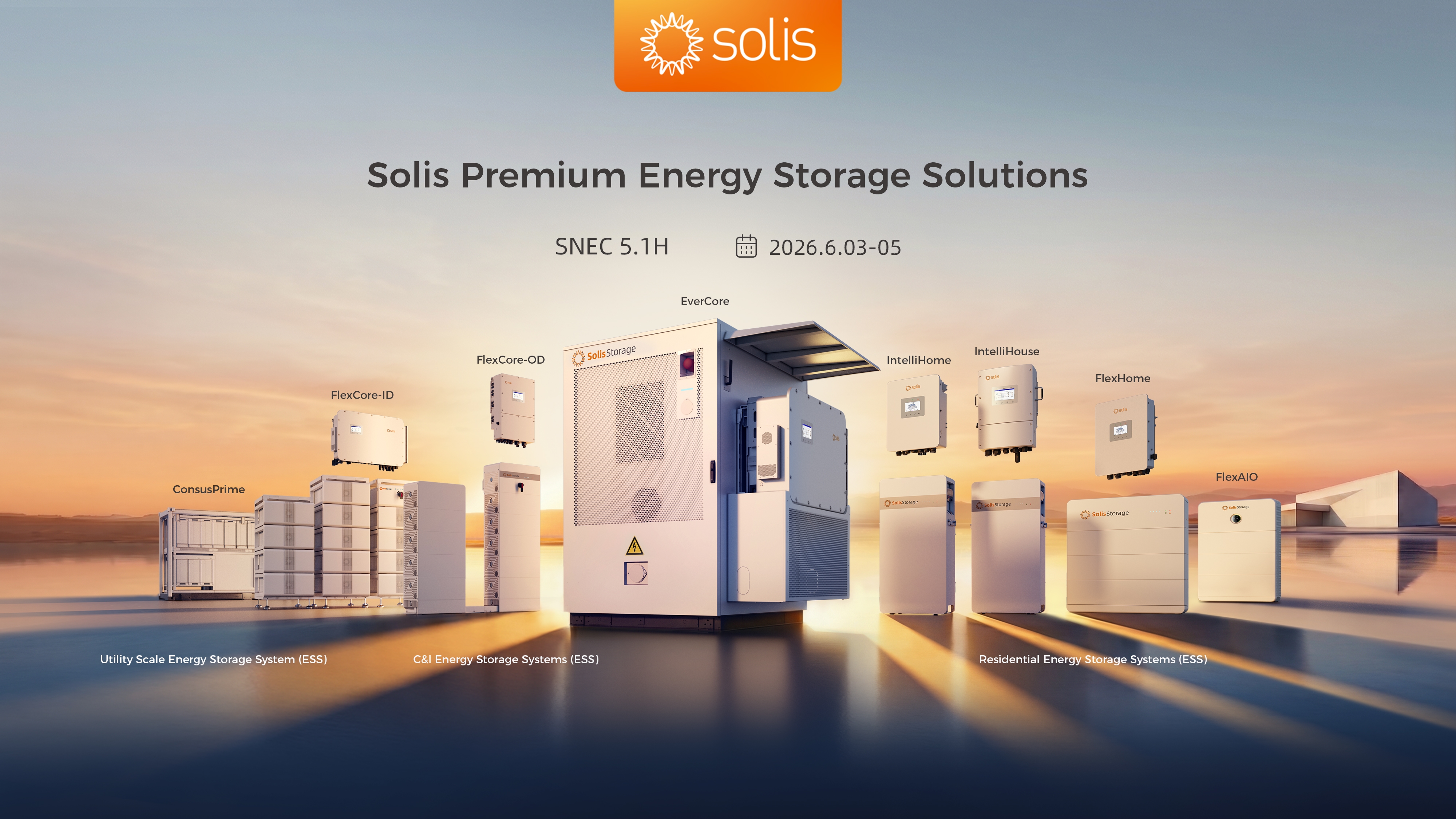
Ginlong (Solis) Technologies Co., Ltd., founded in 2005 and listed on the Shenzhen Stock Exchange in 2019 (Stock Code: 300763), is a manufacturer of solar inverters and energy storage solutions. The company reports more than 5,000 employees, an annual production capacity of 80 GW, and an R&D team exceeding 1,000 people. Third-party rankings provide context: Wood Mackenzie ranked Solis as the world’s #1 residential PV inverter manufacturer by shipments in 2023 and the 3rd largest inverter manufacturer globally, while EuPD Research has named Solis a “Top Inverter Brand” for eleven consecutive years. Its energy storage subsidiary, SolisStorage, develops systems around its own PCS, EMS, and system integration capabilities. The portfolio is structured in three segments rather than one product line: residential, stackable mid-scale, and commercial & industrial.
Residential: IntelliHome
IntelliHome is a residential energy storage system using lithium iron phosphate (LiFePO4) chemistry. It offers a nominal capacity of 5 kWh, an operating voltage of 44.8–57.6 V, a recommended charge/discharge current of 50 A, a cycle life of more than 6,000 cycles (10 years), and an IP66 ingress protection rating. The product is suited to household applications, including outdoor installation.
Stackable Mid-Scale: FlexCore-ID
FlexCore-ID is a stackable energy storage system based on a 20 kWh battery pack with LFP cells of 314 Ah capacity. The cell cycle life is ≥8,000 cycles (25±2°C, 0.5P, EOL 70%). Documented target applications include small farms, shopping malls, hospitals, large residences, and small industrial and commercial enterprises. For this segment, modularity is the key fit factor: capacity can be added as the load profile or budget grows.
Commercial & Industrial: EverCore ESS
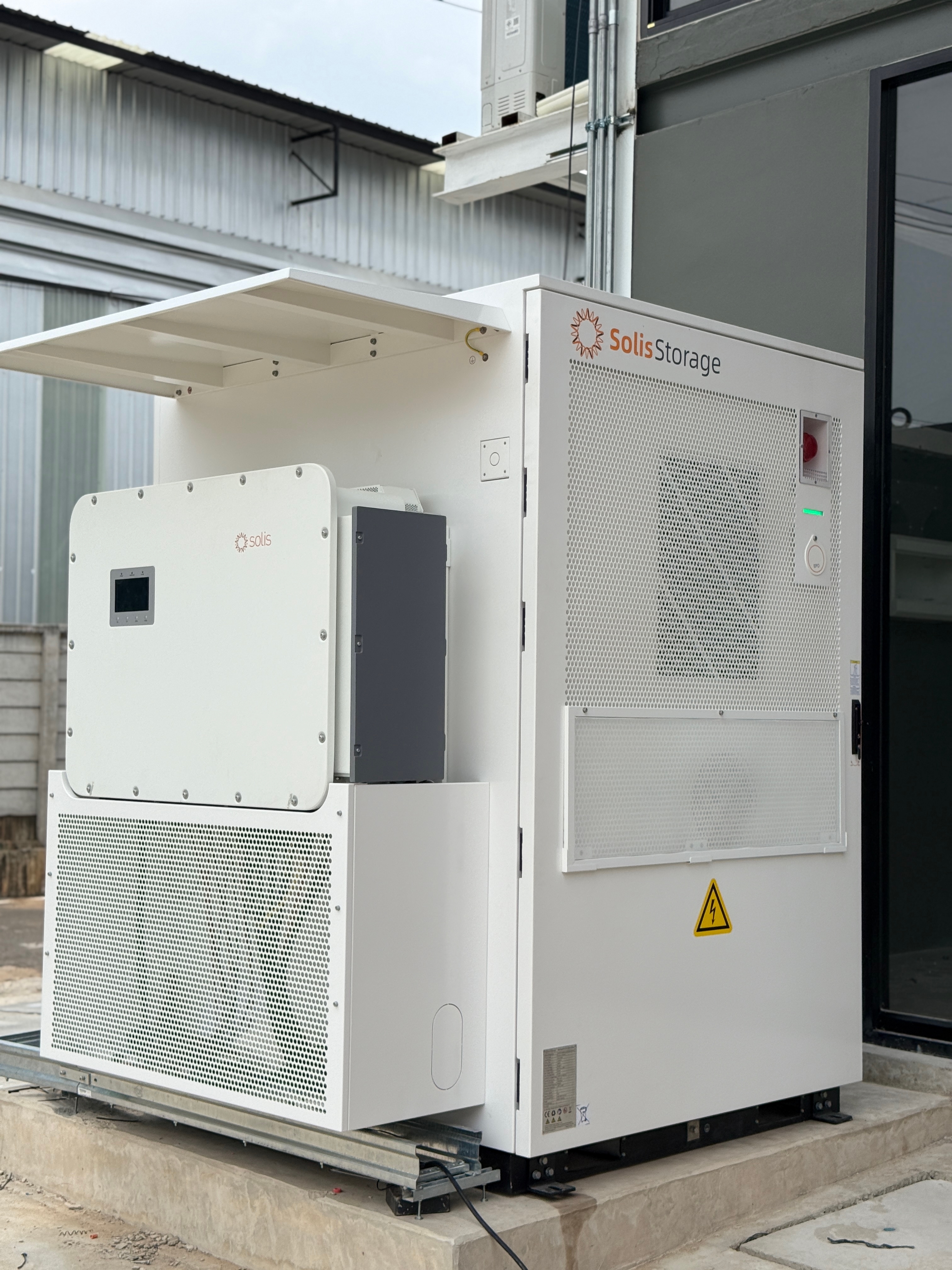
EverCore ESS is the C&I system in the SolisStorage portfolio, available in rated energy capacities of 100.5 kWh, 120.6 kWh, and 261.2 kWh, with inverter power ratings of 50 kW, 60 kW, and 125 kW. It uses EVE LFP cells (3.2 V, 314 Ah) with a documented cycle life of 8,000 cycles, and carries an IP55 rating for the battery cabinet and IP66 for the inverter. The system is designed for renewable energy and power grid applications, including renewable power plants, utility companies, commercial & industrial users, and residential users.
| Project Segment | Representative Conditions | SolisStorage System | Key Fit Factors |
|---|---|---|---|
| Household / residential | Outdoor or indoor installation, limited space, daily cycling | IntelliHome (5 kWh) | IP66; >6,000 cycles / 10 years; LiFePO4 chemistry |
| Small farm, shopping mall, hospital, large residence, small C&I | Variable load growth, need for modular expansion | FlexCore-ID (20 kWh stackable pack) | 314 Ah LFP cells; ≥8,000 cycles; stackable architecture |
| C&I industrial / grid-facing | Peak shaving, frequency regulation, VPP, backup, outdoor and harsh environments | EverCore ESS (100.5–261.2 kWh; 50–125 kW) | IP55 cabinet + IP66 inverter; C5 anti-corrosion; wide-temperature and high-altitude operation; hybrid inverter |
For projects with region-specific requirements, SolisStorage also supports OEM/ODM customization covering logo, outer package, software interface, regional voltage standards, communication protocol, and function parameters. Standard off-the-shelf models have a minimum order quantity of one unit, while customized OEM orders start at 20 units. This matters for projects in markets with special grid codes or where branding and protocol integration are part of the specification.
Technical Fit Factors: A Checklist for Project Evaluation
Based on the SolisStorage product documentation and application notes, five fit factors can be extracted for use in project evaluation. These are applicable beyond the SolisStorage portfolio and can serve as a general comparison framework.
1. Application Type and Operating Mode
The documented application field is the renewable energy and power grid industry, including renewable power plants, utility companies, commercial & industrial users, and residential users. Typical functions are peak load shifting, backup power supply, and self-consumption of PV power. Project types include energy storage system integration, grid stability retrofitting, peak shaving / frequency regulation, and Virtual Power Plant (VPP) related projects.
Operating mode is a separate fit factor. The systems are documented to run in grid-tied mode, off-grid mode, and seamless backup switching mode, with 24/7 continuous operation. In the EverCore design, the hybrid inverter integrates PCS, static transfer switch (STS), PV inverter, circuit breaker protection, and EMS into one unit, allowing grid-tied / off-grid switching in less than 10 ms without an external STS. For facilities with sensitive equipment, this switching time is a hard specification, not a preference.
2. Environment, Protection, and Corrosion Resistance
Deployment environment is one of the most common sources of fit mismatch. Documented operating conditions for the SolisStorage product family include wide temperature range, coastal salt fog, and high altitude, in both household outdoor and industrial outdoor settings. The special environmental requirements listed are C5 anti-corrosion certification and IP66 / IP55 ingress protection. EverCore is rated IP66 for the inverter and IP55 for the battery cabinet, and operates from −25°C to 55°C and at altitudes up to 4,000 meters. For sites near coastlines, where salt fog accelerates corrosion, corrosion class ratings should be reviewed before shortlisting.
3. Thermal Management and Cooling Architecture
Cooling choice directly affects maintenance cost and reliability. EverCore keeps an air-cooled design for the 125 kW / 261 kWh configuration, using a patented diversion air duct combined with Coanda-effect airflow attachment on battery pack surfaces. According to Solis, this improves heat dissipation efficiency by 30% compared with traditional air cooling. The AC-DC separation architecture also removes inverter heat from the cabinet: 6 kW of inverter power heat is dissipated to the ambient environment, leaving 3.5 kW of electrochemical heat to be managed inside the battery cabinet. Temperature uniformity is reported to be close to liquid-cooled solutions while keeping the maintenance profile of air cooling.
4. Battery Cells, Cycle Life, and Lifecycle Cost
Cell selection has an outsized effect on long-term economics. EverCore uses A-grade 314 Ah LFP cells with an internal resistance of 0.15±0.05 mΩ, compared with 0.17 mΩ for typical 280 Ah cells. At 0.5C charge-discharge, the cell reaches 8,000 cycles with ≥70% retained capacity — roughly 14% more than the 7,000 cycles of conventional 280 Ah cells. Based on 500 cycles per year, this extends the economic lifecycle from approximately 14 years to 16 years. Buyers evaluating lifecycle cost should compare cell cycle life at a defined end-of-life threshold rather than at nominal conditions.
5. Software Ecosystem and Multi-Revenue Readiness
In markets where storage revenue depends on multiple streams, software integration is a selection criterion. EverCore has been connected, or is in the process of connecting, with 102 third-party VPP / EMS operators in 11 European countries. Representative integrations include the Kraken energy management platform under Octopus Energy in the UK market and aggregator platforms such as Check Watt in the Nordic market. Solis also operates its Solis AI Cloud platform, deployed at more than 5,500 energy storage power stations, integrating Nordpool wholesale and Flatpeak retail electricity price data for minute-level charge-discharge optimization. In one documented residential project in Latvia, Solis AI optimization increased annual electricity bill savings by 302.6%.
Application Evidence: Two C&I Projects with Different Priorities
Two documented deployments show how the same product family adapts to different project conditions.
Denmark: Warehouse Self-Usage with Uninterrupted Switching
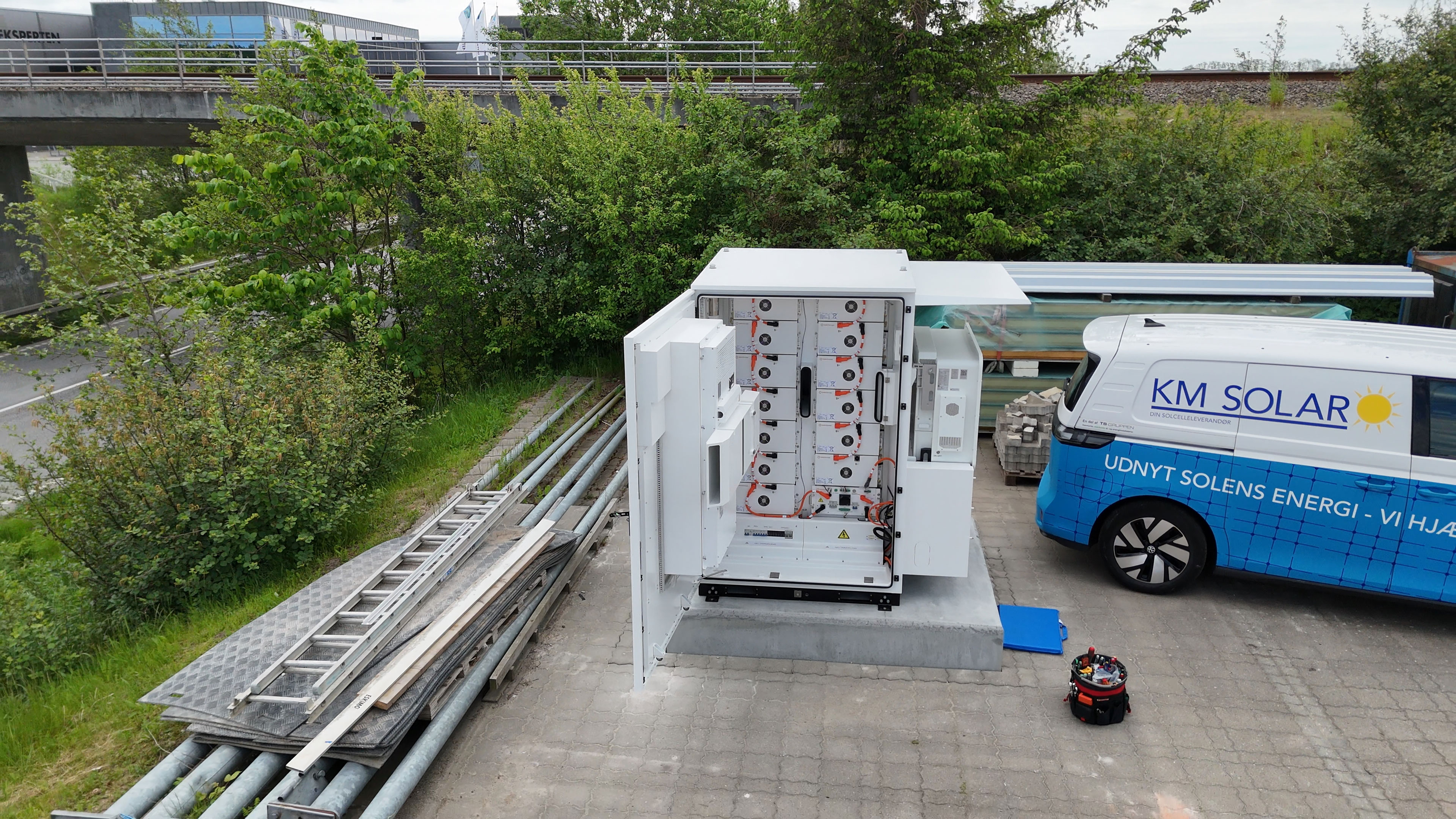
A C&I industrial end user in Denmark operates a 125 kW / 261 kWh EverCore system for self-usage of a warehouse, with a 20-year project horizon. The reported result is electricity bill savings. The project highlight is switching between on-grid and off-grid in under 10 milliseconds to prevent interruptions, a requirement typical for industrial facilities where a supply gap can disrupt operations.
Thailand: Self-Consumption and Backup Power
In Thailand, a 125 kW / 522 kWh EverCore system serves a self-consumption and backup power project, also planned for 20 years. The documented outcomes are stable operation and electricity bill savings. The configuration combines 125 kW of inverter power with 522 kWh of storage capacity, a larger battery-to-power ratio than the Denmark deployment. The EverCore architecture supports up to six battery cabinets on a single inverter, which makes battery-to-power ratio variations possible within the same product family and supports phased capacity expansion without additional inverter investment.
Market Trends Shaping the Fit Calculation
Several verified market indicators help buyers place the scenario-fit question in context.
- The residential energy storage market is estimated to grow from USD 2.69 billion in 2024 to USD 4.58 billion by 2030, at a CAGR of 9.3% (MarketsandMarkets). Residential projects tend to prioritize safety ratings, cycle life, and outdoor tolerance.
- The long-duration energy storage (LDES) market was valued at USD 4.85 billion in 2024 and is expected to grow at a CAGR of 13.6% through 2030 (MarketsandMarkets). Long-duration capability is directly relevant to C&I and grid-facing projects where energy must be shifted over hours.
- China’s exports of lithium-ion batteries for energy storage and non-automotive uses exceeded USD 65 billion in 2024, up 51.4% from the previous year (Reuters / China Electric Vehicle Industry Technology Innovation Strategic Alliance). A larger supply base reduces the risk of availability constraints, which shifts competitive weight toward fit, reliability, and service.
The common thread is a market moving from generic products toward application-specific designs. Buyers who document their project conditions before comparing systems gain a clearer evaluation baseline than buyers who compare product specifications in isolation.
How a Scenario-Fit Approach Compares with Conventional Selection
Conventional C&I storage procurement often starts with a standardized container specification and then adapts the site to the product. The scenario-fit approach reverses this sequence: it defines the project’s application, environment, operating mode, and software needs first, then evaluates which architecture and configuration match.
Three architectural differences in the EverCore design illustrate what this means in practice:
- AC-DC separation. The hybrid inverter and battery cabinet are physically separated. Inverter heat is rejected to ambient air, while the cabinet manages only battery thermal load. This allows the inverter to reach IP66 and the cabinet to maintain IP55. Solis estimates, based on 20 years of power electronics experience, that the separated protection design reduces the full-lifecycle failure rate by 50%.
- Single-controller architecture. Traditional systems often have independent CPUs for BMS, PCS, EMS, and STS, creating a distributed “multi-brain” control topology. EverCore uses a single central controller, reducing failure points and improving fault location and response speed.
- Maintenance-driven design. Air cooling removes liquid coolant replacement. Based on industry experience, Solis estimates lifecycle O&M savings of approximately €9,500 per unit from eliminating fluid replacement (€2,500), simplifying PCS replacement (€1,500), simplifying pack replacement (€1,500), and reducing routine inspection (€4,000). Component selection reinforces this: the cooling fans are specified for 10-year maintenance-free performance and the flammable gas detectors for 10-year calibration-free operation.
There are also boundaries to this approach that buyers should weigh. Air cooling, despite the improved airflow design, is not the optimal answer for every duty cycle; in projects with sustained high-rate charge and discharge, liquid-cooled systems may offer more continuous thermal throughput margin. Buyers should therefore validate the cooling architecture against their actual load profile rather than assume one technology fits all scenarios. In addition, the physical separation of inverter and battery means two units to locate and interconnect on site, which should be reflected in the early site layout planning.
Future Outlook: Fit Will Be Defined by Software and Service, Not Only Hardware
The next step in scenario fit is likely to be software-defined. In mature electricity markets, the profit model for C&I storage has evolved from basic peak-valley arbitrage to multi-dimensional revenue including grid ancillary services (FCR / aFRR / mFRR), demand response, and VPP dispatch. That evolution increases the importance of open software ecosystems, AI-assisted scheduling, and compatibility with third-party aggregators.
SolisStorage states its ambition to become a trusted leader in the global energy storage industry by combining power electronics, intelligent algorithms, and digital energy management. For buyers, the practical implication is that shortlists should include not only hardware specifications and environmental ratings, but also evidence of ecosystem integration and service capacity. SolisStorage offers 24/7 global remote technical support, 27 local overseas service centers, and a 48-hour on-site fault handling and whole-machine replacement guarantee.
FAQ: Energy Storage System Selection by Project Scenario
What project types are energy storage systems designed for?
According to SolisStorage product documentation, the systems are designed for the renewable energy and power grid industry, including renewable power plants, utility companies, commercial & industrial users, and residential users. Typical applications include energy storage system integration, grid stability retrofitting, peak shaving / frequency regulation, backup power supply, and self-consumption of PV power. Virtual Power Plant (VPP) related projects are also listed as a project type.
How do I choose between a residential ESS and a C&I energy storage system?
The choice depends on load size, installation space, and operating profile. SolisStorage’s IntelliHome is a 5 kWh residential system rated IP66 with more than 6,000 cycles. FlexCore-ID is a stackable system with 20 kWh packs intended for small farms, shopping malls, hospitals, large residences, and small industrial and commercial enterprises. EverCore ESS offers rated energy of 100.5 kWh, 120.6 kWh, or 261.2 kWh with inverter ratings of 50 kW, 60 kW, or 125 kW for C&I and grid-facing applications.
What environmental conditions should an outdoor ESS be rated for?
Documented conditions for the SolisStorage product line include wide temperature range, coastal salt fog, and high altitude, in household outdoor and industrial outdoor settings. The special requirements listed are C5 anti-corrosion certification and IP66 / IP55 ingress protection. EverCore operates from −25°C to 55°C and at altitudes up to 4,000 meters.
What supporting equipment is required to run an energy storage system?
The product documentation lists three supporting components: a lithium iron phosphate battery, a smart energy management platform, and monitoring sensors. In SolisStorage systems, the smart energy management platform is connected to the Solis AI ecosystem, which is deployed at more than 5,500 energy storage power stations.
Which operating modes should a project specification include?
The documented operating modes are grid-tied mode, off-grid mode, and seamless backup switching mode, with 24/7 continuous operation. Projects that require uninterrupted power should specify seamless backup switching and verify the switching time against the sensitivity of the connected loads.
Why does switching speed between grid-tied and off-grid mode matter?
Switching speed determines whether sensitive equipment is disrupted during a grid event. In the EverCore system, the hybrid inverter integrates the static transfer switch (STS) and switches in less than 10 ms without an external STS. The Denmark deployment of the 125 kW / 261 kWh system lists sub-10 ms switching as its key highlight for preventing interruptions.
What cell characteristics affect the lifecycle cost of a C&I energy storage system?
Cycle life and internal resistance are the two most relevant characteristics. The 314 Ah LFP cells used in EverCore have a documented internal resistance of 0.15±0.05 mΩ and reach 8,000 cycles at 0.5C with ≥70% retained capacity, compared with 7,000 cycles for conventional 280 Ah cells. At 500 cycles per year, this extends the economic lifecycle from roughly 14 years to 16 years.