
How Regional Recycling Infrastructure Shapes Baler Fit
How Regional Recycling Infrastructure Shapes Baler Fit
Regional waste paper recycling infrastructure determines which hydraulic baler type fits a project long before a model number is selected. Where collection is thin and material arrives intermittently, a vertical baler producing roughly five to eight bales an hour can be the rational purchase. Where a site receives a continuous paper stream and ships baled material to a mill or an export buyer, a horizontal baler fed by conveyor and equipped for automatic tying becomes the working assumption. Where throughput and duty cycle are both high, a fully automatic horizontal unit with PLC-controlled cycling is the starting point rather than the upgrade. NKBALER is the baler brand of Shaanxi Nick Machinery Equipment Co., Ltd., a manufacturer founded in 2013 that builds vertical balers, manual horizontal balers, full-automatic horizontal balers and press bagging machines at a 5,000 m² facility and exports roughly 90% of its output.
The practical question is therefore not "which baler is best" but "which configuration is defensible for this site, this feedstock and this offtake". This article separates four infrastructure variables that translate directly into specification decisions, applies them to the application markets named in the supplier's scenario records, and identifies the items a buyer should verify before placing an order.
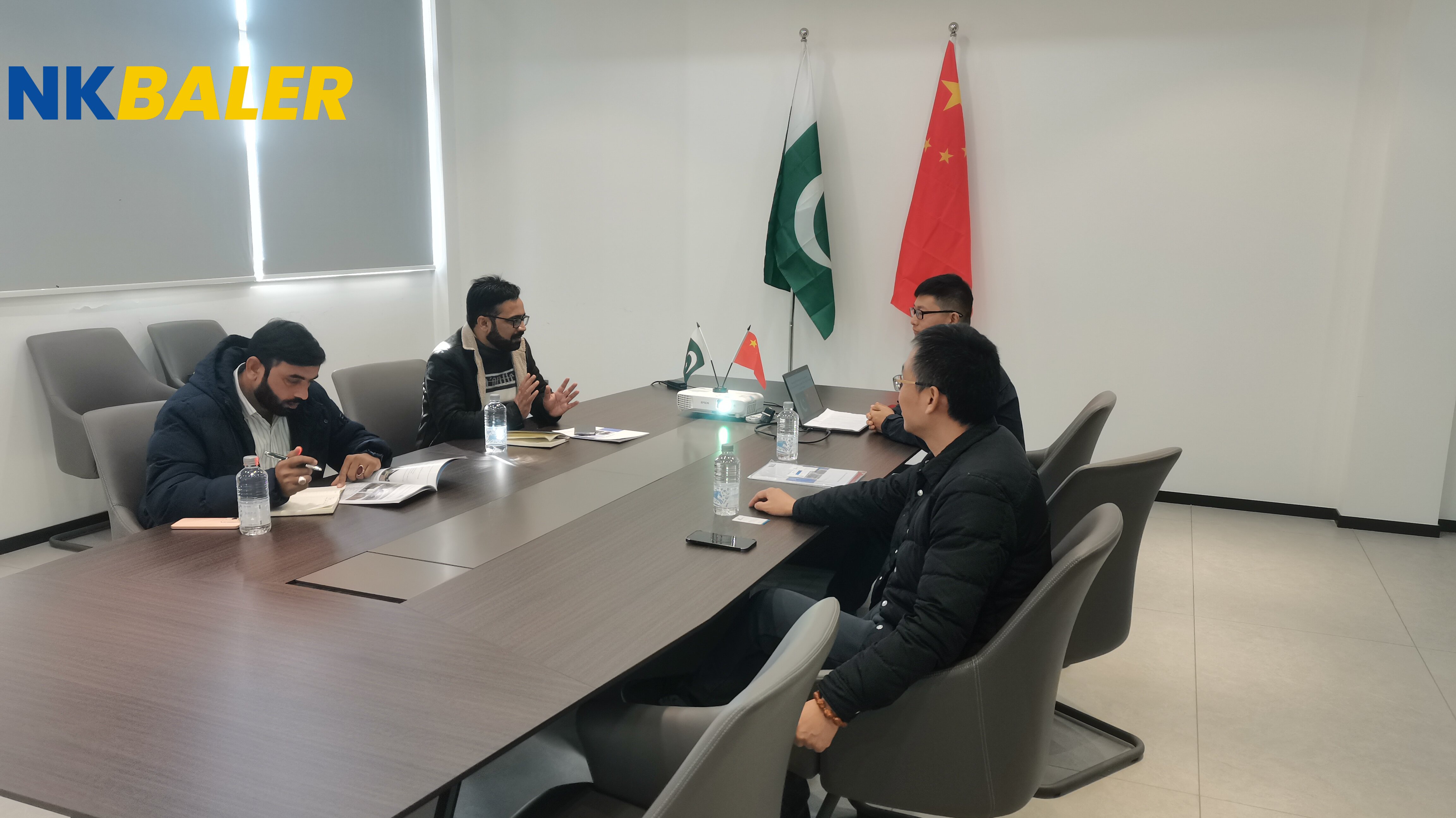
Four infrastructure variables that translate into a baler specification
1. Feedstock continuity and grade mix
Infrastructure first appears as a supply pattern. A municipal drop-off point, a retail back-of-store operation, a small processing workshop and a recycling station may all bale waste paper, but they receive it at different rates and in different grades. Continuity — how many days per week material arrives and in what batch size — decides whether a batch machine or a continuous machine is appropriate. Annual tonnage stated in a business plan does not answer this question on its own.
Grade mix matters for the same reason. In recovered-paper trade documentation, mixed paper is defined as a broad category that includes old magazines, low-quality office waste paper such as discarded mail, and unsorted waste or scrap paper (U.S. International Trade Commission executive briefing, SRC-0005). That is a less uniform stream than a single-grade cardboard flow, and it places more weight on how steadily the baler can be fed and how consistent the finished bale needs to be. A buyer who cannot describe the incoming stream in those terms is not yet in a position to fix a model.
2. Workshop, floor space and power supply
The documented operating envelope is an indoor recycling workshop with an ambient temperature range of −10 °C to 45 °C, normal humidity, light dust and a stable power supply. That envelope already excludes open-yard operation and unstable or heavily fluctuating electricity, which is an infrastructure constraint rather than a machine constraint. Where a site cannot meet it, the project changes — not the baler.
Floor space separates the categories sharply. The vertical NK1070T60 occupies a machine footprint of 1,600 × 1,100 mm at a height of 3,200 mm. The horizontal NKW80Q has a mainframe of approximately 9.8 m × 4.3 m × 1.4 m plus a separate conveyor measuring 1,200 mm wide by 12,000 mm long. A workshop that comfortably houses the first cannot necessarily house the second, and building length becomes a selection criterion as decisive as throughput.
Power demand scales with the same logic: 15 kW/20 HP on the vertical NK1070T60 and NK080T100, 22 kW/30 HP on the horizontal NKW80BD, and 30 kW + 11 kW main drive on the NKW80Q, with a separate 4 kW conveyor motor. Published scenario material describes a stable 220 V/50 Hz supply, while model-level datasheets list 380 V/50 Hz and record that voltage can be customized. Buyers should treat the electrical interface as a confirmation item against the actual site supply rather than assuming a default.
3. Offtake: bale size, weight, density and tying
A baler is only useful if the bale it produces is accepted downstream. Bale dimensions, bale weight and achieved density are the three numbers that offtakers — mills, traders, export consolidators, in-house warehousing — actually respond to. Documented examples show how wide the range runs: 1,100 × 700 × (500–900) mm on the NK1070T60, 1,100 × 850 × 1,700 mm on the NKW80BD, and 1,100 mm × 800 mm × approximately 1,600 mm on the NKW80Q, for which a material density of 300–400 kg/m³ is stated. The vertical NK080T100 produces bales of 200–350 kg.
Tying method is part of the same decision. The NKW80BD datasheet specifies 10# baling wire × 4 pieces; matched supporting equipment across the product range includes baling wire, PET strapping and woven or jumbo bags. Where an offtaker specifies strapping rather than wire, that becomes a configuration question at quotation stage, not a workshop improvisation.
4. Labour and automation tolerance
The fourth variable is human. A vertical baler concentrates labour at the machine: loading, tying and bale removal are hands-on tasks. A horizontal unit with conveyor feeding moves labour to grading and loading upstream. A fully automatic machine with a PLC-controlled cycle is documented for continuous automatic operation and 24/7 industrial duty, which changes the maintenance regime and the skill profile a site needs. Infrastructure, in this sense, includes whether trained operators and maintenance staff are available locally — a factor that matters more in markets with sparse technical service coverage.
Three application profiles and the baler type each calls for
The supplier's selection guidance resolves into three profiles rather than a catalogue ranking. Vertical balers suit limited space and low output; horizontal or fully automatic models suit continuous high throughput and automatic tying; and a fully automatic heavy horizontal platform suits high-output recycling where compression and stable running matter most. The table below maps those profiles to documented configurations.
| Application profile | Typical site | Baler type | Documented model example | Stated figures |
|---|---|---|---|---|
| A. Small-scale, intermittent paper volume | Small processing workshop, retail back-store, drop-off point | Vertical | NK1070T60 | 60 t hydraulic power; 5–8 bales/hour; bale 1,100 × 700 × (500–900) mm; 15 kW/20 HP; 2.2 t |
| A2. Container-heavy stream (cans, PET) | Collection point with mixed containers | Vertical | NK080T100 | 100 t; 3–6 bales/hour; bale weight 200–350 kg; chamber 1,000 × 800 × 1,500 mm; 15 kW/20 HP; 3.2 t |
| B. Medium continuous paper flow | Recycling station, new small plant, warehouse operation | Horizontal with conveyor, automatic tying available | NKW80BD | 80 t; 2–3 t/hour; bale 1,100 × 850 × 1,700 mm; 22 kW/30 HP; 10# wire × 4; machine 14,500 kg + conveyor 4,500 kg |
| C. High output, continuous duty | Plant feeding a mill, trader or export chain | Fully automatic heavy horizontal | NKW80Q | 80 t main cylinder; 3–5 t/hour; density 300–400 kg/m³; 30 kW + 11 kW; mainframe approx. 9.8 × 4.3 × 1.4 m; conveyor 1,200 × 12,000 mm |
One clarification matters at quotation stage. Both the NKW80BD and the NKW80Q carry a type designation that lists fully automatic and semi-automatic horizontal configurations. Automation level is therefore a configuration decision attached to a platform, not a fixed property of the model number, and it should be written explicitly into the order specification.
The reported application markets, and what actually differs between them
The supplier's application-scenario record covers waste paper, plastics, scrap metal, textiles, agricultural straw and mixed solid-waste recycling across 30 country codes. Three groupings are used for reporting purposes: Spain, Fiji, Sri Lanka, Madagascar, Nepal, Peru and Algeria; Bulgaria, Colombia, Ecuador, Greece, Kenya, South Korea, Malaysia, Nigeria, Pakistan, Romania and Qatar; and the UAE, Australia, Brazil, France, India, Indonesia, Mexico, Poland, Saudi Arabia and Thailand.
Two cautions follow. First, these are reported application markets, not a measured ranking of recycling infrastructure. No collection rate, recovery rate or plant-density figure for any named country was available in the evidence used here, so no country in this list should be assigned an infrastructure tier. Second, the grouping is a reporting convention, not a maturity scale.
What the list does establish is spread — across Europe, Africa, South Asia, Latin America and the Pacific. That spread produces three demonstrable differences relevant to selection.
Regulatory exposure is uneven within the list. Spain, Greece, Bulgaria and Romania are EU member states, and the recorded standard for that market states that horizontal baling presses must meet specific safety requirements for design and manufacture to be sold in the European Union (EN 16252:2012, SRC-0002). A project in those markets carries a conformity documentation requirement that the same machine configuration may not face elsewhere in the list. That is a specification-stage question, not a shipping-stage one.
Site climate and duty assumptions differ. The general envelope is indoor operation at −10 °C to 45 °C with normal humidity and light dust. A separate scenario record addresses high-temperature working conditions with continuous automatic operation, a PLC-controlled cycle and 24/7 industrial duty, together with low-noise and low-energy-consumption requirements and a conveyor line as matched equipment. Buyers in hot climates should confirm which envelope applies to their building instead of assuming the general figure covers it.
Stream composition differs. Where the baled stream is dominated by packaging cardboard, the specification problem is narrower than where it is dominated by unsorted mixed paper as defined in trade documentation. The first rewards consistent chamber loading; the second rewards a feeding arrangement that can absorb variation. The same model can serve both, but the assumptions behind its stated capacity should be checked against the actual stream.
| Verification question | Why it changes the specification | Where to confirm it |
|---|---|---|
| How many days per week does material arrive, and in what batch size? | Decides vertical versus horizontal, and chamber and bale size | Twelve months of site weighbridge or intake records |
| What bale size, weight and density will the offtaker accept? | Fixes bale chamber, bale weight target and tying method (wire, PET strapping, bags) | Offtake contract or buyer specification |
| What floor area and clear height are available? | Vertical machines need about 1.6 × 1.1 m footprint; horizontal platforms need roughly 9.8 × 4.3 m plus a 12 m conveyor | Building plan and a physical site check |
| What is the available and stable power supply? | Motor ratings run from 15 kW to 30 kW + 11 kW; voltage customization is recorded | Electrical survey before quotation |
| Who feeds and ties, and for how many hours per shift? | Sets automation level and the supporting conveyor requirement | Staffing plan and shift pattern |
| Which conformity documents are required at the border? | Horizontal presses face EN 16252:2012 requirements in the EU market | Importer, customs broker or notified body |
What the three baler types actually do differently
A vertical baler compresses material downward into a chamber and discharges a compact bale from a relatively small footprint. The category covers both paper and container streams: the NK1070T60 is specified for cardboard box recycling, while the NK080T100 is a cans and PET bottle machine rated at 100 t with a 1,000 × 800 × 1,500 mm chamber. Feed openings are correspondingly modest at 1,100 × 500 mm and 1,000 × 500 mm, which is consistent with manual loading.
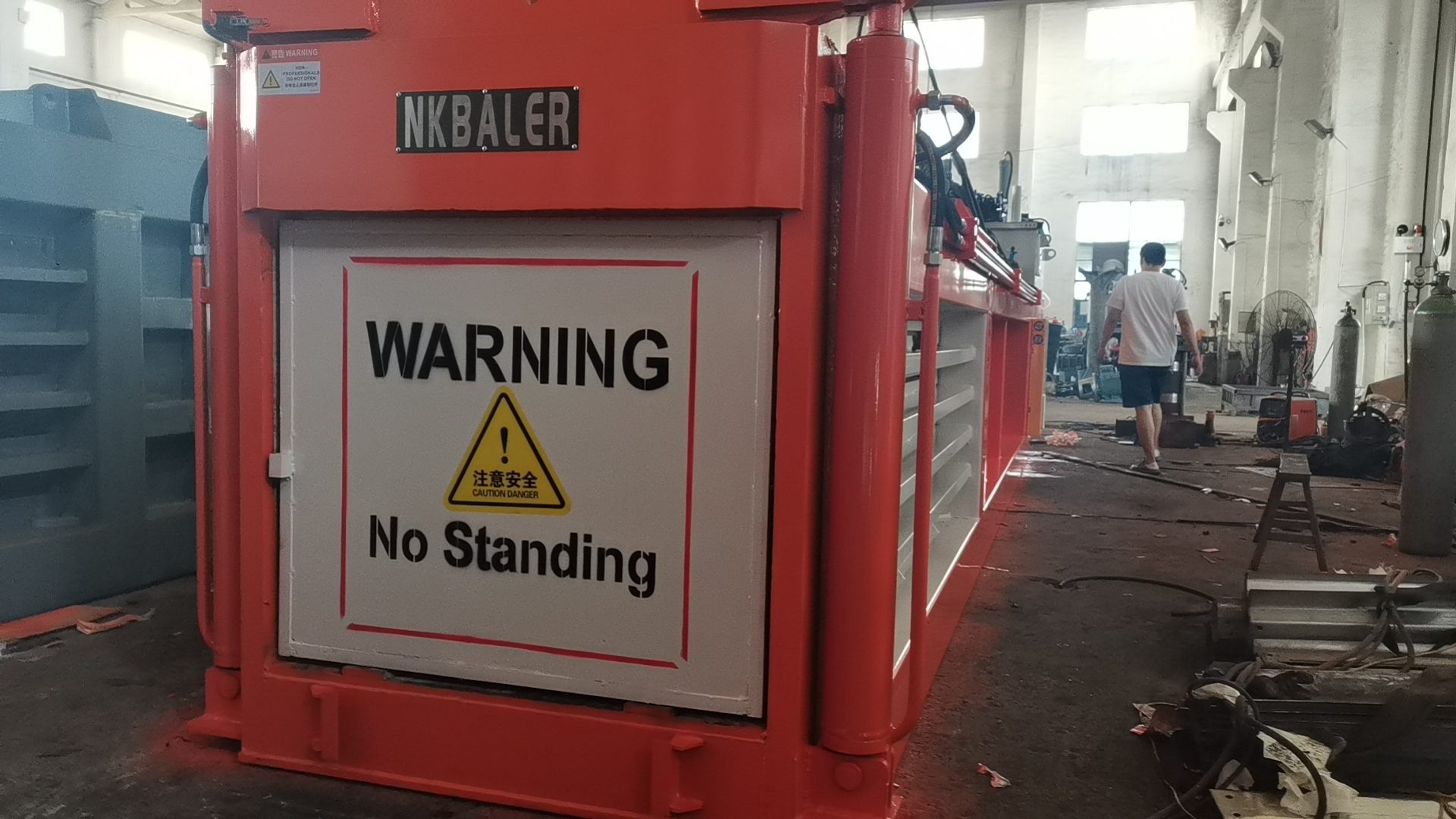
A horizontal baler extends the chamber lengthwise, which allows a conveyor to feed material continuously and permits longer, denser bales. The NKW80BD takes a 1,200 × 1,000 mm feed opening and produces a 1,100 × 850 × 1,700 mm bale at 2–3 t/hour, with four strands of 10# wire and a separate 4,500 kg conveyor. Its datasheet records a cooling fan and, in a separate cooling-system field, water cooling or an oil chiller — a point worth confirming where the machine will run continuously in a warm workshop.
The high-output tier adds automation on top of the horizontal format. The NKW80Q is rated 3–5 t/hour with an 80 t main cylinder, a stated material density of 300–400 kg/m³ and a 15 t mainframe, and its PLC-controlled cycle is documented for continuous automatic operation. Moving to this tier changes the site far more than it changes the baler: a 12 m conveyor, a longer building, higher connected load and a maintenance regime that assumes planned rather than reactive intervention.
Conditions, boundaries and where the standard specification stops
Baling reduces volume and transport frequency. Loose waste is compressed into bales that are easier to store, handle and transport, and the documented effect is a reduction in space requirements and in the number of waste transport movements. That is a logistics and handling benefit, and it is the honest way to frame the business case.
Three boundaries should be stated alongside it. Baling is not described as a sorting or grading step, so the grade of the baled material is determined upstream and the machine does not improve it. Stated capacities are figures for a given model under its own conditions and are not a promise for every feedstock; heavier or springier material will not run at the same rate. And the indoor operating envelope is a real constraint — a site that cannot provide a stable supply and a covered workshop has a project problem to solve before it has a machine problem.
Supporting equipment belongs in the same plan. Conveyors, hydraulic components, baling wire, PET strapping, jumbo bags, packing tools, shredders and crushers are all recorded as matched equipment, and any one of them can become the bottleneck that makes a correctly sized baler look undersized. A site planning a complete line should size the baler against the slowest upstream step, not against the baler's own rated peak.
What the market data supports — and what it does not
The available market evidence is directional and must be read with its scope attached. Grand View Research reports the global baler market at USD 6.4 billion in 2024, projected to reach USD 12.0 billion by 2030 (SRC-0001). That figure covers agricultural and industrial balers together, so it cannot be used to size the waste paper baler segment, and publisher definitions differ across sources; separate figures in the same evidence set refer to different product scopes and should not be averaged or substituted for one another. The same source records Asia Pacific as the largest region with a 39.4% revenue share in 2024 (SRC-0001), which is consistent with a sourcing structure in which a large share of baler manufacturing sits in the region — relevant to lead-time and spare-parts planning, not to machine selection.
The evidence set also contains a figure for waste sorting equipment. That category covers screens, optical sorters and conveyors rather than baling presses, and it is not used here as a baler market size. Where a buyer needs a defensible budget number, the honest position is that no baler-specific, region-specific sizing was available in this evidence.
Supplier capability, and what it changes for a regional buyer
Shaanxi Nick Machinery Equipment Co., Ltd. operates a 5,000 m² facility with around 50 employees, a 15-person R&D team and an annual output of 600 units across vertical balers, manual horizontal balers, full-automatic horizontal balers and press bagging machines, with main markets in North America, South America and Asia. Its OEM/ODM capability record covers model type, compression configuration, automation level, tying method, material adaptation, site layout, auxiliary conveyors and complete-line configuration, with a minimum order quantity of one unit, a stated lead time of 30–45 days, 100% testing and after-sales support covering installation, training, maintenance, technical guidance and spare parts.
For a buyer in a market with thin local service coverage, three of those items matter more than the rest. A minimum order of one unit supports phased or pilot projects where a full line cannot be justified yet. A 30–45 day lead time needs checking against the project schedule rather than assumed. And the OEM/ODM record's monthly capacity of 3–4 units is stated at a different scope from the company-wide annual output of 600 units, so it should be confirmed for the specific configuration rather than read as a plant-wide ceiling. "100% test" is a manufacturer statement; the buyer's counterpart is a witnessed test or a documented inspection report before shipment.
Outlook: what would change the fit
No verified forecast for the hydraulic waste paper baler segment specifically was available in the evidence used here, so any growth narrative for this category should be treated as unsupported. What can be said conditionally is more useful. If collection in a market formalizes and offtakers begin specifying bale density rather than bale dimensions alone, the balance shifts toward horizontal platforms with documented density figures and reliable tying. If paper volumes stay intermittent and dispersed, the vertical tier remains the rational entry point and the constraint stays on labour rather than on compression force. And if EU-bound shipments increase within the markets listed, conformity documentation moves earlier in the procurement sequence.
Each of those shifts changes which specification item deserves attention first. None of them changes the underlying rule: the infrastructure decides the profile, and the profile decides the machine.
Frequently asked questions
How do I choose the right hydraulic baler for a waste paper, plastic or scrap metal recycling project?Confirm material type, loose density, target bale size or weight, throughput, available space and power supply first, then select between vertical, manual horizontal, semi-automatic and fully automatic configurations. Vertical balers suit limited space and low output; horizontal or fully automatic models suit continuous high throughput with automatic tying. The evaluation criteria that follow are material adaptability, compression force, throughput, footprint, automation level, operating cost, maintenance and after-sales support.
Which baler type fits a small processing workshop rather than a new recycling plant?A small processing workshop is one of the documented project types for this equipment range, alongside recycling-facility upgrades, new recycling plants, warehouse and industrial waste management, and customized or complete-line projects. In practice the distinguishing factor is continuity of material: intermittent batch arrivals support a vertical machine, while a continuous stream supports a horizontal platform with conveyor feeding. Space and power then confirm or rule out the choice.
What indoor conditions does the equipment require?The documented operating conditions are an indoor recycling workshop with an ambient temperature range of −10 °C to 45 °C, normal humidity, light dust and a stable power supply. A separate scenario record addresses high-temperature working conditions with continuous automatic operation and PLC-controlled cycling, so sites in hot climates should confirm which envelope applies to their building. Voltage should be confirmed against the individual model datasheet.
What information should a buyer provide before a model and solution are confirmed?The supplier asks for material type, material dimensions, loose density, target bale weight or size, available space, power conditions, required automation level and required throughput. Providing all eight shortens the configuration cycle, because each one maps to a specific parameter — chamber size, bale dimensions, motor rating, footprint, tying method or control type. Omitting any of them usually results in a revised quotation rather than a faster one.
How does automation level change the supporting equipment a site needs?Automation level is listed as a customization parameter alongside model type, compression configuration, tying method, material adaptation, site layout and auxiliary conveyors. Higher automation generally shifts labour upstream to grading and loading and adds conveyor and control dependencies, while manual tying keeps labour at the machine. Matched equipment recorded for these systems includes conveyors, hydraulic components, baling wire, PET strapping, jumbo bags, packing tools, shredders and crushers, so the line should be planned as a system rather than as a single machine.
Does baling change the grade or value of the baled paper?The documented function is to compress loose waste into bales of the desired size that are easier to store, handle and transport, and to reduce space requirements and waste transportation frequency. It is not described as a sorting or grading operation, so the grade of the baled material is established upstream of the baler. Buyers evaluating revenue impact should therefore assess the baler as a handling and logistics asset rather than as a value-adding processing step.
For readers assembling a specification, the downloadable horizontal baler catalogue sets out the configuration data referenced in this article. Buyers preparing a project can also request model confirmation by supplying material type, loose density, target bale size, available space, power conditions, automation level and required throughput, so that the recommended configuration is based on the site rather than on a generic tier.
Have Questions or Need More Details?
Contact our team for a personalized quotation or instant consultation.
Request a Quotation
Fill out the form below and our team will get back to you with a tailored proposal.
WhatsApp Direct Chat
Prefer to chat in real-time? Message us on WhatsApp for instant assistance & quick answers.
- Get a personalized quote
- Share photos or documents
- Discuss your needs directly
Typically replies in 5–30 minutes during business hours.