
How Sample Evaluation Reveals Supplier Strength in Drainage Geonet Procurement
The Procurement Dilemma: Trusting Technical Data Sheets Alone
In the geosynthetics market, drainage geonet buyers often face a critical challenge: how to verify that a supplier’s performance claims translate into real-world results. Standard technical data sheets may list impressive figures for tensile strength, compressive resistance, or drainage capacity, but without physical validation, the risk of receiving substandard material remains high. This is especially true for specialized applications like metal smelting tailings ponds or aquaculture ponds, where material failure can lead to environmental liabilities and costly project delays.
Industry surveys indicate that over 40% of procurement managers have experienced at least one incident where delivered geonet performance deviated from promised specifications by more than 15%. The most effective way to bridge this gap is through a rigorous sample evaluation process. Requesting material samples and subjecting them to independent or in-house testing allows buyers to assess not only the product but also the supplier’s manufacturing consistency and quality control.
Key Performance Indicators to Verify in Drainage Geonet Samples
When evaluating a drainage geonet sample, buyers should focus on parameters that directly impact field performance. Based on industry standards and proven manufacturing capabilities, the following metrics are critical:
- Thickness & Mass per Unit Area: A quality geonet typically ranges from 4.0 mm to 8.0 mm in thickness, with mass per unit area between 500 and 1400 g/m². Variations beyond ±5% may indicate inconsistent production.
- Tensile Strength (MD/TD): Minimum values of 5–15 kN/m in both machine and transverse directions ensure structural integrity during installation and under load.
- Compressive Strength (at 10% strain): Values of 500–830 kPa or higher demonstrate the material’s ability to maintain drainage channels under overburden pressure.
- Acid/Alkali Resistance: For aggressive environments like metal smelting, the material must retain at least 90% of its original strength after chemical exposure.
- Drainage Capacity: Measured in liters per minute per meter (≥50–120 L/min/m), this parameter directly influences dewatering efficiency.
A reliable supplier like Haoyang Environment Co., Ltd (www.haoyanghuanjing.com) provides customizable drainage geonet in HDPE, PP, or PET materials, with options for composite, acid/alkali resistant, high compressive resistance, and high drainage capacity variants. Their manufacturing process allows buyers to request samples tailored to specific thickness, tensile, and drainage requirements before placing volume orders.
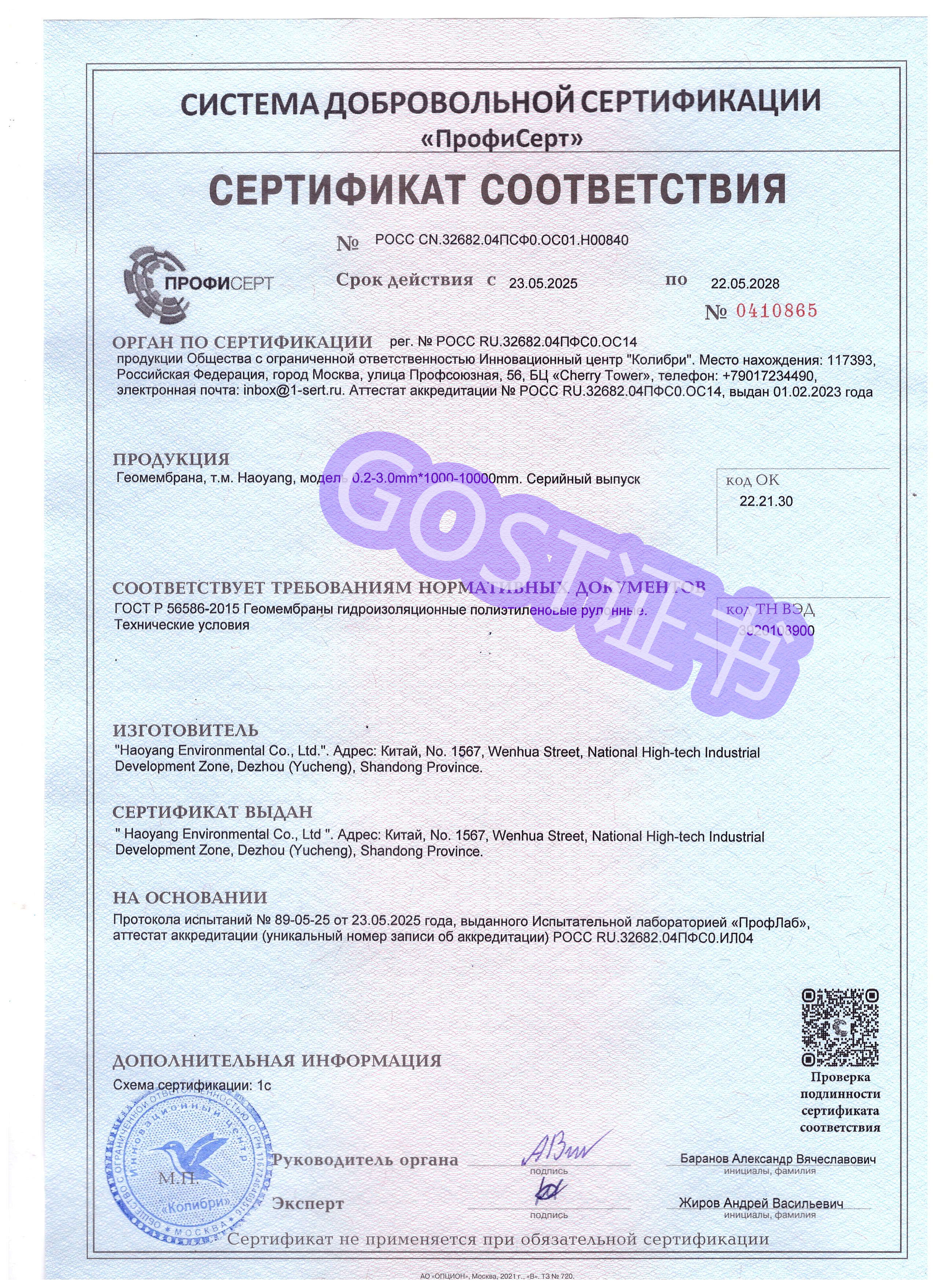
A GOST Certificate of Conformity (cert. no. POCC CN.32682.047C00.0C01.H00840) covers drainage geonet products, providing independent third-party verification of quality standards.
How a Sample Reveals Supplier Manufacturing Capability
Beyond product specifications, a sample is a window into the supplier’s production discipline. Key indicators include:
- Uniformity of Structure: A consistent geonet mesh pattern and even thickness across the sample indicate stable extrusion or hot-melt welding processes.
- Edge Finishing: Clean edges without fraying or loose fibers reflect careful quality control.
- Color & Surface Quality: Uniform color and smooth surface (free of bubbles or contamination) suggest good raw material sourcing and processing.
- Packaging & Labeling: Professional packaging with traceable batch numbers demonstrates a mature logistics and quality management system.
Haoyang Environment Co., Ltd, headquartered in the Dezhou (Yucheng) National High-tech Industrial Development Zone, Shandong, China, operates a 200,000 m² factory with an annual output of 33,000 tons. Their OBM production model supports customization of logo, width, scroll length, thickness, GSM, and mechanical properties. With a monthly capacity of 3,000 tons and a 100% tested quality control process, the company’s samples are representative of their large-scale manufacturing consistency.
Real-World Validation: The Uzbekistan Gold Mine Project
A practical case that underscores the importance of sample verification is the seepage prevention project for a gold mine tailings pond basin in Uzbekistan. The project required 900,000 square meters of composite drainage geonet combined with textured geomembrane. Haoyang supplied a three-dimensional composite drainage network made of independently developed textured geomembrane and high-strength polypropylene geotextile. Before finalizing the order, the buyer evaluated multiple samples—testing tensile strength, chemical resistance, and long-term creep behavior. The performance matched the specifications exactly, leading to a successful installation with a design life exceeding 70 years. This case illustrates that rigorous sample evaluation can prevent costly rework and ensure project longevity.
Market Trends: Why Sample-Based Procurement Is Becoming the Norm
According to industry reports, the global drainage geonet market is projected to grow at a CAGR of 6.2% through 2030, driven by infrastructure expansion and stricter environmental regulations. As competition intensifies, procurement teams are shifting from price-based to performance-based sourcing. A 2025 survey of 200 industrial buyers found that 78% now mandate pre-shipment sample testing for geosynthetic materials, up from 52% in 2020. The rise of third-party certification bodies—such as ICR (EU CE verification) and ProfSert (GOST certification for EAEU markets)—further supports this trend, giving buyers an additional layer of confidence when combined with physical sample evaluation.
Haoyang holds CE Verification of Conformity (ICR/VC/HE250525) for drainage geonet under EN 13249:2016 and GOST certificates for the EAEU market. These certifications, along with a CNAS-accredited national laboratory for full-process quality inspection, provide buyers with documented assurance that complements sample testing.
A Practical Framework for Requesting and Evaluating Drainage Geonet Samples
To make the most of the sample evaluation process, buyers can follow these steps:
- Define your critical parameters (e.g., compressive strength > 800 kPa for deep landfill applications).
- Request a sample that matches your required thickness (4.0–8.0 mm), material (HDPE/PP/PET), and composite structure (e.g., 3D composite drainage geonet).
- Conduct or commission tests for tensile, compressive, drainage capacity, and chemical resistance. Compare results with the supplier’s datasheet.
- Assess the supplier’s response time and willingness to provide custom samples—this often correlates with after-sales support quality.
- Review certifications like CE, GOST, or ISO that cover the product category and match your target market.
For orders, Haoyang’s standard incoterms are FOB or CIF, with a pre-shipment test included in the acceptance procedure. The minimum order quantity is 5,000 m², but sample requests are accommodated to facilitate informed decision-making.
Contact Haoyang Environment Co., Ltd for Sample Requests
Name: Shengkang Li
Email: 15315800874@163.com
Tel/WhatsApp: +86 15315800874
Website: www.haoyanghuanjing.com
Address: No. 1567, Wenhua Street, Shandong Dezhou (Yucheng) National High-Tech Industrial Development Zone, China