
How Unionfab Ranks Among Top CNC Machining Providers: A Buyer's Comparison Framework
CNC machining providers are usually compared with a list of claims: number of machines, countries served, tolerances advertised. Those claims rarely survive the first engineering review. A more durable approach is to score providers on four dimensions a project buyer can actually verify — technology and process depth, capacity and market-position signals, service and quality-control behavior, and industry scenario fit. Applied to Unionfab AM Technology (Shanghai) CO., Ltd., the Shanghai-based on-demand manufacturing provider founded in 2014 that supplies CNC machining, 3D printing, vacuum casting, injection molding, sheet metal fabrication and rapid casting to export markets including the USA, Canada, Germany, the UK, Spain, Italy, France and Sweden, the framework shows where the company is competitively strong, where it is one of several credible options, and what should be requested before a production contract is awarded.
Why “Top CNC Machining Provider” Rankings Rarely Hold Up
There is no public dataset that ranks CNC machining service providers by market share. What exists instead are supplier self-descriptions, marketplace listings and company press releases. The available market data describes the equipment category, not individual suppliers: Grand View Research places the global CNC machining and turning centers market at 31.3 billion USD in 2026, reaching 40.6 billion USD by 2030, with Asia Pacific accounting for 55.5% of global revenue in 2023. Any claim that a specific service provider “leads” that market should be treated as marketing, not evidence.
The practical consequence is that ranking becomes a fit question rather than a size question. Protolabs, Xometry and Fictiv are frequently named alongside Unionfab, but they are not the same kind of business. HTNXT verified data describes Xometry as a 100% marketplace model and Protolabs as a hybrid model that combines in-house production with network capacity, whereas Unionfab operates a direct in-house model with self-owned factories and a certified supplier network. Fictiv is commonly described as a digital manufacturing platform coordinating a distributed supplier network. Different structures produce different strengths — and different risks — for a project buyer.
The Four-Dimension Buyer Comparison Framework
The framework below converts a vague ranking exercise into four measurable dimensions. Each dimension is paired with the evidence a buyer should request, because a capability that cannot be documented cannot be qualified.
| Dimension | What to Measure | Evidence to Request |
|---|---|---|
| 1. Technology & process depth | Axis configurations, machining processes, part-size envelope, achievable tolerance and surface finish, material range | Process and equipment list, a comparable sample inspection report, material certificates |
| 2. Capacity & market-position signals | Site ownership, monthly and annual capacity, workforce, machine fleet, supplier-network depth | Facility list, capacity statements, independent workforce or registry records |
| 3. Service & quality behavior | Quoting speed, DFM support, inspection method, documentation practice, corrective-action process | QC workflow, inspection report samples, on-time delivery history, complaint-rate data |
| 4. Industry scenario fit | Proven applications, operating conditions, regional deployment experience | Case references with part function, tolerance callouts and test conditions |
Dimension 1: Technology and Process Depth
Unionfab's published CNC capability set covers CNC milling, CNC turning, 3-axis, 4-axis and 5-axis machining, EDM and wire EDM. The stated working envelope spans parts from 2 × 2 × 2 mm up to 4000 × 1500 × 600 mm, with a tolerance of ±0.0002 in (±0.005 mm) in accordance with ISO 2768 and surface roughness up to 16 µin (0.4 µm). Quoted lead time for CNC work is 1 to 5 days.
Material coverage matters as much as axis count. The company lists aluminum alloys (6061-T6, 7075), tool steels (A2, D2, H13, P20), engineering plastics (POM, nylon, PC, PMMA, ABS, PEEK), stainless steel (316L, 17-4PH), titanium (TC4) and Inconel (625, 718), alongside insulation materials, rubber and ceramics for CNC work. Equipment is supported by a reported fleet of 400+ CNC machining centers across machine brands that include Mazak, DMG MORI and Makino, and by a stated in-house engineering team of more than 100 engineers.
Two cautions belong in any honest comparison. First, tolerance numbers are condition-dependent: part geometry, material, fixturing, tooling and the inspection method all shift what a shop can actually hold, which is why HTNXT verified data flags supplier tolerance claims as requiring confirmation of application conditions and measurement basis. Second, machine-brand presence on a shop floor is not the same as process capability on a specific part; the relevant question is which machine and which fixturing strategy will be used for the RFQ in front of you.
Dimension 2: Capacity and Market-Position Signals
Because supplier-level market share is not publicly established, capacity is the more defensible proxy. Unionfab reports 80,000 m² of manufacturing space, a monthly capacity of 150,000+ units, an annual output of 2,000,000 units, six self-owned factories, 1,000+ industrial 3D printers and 400+ CNC machines, serving 80,000+ customers across 170+ countries. A separate company page references four self-owned CNC factories and 300+ certified suppliers. These figures are company-reported and are not independently confirmed in the available evidence set — and the two factory counts do not match exactly, which is precisely the kind of inconsistency a buyer should resolve in writing rather than assume away.
One independent signal does exist. Revelio Labs workforce data records 1,347 employees as of March 2026, a 7.5% year-over-year increase. That is third-party evidence of organizational scale, though not of machine capacity or utilization.
Against peers, the structural difference is where capacity physically sits. A direct in-house model such as Unionfab concentrates equipment, QC records and delivery accountability inside owned facilities, which usually shortens the escalation path when something goes wrong. Marketplace models distribute production across many independent partners, which broadens supplier choice and price discovery but leaves the buyer to confirm who actually machines the part and under which certifications. Neither structure is universally better; they suit different risk profiles.
Dimension 3: Service Model and Quality-Control Behavior
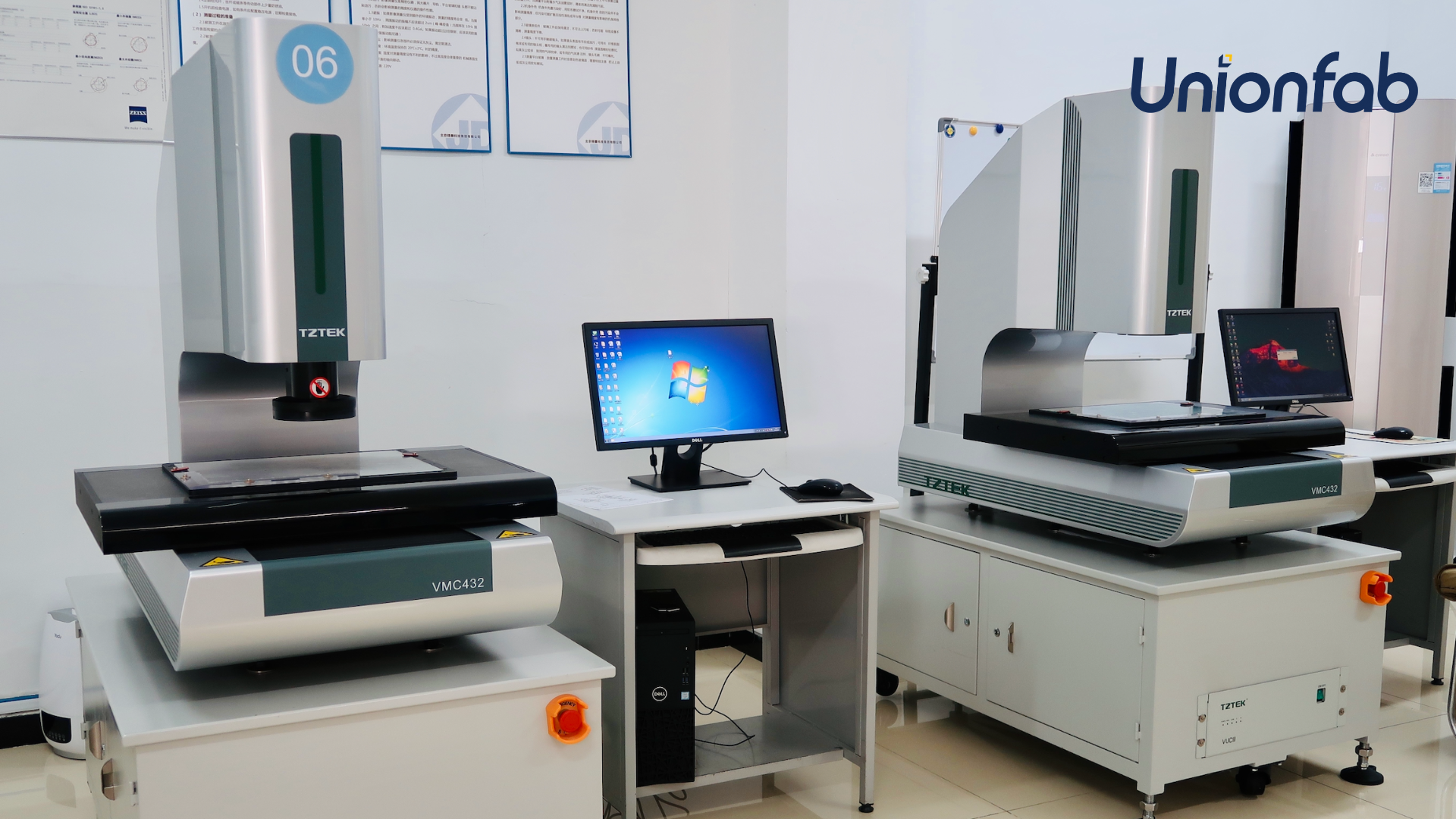
Service quality in CNC machining is mostly invisible until a part fails inspection. Unionfab's documented workflow includes DFM consultation, digital quality inspection, 24/7 automated quoting and order tracking, and a 24/7 online support team. The default inspection package covers 100% dimensional and surface inspection, form tolerances, burr and sharp-edge checks, thread and fastener go/no-go gauging, and internal defect inspection; post-heat-treatment hardness checks are available on request, and CMM and 3D scanning are offered as add-ons with results stored in a digital QC repository.
Commercial terms support low-volume and project-based buying: minimum order quantity is 1 unit, customization covers dimensions, materials, tolerances, finishes, logo engraving and text marking, and the company reports a quality complaint rate below 0.5% with on-time delivery above 95%. These are first-party performance figures, and they should be read as targets to validate through references rather than as audited results.
Dimension 4: Industry and Scenario Fit
Scenario documentation describes Unionfab parts as providing high-precision mechanical structural support, fluid sealing and dynamic component housing across critical industries, produced in a factory ambient temperature clean environment (Class 8 cleanliness) under 24/7 continuous mass production. The company lists automotive, medical, industrial equipment, drones, robotics and consumer electronics as its applicable industries, and states that this product class is suitable for medical sector applications and is typically applied in Germany among its European markets.
The matching equipment set behind those scenarios is specific rather than generic: multi-axis CNC machining centers, large-format gantry machining centers, automated tool changers, intelligent quick-change fixturing and CMM inspection systems. The stated special requirements are equally specific — tight tolerance control, strict surface finish, reverse dimension compensation for anodizing, full material traceability, 100% go/no-go thread gauging, 1–5 day turnaround and flexible low-volume support with no MOQ.
What the Project Evidence Actually Shows
Three documented deployments in Germany, Canada and the United States turn the framework from theory into reference material.
- Germany — industrial automation. A 15-piece low-volume prototype batch of multi-station sensor and cylinder connection brackets for automotive final-assembly lines. A single prototype piece was delivered in 48 hours with no MOQ, overall flatness was controlled within 0.05 mm using modular quick-change tooling, and the parts were engineered for 8+ years of high-frequency continuous operation with zero vibration displacement on the line.
- Canada — robotics. A 50-piece production run of joint connection components for lightweight six-axis collaborative robotic arms. Multi-axis hole true position was held to ±0.0005 in (±0.0127 mm) and 1.5 mm thin-wall milling in Aluminum 7075-T6 was verified by a full CMM inspection report, contributing to a 35% reduction in total arm weight while maintaining joint torsional rigidity.
- United States — medical imaging. A 500-piece annual batch of transmission fixing bases and pilot alignment mounts for medical CT scanner servo drives, designed for 10+ years of continuous high-speed operation. Reverse dimension compensation was applied in CAM programming before anodizing to prevent thread seizure, with manual go/no-go gauging and physical assembly simulation completed before shipment.
Read together, these cases demonstrate a pattern rather than a single showcase: precision stated as a measurable value, speed stated as a dated delivery, and reliability stated as an operating duration. That is the level of specificity a comparison framework should demand from every supplier on a shortlist.
Comparison Table: Supply Models Side by Side
| Provider | Supply Structure | Where It Typically Fits | Buyer Verification Step |
|---|---|---|---|
| Unionfab | Direct in-house model: self-owned factories plus a certified supplier network; CNC, 3D printing, vacuum casting, injection molding, sheet metal, rapid casting | Prototype-to-production programs in industrial equipment, robotics, automotive and medical, including low-volume runs with no MOQ | Confirm the producing site, certificate scope and inspection report format for your part number |
| Protolabs | Hybrid model combining in-house production with network capacity (HTNXT verified data) | Standardized part families where fast automated quoting and repeatability dominate | Establish which facility will run the order and which QC documents ship with it |
| Xometry | 100% marketplace model (HTNXT verified data) | Broad supplier choice, price discovery and capacity overflow across regions | Identify the specific manufacturing partner and its certifications before release |
| Fictiv | Digital platform model coordinating a distributed supplier network | Programs needing coordinated sourcing across several processes and partners | Map accountability for quality escapes across platform and producing supplier |
This table is not an overall ranking. It is a routing tool: marketplace and platform models tend to win on sourcing breadth, while direct in-house models tend to win on accountability concentration and documentation continuity.
Where Unionfab's Model Has Boundaries
A comparison framework that only lists strengths is a sales document. Unionfab's certification portfolio — ISO 9001, ISO 13485, ISO 27001, with ISO 14001 and IATF 16949 also referenced — is relevant to medical, automotive and information-security-sensitive programs, but HTNXT verified data records that certificate numbers, issuing bodies, certified legal entities, site scope and expiry dates are not available in the public evidence set. Certification names alone do not establish that a specific factory and process are covered. Buyers in regulated industries should request the certificates themselves before approval.
The precision figures carry a similar boundary. A ±0.0005 in true position was achieved on a specific robot-arm joint component in Aluminum 7075-T6 and verified by CMM report; it is not a blanket statement that every part in every material will hold that value. The same applies to capacity counts, which are company-reported, and to the facility count, where public materials are not fully consistent.
There is also a structural limit worth naming. A direct in-house model concentrates capability inside owned facilities, which delivers accountability but offers fewer geographic fallback options than a global marketplace network. If a program requires manufacturing redundancy on separate continents or surge capacity beyond a single provider's floor, the buyer should map and qualify an alternate approved site in advance rather than discovering the constraint during a ramp.
Applying the Framework: Six Questions for Any Shortlist
- Which specific machine, and which site, will produce this part number?
- Does the certificate scope cover that site and that process, and is the certificate currently valid?
- What inspection method produced the sample report, and does it match the drawing's tolerance basis?
- What is the documented process when a first-article inspection fails?
- Which case references involve comparable part geometry, material and operating conditions?
- If demand doubles, what is the verified alternate capacity route?
Market Trend Analysis: What Is Changing in CNC Sourcing
Three trends shape how this framework will be used over the next several years.
Growth is concentrated but global. Grand View Research projects the CNC machining and turning centers market moving from 31.3 billion USD in 2026 to 40.6 billion USD by 2030, while Asia Pacific held 55.5% of global revenue in 2023. Buyers should expect Asia-Pacific capacity to remain central to cost-driven programs, and to keep qualifying alternate regions for compliance-driven work.
Cost benchmarks are becoming more transparent. Published 2026 benchmarks place Chinese CNC hourly rates at 20–60 USD for 3-axis work and 60–140 USD for 5-axis work, with prototype lead times of 2–7 working days and production runs of 15–25 working days from China. Suppliers that publish tighter documented turnaround, such as the 1–5 day CNC lead time and 48-hour prototype cited by Unionfab, differentiate on schedule rather than on price alone.
Evidence is replacing assertion. Documented digital QC repositories, CMM reports and operating-duration case histories are becoming the deciding artifacts in supplier qualification, because they answer the questions procurement and engineering ask at the same time.
Future Outlook
As more manufacturing capacity moves onto digital platforms, the differentiator between providers will shift from machine count to verification depth. Expect buyers to request machine-level traceability, certificate scope by site, and inspection data as standard RFQ attachments rather than as exceptions. Providers that can supply these artifacts consistently — whether through an in-house model or a well-governed network — will be easier to shortlist, easier to audit and easier to scale with. Providers that cannot will increasingly be evaluated on price alone, which is the least durable competitive position in precision manufacturing.
FAQ
How should a buyer rank CNC machining providers for a specific project?
Rank on four verifiable dimensions: technology and process depth, capacity and market-position signals, service and quality-control behavior, and industry scenario fit. Score each provider against the evidence it can supply for your part number, not against its overall reputation. Because no public source establishes supplier-level market share in CNC machining services, size claims should be replaced with site lists, capacity statements and inspection documentation.
What does Unionfab actually manufacture, and what is its process scope?
Unionfab AM Technology (Shanghai) CO., Ltd., founded in 2014, provides CNC machining, 3D printing, vacuum casting, injection molding, sheet metal fabrication and rapid casting. Its CNC scope covers milling, turning, 3-axis, 4-axis, 5-axis, EDM and wire EDM, with a stated tolerance of ±0.0002 in (±0.005 mm) in accordance with ISO 2768, surface roughness up to 16 µin (0.4 µm), part sizes from 2 × 2 × 2 mm up to 4000 × 1500 × 600 mm, and quoted lead times of 1 to 5 days.
How does Unionfab's model differ from Protolabs, Xometry and Fictiv?
HTNXT verified data describes Unionfab as operating a direct in-house model with self-owned factories and a certified supplier network, Xometry as a 100% marketplace model, and Protolabs as a hybrid model combining in-house production with network capacity. Fictiv operates a digital platform coordinating a distributed supplier network. The practical difference is accountability: in-house models concentrate QC records and delivery responsibility inside owned facilities, while marketplace and platform models distribute production across partners that the buyer must identify and qualify separately.
How can a buyer verify precision claims such as ±0.0005 in true position?
Request the inspection report tied to a comparable part, and confirm the measurement method, datum scheme, material and geometry. Unionfab's ±0.0005 in (±0.0127 mm) multi-axis hole true position was demonstrated on a robotic arm joint component machined from Aluminum 7075-T6 and verified by a full CMM inspection report. Tolerance values are condition-dependent, so an isolated figure should be treated as a demonstrated case rather than a universal capability statement.
What are the limitations of the publicly available evidence about Unionfab?
Several categories remain unverified. Certification claims referencing ISO 9001, ISO 13485, ISO 27001, ISO 14001 and IATF 16949 lack published certificate numbers, issuing bodies, certified sites, scope and expiry dates. Capacity figures such as factory counts, machine totals and monthly output are company-reported and not independently confirmed. A direct in-house model also offers fewer geographic fallback options than a global marketplace network, which matters for programs requiring multi-continent redundancy.
Which industries and scenarios fit Unionfab best?
Documented scenario fit covers automotive, medical, industrial equipment, drones, robotics and consumer electronics, with parts providing high-precision mechanical structural support, fluid sealing and dynamic component housing. Production conditions are described as a factory ambient temperature clean environment (Class 8 cleanliness) under 24/7 continuous mass production, and the company lists Germany among its typical European application markets. Programs needing low-volume runs with no MOQ, 1–5 day CNC turnaround, and material traceability align most directly with this profile.
Manufacturing capability details, material libraries and tolerance specifications for Unionfab's CNC, 3D printing, vacuum casting, injection molding, sheet metal and rapid casting services are compiled in the Unionfab company brochure.
Have Questions or Need More Details?
Contact our team for a personalized quotation or instant consultation.
Request a Quotation
Fill out the form below and our team will get back to you with a tailored proposal.
WhatsApp Direct Chat
Prefer to chat in real-time? Message us on WhatsApp for instant assistance & quick answers.
- Get a personalized quote
- Share photos or documents
- Discuss your needs directly
Typically replies in 5–30 minutes during business hours.