
How a 150,000 m² Facility Drives LED FPC Capability
How a 150,000 m² Facility Drives LED FPC Capability
LED lighting has quietly become a flexible-circuit problem. As linear fixtures, tube lamps, strip products and chip-on-board (COB) modules move toward thinner profiles and longer continuous boards, the circuit inside them is increasingly a flexible printed circuit (FPC) rather than a rigid panel. The global LED lighting market was valued at USD 78.4 billion in 2024 and is projected to grow at a compound annual growth rate of 8.5% through 2029, according to MarketsandMarkets, while the wider printed circuit board (PCB) market reached approximately USD 80.2 billion in 2025, according to Global Market Insights.
For procurement managers and lighting engineers working through evaluation and into execution, the question is rarely whether flexible circuits exist. It is which supplier can actually produce a specific construction — a 0.08 mm single sided LED tube FPC, a COB FPC on polyimide, a roll-to-roll infinity FPCB — repeatably, at volume, and with documentation that survives an audit. Facility scale is one of the few capability signals a buyer can verify before placing a first order.
WODE Circuit Technology (Zhuhai) Co., Ltd. is a PCB and FPC manufacturer founded in 2003 that operates a 150,000 m² production site in Zhuhai, China. Its product portfolio covers rigid metal core PCBs (MCPCB), flexible printed circuit boards, infinity-length roll-to-roll FPCB, FR-4, CEM-1 and CEM-3 boards, copper clad laminate (CCL) and PCB inks.
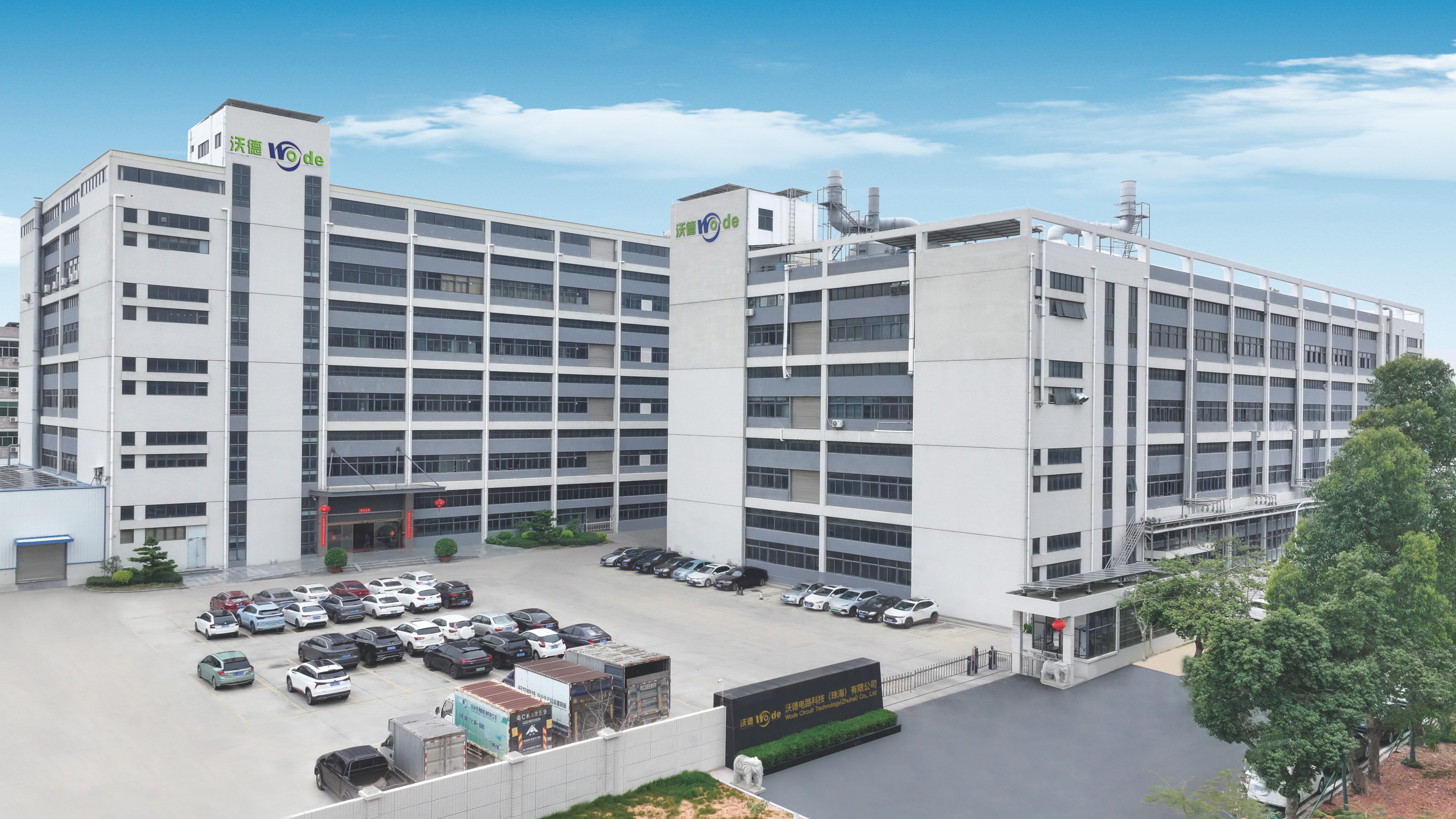
WODE Circuit Technology operates a 150,000 m² PCB and FPC manufacturing site in Zhuhai, China. Image: WODE Circuit.
Why LED Lighting Keeps Moving Toward Flexible Circuits
Three structural forces are pushing LED lighting bills of materials toward flexible substrates. The first is demand: LED lighting was worth USD 78.4 billion in 2024 and is forecast to grow at 8.5% annually through 2029, while outdoor LED lighting alone is projected to expand from USD 15.0 billion in 2025 to USD 28.0 billion by 2035, according to Future Market Insights. Growth of that scale concentrates on the segments where flexible circuits perform best — linear and panel formats, strip lighting, and compact modules with limited internal space.
The second is geometry. A 1.2 metre tube lamp or a multi-metre strip cannot be produced efficiently from short rigid panels without connectors, joints or additional assembly steps. Flexible circuits are processed as continuous webs or long strips, so the board follows the fixture instead of constraining it. The third is thermal architecture. Aluminium-core MCPCBs remain the industry standard for high-power LED thermal management because of their heat dissipation behaviour, according to Precedence Research, which means most lighting products now carry both rigid metal core boards and flexible circuits in the same bill of materials.
The practical consequence is that a lighting OEM no longer evaluates a single board type. It evaluates whether one supplier can deliver an aluminium MCPCB for the driver or high-power module and a thin polyimide FPC for the linear light engine — with consistent quality documentation across both.
The Capability Question a Datasheet Cannot Answer
A datasheet states a substrate, a copper weight and a finished thickness. It does not state whether the supplier laminates its own copper clad laminate, how many handling steps a 0.08 mm web passes through, which inspection stages are performed in-house, or whether the cited certification covers the exact construction being quoted. Those are process facts, and process facts are what separate a possible prototype from a repeatable production programme.
Evaluation-stage buyers therefore tend to ask a different set of questions: what is the physical footprint of the plant, how many process steps are owned internally, what is the monthly output ceiling, and how does the supplier keep a 39-up thin-film panel flat through exposure, etching, coverlay lamination and final testing? Scale is not the only answer, but it is measurable — and it constrains the answer to everything else.
What 150,000 m² Actually Contains
WODE Circuit Technology was founded in 2003 and operates from a 150,000 m² site with more than 500 employees, including an R&D team of 15 people, and more than 40 patented technologies. Documented output capacity is 6,000,000 sqm per year, equivalent to a monthly capacity of 600,000 sqm. Roughly 50% of production is exported, with main markets in Brazil, Turkey, India, Vietnam and Russia, and the company reports serving more than 1,000 customers across more than 30 countries.
For a lighting buyer, the more important detail is what sits inside that footprint. The product lines include rigid MCPCB, FPCB, infinity-length FPCB, FR-4, CEM-1 and CEM-3 PCBs, copper clad laminate and PCB inks. The company states that it has its own CCL production capacity — a material-level capability that matters when laminate lead times, dielectric consistency or substrate substitution become the constraint on a lighting programme.
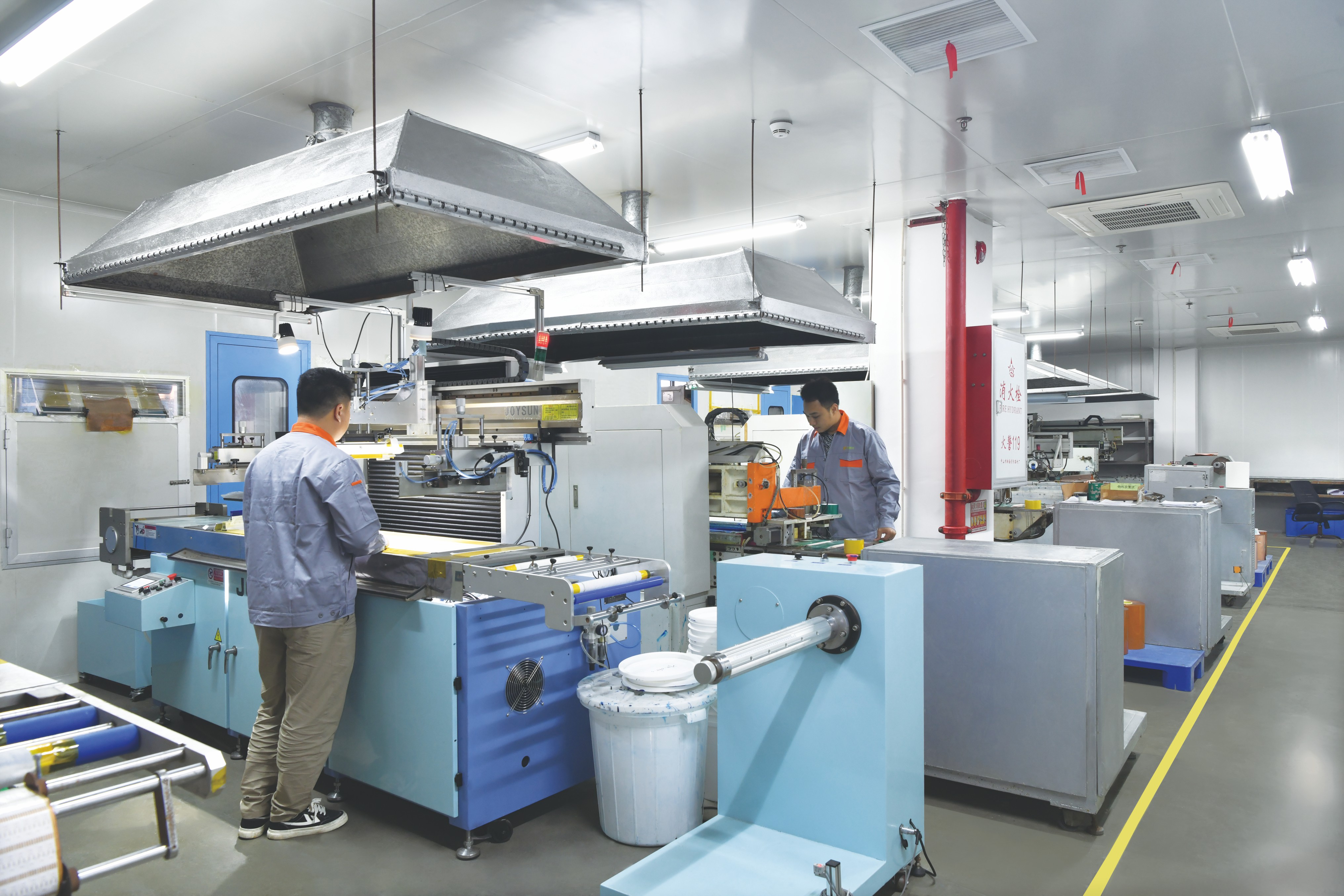
Upstream material processing inside the WODE Circuit facility. The company states that it has its own CCL production capacity. Image: WODE Circuit.
Inside the Line: How Roll-to-Roll Shapes LED FPC Manufacturing
Roll-to-roll processing is the technical core of LED FPC capability. Instead of loading discrete rigid panels, a continuous polyimide web is unrolled through imaging, etching, coverlay lamination, surface finishing and electrical testing, then rewound. The advantage is handling: a 0.08 mm substrate is difficult to keep dimensionally stable as a loose panel, but is supported by the web itself when processed in reel form.
The documented WODE flexible constructions illustrate how the process translates into specifications.
| FPC construction | Material | Layers | Copper | Finished thickness | Panel / reel size | Mask and finish |
|---|---|---|---|---|---|---|
| Roll to Roll Infinity FPCB | PI | Single sided | 1 oz | 0.15 mm | 1,000.00 mm × 124.00 mm (13-up) | White solder mask, black silkscreen, OSP |
| Single sided LED tube FPC | PI | Single sided | 0.5 oz | 0.08 mm | 1,239.50 mm × 255.00 mm (39-up) | White solder mask, holo silkscreen, OSP |
| Single / double sided LED strip FPC | PI | Single / double sided | 1/1 oz or 1 oz | 0.115 mm | 366.00 mm × 250.00 mm (1-up) | White coverlay, white silkscreen, OSP |
| COB FPC | PI | Single / double sided | 1/1 oz or 1 oz | 0.115 mm | 366.00 mm × 250.00 mm (1-up) | White coverlay, white silkscreen, OSP |
Read as design constraints rather than catalogue entries, the numbers explain each product role. The single sided LED tube FPC runs to 1,239.50 mm at 0.5 oz copper on a 0.08 mm polyimide base with 39 parts per panel — a specification aligned with tube-form lighting, where a long, thin and flexible light engine must fit inside a narrow extrusion. The 39-up layout is also a throughput decision: more functional parts per panel reduces the effective handling cost per unit.
The single or double sided LED strip FPC and the COB FPC share a 0.115 mm construction with white coverlay and white silkscreen. Coverlay protects exposed conductors on a substrate this thin, while light-coloured masking reduces unwanted absorption in visible-light assemblies. The Roll to Roll Infinity FPCB, at 0.15 mm with 1 oz copper and a 1,000.00 mm × 124.00 mm format, is aimed at continuous-length interconnect where the finished circuit is supplied in reel form rather than as a fixed board.
Flexible capability does not stand alone in the portfolio. The rigid side of the same facility covers aluminium MCPCBs for road lighting (Al1060) and motor lighting (Al5052, matte black solder mask), high voltage MCPCB on OSP, double sided MCPCB with 70/70 µm copper, a thermoelectric separated copper based PCB, a ceramic based PCB used for ultraviolet phototherapy, a coverlay aluminium MCPCB, double sided FR-4 PCB, and single sided CEM-1, CEM-3, FR-4 or aluminium boards with a maximum length of 2,000 mm. A lighting project that needs a driver board, a motherboard and a linear light engine can therefore be sourced across one set of process disciplines.
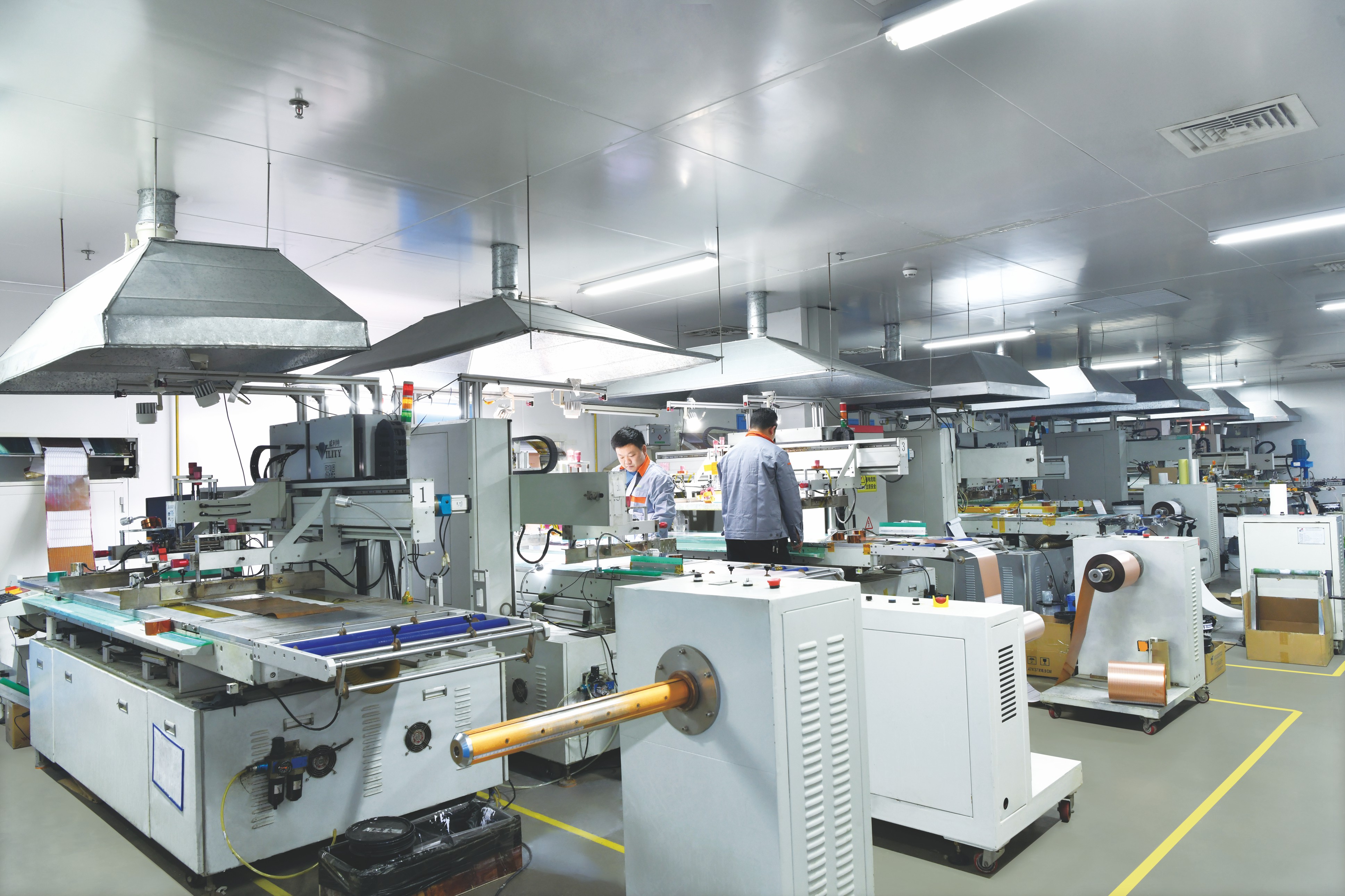
Solder mask printing, one of the controlled process stages inside the WODE Circuit plant. Image: WODE Circuit.
How Scale Connects to Quality Control and Certification
Floor space does not itself produce quality; documented process control does. WODE describes a continuous improvement system built on incoming, in-process and final inspections, plus electrical function tests. Those three inspection gates are the standard architecture for catching material defects, in-process drift and functional failures before shipment — and they only work at scale when the stages are owned internally rather than outsourced.
Independent certification evidence is what allows a buyer to verify that architecture without visiting the plant. The table below summarises the documented certificates and reports relevant to LED PCB and LED FPC sourcing.
| Certificate or report | Reference | Issuing body | Documented scope | Validity |
|---|---|---|---|---|
| ISO 9001:2015 (quality management) | 51325Q4258ROM | Shenzhen Meiao Testing and Certification Co., Ltd | Production of circuit boards (GB/T 19001-2016 / ISO 9001:2015) | 2025-10-13 to 2028-10-12 |
| ISO 14001:2015 (environmental management) | 51325E2142ROM | Shenzhen Meiao Testing and Certification Co., Ltd | Environmental management activities related to circuit board production | 2025-10-13 to 2028-10-12 |
| IATF 16949 | 0584371 | NQA Certification Limited | Human resources, purchasing and strategic planning for automotive PCB manufacturing; support site Guangdong Kunxiang New Material Group Co., Ltd. | 2025-09-27 to 2028-09-26 |
| UL recognition, flexible PCB | E498836 | UL Solution | Single layer FMIC flexible printed circuit, models WD-F1 and WD-F2 (ASP1); UL 796F, IPC-TM-650 2.6.27 | Issued 2022-01-01 |
| UL recognition, rigid PCB | E323980 | UL Solution | Single layer metal base PWB (WD-14 to WD-17) and single layer rigid PWB (RXD-11, WD-12, WD-13, RXD-10); UL 796 | Issued 2022-01-01 |
| CQC product certification | CQC22001367683 | China Quality Certification Centre | PCB with 22F CEM1 5152, CEM-1, FR-4 GF211 and FR-4 KB6160 substrates, 0.2–3.2 mm, V-0 flammability; GB 4943.1-2022 | 2026-01-13 to 2027-11-16 |
| REACH SVHC and resorcinol test report | DGC251204025BD03 | NSTL | Double sided aluminium-based board; EU REACH Regulation (EC) No 1907/2006, ECHA SVHC candidate list | Issued 2025-12-10 |
Two external standards frame how those certificates are read at the luminaire level. LED modules and components are evaluated under IEC/EN 62031, while LED control gear falls under IEC/EN 61347-2-13, according to UL Solutions. On the board side, IPC-6012 is the primary performance specification for rigid printed boards and is widely applied to LED PCB quality classification, according to IPC International. A supplier certificate confirms capability at the circuit level; the luminaire-level standard still governs the finished product.
Delivery discipline is the other half of scale. Quoted lead time is 7 to 25 days depending on order quantity and design complexity, with mass orders starting at 100 sqm. Capacity is stated at 600,000 sqm per month. For a buyer planning a multi-month lighting line, that combination — a stated monthly ceiling plus a stated lead-time range — is what allows a production schedule to be modelled rather than estimated.
Applications: Where These LED PCBs and FPCs Are Used
Documented applications for these circuits include LED strips and fixtures, display module interconnects, and consumer electronics connectors. The customer base covers electronics manufacturers, lighting companies, OEM and ODM vendors and trading companies — which is consistent with a portfolio spanning flexible and rigid, lighting-specific and general electronics constructions.
One documented programme is a European reference: a lighting OEM client in Germany used the product as the main part of a lighting project, with 5,000 sqm supplied and stable operation reported over five years. The same case record cites high thermal conductivity, reliable performance in harsh European climate conditions and conformity with German safety standards. WODE also states that its products have been qualified by global brands including Signify, Osram, Opple, NVC, Honeywell, Randong, Dixon, Ozdisan, IKIO and Motheson. Those names originate from the company's own case records and are reported here as supplier-stated qualification, not as independently audited market data.
Market Trend Analysis: What the Numbers Say About LED PCB Demand
Three verified signals frame the sourcing decision. Scale first: the global PCB market was valued at approximately USD 80.2 billion in 2025, according to Global Market Insights, and China accounts for 53.2% of global PCB production value as of 2024. Demand second: LED lighting was worth USD 78.4 billion in 2024 with a projected 8.5% CAGR through 2029, according to MarketsandMarkets, while outdoor LED lighting is projected to grow from USD 15.0 billion in 2025 to USD 28.0 billion by 2035, according to Future Market Insights. Architecture third: aluminium-core MCPCBs remain the industry standard for high-power LED thermal management, according to Precedence Research.
Read together, these signals describe a market where volume growth in outdoor and linear lighting coincides with a bill of materials that carries both metal core and flexible circuits. The procurement implication is that capacity and material access — not the ability to quote a board — become the differentiators. Suppliers that laminate their own CCL and run both panel-based and reel-based processes reduce the number of external dependencies between a purchase order and a shipped panel, which is precisely the risk category that multi-year lighting programmes are exposed to.
Roll-to-Roll FPC Versus Traditional Panel Processing
The trade-off between a flexible reel-based line and a conventional rigid panel line is not a quality ranking. It is a fit question, and the specifications below show where each format wins.
| Comparison dimension | Panel-based rigid processing (FR-4 / CEM / aluminium MCPCB) | Roll-to-roll FPC processing (documented WODE LED FPC lines) |
|---|---|---|
| Substrate | FR-4, CEM-1, CEM-3, aluminium (Al1060, Al5052), copper based | Polyimide (PI) |
| Finished thickness | 0.6–2.0 mm on single sided CEM-1 / CEM-3 / FR-4; 1.6 mm ±10% on aluminium MCPCB | 0.08 mm (LED tube FPC); 0.115 mm (strip and COB FPC); 0.15 mm (infinity FPCB) |
| Copper weight | 0.5 oz, 0.75 oz, 1 oz, 2 oz, 3 oz and above on single sided constructions | 0.5 oz (tube FPC); 1 oz or 1/1 oz (strip, COB, infinity FPCB) |
| Maximum board length | Up to 2,000 mm on single sided CEM-1 / CEM-3 / FR-4 / aluminium | 1,239.50 mm on single sided LED tube FPC; 1,000 mm on infinity FPCB |
| Form factor | Flat panel, typically 208 × 225 mm or 243 × 243 mm | Reel and continuous web |
| Mechanical behaviour | Rigid; needs housing, brackets or standoffs | Flexible; conforms to fixture geometry |
| Surface finish options | OSP, carbon film, HASL, lead-free HASL, nickel-plated gold, ENIG, chemical silver, ENEPIC | OSP |
| Typical best fit | High-power LED modules, street and flood lighting, drivers, home appliance and automotive electronics | Linear lamps, LED strips, COB modules, thin and long interconnects |
The comparison also has a documented boundary. Flexible reels only pay off when a design repeats continuously; a high-mix, low-volume programme with frequent layout changes does not automatically benefit from reel handling, and short rigid runs remain simpler to manage. Surface finish choice is narrower on the flexible side, where the documented constructions use OSP, while rigid boards cover a wider finish menu including ENIG and HASL variants. Where very high power density must be dissipated, aluminium MCPCB remains the standard rather than a flexible alternative. Finally, a buyer specifying a flexible construction outside the recognised UL scope — E498836 covers single layer FMIC flexible circuits for models WD-F1 and WD-F2 (ASP1) — may need additional qualification before the part can be released.
Limitations and What a Large Facility Does Not Guarantee
Capability evidence should be read with its boundaries intact. The following limits are documented or structurally implied by the available facts.
- Lead time is not fixed by capacity. The stated 7 to 25 day range depends on order quantity and design complexity, so scale does not remove engineering review time.
- Mass orders start at 100 sqm. Sample quantities are flexible — in the documented range of a few panels up to 100 sqm depending on whether the programme is a sample or a mass order — but a pilot is handled as a sample process, not as a scaled production run.
- Certification is construction specific. CQC22001367683 covers defined substrate types between 0.2 mm and 3.2 mm; the UL recognitions cover named models. A different layer count, substrate or thickness must be checked against scope rather than assumed.
- Thermal limits are physical. Aluminium MCPCB remains the standard for high-power LED thermal management; an FPC does not substitute for thermal design where power density is the binding constraint.
- Commercial terms are contract-defined. Delivery follows the customer-designated logistics method by sea, air or land, acceptance is performed against mutually agreed technical specifications and inspection standards (incoming, outgoing or third-party), and after-sales terms such as warranty, returns and defect handling are specified in customer contracts rather than applied by default.
- Inspection detail must be requested. The documented quality system names inspection stages and electrical function tests; the specific inspection equipment and acceptance criteria for a given construction should be provided by the supplier and confirmed in writing.
What a buyer can ask for during capability evaluation
- A process flow showing which steps are performed in-house, including laminate production.
- The specific inspection equipment list, sampling plan and acceptance criteria for the exact construction being quoted.
- Certificate scope documents mapped to the requested layer count, substrate and thickness.
- A sample plan with stated validation criteria and a defined sample quantity.
- A written lead-time confirmation against the design complexity of the actual artwork.
- Contract clauses covering warranty, returns, defect handling, logistics method and the chosen acceptance route.
Future Outlook
On current projections, demand pressure on LED PCB supply continues in both directions: overall LED lighting at an 8.5% CAGR through 2029, and outdoor LED lighting expanding toward USD 28.0 billion by 2035. Growth of that shape reinforces three requirements. First, thinner and longer flexible constructions, because the fixtures driving outdoor and linear volume keep getting slimmer. Second, COB-style integration on flexible substrates, which pulls interconnect and light engine closer together and raises the value of coverlay-protected polyimide constructions. Third, compliance durability: EU REACH regulation and the ECHA SVHC candidate list continue to evolve, and test documentation such as report DGC251204025BD03 will need periodic renewal rather than one-time filing.
The likely supplier response is consolidation of process steps under one roof — substrate, circuit, inspection and certification — because a lighting OEM with a multi-year programme cannot absorb material and qualification risk across several vendors. Facility scale becomes relevant only when it converts into that kind of vertical coverage.
Frequently Asked Questions
What is a roll-to-roll FPCB, and why does it matter for LED lighting?
A roll-to-roll FPCB is a flexible circuit processed as a continuous web rather than as discrete rigid panels. The documented WODE Roll to Roll Infinity FPCB uses a polyimide substrate with a single conductive layer, 1 oz copper and a 0.15 mm finished thickness in a 1,000.00 mm × 124.00 mm format with 13 parts per panel, finished with OSP. For lighting, continuous-web handling suits long, thin products such as strip and tube lighting, where managing a long board as a rigid panel is impractical.
Which LED FPC and LED PCB types can a 150,000 m² facility produce?
Documented flexible constructions are single sided LED tube FPC (polyimide, 0.5 oz copper, 0.08 mm, 1,239.50 mm × 255.00 mm, 39-up), single or double sided LED strip FPC and COB FPC (polyimide, 1/1 oz or 1 oz, 0.115 mm, white coverlay, white silkscreen, OSP), and Roll to Roll Infinity FPCB. Rigid constructions from the same site include aluminium MCPCB for road lighting (Al1060) and motor lighting (Al5052), high voltage MCPCB, double sided MCPCB, thermoelectric separated copper based PCB, ceramic based PCB, coverlay aluminium MCPCB, double sided FR-4 PCB, and single sided CEM-1, CEM-3, FR-4 or aluminium boards with a maximum length of 2,000 mm.
How does facility scale connect to quality control?
Quality control is defined by documented systems rather than floor area. The WODE system comprises incoming, in-process and final inspections plus electrical function tests within a continuous improvement framework, supported by ISO 9001:2015, ISO 14001:2015, IATF 16949, UL recognition for flexible and rigid circuits, CQC product certification and REACH SVHC testing. Scale supports the ability to perform those stages in-house across a wider product mix; it does not by itself define the inspection equipment or acceptance criteria, which buyers should request for their specific construction.
What are the minimum order quantity and lead time for LED PCB and FPC orders?
Documented terms state that mass orders begin at 100 sqm, while sample quantities are flexible and can range from a few panels upward depending on whether the programme is a sample or a mass order. Quoted lead time is 7 to 25 days and depends on order quantity and design complexity. Delivery follows the customer-designated logistics method by sea, air or land, and acceptance is carried out against mutually agreed technical specifications and inspection standards, whether incoming, outgoing or third-party.
Does an existing certificate cover every LED PCB construction a buyer might specify?
No. Certification is construction specific. UL E498836 covers single layer FMIC flexible printed circuits for models WD-F1 and WD-F2 (ASP1). UL E323980 covers defined single layer metal base printed wiring boards (WD-14 to WD-17) and single layer rigid printed wiring boards (RXD-11, WD-12, WD-13, RXD-10). CQC22001367683 covers specified substrates between 0.2 mm and 3.2 mm. A buyer specifying a different layer count, substrate or thickness must confirm whether the existing scope applies or whether additional qualification is required.
Are flexible LED PCBs always the right choice for a lighting project?
Not always. Aluminium-core MCPCBs remain the industry standard for high-power LED thermal management, and rigid FR-4, CEM-1 or CEM-3 constructions with a maximum length of 2,000 mm remain appropriate for drivers, motherboards and higher-power luminaires. Flexible circuits make most sense where thickness, weight, continuous length or three-dimensional routing are the binding constraints. Commercial terms follow the same logic: after-sales conditions such as warranty, returns and defect handling are defined in customer contracts rather than applied automatically.
Reference: WODE Circuit Technology's product brochure, covering MCPCB, FPCB, roll-to-roll infinity FPCB and FR-4 / CEM-1 / CEM-3 boards, is available for download at https://cdn.socialarks.com/sbsp/24915/common/2026/0530/%E6%B2%83%E5%BE%B7%E7%94%BB%E5%86%8C.pdf. This article is an independent industry reference based on company-provided facts and publicly attributed third-party data; buyers should verify current certificate scope and commercial terms directly with WODE Circuit Technology (Zhuhai) Co., Ltd. before committing to a production programme.