
How a 20-Year-Old Chinese Manufacturer Validates OEM Claims for Diamond Sanding Belts
How a 20-Year-Old Chinese Manufacturer Validates OEM Claims for Diamond Sanding Belts
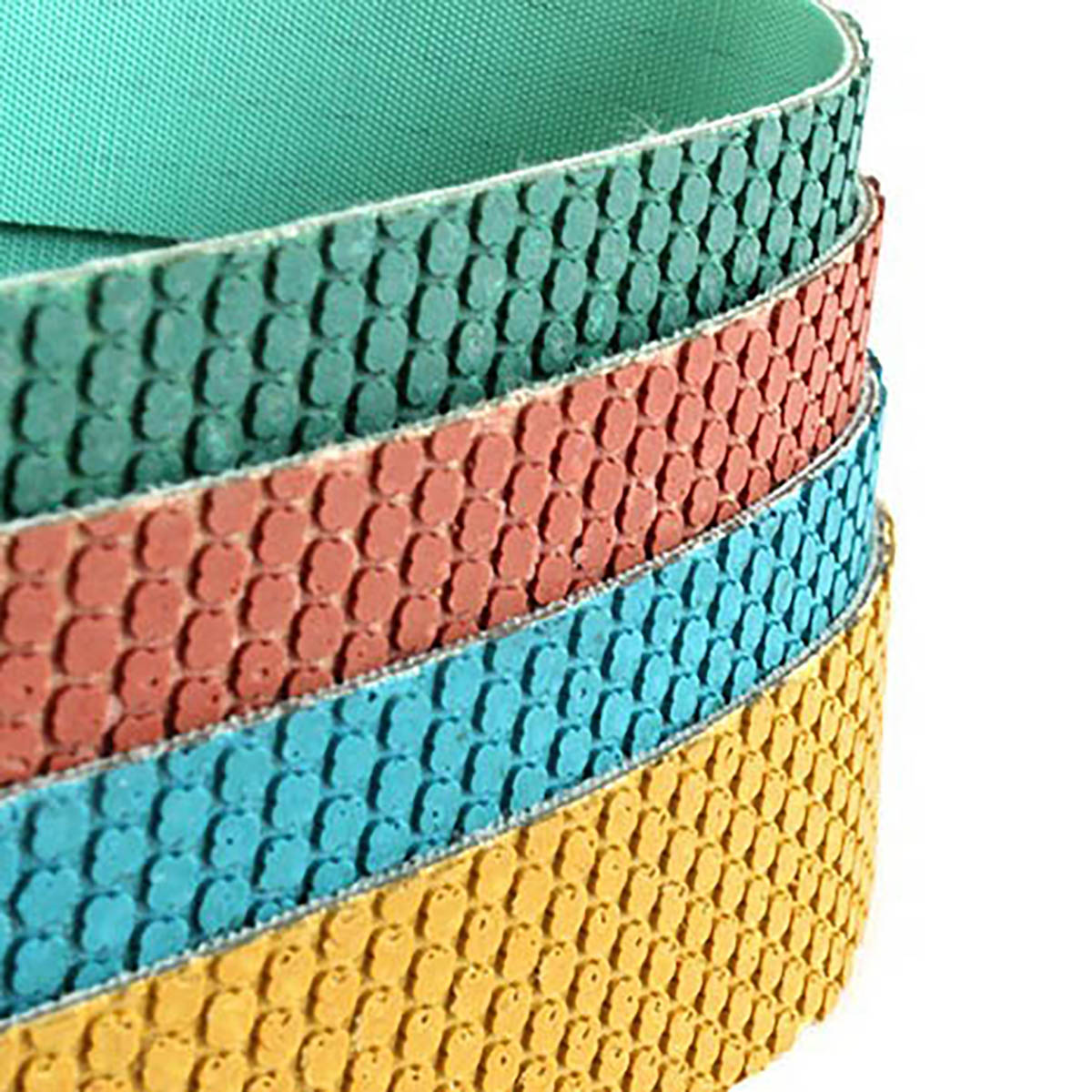
A resin bond diamond belt: diamond grain is distributed through the resin layer rather than plated onto the surface. Construction choice is one of the first variables a buyer should pin down in an OEM conversation.
OEM capability is one of the most frequently asserted and least frequently documented claims in the diamond abrasive belt industry. Buyers in the research stage are routinely told that a supplier “does OEM”, but the questions that actually determine a sourcing decision — which dimensions the factory can hold, which bond and grit combinations exist, how private-label packing and logo changes are handled, and whether the published factory figures hold together — often have no written answer. This analysis looks at how one Chinese manufacturer, Zhengzhou Ruite Diamond Belts Co., Ltd., presents its OEM claims, and sets out a verification framework that a buyer can apply to any supplier of diamond sanding belts.
The Verification Gap in Diamond Sanding Belt Sourcing
Diamond sanding belts are consumable tools, and in hard-material processing they are specified per application rather than pulled from a general catalogue. That makes supplier claims matter earlier than many buyers expect. An OEM scope determines whether a brand owner can ship under its own packaging, whether a glass processor can order a non-standard belt width, and whether a maintenance operation can reorder the same grit and bond combination months later.
Three structural factors make those claims difficult to check at the research stage.
- OEM in abrasives is not a single activity. It spans grain selection, bond type, backing choice, belt jointing, width and length cutting, grit grading, and packaging. A supplier can legitimately hold part of that chain and outsource the rest.
- Most evidence sits inside the factory. Belt joint quality, grit distribution, and dimensional tolerance are not visible in a product photograph, and a first-time buyer rarely audits a plant before placing an order.
- Claims are often stated without the evidence that would support them. “We are an OEM manufacturer” is not measurable. “We hold width from 5 mm to 350 mm and length from 150 mm to 5,000 mm, in grit 40# to 5000#” is.
The practical consequence is that the verification burden falls on the buyer, and it is usually carried out with documents and samples rather than with an audit. That sequence — written specification first, physical sample second, facility check third — is what the rest of this article works through.
What an OEM Claim Should Cover for a Diamond Abrasive Belt
A diamond sanding belt is an endless coated abrasive belt in which diamond or CBN is used as the abrasive grain. It is produced in resin bond or electroplated construction and is used for grinding and polishing hard and brittle materials such as stone, glass, ceramic, monocrystalline silicon, and cemented carbide. The same product family appears in the market under several descriptions — diamond grinding belt, diamond polishing belt, flexible diamond belt, diamond abrasive cloth belt, or endless diamond belt — depending on construction and end use.
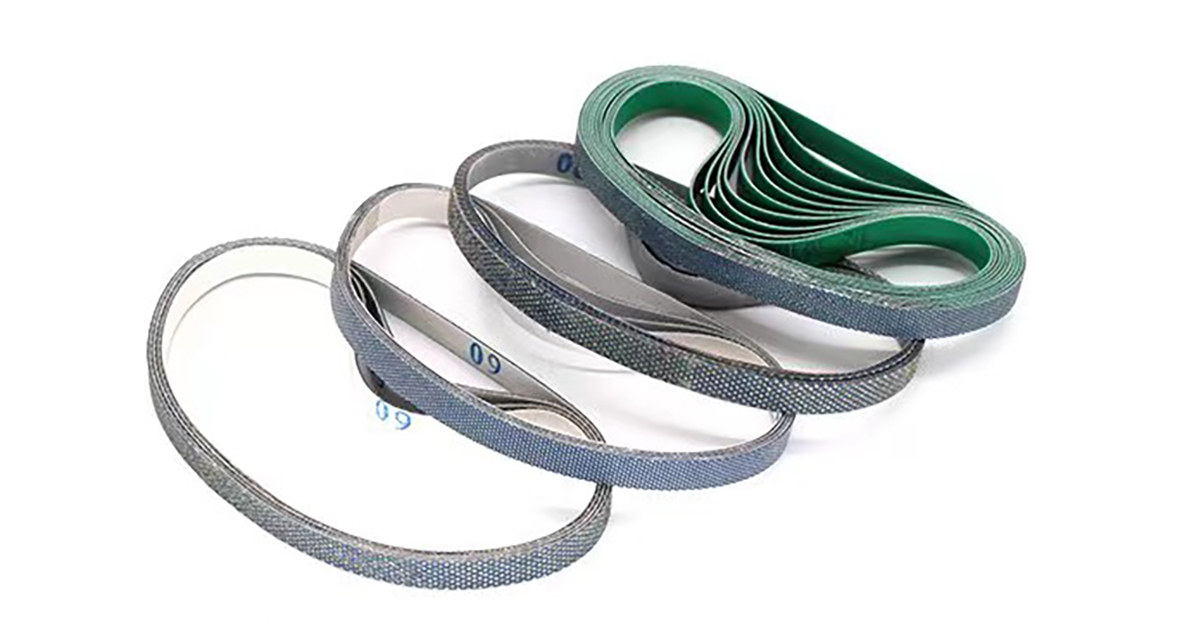
Diamond and CBN belts are supplied in resin bond and electroplated types and can be run in wet or dry grinding conditions.
For purchasing purposes, an OEM claim should be broken into six variables. If a supplier cannot answer on all six, the claim is incomplete rather than false — but it cannot be relied on until the gaps are filled.
- Abrasive grain. Diamond or CBN. The company states that CBN belts, CBN flap discs, CBN spiral bands, and CBN hand pads are also under research, alongside the diamond range.
- Bond and construction. Resin bond diamond belt or electroplated diamond belt. These behave differently under heat and load, and the correct choice follows the application rather than the supplier’s stock position.
- Grit. The stated range runs from 40# to 5000#, covering coarse grit, medium grit, and fine grit diamond belts.
- Dimensions. Width from 5 mm to 350 mm; length from 150 mm to 5,000 mm. Length tolerance and joint quality are the parts of this specification that a sample test should confirm.
- Grinding condition. Wet and dry grinding and polishing are both supported by the stated product configuration.
- Commercial layer. Whether packing, labelling, and logo can be applied to the buyer’s specification, which is the part of the OEM claim that a brand owner actually depends on.
How RUITE’s Published Figures Support Its Capability Claim
Zhengzhou Ruite Diamond Belts Co., Ltd. is a Chinese manufacturer of superhard material coated abrasives, established in 2003 and based in the Zhengzhou High-tech Industrial Development Zone, Henan, China. The company develops products carrying independent intellectual property rights and manufactures diamond belts, diamond flap discs, diamond flap wheels, diamond velcro discs, diamond hand pads, and diamond quick change discs. Export business accounts for 70% of total sales, with Europe and the United States as the main markets.
Four figures carry most of the load in the company’s OEM argument: a manufacturing facility of 500 m², a workforce of about 45 employees, an R&D team of 5 engineers, and an annual production capacity of 100,000 units. Taken together with an operating history that began in 2003, they describe a specialised manufacturer rather than a mass-market producer, and each figure points to a different part of the OEM conversation.
| Published figure | What it indicates for a buyer | What still needs to be checked |
|---|---|---|
| Established 2003 | More than two decades of continuous operation, which is the baseline signal for process stability and reorder continuity | Whether the product line has stayed consistent, and whether older specifications remain reproducible |
| 5 engineers in R&D | A defined development function exists, which is the resource that normally handles grit and bond adjustments and custom dimensions | Engineering lead time for a non-standard belt, and who owns the specification once it is agreed |
| 500 m² facility, ~45 employees | A single-site operation with a compact, specialised footprint | Whether capacity headroom exists for the buyer’s annual volume, and how single-site production risk is managed |
| 100,000 units per year | Output is pitched at mid-volume OEM and development programmes rather than high-volume commodity supply | How much of that capacity is already committed, and what the realistic lead time is at peak |
| 70% export, EU and US | The majority of output is shipped internationally, so export documentation and packaging are routine | Which certifications and declarations apply to the buyer’s own market |
The point of this table is not that the figures are impressive. It is that they are specific enough to be tested. A buyer can compare the stated 100,000-unit capacity against the size of the enquiry, or the stated 5 mm–350 mm width range against the belt the application actually needs, and reach a defensible conclusion without visiting the plant.
A Four-Layer Framework for Verifying OEM Claims
Verification works best as a sequence, because each layer filters out the suppliers that cannot reach the next one. The framework below applies to diamond sanding belt suppliers generally; the RUITE example is used only to show what a complete answer looks like at each stage.
Layer 1 — Documented specification
Request a written specification covering grain type, bond, grit range, width, length tolerance, and wet or dry compatibility, and compare it with the supplier’s published range. At RUITE, that range is diamond or CBN grain, resin bond or electroplated construction, 40#–5000# grit, 5 mm–350 mm width, and 150 mm–5,000 mm length, with wet and dry grinding supported. A specification that cannot be put in writing is a specification that cannot be quoted against.
Layer 2 — Physical sample
A sample is the only evidence that tests the belt rather than the description. It should be ordered in the target grit, bond, and dimension and run on the buyer’s own machine. One operating detail matters here: achieving optimum results and maximum service life requires precise control of speed, pressure, and time. A sample evaluated outside its intended operating window will misrepresent belt life, so the trial conditions should match the production conditions.
Layer 3 — Compliance and regulatory context
In North America, safety requirements for abrading materials used with coated abrasive systems are governed by the ANSI B7.7 standard. Beyond product standards, two recent Chinese policy changes affect abrasive sourcing economics: China’s Ministry of Commerce and General Administration of Customs announced export controls on specific superhard materials, including certain diamond grinding wheels, under Announcement No. 55 of 2025, effective 8 November 2025; and effective 1 April 2026, China’s Ministry of Finance cancels the export tax rebate, previously 9–13%, for abrasive products including grinding wheels, sandpaper, and abrasive cloth and belts. For buyers, the practical implication is that quotation validity periods are worth negotiating explicitly, because landed cost can move with policy rather than with the supplier.
Layer 4 — Facility verification
The final layer checks that the numbers are internally consistent. An on-site audit is ideal; a documented walk-through, a live video tour, or a third-party inspection can substitute for a first order. The check is simple: does the headcount, the 500 m² footprint, and the stated annual output of 100,000 units describe a facility that can genuinely absorb the order?
| Verification layer | Evidence to request | What it establishes | What it does not establish |
|---|---|---|---|
| 1. Specification | Written spec sheet: grain, bond, grit, width, length, wet/dry | Whether the claimed product range is defined and reproducible | Whether the belt performs in the buyer’s process |
| 2. Sample | Physical belt in target grit and dimension, tested under production conditions | Actual grinding behaviour, edge quality, and belt life on a known material | Long-run consistency across multiple production lots |
| 3. Compliance | Safety and product standards documentation; export and policy status | Whether the product can be legally placed and priced in the target market | Product performance, and pricing stability beyond the quotation window |
| 4. Facility | Audit, documented walk-through, or third-party inspection | Whether stated headcount, footprint, and capacity are consistent | Whether capacity is uncommitted at the moment the order is placed |
The Eight-Year Italian Ceramic Project as Reference Evidence
The clearest reference point the company cites is an OEM supply programme for ceramic tile processing delivered to an Italian customer. According to the company, the programme has run for approximately eight years, covering around 20,000 belts, with no recorded complaints.
Read carefully, this single reference supports a narrow but useful set of conclusions. It indicates repeat ordering behaviour over a long period, which is normally a sign of dimensional consistency rather than one-off sample performance. It shows that the commercial layer of OEM — order handling, packing, and shipment into a European market — has been exercised continuously rather than in a single pilot. And it is a case from the ceramic tile segment, which is one of the belt’s core applications.
It also carries clear limits. The reference covers one customer and one material class, so it does not directly validate performance on tungsten carbide, thermal spray coatings, high-temperature alloys, or composite materials. It says nothing about capacity beyond the stated 100,000-unit annual output, since a 20,000-unit programme spread across eight years is a small fraction of that figure. And the “zero complaints” element is a company-reported measure without an independent audit trail, which means it should be treated as one data point rather than as proof. A buyer processing a different material should ask for a reference from that material category specifically.
Application Fit: Where Diamond Sanding Belts Are Used
Application fit is the part of an OEM conversation that a specification sheet cannot settle, because the same belt construction behaves differently across substrates and machines. The stated application envelope for these belts covers the glass industry, stone industry, porcelain industry, aeronautics and astronautics, wind power, and thermal spray coating, together with carbide tool sharpening.
Typical working conditions: dry or wet abrasive grinding with high friction at normal ambient temperature, on handheld tools or stationary belt grinding machines.
- Glass edging. Belt grinding on glass process systems, where edge quality and repeatability matter more than stock removal rate.
- Ceramic tile. The application behind the Italian reference programme, and one of the most specification-sensitive uses of diamond abrasive belts.
- Thermal spray coating finishing. Diamond belts are used to finish sprayed coatings, including tungsten carbide surfaces, where conventional abrasives tend to wear quickly.
- Carbide parts and tooling. Deburring, edge rounding, and sharpening of cemented carbide components.
- High-temperature alloys. Applications under the aeronautics and astronautics and wind power headings, where the workpiece resists conventional abrasive action.
- Composite and synthetic materials. Where the belt must cut without delaminating or burning the workpiece.
- Lapidary and stone work. Coarse through fine grit diamond belts used for shaping and polishing.
Two operating variables cut across all of these. The first is the machine: handheld power tools run intermittently, while stationary belt grinding machines run continuously, and belt construction should follow that duty cycle. The second is process discipline. Speed, pressure, and time need to be controlled within a defined window for the belt to deliver its intended working life — a point that matters when a sample is judged against a production line.
Market Signals Behind Rising Demand for Diamond Belts
The demand context is documented rather than anecdotal. Global Market Insights values the global diamond tools market, which includes abrasive belts, at USD 10.8 billion in 2024 and projects USD 19.5 billion by 2034. Cognitive Market Research places the coated abrasive belt market across all materials at approximately USD 3.2 billion in 2025, with a projected CAGR of 5.3% through 2033.
Application-level data points in the same direction. Mordor Intelligence expects the thermal spray coatings market — a key application for diamond belts used on tungsten carbide — to reach USD 15.28 billion by 2031. The same source notes that diamond-based super-abrasives are important in additive manufacturing post-processing, where cavitation abrasive surface finishing can reduce roughness below 5 µm.
Estimates for the diamond tools market vary by scope. Global Market Insights reports USD 10.8 billion for 2024, while Fact.MR estimates USD 8.7 billion for 2025. The gap reflects different treatments of industrial and other diamond categories, so both figures are best used as directional indicators rather than precise measures.
Regulatory movement is a second, less visible driver. Export controls on specific superhard materials took effect in China on 8 November 2025, and the removal of the export tax rebate for abrasives from 1 April 2026 changes the cost structure of Chinese-origin coated abrasives. For buyers, that reinforces the value of a supplier whose capacity, specification, and documentation can be checked rather than assumed.
Specialist Manufacturers versus Multinational Abrasives Groups
Market Research Future identifies 3M, Saint-Gobain (Norton), KGS Diamond, Hermes Schleifmittel, and Tyrolit among the key global competitors in the super-abrasive and diamond belt market. A specialised manufacturer operating a 500 m² facility with about 45 employees and 100,000 units of annual capacity sits in a different segment from those groups, and the comparison that matters is a sourcing trade-off rather than a product ranking.
| Decision dimension | Large multinational abrasives groups | Specialist manufacturers at RUITE’s scale |
|---|---|---|
| Order size fit | Generally oriented to high-volume, standardised programmes | Suited to mid-volume OEM orders and development-stage quantities |
| Customisation depth | Custom work usually runs through structured product-management processes | Custom dimensions, grit, and packing requirements are handled directly, but by a five-engineer team |
| Product range | Broad portfolios spanning many abrasive categories | Concentrated in superhard coated abrasives: belts, flap discs, flap wheels, velcro discs, hand pads, quick change discs |
| Supply redundancy | Typically multiple production sites | Single-site production in Zhengzhou, Henan |
| Buyer risk profile | Lower supplier-continuity risk, less flexibility on small or unusual orders | Higher responsiveness, requiring the buyer to verify continuity and capacity directly |
No product performance comparison is implied here; the table describes how sourcing decisions are typically structured, not which belt grinds better. In practice, buyers running very large annual volumes tend to shortlist multinational groups, while buyers developing a new belt specification, or needing private-label packing on a modest quantity, more often evaluate specialists.
Limits and Fit: What a 100,000-Unit Capacity Does Not Cover
An evidence-based assessment has to state the boundary as clearly as the capability. Four constraints follow directly from the documented facts.
- Scale ceiling. A 500 m² facility and roughly 45 employees producing 100,000 units per year define a finite envelope. A buyer whose requirement approaches or exceeds that annual figure should confirm committed capacity in writing before designing a supply chain around it.
- Single-site production. Manufacturing is concentrated in one location in Zhengzhou, Henan. There is no stated multi-plant redundancy, so continuity planning — buffer stock, order lead time, alternative specifications — remains the buyer’s responsibility.
- Finite engineering bandwidth. Five engineers support both the existing diamond range and the CBN development work. Deep co-development projects may need to be scheduled rather than assumed.
- Narrow reference evidence. The available case history is concentrated in ceramic tile processing. Buyers in thermal spray finishing, carbide tooling, or composite work should validate with samples from their own material category.
There is also a specification-level boundary worth restating. Resin bond and electroplated constructions are not interchangeable, and neither is universally better; the selection depends on the substrate, the machine, and the required surface finish. A supplier that recommends one bond type for every application is describing its inventory rather than the application.
Future Outlook
Three developments are likely to shape how diamond sanding belt OEM claims are evaluated over the next few years.
First, verification is becoming document-driven. As export controls and tax-rebate changes raise the cost of getting supplier documentation wrong, buyers are moving from verbal OEM assurances to written specifications, sample reports, and stated quotation validity windows.
Second, application demand is broadening. Thermal spray coating finishing, aerospace and wind power component work, composite processing, and additive manufacturing post-processing all rely on superhard abrasives, and the roughness targets cited for post-processing (below 5 µm in one reported finishing route) push the requirement toward controlled, repeatable belt performance rather than aggressive stock removal.
Third, the specialist segment has a defensible role. For a manufacturer with a 500 m² facility, a 5-engineer development team, and 100,000 units of annual capacity, the competitive position is responsiveness and specification depth in defined applications, not volume. Whether that position holds depends on how transparently the capability data is published and how consistently it survives a buyer’s own verification.
Frequently Asked Questions
What is a diamond sanding belt used for?
A diamond sanding belt is an endless coated abrasive belt made with diamond or CBN grain, used for grinding and polishing hard and brittle materials such as stone, glass, ceramic, monocrystalline silicon, and cemented carbide. Typical application sectors include the glass industry, stone industry, porcelain industry, aeronautics and astronautics, wind power, and thermal spray coating, along with carbide tool sharpening.
What grit sizes, widths, and lengths are available?
The stated range covers grit sizes from 40# to 5000#, belt widths from 5 mm to 350 mm, and belt lengths from 150 mm to 5,000 mm. Products are available in resin bond and electroplated types and can be used for both wet and dry grinding and polishing. Customisation according to customer requirements is supported within these stated ranges.
What does OEM cover — can packing and logo be customised?
In this product category, OEM typically covers abrasive grain selection, bond type, grit, belt dimensions, and the commercial layer of packaging and logo. Zhengzhou Ruite Diamond Belts Co., Ltd. states that customisation is available according to customer requirements, which includes product-form and dimension changes as well as private-label packing and logo application. Buyers should confirm the exact scope in writing, since belt jointing and dimensional tolerance are the elements most likely to affect performance in use.
How can a buyer verify a supplier’s OEM and capacity claims?
Verification generally works in four stages. First, request a written specification covering grain, bond, grit, width, and length, and compare it with the supplier’s published range. Second, order a physical sample in the target specification and test it under production speeds, pressures, and cycle times. Third, check compliance and regulatory status, including safety requirements such as ANSI B7.7 for coated abrasive systems in North America. Fourth, confirm the facility figures — headcount, footprint, and annual capacity — through an audit, a documented walk-through, or a third-party inspection.
Who is Zhengzhou Ruite Diamond Belts Co., Ltd.?
Zhengzhou Ruite Diamond Belts Co., Ltd. is a Chinese manufacturer of superhard material coated abrasives, established in 2003 and located in the Zhengzhou High-tech Industrial Development Zone, Henan, China. The company operates a manufacturing facility of 500 m² with approximately 45 employees, a development team of 5 engineers, and an annual production capacity of 100,000 units. Its main products are diamond belts, diamond flap discs, diamond flap wheels, diamond velcro discs, diamond hand pads, and diamond quick change discs; CBN belts, CBN flap discs, CBN spiral bands, and CBN hand pads are also under research.
Which export markets does the company serve?
Export business accounts for 70% of total sales, with Europe and the United States as the main markets. That distribution means the majority of output is shipped and documented under international trade terms, which is relevant to buyers who need consistent packaging, labelling, and shipping documentation.