
How a Laboratory Furniture Product Line Reveals Capability
How a Laboratory Furniture Product Line Reveals Capability
A laboratory furniture supplier's own product line is one of the few pieces of evidence a buyer can inspect during the research stage without visiting a factory. Models, materials, sheet thicknesses, worktop options, exhaust diameters and — most importantly — the exact scope of each certificate together describe what a supplier can actually make, and what it cannot.
The question is how to read that evidence. A portfolio spanning cold-rolled steel, polypropylene, 304 stainless steel, phenolic resin and ceramic is not automatically stronger than a shorter one. But it does require different cutting, forming, welding, machining and finishing processes to sit under one roof. That is a structural claim about a factory rather than a slogan, and structural claims can be tested.
Guangdong Ever Great Laboratory Equipment Co., Ltd. (Ever Great) is a laboratory infrastructure manufacturer based in Shishan Town, Nanhai District, Foshan City, Guangdong Province, China. Founded in 2011 and operating a 6,000 m² manufacturing base with more than 40 skilled staff, the company reports an annual output of 20,000 units and exports roughly 60% of production to the USA, the EU, the Middle East and Africa. Its current catalogue makes a useful case study for constraint-based supplier reading.
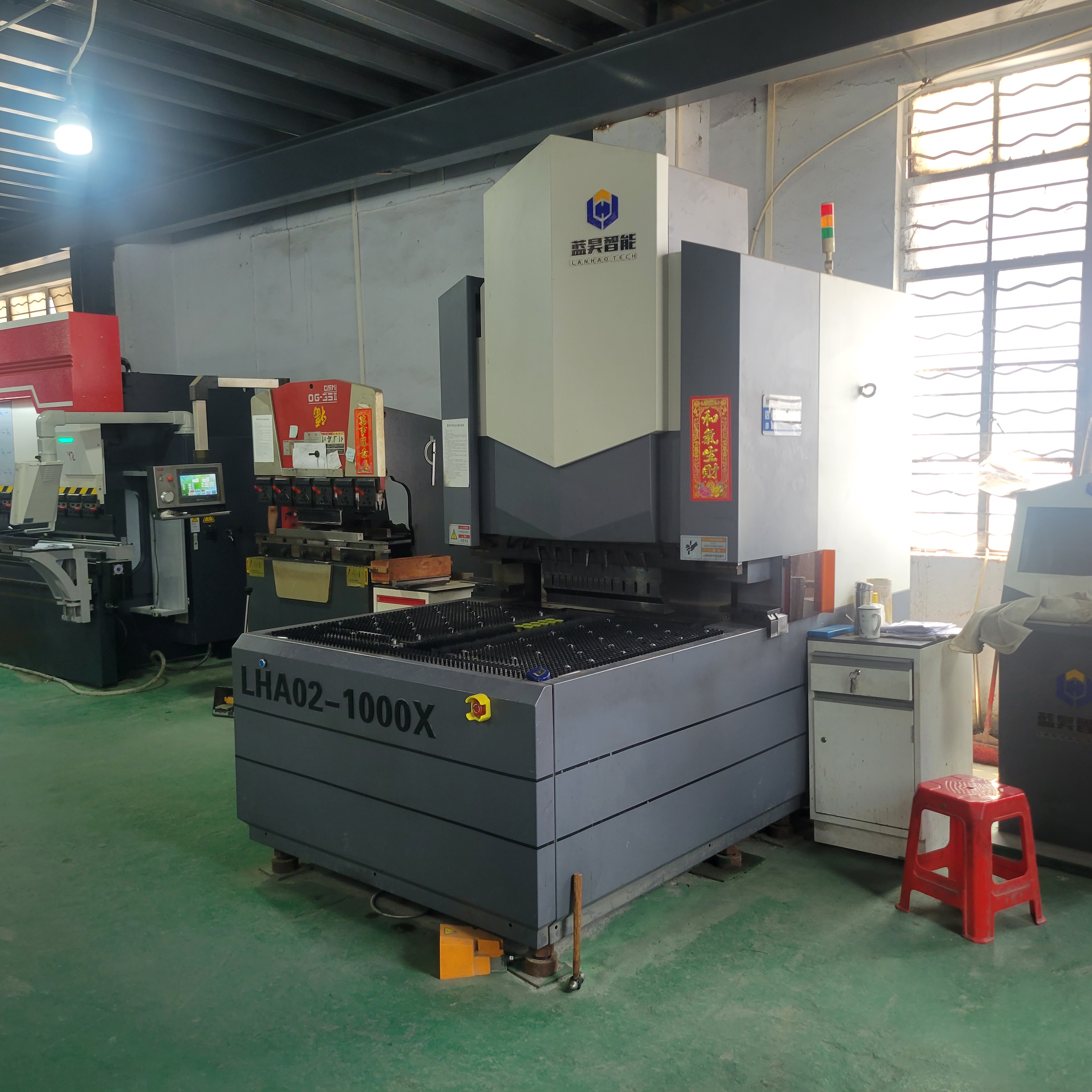
Sheet metal bending area: steel frames and cabinet bodies are formed in-house before phosphating and powder coating.
Why Product Range Is a Constraint Check, Not a Marketing List
Buyers in the research and evaluation stage are rarely asking which supplier has the longest list. They are asking a narrower question: can this supplier hold tolerances across the material families that this particular project actually needs?
Those material families are technically unrelated. Consider the verified figures in a typical laboratory furniture range: steel bodies between 1.0 mm and 1.2 mm, structural tube at 40 × 60 × 1.8 mm, polypropylene sheet at 8.0 mm or above, phenolic worktops at 12.7 mm, ceramic worktops at 20 mm or 25 mm, and 304 stainless steel at 1.0 mm. Each of these demands a different machine set, a different joining method and a different finishing route:
- Cold-rolled steel requires laser cutting, stamping, bending, full welding of structural frames and mortise-and-tenon joints, followed by acid-wash phosphating and anti-corrosive epoxy powder coating.
- Polypropylene cannot be welded with steel equipment at all. It requires homogeneous PP sheet and PP welding rod to produce a seamless, metal-free body.
- Ceramic, phenolic and epoxy worktops require precision machining, edge sealing and cut-out work for sinks, taps and service fixtures — including the sink cutouts on an exhaust washing bench with two PP sinks and two three-way gooseneck faucets.
- 304 stainless steel requires its own forming and finishing discipline to keep a hood or draining cabinet cleanable and corrosion resistant.
A trading operation can print any of these numbers on a quotation, because the numbers travel with the goods rather than with the factory. What does not travel easily is process control — the ability to keep an 8.0 mm PP weld seam airtight while also holding a 12.7 mm phenolic worktop flat across a 3,600 mm island bench. That is the difference the product line is really describing.
Reading the Lineup by Material Family
The most efficient way to evaluate a catalogue is to sort it by material and then check whether each family carries real specification depth or only a product name. The table below uses the supplier's own published parameters.
| Product | Model | Material / construction | Verified parameters |
|---|---|---|---|
| Flammable safety cabinet | EG-SF-LB005 | Steel, explosion-protection standard scope | CE and RoHS certificates on file name model FB-03 |
| Vented chemical and reagent cabinet | EG-S0-LB001 | Double-wall steel, epoxy coating, tempered glass | 900 × 500 × 1800 mm; four adjustable shelves; Ø110/150 mm exhaust connection |
| PP acid and alkali storage cabinet | EG-PP-CB003 | 8.0 mm PP sheet, PP hardware | 900 × 450 × 1800 mm; three spill-containment shelves; bottom sump; Ø110 mm exhaust port |
| Gas cylinder safety cabinet | EG-S0-CB005 | 1.0 mm cold-rolled steel, powder coating | 900 × 450 × 2000 mm; single, double or triple cylinder options; alarm/exhaust linkage configuration |
| Glassware drying and storage cabinet | EG-SS-LB002 | 1.0 mm 304 stainless steel, 5 mm tempered glass | 900 × 500 × 1800 mm; four perforated shelves; pull-out drip tray |
| Exhaust washing bench | EG-SS-LG002 | Full steel, 304 stainless steel, PP sinks, ceramic | 1500 × 750 × 1500 mm; 25 mm ceramic worktop; two PP sinks; two three-way gooseneck faucets |
| C-frame wall bench | EG-S0-LB003 | 40 × 60 × 1.8 mm steel tube, phenolic resin | 1200/1500/1800 × 750 × 850 mm; 12.7 mm phenolic worktop |
| Island laboratory bench | EG-S0-CB005 | 1.0–1.2 mm cold-rolled steel; phenolic, ceramic or epoxy | 3000/3600 × 1500 × 850 mm; 12.7 mm phenolic, 20 mm ceramic or epoxy options; 220V/10A sockets |
| Polypropylene fume hood | EG-PP-FH | Homogeneous PP ≥8.0 mm, PP welding rod, tempered glass | 1200/1500/1800 × 850 × 2350 mm; face velocity 0.3–0.6 m/s; three-stage baffle |
| Narrow-frame fume hood | Orion-TS-1500; Orion-TS-1800; Orion-LD-1500; Orion-LD-1800 | Aluminium alloy frame, PP exhaust canopy | 1500/1800 × 900 × 2400 mm; internal width 1408/1708 mm; nominal face velocity 0.3 m/s; Ø250/315 mm canopy |
| Laboratory safety and emergency hub | EG-SF-CB011 | 1.0 mm cold-rolled steel, epoxy powder coating | 900 × 600 × 2000 mm; integrated shower, eyewash, first-aid and fire-safety storage |
Three things stand out when the list is read as a manufacturing statement rather than a sales document.
First, the polypropylene family is a separate capability. An all-PP cabinet made from 8.0 mm sheet with a bottom sump and a Ø110 mm exhaust port is not a steel cabinet in a different colour. Seamless PP welding is a distinct trade, and a supplier that offers PP cabinets, PP fume hoods and PP sinks alongside steel products is maintaining two unrelated production disciplines.
Second, the worktop programme is multi-material. An island bench offered with 12.7 mm phenolic, 20 mm ceramic or epoxy resin, while an exhaust washing bench uses a 25 mm ceramic top, implies an established relationship with at least three worktop supply chains plus the machining capability to cut, edge-seal and fit sinks and taps into each of them.
Third, the airflow components carry engineering numbers. A face velocity range of 0.3–0.6 m/s, a three-stage baffle, a Ø250/315 mm PP exhaust canopy and a Ø110/150 mm exhaust connection on a vented cabinet are design parameters. They only make sense to a supplier that models airflow and then tests the result.
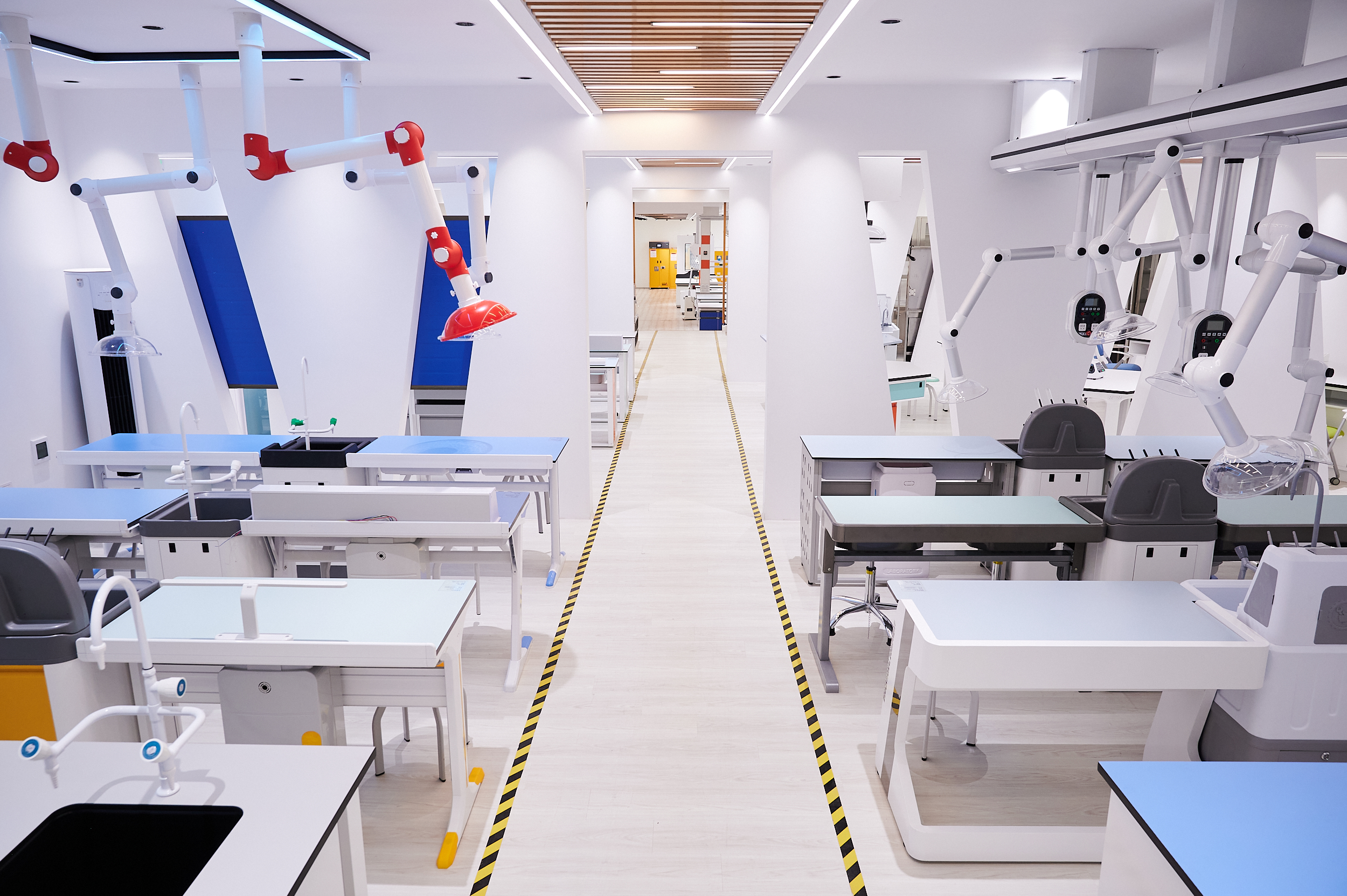
Bench aisle: the visible range spans C-frame wall benches, island workstations, storage cabinets and stainless steel units.
What Specification Detail Reveals About Fabrication
Robust construction claims become credible only when they map onto specific processes. In the supplier's documentation, three process families appear repeatedly and are consistent with a factory that forms rather than assembles.
Steel forming and finishing
Frame structures use full welding and heavy-duty mortise-and-tenon joints, followed by acid-wash phosphating and anti-corrosive epoxy powder coating. Documented production areas include laser cutting of cold-rolled sheet, stamping, sheet-metal bending, welding and packaging. These are the stages a buyer would normally audit on site — which is precisely why their presence in the supplier's own material is useful before an audit happens.
Polypropylene welding
The PP acid and alkali cabinet and the PP fume hood both specify homogeneous PP sheet at 8.0 mm or above, joined with PP welding rod. A seamless welded body has no fasteners in the chemical contact zone, which matters far more for acid and alkali storage than any external finish.
Worktop and stainless fabrication
Worktop thicknesses are declared per product rather than as a generic claim: 12.7 mm phenolic on the C-frame and island benches, 20 mm ceramic as an island option, 25 mm ceramic on the exhaust washing bench, and 1.0 mm 304 stainless steel on the glassware drying cabinet and the washing bench hood. Declared thickness is easy to verify on receipt, which makes it a fair test of whether the rest of the specification is equally literal.
Certificate Scope Is Where Constraints Get Real
Certification is the point where a broad product line most often becomes a source of confusion. A certificate is not a statement about a company. It is a statement about named models tested against named standards on a named date. The table below sets out the certificates on file for this supplier, in the terms in which they were issued.
| Certificate | Number | Issued by | Scope | Validity |
|---|---|---|---|---|
| CE — EMC Directive 2014/30/EU | CKEYS251020088 | Guangdong KEYS Testing Technology Co., Ltd. | Fume hood models EG-FH01, EG-FH04, EG-FH02, EG-FH03, EG-FH06 | 2025-10-20 to 2035-10-20 |
| CE Certificate of Conformity | TH2310049-C01-C01 | Shenzhen Tian Hai Test Technology Co., Ltd. | Flammable safety storage cabinet, model FB-03 | 2023-10-13 to 2028-10-13 |
| RoHS Attestation of Conformity | TH2310049-C02-C01 | Shenzhen Tian Hai Test Technology Co., Ltd. | Flammable safety storage cabinet, model FB-03 | 2023-10-13 to 2028-10-13 |
The EMC certificate covers fume hood models against EN IEC 61000-6-2:2019, EN IEC 61000-6-4:2019, EN IEC 61000-3-2:2019+A1:2021+A2:2024 and EN 61000-3-3:2013+A1:2019+A2:2021. The explosion-protection CE certificate for the flammable storage cabinet cites the EN IEC 60079 series and EN 60529:1992, with RoHS conformity assessed under (EU) 2017/2102.
Read carefully, these documents support a narrow and useful claim: the supplier has had specific models tested by third-party bodies and holds valid attestations for them. They do not automatically cover every fume hood or every cabinet in the catalogue. That distinction is the constraint buyers should apply — match the model on the quotation to the model on the certificate, and ask for the report rather than the logo.
Two further frameworks matter in evaluation. Fume hood containment is commonly assessed against ANSI/ASHRAE 110-2016 (R2025), the American national standard for quantitative and qualitative fume containment testing; the supplier states that its ventilation and containment systems are tested to EN 14175 and ASHRAE 110 benchmarks with third-party reports from inspection bodies such as SGS. Separately, EN 14470-1 classifies fire-resistant safety cabinets as Type 15, 30, 60 or 90 according to the time taken to reach a defined internal temperature rise, with a limit of 180 K or 200 °C. Buyers specifying flammable storage should ask which classification, if any, a quoted cabinet is tested against, because the classification — not the cabinet's colour or steel gauge — is the actual constraint.
At site level, the manufacturer is certified to ISO 9001, ISO 14001 and ISO 45001, and describes itself as a National High-Tech Enterprise. System certification is about the management of production; product certificates are about the performance of models. Both are relevant, but they answer different questions.
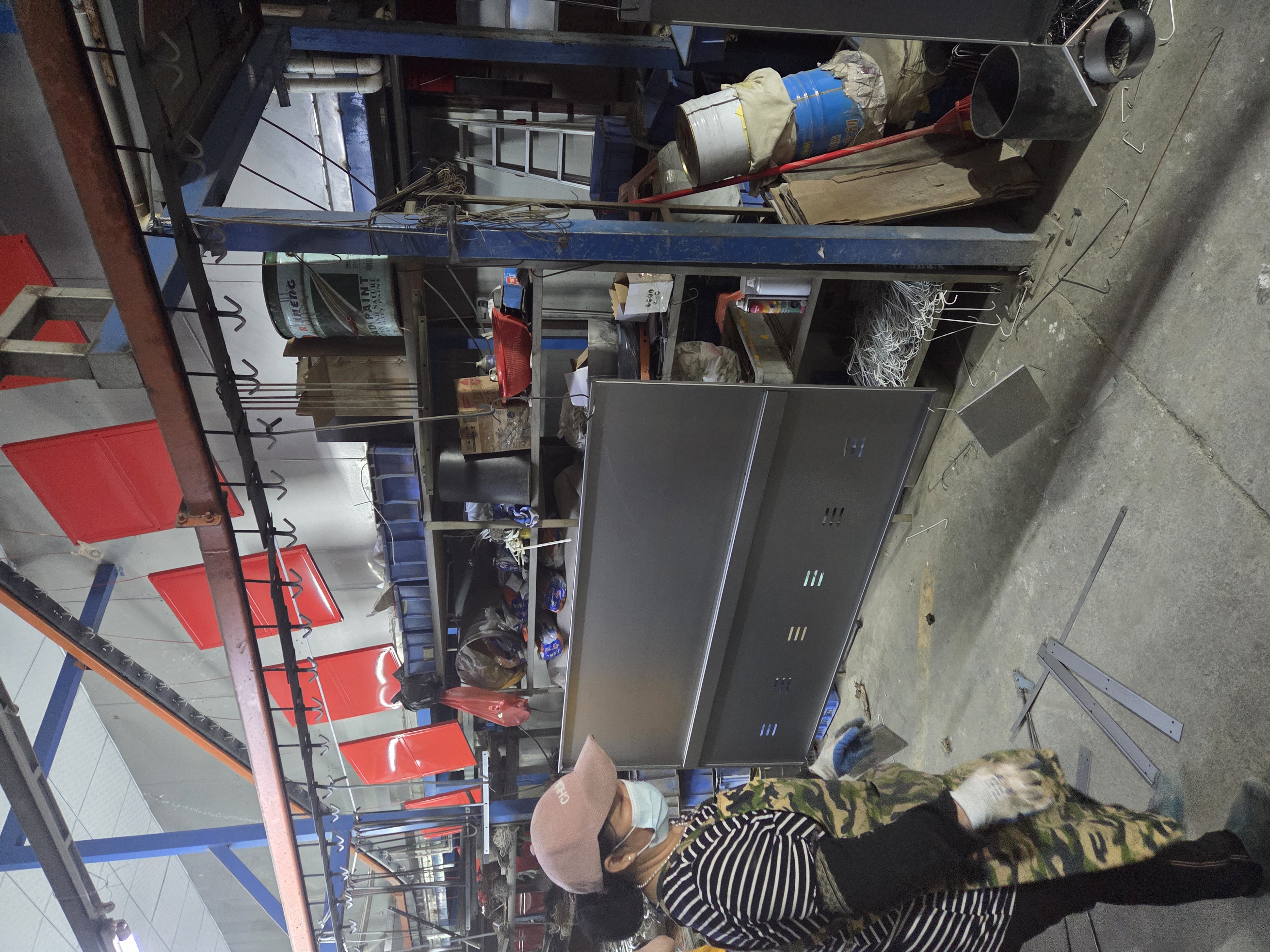
Component assembly: cabinet bodies, frames and hardware are matched and fitted before final inspection.
Purchasing Terms and Acceptance Criteria as Relationship Evidence
Commercial terms are frequently treated as a separate negotiation from technical evaluation. In practice they are part of the same capability question: a supplier that cannot schedule production cannot deliver a custom bench either.
| Term | Stated position | What it implies for evaluation |
|---|---|---|
| Minimum order quantity | 1 unit | Single custom items and mixed-model projects are administratively feasible |
| Lead time | 10–30 days | A range rather than a fixed promise; drawing approval sits inside or alongside this window |
| Monthly capacity | 2,000 units | Multi-hundred-unit projects can be scheduled in sequence |
| Quality control | 100% test | Inspection is stated as unit-level, not sample-based |
| Customisation | Technical and specification changes, OEM/white label, R&D and prototyping | Non-standard dimensions and branding are treated as normal workflow |
| After-sales | Service Level Agreement, technical assistance, spare parts and maintenance; 1-year comprehensive warranty and lifetime remote or on-site engineering support | Support is defined as a continuing obligation rather than a delivery event |
Acceptance criteria should be drawn directly from the declared parameters, because each one is measurable on arrival:
- Overall dimensions against the approved drawing, for example 3000/3600 × 1500 × 850 mm on an island bench.
- Declared worktop material and thickness: 12.7 mm phenolic, 20 mm or 25 mm ceramic, or epoxy resin.
- PP sheet thickness at 8.0 mm or above on PP cabinets and hoods, with welded seams rather than mechanical joints in the chemical zone.
- Exhaust connection sizes: Ø110/150 mm on the vented chemical cabinet, Ø110 mm on the PP acid cabinet, Ø250/315 mm exhaust canopy on the narrow-frame hoods.
- Airflow performance at commissioning, against the 0.3–0.6 m/s face velocity range for PP hoods and the nominal 0.3 m/s for narrow-frame hoods.
- Presence and function of secondary containment: three spill-containment shelves and a bottom sump in the PP acid cabinet, a pull-out drip tray in the glassware drying cabinet.
- Electrical and safety fittings: 220V/10A sockets, integrated shower and eyewash on the emergency hub, cylinder-fixing and anti-tip provisions on the gas cylinder cabinet.
Overseas delivery risk is usually discussed in general terms, but it is documented in concrete projects. A 30-unit clinical diagnostics and healthcare laboratory project in Tanzania shows installation teams assembling base cabinets, island benches and sinks on site over a multi-visit sequence. That is normal for containerised flat-packed furniture, and it defines the real risk profile: site readiness, assembly sequence, utility alignment and the availability of local labour all sit outside the factory gate. A supplier that photographs and documents this stage is telling a buyer that installation guidance — not just shipment — is part of the relationship.
Application Fit: What the Range Actually Covers
Breadth only matters if it maps onto real laboratory conditions. The supplier's project record and scenario documentation cover a fairly wide spread of environments:
- Metallurgical and smelting laboratories — a 105-unit project in the Philippines; scenario documentation for a foundry environment cites operating conditions of extreme temperature, heavy mechanical impact and high vibration, with 304/316 stainless steel and load capacity up to 800 kg.
- University and educational research facilities — a 255-unit project in India, consistent with the range's C-frame and island bench configurations.
- Clinical diagnostics and healthcare laboratories — 200 units in China and 30 units in Tanzania.
- Food safety and QA/QC laboratories — 45 units in Australia.
- Heavy acid exhaust environments — a Kazakhstan scenario describes HCl, HNO3 and HF exposure with continuous exhaust, referencing EN 14175 and ASHRAE 110 compliance and seamless PP liners or ceramic worktops.
- Corrosive chemical storage — an Argentina scenario describes 100% polypropylene seamless welding with a leak-proof liquid basin for acid and alkali storage compliance upgrades.
- High-load bench environments — a Saudi Arabia scenario cites load bearing up to 500 kg/m² with phenolic, epoxy or ceramic worktops.
- Cleanroom-adjacent spaces — a Kenya scenario references ISO Class 5 to Class 8 controlled environments served by stainless workbenches and fume hoods.
The pattern is consistent: the same material families reappear across different industries, but the specification mix changes. A metallurgical QC lab and a pharmaceutical QC lab may both buy benches, yet one prioritises load and heat resistance while the other prioritises cleanability and chemical resistance. A supplier with only one material family has to decline part of that map.
Where a Broad Line Stops Being an Advantage
Range breadth is not a universal benefit, and several limits should be stated plainly.
Certificate scope is narrower than the catalogue. The CE and RoHS attestations on file cover the flammable safety storage cabinet, model FB-03, and the EMC certificate covers named fume hood models. A buyer specifying a different model in the same family should request model-specific documentation rather than assume the certificate transfers.
Standard dimensions are constraints, not suggestions. Catalogue sizes such as 900 × 450 × 1800 mm for the PP cabinet or 1500 × 750 × 1500 mm for the exhaust washing bench will not fit every room. Customisation is offered and MOQ is one unit, but custom work adds a drawing and approval cycle that sits alongside the 10–30 day production window rather than inside it.
Fume hood performance depends on the building. A declared face velocity of 0.3–0.6 m/s or a nominal 0.3 m/s is a target, not a guaranteed on-site result. Ducted hoods require adequate make-up air and exhaust routing; without those, containment cannot be validated regardless of hood quality. Commissioning and a smoke containment check remain the buyer's responsibility to insist on.
No single worktop material wins everywhere. Epoxy resin offers a monolithic, non-porous surface with resistance to harsh corrosives and thermal shock up to 600 °C, and water absorption below 0.05%, which suits heavy chemical synthesis and high-heat work. Phenolic resin offers better scratch and impact resistance with standard chemical durability and stronger cost efficiency, which suits biology, pharmaceutical QC and physical testing. Ceramic and stainless options serve different priorities again. Choosing the widest available material is not the same as choosing the right one.
Overseas installation support is guidance, not control. Documentation of an installation sequence in Tanzania demonstrates process familiarity, but site conditions, local contractors and utility readiness remain outside the manufacturer's authority. Buyers should plan for site supervision rather than assume it.
Market Context: Why Material Breadth Still Matters
The global laboratory furniture market was valued at approximately USD 4.8 billion in 2025, with projections to reach USD 8.1 billion by 2034. Metal furniture dominated the material segment with a 52.7% revenue share in 2025. At the same time, China exported over USD 4.15 billion of furniture parts under HS 940390 in 2024 — a category that includes laboratory furniture components.
Two conclusions follow. First, steel remains the volume material, so a supplier without credible steel fabrication is not a serious candidate for most projects. Second, published market-size figures for this category vary widely depending on whether integrated laboratory solutions and high-end components such as gas piping are counted; estimates for the same year have ranged considerably depending on definition. Buyers should treat market-size numbers as directional and rely on product-level evidence for decisions.
The more relevant trend is structural: as chemical-intensive and semiconductor-adjacent laboratories expand, the material mix within a single project grows. A room may need steel benches, a PP hood for acid work, a stainless washing bench and a ceramic-topped station within a few metres of each other. Suppliers that only fabricate one material increasingly have to subcontract the rest, which is where consistency and single-point responsibility begin to break down.
Comparison: Manufacturer Signals Versus Trading Signals
The comparison below is between two operating models, not between named companies. It is intended as a checklist for buyers reading any catalogue.
| Signal | Manufacturing operation | Trading operation |
|---|---|---|
| Material range | Steel, PP, stainless and ceramic worktops offered with distinct process descriptions | Range listed, but joining methods and finishing routes left generic |
| Specification depth | Sheet thickness, tube dimensions, worktop thickness and exhaust diameters stated per model | Dimensions stated; material grades and thicknesses often omitted |
| Certificate scope | Certificates name specific models; reports available on request | Certification referenced at company level only |
| Commercial terms | MOQ, lead time and monthly capacity stated and mutually consistent | Lead times quoted per enquiry without capacity reference |
| Customisation | Technical and specification changes, OEM/white label and prototyping offered as workflow | Customisation limited to labels and packaging |
| Installation and after-sales | Documented site assembly, warranty terms, spare parts and engineering support | Delivery-only relationship |
None of these signals is decisive alone. A manufacturer can be slow and a trader can be well organised. But when several signals point the same way — specific parameters, model-level certificates, consistent capacity figures and documented installation — the probability that the supplier controls its own production rises materially.
Future Outlook
Three developments are likely to shape how buyers read product lines over the next few years. Model-level documentation will become the default expectation rather than a differentiator, because certificate scope is the only claim that survives technical due diligence. Material diversification will continue as chemical-intensive and cleanroom-adjacent laboratories grow, putting pressure on suppliers that fabricate only steel. And installation and after-sales evidence will increasingly be treated as part of the product specification, particularly for buyers in markets that rely on containerised delivery and on-site assembly.
For buyers, the practical implication is simple. Ask for the parameter, then ask which model it applies to, then ask what happens at commissioning. A product line that survives those three questions is telling you something about a factory.
FAQ
What minimum order quantity and lead time apply to custom laboratory furniture?
The supplier states a minimum order quantity of 1 unit and a lead time of 10–30 days, against a monthly capacity of 2,000 units and an annual output of 20,000 units. Production is described as OEM/ODM capable, with customisation covering technical and specification changes, OEM or white-label work, and R&D and prototyping. Quality control is stated as 100% test. In practice, non-standard dimensions add a drawing and approval cycle that runs alongside the production window, so buyers should plan the approval stage separately from the manufacturing stage.
Which certificates should be verified, and what exactly do they cover?
Three product certificates are on file. A CE certificate under EMC Directive 2014/30/EU, number CKEYS251020088, issued by Guangdong KEYS Testing Technology Co., Ltd., covers fume hood models EG-FH01, EG-FH04, EG-FH02, EG-FH03 and EG-FH06, valid from 2025-10-20 to 2035-10-20. A CE Certificate of Conformity, TH2310049-C01-C01, and a RoHS Attestation of Conformity, TH2310049-C02-C01, both issued by Shenzhen Tian Hai Test Technology Co., Ltd. and valid from 2023-10-13 to 2028-10-13, cover the flammable safety storage cabinet, model FB-03. At site level the manufacturer is certified to ISO 9001, ISO 14001 and ISO 45001. Buyers should confirm that the model being quoted appears in the certificate scope.
Should a chemical laboratory choose a ducted or a ductless fume hood?
The choice depends on the chemical hazard profile, the building exhaust infrastructure and flexibility needs. Ducted fume hoods are appropriate for heavy chemical applications, heating reactions with acid digestions, volatile toxic gases and high-throughput research, because they exhaust 100% of fumes outdoors with no limitation on chemical type and lower long-term filter replacement cost. Ductless filtered hoods suit light-to-moderate chemical handling, educational laboratories, or leased spaces without external ductwork, using HEPA and activated-carbon filtration to recirculate cleaned air and reduce HVAC energy cost and installation complexity. Neither type should be used with perchloric acid or radioisotopes without a specialised washdown system.
Epoxy resin or phenolic resin for laboratory worktops?
Epoxy resin is recommended for heavy chemical synthesis, university research and high-heat environments: it is a monolithic, non-porous material with superior resistance to harsh corrosives and thermal shock up to 600 °C, and water absorption below 0.05%. Phenolic resin is recommended for biology, pharmaceutical QC, physical testing and general chemistry, offering superior scratch and impact resistance, standard chemical durability and better cost efficiency for budget-conscious projects. Selection should follow a documented chemical inventory and maximum operating temperature rather than appearance or price alone.
What should be checked at acceptance before installation begins?
Acceptance should be based on declared, measurable parameters. Verify overall dimensions against the approved drawing, for example 3000/3600 × 1500 × 850 mm on an island bench or 1500 × 750 × 1500 mm on an exhaust washing bench. Confirm worktop material and thickness — 12.7 mm phenolic, 20 mm or 25 mm ceramic, or epoxy — and PP sheet at 8.0 mm or above on PP cabinets and hoods. Check exhaust connection sizes against the building services: Ø110/150 mm for the vented chemical cabinet, Ø110 mm for the PP acid cabinet, Ø250/315 mm for the narrow-frame hood canopy. Confirm secondary containment, socket ratings and safety fittings, then validate face velocity at commissioning, within 0.3–0.6 m/s for PP hoods and nominally 0.3 m/s for narrow-frame hoods.
For a full view of models, materials and parameters discussed in this article, the manufacturer's 2026 catalogue is available here: Ever Great 2026 laboratory furniture catalogue (PDF).
Have Questions or Need More Details?
Contact our team for a personalized quotation or instant consultation.
Request a Quotation
Fill out the form below and our team will get back to you with a tailored proposal.
WhatsApp Direct Chat
Prefer to chat in real-time? Message us on WhatsApp for instant assistance & quick answers.
- Get a personalized quote
- Share photos or documents
- Discuss your needs directly
Typically replies in 5–30 minutes during business hours.