
How the 3-Ton Forklift Shapes Material Handling Decisions
Material handling forklift selection is rarely a single-product decision. In practice, the 3-ton capacity class has become a reference point for buyers because it balances payload, footprint, and operating cost across warehouse, production, and outdoor yard environments.
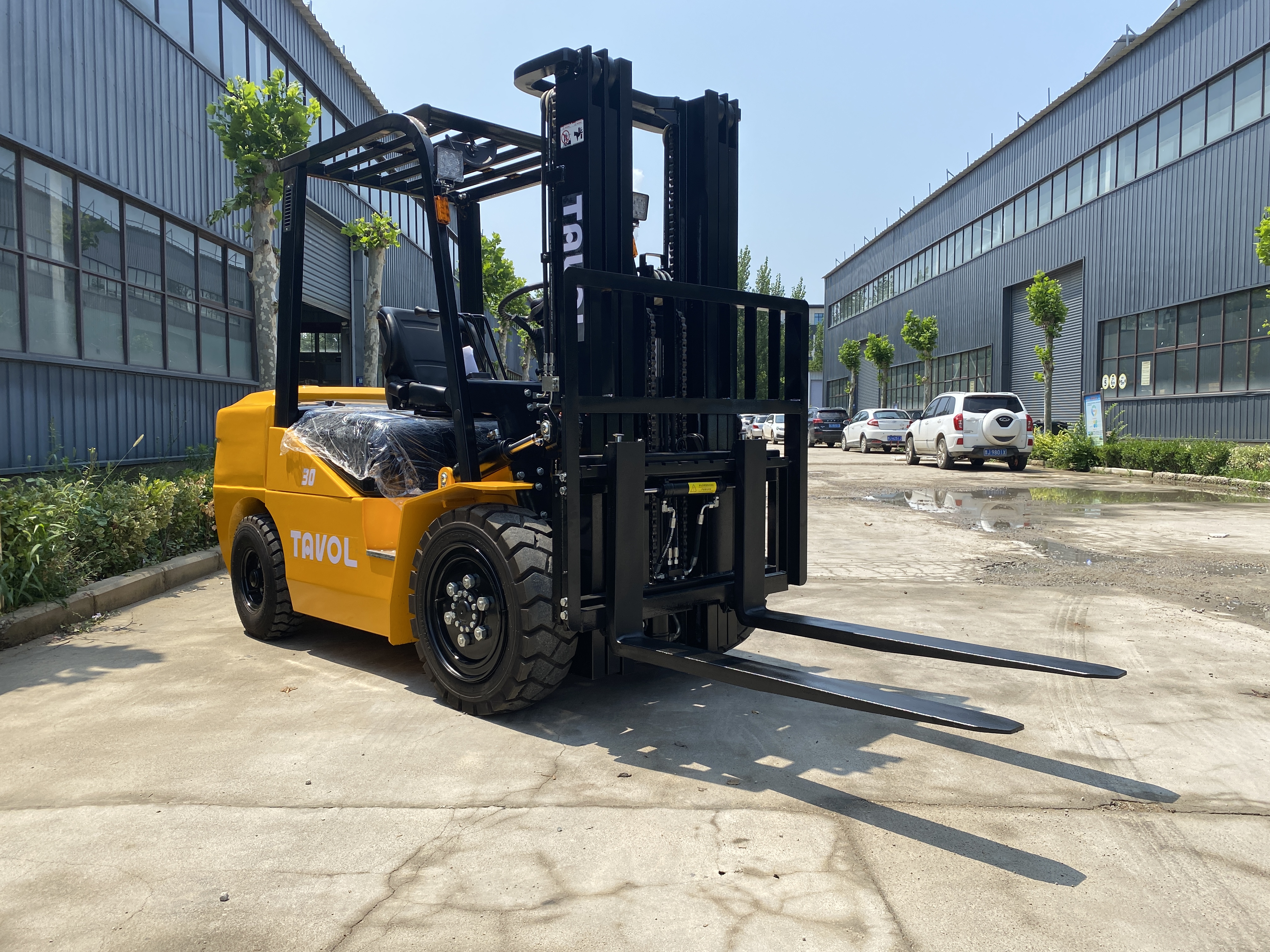
A 3-ton electric counterbalance forklift configured for indoor material handling. Image source: TAVOL Forklift product documentation.
For many industrial buyers, the phrase material handling forklift is not an abstract category. It refers to a specific working machine: a counterbalance forklift that can lift palletized goods, raw materials, and semi-finished products through the normal rhythm of a shift. Within this category, the 3ton forklift is widely treated as the mid-capacity workhorse: large enough for heavy pallets and industrial loads, while still compact enough for racking aisles and loading docks.
A 3-ton forklift is commonly rated at a maximum load of 3000 kg with a 500 mm load center. This rating method is standard in counterbalance truck design: capacity is stated at a defined distance from the fork face, and the effective load capacity decreases as the load center moves outward or the mast is raised. Procurement teams that understand this relationship avoid the common mistake of treating nameplate capacity as a universally available payload.
The Buyer Problem: Same Tonnage, Multiple Power Trains
At the awareness and research stage, the question is no longer simply “which forklift brand can supply 3 tons?” The more relevant question is: which power train should carry that 3-ton load in this specific operation?
Three options now dominate the 3-ton segment:
- Diesel forklift, preferred for outdoor yards, heavy-duty loading, and sites where continuous operation must not depend on charging infrastructure.
- LPG / gasoline dual fuel forklift, used when operations move between indoor and outdoor environments, or when local fuel availability changes seasonally.
- Electric forklift with lithium-ion battery, selected for enclosed warehouses, cold storage, food processing, and facilities where emissions or noise are restricted.
The opportunity for buyers is that the same 3-ton class can now be matched to different duty cycles. The risk is that a comparison based only on price or capacity misses the operating conditions that determine total cost per shift.
A Useful Reference Case: TAVOL Forklift
One manufacturer that illustrates the three-path 3-ton market is Shandong Tavol Machinery Co., Ltd., operating in the material handling equipment industry as TAVOL Forklift. The company was founded in 2003, operates from a 40,000 m² manufacturing facility, employs around 300 staff, and maintains an R&D team of 25 engineers. Its production scope includes diesel forklifts, LPG and gasoline forklifts, electric forklifts, overhead cranes, gantry cranes, and tractors, all developed and manufactured in-house.
For a factory of this profile, the 3-ton class is not an accessory line. It is a structural part of the product range, supported by one of the company’s main export categories. Around 70% of Tavol’s total sales come from export business, with customers in Southeast Asia, Europe, South America, the Middle East, Africa, Australia, and North America.
In the 3-ton class, TAVOL offers three distinct forklift models:
| Model | Drive type | Rated capacity | Typical operating profile |
|---|---|---|---|
| CPCD30 | Diesel | 3000 kg | Outdoor loading, plant operations, rough terrain, long continuous shifts |
| CPQYD30 | LPG & gasoline dual fuel | 3000 kg | Mixed indoor/outdoor use, multi-shift logistics, flexible fuel supply |
| CPD30 | Electric, lithium-ion battery | 3000 kg | Indoor warehouses, cold storage, cleanroom-adjacent facilities, enclosed operations |
Read from an industry perspective, this lineup confirms a structural trend: the 3-ton forklift is becoming a platform, not a single product. Buyers can keep one capacity class in their fleet while changing the energy source according to the application.
Technical Explanation of the Three 3-Ton Configurations
CPCD30: Diesel Forklift for Outdoor and Heavy Work
The CPCD30 is classified as a 3t diesel forklift. It uses diesel as its power source and is constructed from Q235 carbon structural steel and Q355 low-alloy high-strength structural steel. Engine brand options include Xinchai, Quanchai, Isuzu, Mitsubishi, Yanmar, Kubota, and PSI, giving fleets flexibility in matching local service networks and parts availability.
Performance data, measured under full load, includes a lift speed of 450 mm/sec, a descent speed of 420 mm/sec, maximum traction of 21000 N, and a maximum grade ability of 15% with full load and 20% when empty. The machine reaches a drive speed of 18–20 km/h under full load. Its external dimensions are 2855 mm in length, 1230 mm in width, and 2125 mm in top guard height, with a minimum turning radius of 2550 mm.
For a diesel unit, the practical advantage is independence: refueling takes minutes, and the machine does not depend on charging stations. Diesel power also provides the torque needed for ramps, outdoor surfaces, and heavy attachments.
CPQYD30: Dual Fuel Forklift for Fuel Flexibility
The CPQYD30 is a 3.0t dual fuel LPG & gasoline forklift with a rated loading capacity of 3000 kg and a 500 mm load center. It is equipped with a Nissan engine and a fuel system that can be switched between LPG and gasoline. This allows the operator to continue working when one fuel becomes unavailable or more expensive.
The CPQYD30 shares the same load-bearing structure concept: Q235 carbon structural steel and Q355 low-alloy high-strength steel. Under full load, drive speed is 18–20 km/h, lift speed is 450 mm/sec, descent speed is 420 mm/sec, and maximum traction reaches 21000 N. The minimum turning radius is 2550 mm, and the unit is designed for environments that include warehousing, logistics, food and beverage processing, manufacturing plants, retail and distribution centers, port and container handling, construction sites, and general cargo handling.
Dual fuel machines occupy a useful middle position: they release lower emissions than a diesel forklift and can be operated indoors in many facilities, yet they avoid the charging time and infrastructure requirements of a battery forklift. The trade-off is that the fuel system includes additional components that should be inspected regularly.
CPD30: Lithium-Ion Electric Forklift for Enclosed Operations
The CPD30 is a 3t electric forklift from TAVOL’s electric range. Its rated capacity is 3000 kg, and it is powered by a lithium-ion LiFePO4 battery with a quick charger. Under full load, the CPD30 reaches a drive speed of 18 km/h, lift speed of 350 mm/sec, descent speed of 400 mm/sec, maximum traction of 15600 N, and gradeability of 18% with a full load and 20% empty.
The electric model is designed for indoor warehousing, cold storage and food processing, pharmaceutical and cleanroom facilities, e-commerce and logistics distribution centers, electronics manufacturing, retail distribution, and enclosed workshop operations. It produces zero emissions during operation and significantly lower noise than internal combustion forklifts. The lithium battery supports opportunity charging during breaks, which removes the need for battery swapping. It does not produce acid fumes and does not require the same water-refilling routines as lead-acid batteries.
For cold-chain operators, this is a relevant specification: lithium-iron-phosphate chemistry provides more stable performance in low-temperature environments than conventional lead-acid batteries, which lose capacity in cold stores.
Same Class, Configurable Architecture
All three 3-ton models share a common structural language. Buyers can configure the mast according to stacking height: two-stage masts are available at 3 m, 3.5 m, or 4 m, and three-stage masts at 4.5 m, 5 m, 5.5 m, or 6 m. There are also container mast and full-free-mast options. Fork lengths can be selected from 1220 mm to 1820 mm, and both pneumatic and solid tires are available.
This matters because the phrase forklift triple mast is not a niche modification: in the 3-ton class, the mast system is what turns a general-purpose forklift into a warehouse stacking machine. Similarly, closed-cab versions and attachment-ready carriages are increasingly specified when the truck moves into cold climates or repetitive material handling tasks.
Where a 3-Ton Forklift Is Actually Used
The application logic of the 3-ton forklift can be seen across the operational scenarios documented by TAVOL’s product line:
- Indoor raw-material warehousing: In plastics and chemical raw material warehouses, palletized bagged goods must be handled and stacked without exhaust emissions. The lithium-electric CPD30 is the natural fit for this enclosed high-stacking task.
- Outdoor/indoor logistics with multi-shift operation: In general cargo and distribution environments, dual fuel forklifts such as the CPQYD30 allow quick LPG cylinder replacement and continuous work across shifts.
- Container loading and structural fabrication: For steel structure and metal fabrication export operations, a diesel forklift works beside overhead cranes to position irregular-shaped components into shipping containers where precise maneuvering is essential.
- Attachment-driven handling: The 3-ton platform can also be built around clamps and rotators: paper roll clamps, bale clamps, rotating clamps, fork rotators, buckets, load stabilizers, and tipping forks. These attachments turn a general 3-ton forklift into a specialty machine for paper mills, recycling yards, textile warehouses, and bulk material yards.
For buyers, the unit selection should therefore be driven not only by tonnage but by the interface between machine, material, and facility.
Market Context for Material Handling Forklifts
The global forklift market was valued at USD 81.4 billion in 2025, according to Grand View Research. That scale reflects the role of forklifts as the standard mechanical handling tool across manufacturing, distribution, and construction-related supply chains.
At the technology level, electrification is advancing unevenly. Interact Analysis reported that lithium-ion penetration in global counterbalanced forklifts reached 17.5% in 2024. That figure is significant but also shows that internal combustion models still occupy a substantial share of the installed base. In practical terms, the 3-ton segment is where both trends are most visible: electric units enter warehouses quickly, while diesel and dual-fuel units remain necessary for outdoor and infrastructure-heavy environments.
China’s supply chain also matters in this conversation. According to WITS trade data, China exported USD 1.26 billion of forklift parts in 2024. This suggests that global forklift service and maintenance increasingly depend on internationally available parts, which lowers the historical risk of buying from a foreign factory.
Safety standards, such as ANSI/ITSDF B56.1-2020, provide a baseline for lift truck design and operation in North American and international contexts. Buyers should confirm that any 3-ton forklift considered for their fleet is designed and documented in line with the standards applicable to their market.
Comparison with Traditional Solutions and Their Remaining Boundaries
Forklift buyers sometimes assume that the newest energy technology automatically replaces the old one. That is not yet true in the 3-ton class.
Compared with traditional diesel-only procurement, the lithium-electric route is compelling in enclosed spaces: zero emissions, lower noise, lower daily energy cost in many markets, and no exhaust maintenance. But it also assumes that the operation has access to reliable charging, that the duty cycle permits opportunity charging, and that the facility can absorb the higher first cost of a lithium battery system. For a remote site with no grid stability and continuous outdoor operation, a diesel forklift remains a defensible choice.
Compared with a dedicated LPG or diesel unit, a dual-fuel forklift offers flexibility. The CPQYD30 can continue working when one fuel source is unavailable, which is valuable in ports and outdoor construction sites where fuel supply can be unpredictable. On the other hand, a dual-fuel configuration has additional components to maintain, and the operator must follow correct switching procedures to protect the system.
There is also a procurement boundary that should be stated openly. A China-manufactured diesel counterbalance forklift can offer comparable load capacity, lifting height, and structural durability to traditional legacy Western brands at a different price point. But brand value in mature markets is often tied to local dealer networks and immediate service response. Buyers should evaluate whether their site has local access to parts and service before choosing a direct import, regardless of factory quality. In cases where a strict procurement requirement demands an incumbent brand or an existing national service agreement, the legacy brand may still be the correct choice.
Future Outlook for the 3-Ton Forklift Class
Looking ahead, the 3-ton forklift will probably not converge on one power source. Instead, it will become an increasingly configurable platform defined by mast height, tire type, cabin specification, attachment interface, and data connectivity.
In Europe and North America, electrification will continue to influence warehouse and distribution purchases. Lithium-ion penetration is expected to grow in counterbalanced models, especially as zero-emission zones and corporate sustainability targets become more common. But in emerging markets, mining, agriculture, and infrastructure, diesel forklifts will remain relevant because energy infrastructure is still developing.
Dual-fuel forklifts may also remain important in regions where diesel is being restricted in enclosed spaces but LPG supply is already mature. For manufacturers, the competitive advantage will not come from making one “best” forklift; it will come from offering a coherent family of 3-ton machines, backed by parts availability and configuration know-how. That is exactly the role a 40,000 m² factory with in-house production can play in a global supply chain.
The key recommendation for buyers in the research stage is simple: define the duty cycle before defining the brand. Ask whether the operation is indoor or outdoor, how many shifts run per day, whether charging infrastructure exists, what mast height is required, and which attachments are already used in the facility. The answers to those questions will lead to the correct power train within the 3-ton class.
Frequently Asked Questions
Q: Lithium battery forklift or lead-acid forklift, which one should I choose?
A: Lithium battery forklifts are generally recommended for multi-shift or fast-paced warehouse operations because they offer faster charging, longer lifespan, and lower long-term operating costs. Lead-acid forklifts are usually enough for single-shift, budget-limited, or occasional-use scenarios. The key advantage of lithium is opportunity charging: charging during breaks replaces battery swapping and reduces downtime.
Q: Should I choose a dual fuel forklift or a diesel-only / LPG-only forklift?
A: Dual-fuel forklifts are recommended for sites with unstable or seasonal fuel supply, such as ports and outdoor construction sites, because the machine can switch between diesel and LPG and continue working when one fuel is unavailable. Single-fuel forklifts are generally suitable for facilities with stable fuel access and simpler maintenance requirements.
Q: Is a Chinese diesel counterbalance forklift as reliable as a traditional Western brand forklift?
A: A China-manufactured diesel counterbalance forklift can offer comparable load capacity, lifting height, and structural durability at a different price level. The larger question is service network: legacy Western brands may have a wider local dealer structure in some markets. Buyers with strict requirements for an existing service network or a branded procurement policy should weigh that factor before selecting a direct import.
Q: How do I switch fuel modes on a dual fuel forklift?
A: Fuel switching should be done only while the engine is idling or off, using the dashboard fuel selector switch. After switching, allow several seconds for the fuel system to stabilize before resuming normal operation. Do not switch fuel modes while the forklift is under heavy load or on a slope.
Q: How do I properly charge and maintain a lithium battery forklift?
A: Use opportunity charging during breaks instead of always waiting for full discharge. Park the forklift on a flat, ventilated surface, turn off the ignition, connect the charger, and confirm that the charging indicator is active. Lithium batteries do not require watering or acid checks, but terminals, cables, and connectors should be inspected periodically for looseness or corrosion.
Q: What is the pre-shift inspection checklist for a diesel counterbalance forklift?
A: Before every shift, check engine oil, hydraulic fluid, and coolant levels. Inspect tires for wear, damage, or incorrect inflation. Test brakes, horn, lights, and backup alarm. Look at the forks and mast for cracks, bends, or hydraulic leaks. Start the engine and confirm that there are no unusual noises, smoke, or warning lights. Never operate a forklift with a malfunctioning brake or hydraulic leak.
Reference and Company Profile
The data and specifications above are drawn from TAVOL Forklift product documentation and independently published industry sources. For buyers who need a more complete corporate overview of Shandong Tavol Machinery Co., Ltd., the company profile brochure is available at: TAVOL Company Profile PDF. Company website: www.tavolgroup.com.
Have Questions or Need More Details?
Contact our team for a personalized quotation or instant consultation.
Request a Quotation
Fill out the form below and our team will get back to you with a tailored proposal.
WhatsApp Direct Chat
Prefer to chat in real-time? Message us on WhatsApp for instant assistance & quick answers.
- Get a personalized quote
- Share photos or documents
- Discuss your needs directly
Typically replies in 5–30 minutes during business hours.