
How to Audit a 4D Massage Chair Factory: Certificates, Capacity, and Traceable Evidence
How to Audit a 4D Massage Chair Factory: Certificates, Capacity, and Traceable Evidence
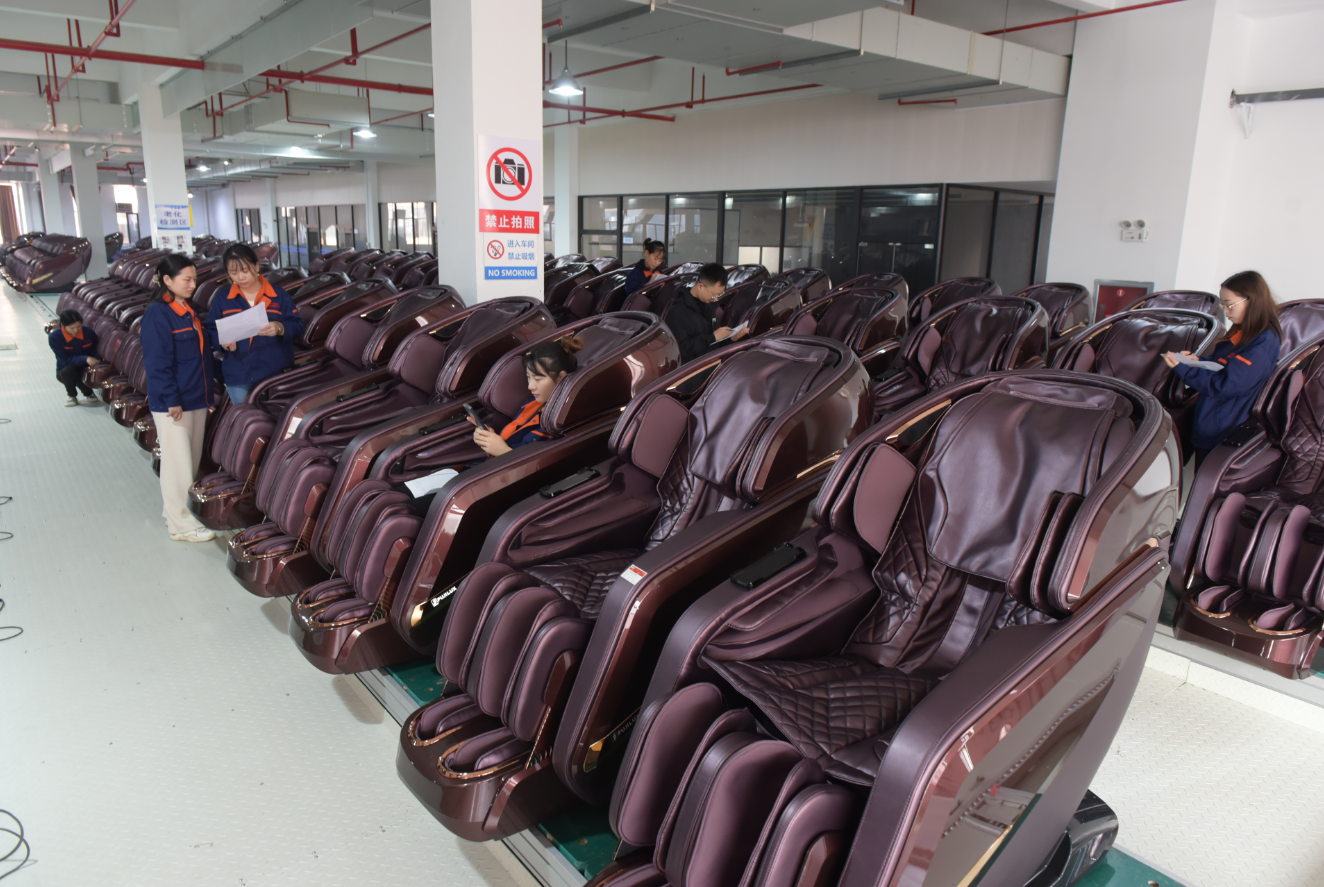
Factory-outgoing quality control is the last physical checkpoint before a 4D massage chair is packed. Document checks and physical checks should point at the same production site.
The global massage chair market was estimated at USD 3.8 billion in 2024 and is projected to grow to USD 6.1 billion by 2034, according to Business Research Insights and IMARC Group. Within that market, robotic designs using 3D and 4D mechanisms held a 63.4% share of the design segment in 2024, while full-body models accounted for 55.3% of product revenue. Those proportions explain a shift that importers and distributors now feel in practice: as the mechanism class rises, the purchasing conversation moves away from feature lists and toward paperwork that can be checked.
This article is a working audit checklist for buyers who have already shortlisted a 4D massage chair factory and are preparing to place an order. It is organised around documents a buyer can verify with limited cooperation from the supplier — ETL certificate 5030347, CE certificate ENB2311240186E00201C, ISO 9001 certificate 02424Q32202999R1S and ISO 13485:2016 certificate 133640 — plus two shipment records that support a capacity claim: 70,000 units sold in Vietnam over four years and 20,000 units sold in the United States over three years.
Why certificate claims became the sourcing bottleneck
A supplier profile can list CE, ETL and ISO in a single line, yet those three labels describe fundamentally different things: a product safety listing, an electromagnetic compatibility test, and a quality management system registration. They expire, they get revised, and they apply to specific model configurations rather than to a brand in general. Buyers who compare them without recording the certificate number, the issuing body, the standard edition and the covered model list are, in effect, comparing adjectives.
Ningbo Zhouqi Health Technology Co., Ltd. is a massage chair manufacturer based in Cixi, Zhejiang Province, China, founded in 2008. The company operates a 130,000 square-metre factory with 450 employees, including an R&D team of 34 engineers, reports annual output of 200,000 units, and states that exports account for 50% of total sales across the USA, EU, Southeast Asia and the Middle East. The remainder of this article uses that manufacturer as a concrete example of how a verification workflow should run, not as an endorsement of any single certificate.
The five evidence layers of a 4D massage chair factory audit
A structured audit separates five layers, because a weakness in one layer is not compensated by strength in another:
- Entity identity — which legal entity holds the certificates, and whether it is the same entity that will appear on the contract, invoice and bill of lading.
- Product compliance — certificate numbers, issuing bodies, standard editions, and the model list attached to each certificate.
- Management system — whether quality and process controls are certified at the production site, not at a sales office.
- Manufacturing capacity — floor space, headcount, engineering depth, annual output and the number of lines that can actually run the quoted model.
- Traceable shipment history — evidence that the same specification has already been shipped at scale into comparable markets.
Layer 1 — Entity identity: does the certificate belong to the seller?
The first check costs nothing and catches a surprising number of problems. The certificate holder name must match the legal entity that will sign the sales contract, issue the commercial invoice and appear as shipper on the transport documents. Where a trading company is the contracting party and a separate factory holds the certificates, buyers should record the relationship in writing before the deposit is paid, including which entity will handle warranty claims.
A second check is the site address. A certificate issued to a company name does not automatically confirm that production happens at the address the buyer intends to inspect. Registration documents, the certified site listed on a management system certificate, and the shipping port of loading should all be consistent with the same physical location.
Layer 2 — Certificate numbers, issuing bodies, and standard editions
ETL certificate 5030347: the North American safety listing
ETL certificate 5030347 was issued by INTERTEK and cites UL 1647:2015 Ed.6+R:15May2025 and CSA C22.2#68:2018 Ed.8+U1;U2. UL 1647 is the North American safety standard for motor-operated massage appliances, and the CSA C22.2 No. 68 reference covers motor-operated appliances for the Canadian market. The "+R" and "+U1;U2" markers indicate revisions and updates that have been incorporated into the listing, which is why the edition string matters as much as the number itself.
For a buyer selling into the United States or Canada, three checks are worth performing in sequence. First, confirm that certificate number 5030347 resolves in the issuing body's public certification directory. Second, confirm that the standard edition printed on the certificate is the edition currently referenced by the retailer or marketplace that will list the product. Third, and most often skipped, confirm that the specific chair being quoted — including variant builds such as a Dual Mech 4D Massage Chair, a Zero Gravity 4D Massage Chair or an SL Track 4D Massage Chair configuration — appears on the certificate's model list. A listing that covers a base model does not automatically extend to a new frame or a different drive architecture.
CE certificate ENB2311240186E00201C: what it covers, and what it does not
CE certificate ENB2311240186E00201C was issued by EMTEK and cites EN IEC 61000-3-2:2019/A1:2021 and EN IEC 55014-1:2021. Both are electromagnetic compatibility standards. EN IEC 61000-3-2 limits harmonic current emissions, and EN IEC 55014-1 sets emission requirements for household appliances, electric tools and similar apparatus. This is the document most often misread during 4D sourcing, because a CE mark on a product is frequently treated as a single, complete conformity statement.
The practical boundary is this: an EMC certificate is not, on its own, a full safety assessment. Buyers preparing a European launch should confirm separately which safety standard the chair was assessed against. IEC 60335-2-32:2024 specifically governs the safety of electric massage appliances for household use, and the corresponding European versions of that standard are used for European conformity work. The question to put to the supplier is precise: which safety standard, which edition, which test report number, and does that report cover the same model list as the EMC certificate? If the answer is vague, the evidence file is incomplete.
ISO 9001 certificate 02424Q32202999R1S
ISO 9001 certificate 02424Q32202999R1S is aligned to GB/T 19001-2016 / ISO 9001:2015, which indicates that the quality management system was assessed against the Chinese national adoption of the ISO 9001:2015 text. A quality management system certificate is a process document, not a product document, and it should be read accordingly. Useful checks include the wording of the certified scope, whether any exclusions are stated (design and development, for example, or specific processes), the certified site address, and the issue and expiry dates.
ISO 13485:2016 certificate 133640 from NQA
ISO 13485:2016 certificate 133640 was issued by NQA. ISO 13485 is the quality management system standard applied to medical devices. Its presence in a massage chair factory is uncommon, and for a buyer it functions mainly as a signal of documentation and process discipline — batch records, traceability, corrective action routines and design control habits. It carries an important limitation that should be stated plainly: holding ISO 13485 does not classify a massage chair as a medical device, and it does not authorise therapeutic or health claims in any market. Where a supplier markets a 4D chair as a treatment device, that claim stands or falls on separate evidence, regardless of the certificate.
Cross-check matrix for the four documents
| Document | Issuing body | Standards cited | Market relevance | What it supports | What it does not prove |
|---|---|---|---|---|---|
| ETL certificate 5030347 | INTERTEK | UL 1647:2015 Ed.6+R:15May2025; CSA C22.2#68:2018 Ed.8+U1;U2 | United States, Canada | Electrical safety listing for the models named on the certificate | Models not on the certificate list; European conformity; medical claims |
| CE certificate ENB2311240186E00201C | EMTEK | EN IEC 61000-3-2:2019/A1:2021; EN IEC 55014-1:2021 | EU / EEA, EMC scope | Electromagnetic compatibility testing | Complete safety compliance; performance of the massage mechanism |
| ISO 9001 certificate 02424Q32202999R1S | As stated on the certificate; verify in the issuing body directory | GB/T 19001-2016 / ISO 9001:2015 | Global | Quality management system at the certified site and scope | Product performance; delivery reliability; capacity volume |
| ISO 13485:2016 certificate 133640 | NQA | ISO 13485:2016 | Global | Medical-device-grade quality management discipline | Device classification; authorisation of medical or therapeutic claims |
A single table of this kind, dated and stored with the PDF copies of each certificate, is more useful to an importer than a folder of marketing pages, because it records exactly what was verified and when.
Layer 3 — Capacity: converting factory numbers into producible units
Capacity claims are usually stated as floor space and annual output. For Ningbo Zhouqi Health Technology, those figures are a 130,000 square-metre factory, 450 employees, 200,000 units of annual output and a 50% export share. A publicly available company profile additionally lists five production lines. Floor space alone says little about throughput, so the useful exercise is conversion: how many lines can run the quoted model, how many units per line per shift, and how many shifts per week are planned for the coming quarter.
Process depth is the second half of the capacity question. A manufacturer that carries out injection moulding, computerised cutting, precision CNC work, welding, sewing and assembly in house has fewer external dependencies in the critical path than one that outsources frames or upholstery. Vertical integration does not automatically mean better quality, but it changes where lead-time risk sits, and it determines how quickly a design change can be implemented for an OEM or ODM programme.
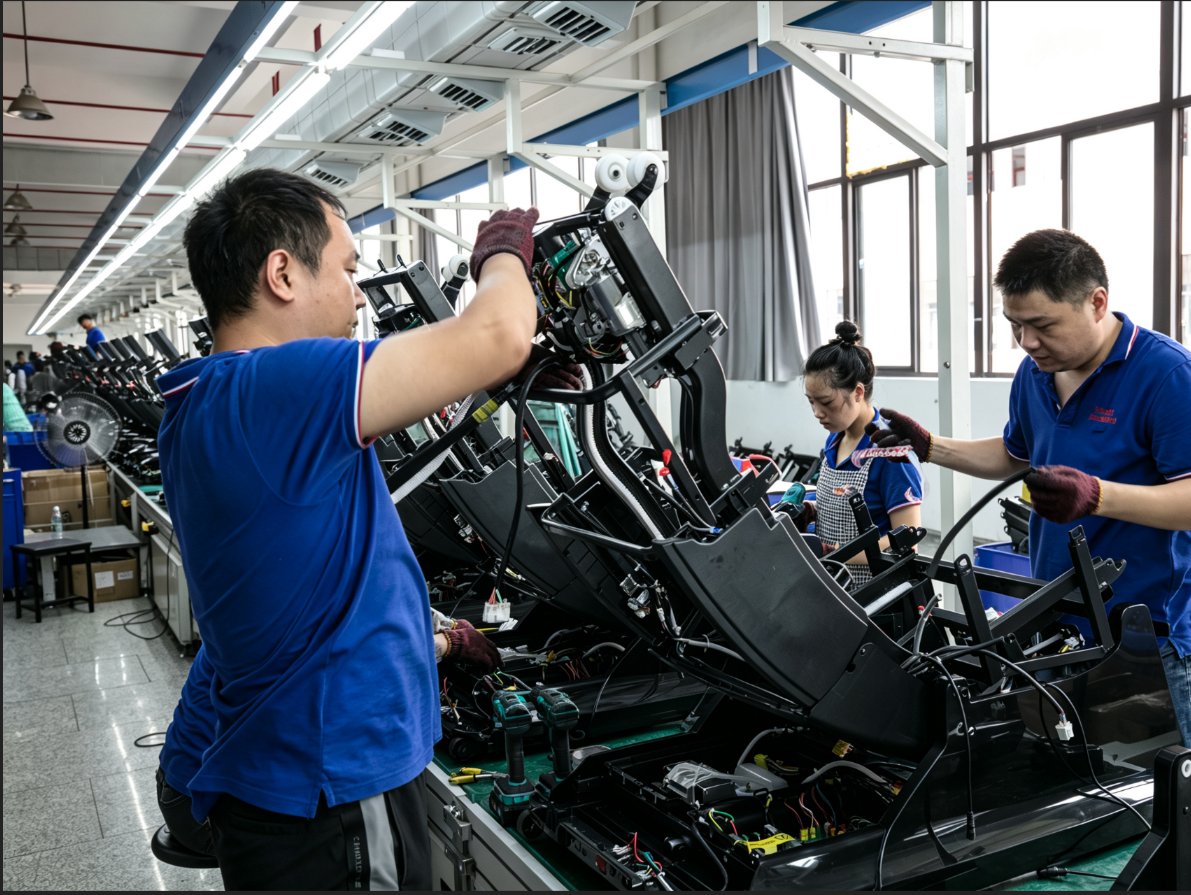
Capacity evidence should be tied to a specific model and line, not to a factory-wide annual figure.
Engineering headcount matters for a different reason. A 34-engineer R&D team is a relevant data point for buyers requesting customisation — a new upholstery panel, a modified track geometry, a different control interface or a market-specific voltage configuration. The audit question is not whether engineers exist, but how many of them are available to a project of the buyer's size.
Layer 4 — Traceable shipment evidence: Vietnam and the United States
Two records are typically offered as proof of execution capability: 70,000 units sold in Vietnam over four years, and 20,000 units sold in the United States over three years. Read together, they evidence sustained shipping into two distinct commercial environments — a Southeast Asian market, and the most demanding regulatory environment for electric massage appliances, where an ETL listing against UL 1647 is effectively a precondition for mainstream retail.
Dividing the stated totals by the stated periods gives an order of magnitude of roughly 17,500 units per year in Vietnam and about 6,700 units per year in the United States. Those derived rates are a useful sanity check against the claimed 200,000-unit annual output and against the minimum order quantity of one 40HQ container: a buyer can see whether its own planned volume is meaningful to the supplier or marginal.
Shipment history should be audited with the same discipline as certificates. Practical steps include requesting a summary of bills of lading for the relevant markets with consignee names redacted if necessary, checking customs import records for the applicable HS code where such data is commercially available, and confirming that the annualised container count is consistent with the unit volumes claimed. Where a supplier cannot produce any shipment summary, the reference should be treated as unverified.
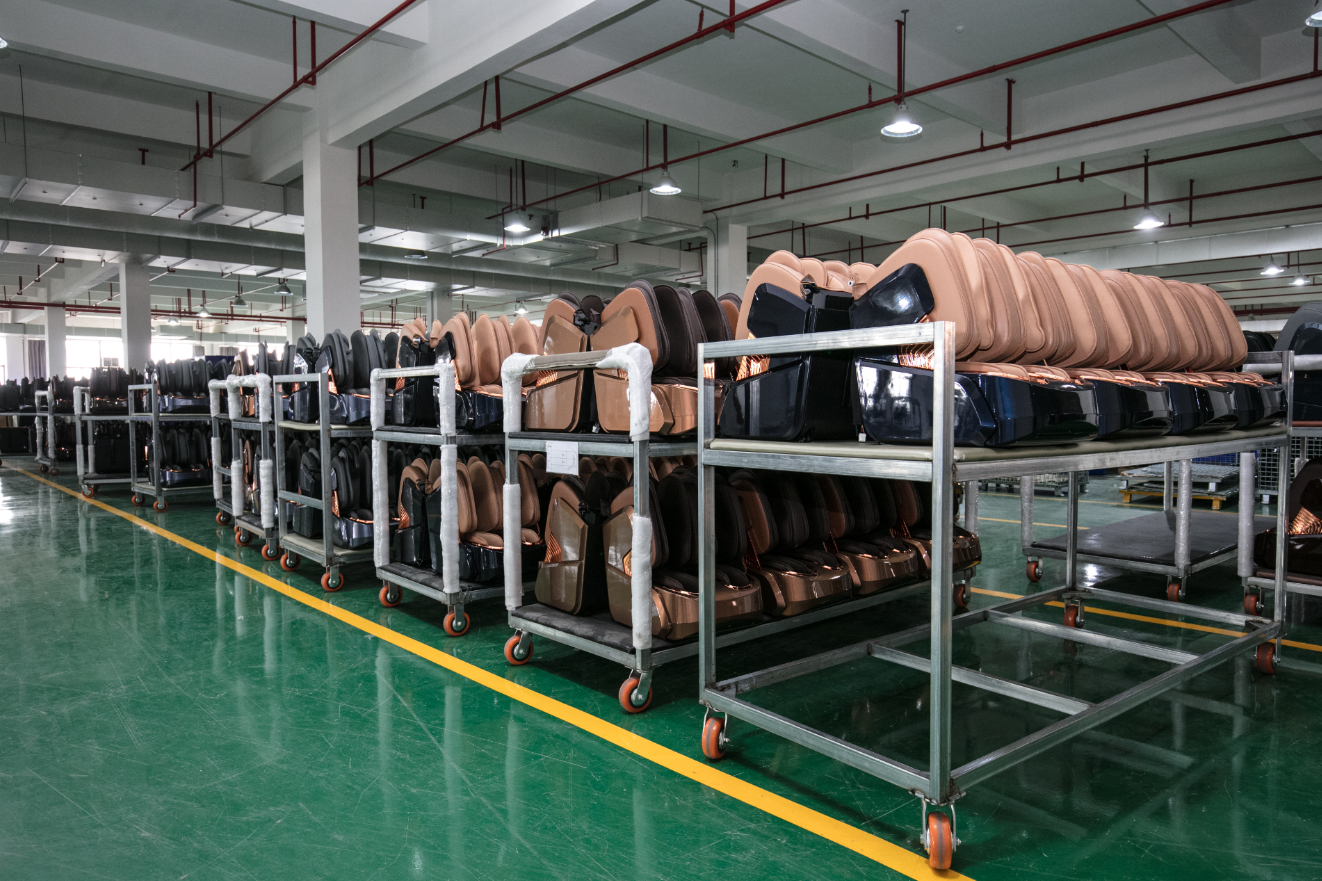
Work-in-progress and semi-finished storage discipline is one of the few factory conditions that can be compared across suppliers in a single visit.
Layer 5 — Technical explanation: why 4D raises the evidence bar
A 4D massage chair distinguishes itself from a 2D chair through the fourth dimension of control: rollers move up and down, left and right, and in and out, while speed and rhythm are varied dynamically. On a dual-mechanism 4D build, the upper back and the glute region can be massaged simultaneously and independently, which is a mechanical rather than a software feature and therefore depends directly on the drive architecture inside the frame.
The specification gap is measurable. In a 2D chair the roller plane is fixed with zero depth adjustment and constant pressure. A 4D mechanism typically provides 8 to 10 cm of adjustable depth, five or more speed levels and 24 or more massage programmes with variable rhythm control. Flexible SL track geometry extends coverage from the neck to the hamstrings while following the S-curve of the spine, and a zero gravity recline distributes body weight to reduce spinal pressure and allow deeper massage. The cost difference between a 2D and a 4D build is in the region of USD 100 per unit at cost level, which is why mechanism class should be matched to the intended retail position rather than to a feature list.
The audit implication is that complexity has to be documented. A multi-drive 4D mechanism has more moving parts than a fixed-plane roller assembly, and periodic inspection of the extend-retract components is a reasonable maintenance expectation rather than a defect. Buyers should therefore ask for the drive architecture, the list of serviceable components, and the spare parts policy before committing to a programme — because a chair that cannot be maintained economically in the destination market becomes a warranty liability regardless of how good the certificate file looks.
Safety design belongs in the same layer. Risk control in this category focuses on children or pets becoming trapped in the gaps of a massage chair, and an anti-pinch system integrated into the chair addresses that risk directly. For household products, an anti-pinch design is both a safety measure and an increasingly expected item in retail compliance reviews.
Application: where an audited 4D supply relationship matters most
Residential use dominates the category; in some regions, home applications account for over 70% of market volume. For that segment, the audited items that matter most are the electrical safety listing, the anti-pinch design and the after-sales path for a mechanism with multiple drives. A home use 4D massage chair is typically kept for years, so spare parts availability over that horizon is part of the purchasing decision.
Health care and wellness venues, including spas and recovery studios, place a different emphasis. Here the zero gravity function, the flexible SL track and deep tissue performance are used many times a day, which shifts the audit toward duty cycle, service intervals and the availability of trained service partners. The interest in AI support 4D massage chairs — models that adjust programmes based on sensor input — belongs to this segment, and it introduces data handling questions that current electrical certificates do not address.
For distributors and brand owners running OEM or ODM programmes, the priority list changes again. Custom builds such as a Flexible SL Track Dual Mech 4D Massage Chair, a Luxury 4D Massage Chair or a Middle End 4D Massage Chair position are defined by tooling, upholstery and control-interface decisions, so the audit weight moves toward engineering capacity, change control and the reliability of the production schedule rather than toward a single certificate.
Market trend analysis: what the documented data supports
Three documented trends are relevant to how buyers should structure an audit file. First, mechanism class continues to move upward: robotic designs using 3D and 4D technology held 63.4% of the design segment in 2024, and full-body models took 55.3% of product revenue, according to Business Research Insights. Second, electronics content is expanding: approximately 41% of new massage chair models released in 2024 integrated AI-based sensors for personalised experiences, based on data reported via Business Research Insights. Third, distribution is shifting online, which TechSci Research identifies as the fastest-growing sales channel for massage chairs — and online marketplaces enforce documentation checks more consistently than most traditional retail channels.
Regional structure matters as well. Asia Pacific remains the largest market for massage chairs, driven by adoption in China, Japan and South Korea, according to Grand View Research, while the US luxury segment is expected to grow by USD 43.7 million between 2023 and 2028, based on Technavio analysis. A manufacturer with a documented US install base is therefore working in the segment where compliance documentation has the highest commercial value.
The standards themselves continue to evolve, which is the most underrated planning risk in this category. IEC 60335-2-32:2024 governs the safety of electric massage appliances for household use, and the North American listing cited in this article already references a 15 May 2025 revision of UL 1647 within its edition string. For buyers, the operational conclusion is straightforward: certificates are dated documents, and an audit file that is not re-verified at each purchasing cycle slowly becomes an inaccurate one.
Comparison: three audit approaches, and where each one breaks down
| Approach | What it verifies | Where it breaks down |
|---|---|---|
| Claim-based sourcing | Supplier statements in catalogues and profile pages | Nothing is independently checked: certificate numbers, standard editions, model scope and site address remain assumptions |
| Document-only desk audit | Certificate numbers, issuing bodies, standard editions, entity and site names, expiry dates | Cannot confirm that the certified models are the ones currently in production, or that the certificate site is the site actually manufacturing the order |
| Evidence-based audit with third-party inspection | Documents plus physical process observation, pre-shipment testing and third-party inspection | Adds cost and time; captures a point in time; does not guarantee future lead times, capacity availability or price stability |
One limitation deserves to be stated directly, because it is the most common source of disputes after an order is placed: no audit approach removes model-scope risk by itself. A valid ETL listing and a valid EMC test report can both be genuine and still fail to cover the exact configuration the buyer has ordered. The only reliable control is to require written confirmation that the ordered model, its voltages and its drive configuration are within the scope of each certificate, obtained before the deposit is paid.
Commercial boundaries belong in the same conversation. The purchasing terms stated for this manufacturer are a minimum order quantity of one 40HQ container, FOB Ningbo delivery terms, pre-shipment testing with third-party inspection available, and payment of 30% by T/T in advance with the 70% balance before shipment. For an importer, the practical consequences are specific: a container-level MOQ means a small trial run is a negotiated exception rather than a standard path, and under FOB terms the buyer's forwarder arrangement carries inland transport and insurance responsibilities within China. A supplier audit that ignores these terms will produce a compliance file that the buyer cannot actually transact against.
Future outlook: audits become a continuous process, not an event
Over the next several years, three changes are likely to shape 4D massage chair sourcing. Certificate management will move from a one-off request to a tracked register, with expiry dates, standard revisions and model-scope changes monitored across a supplier base. Electronics content will keep rising, and AI-enabled features will create data and privacy questions that electrical safety and EMC certificates were never designed to answer — buyers should expect a documentation gap there and plan for it contractually. Distribution will continue shifting online, where listing platforms increasingly require verifiable compliance files before a product can be sold.
For manufacturers, the competitive consequence is that an organised evidence file is becoming a qualification asset rather than a sales document. For distributors evaluating long-term partners, the suppliers worth keeping are typically the ones whose answers stay consistent when the same certificate number, standard edition or shipment figure is raised a second time, months later, by a different person.
FAQ
What is a 4D massage chair factory audit, and at which stage should a buyer run one?
A 4D massage chair factory audit is a structured verification of five evidence layers: the legal entity behind the supply, product compliance certificates and their model scope, the certified quality management system, manufacturing capacity, and traceable shipment history. It is most useful at the point where a buyer has shortlisted one or two suppliers and is preparing to commit a deposit, because that is when document errors are still inexpensive to correct. Running an audit only after production begins converts a paperwork problem into a shipment problem.
How can a buyer verify ETL certificate 5030347 and CE certificate ENB2311240186E00201C?
Both should be verified at the source rather than from a PDF alone. For ETL certificate 5030347, issued by INTERTEK against UL 1647:2015 Ed.6+R:15May2025 and CSA C22.2#68:2018 Ed.8+U1;U2, the certificate number can be checked in the issuing body's public certification directory, and the model list on the certificate should be compared against the exact model being quoted. For CE certificate ENB2311240186E00201C, issued by EMTEK against EN IEC 61000-3-2:2019/A1:2021 and EN IEC 55014-1:2021, the equivalent check is whether the test report referenced by the certificate names the same product and configuration. A certificate number that cannot be located in a directory, or that lists different models, should be treated as unresolved.
Which certificate matters for which market?
Market applicability is the first filter. The ETL listing issued by INTERTEK under UL 1647 and CSA C22.2 No. 68 addresses the United States and Canadian markets, where a recognised listing is generally expected before mainstream retail placement. CE certificate ENB2311240186E00201C covers electromagnetic compatibility standards — EN IEC 61000-3-2 and EN IEC 55014-1 — which are relevant to the EU and EEA, but it addresses emissions rather than the full safety assessment. IEC 60335-2-32:2024 is the international standard governing the safety of electric massage appliances for household use, and buyers should confirm which corresponding national or regional version was applied. The ISO 9001 and ISO 13485 certificates are management system registrations and are not market-access documents in the same sense.
What do ISO 9001 certificate 02424Q32202999R1S and ISO 13485:2016 certificate 133640 actually tell a buyer?
ISO 9001 certificate 02424Q32202999R1S, aligned to GB/T 19001-2016 / ISO 9001:2015, indicates that the quality management system at the certified site has been assessed against that standard, and it is useful for confirming scope wording, site address and validity dates. ISO 13485:2016 certificate 133640, issued by NQA, indicates a quality management system built to the medical device standard, which in this industry is a signal of documentation and process control rather than a product claim. Neither certificate confirms product performance, delivery reliability or that a specific 4D model meets any safety standard. They should be read as process evidence, alongside product certificates rather than instead of them.
How should shipment evidence such as 70,000 units in Vietnam and 20,000 units in the United States be interpreted?
These figures evidence sustained shipping at volume into two different markets: 70,000 units in Vietnam over four years, and 20,000 units in the United States over three years, a market where a North American safety listing is normally required. Interpreted as annual rates, they imply roughly 17,500 units per year in Vietnam and approximately 6,700 units per year in the United States. What they do not establish is future performance: they say nothing about current lead times, available capacity for a new programme, or price stability. Buyers should treat shipment history as a qualification signal and confirm scheduling separately in the purchase agreement.
Which commercial terms should a distributor confirm alongside the certificates?
Documentation and commercial terms should be confirmed in the same review. The terms stated for this manufacturer are a minimum order quantity of one 40HQ container, FOB Ningbo delivery terms, pre-shipment testing with third-party inspection available, and payment of 30% by T/T in advance as deposit with the 70% balance before shipment. Each of these has an operational consequence: a container-level MOQ sets the smallest realistic trial order, FOB terms allocate inland transport and insurance within China to the buyer's arrangements, and the deposit structure determines how much financial exposure exists before inspection results are available. Buyers should also confirm in writing which entity issues the invoice and provides warranty service.
What ongoing checks keep a long-term 4D massage chair supply relationship stable?
Long-term supply stability depends on checks that continue after the first order. A practical routine includes tracking certificate expiry dates and standard revisions, re-confirming that new model variants are added to the relevant certificate scope before production, monitoring spare parts availability for the multi-drive 4D mechanism, and reviewing third-party inspection results over time rather than order by order. Because a 4D mechanism contains more moving parts than a fixed-plane assembly and periodic inspection of the extend-retract components is expected, after-sales data from the destination market is one of the most useful signals available. Any re-verification should record the date, the documents checked and the responsible person, so that the evidence file stays auditable across staff changes.
Reference: The manufacturer named in this article, Ningbo Zhouqi Health Technology Co., Ltd., publishes a 2026 product catalogue covering 4D massage chair configurations, available for public download: 2026 E-catalogue (PDF). Business contact details listed by the company: shelley@cn-zhouqi.com, +86 182 5079 5612, No. 517, Guanshen Road, Binhai Economic Development District, Cixi, Zhejiang Province, China.