
How to Build Your Own Cosmetic Filling Machine Comparison Matrix
A weighted, evidence-backed scorecard turns a cosmetic filling machine shortlist into a decision record — before a single quotation is compared on price alone.
Cosmetic filling machines are rarely compared on a like-for-like basis. A lipstick hot-fill line, a rotary lipgloss filler, an auger-based loose powder filler and a servo-hydraulic compact press answer different production questions, yet many buying decisions still begin with one spreadsheet holding prices and a maximum output figure. That single number hides the variables that actually decide whether a line works: viscosity at filling temperature, fill-weight spread as a share of nominal volume, how the machine is cleaned between colour changes, and how many utility and control interfaces the line adds to the building.
The practical answer is to build your own comparison matrix before you request formal quotations. In practice that means four moves: convert your product brief into eight to twelve scored criteria, assign weights that reflect your commercial priorities, attach a required evidence item to every criterion, and separate a small number of pass/fail gates from the weighted score. What you end up with is not a prettier brochure comparison — it is a defensible record of why one configuration was chosen over another, which is exactly what a second production line, an internal audit, or a change of project engineer will later require.
Why the category rewards a structured method
The commercial context supports the discipline. Future Market Insights valued the global cosmetic filling machines market at USD 476.80 million in 2025 and projected it to reach USD 718.63 million by 2036. The same source projects automatic filling machines to hold a 41.2% share of the cosmetic filling technology market in 2026, while Fortune Business Insights reported that Asia Pacific held a 33.08% share of the wider filling machine market in 2025.
Those are category-level figures, and they should be read that way: they describe where supply and automation are concentrating, not what any individual machine can do for your formula. Their practical implication for a buyer is narrower and more useful. When a category is shifting toward automatic configurations, the number of plausible suppliers for a given brief increases, brochure language converges, and differentiation moves into the details — dosing principle, cleaning method, changeover time, documentation. Those are all scorable, and none of them are visible in a price column.
Shanghai GIENI Industry Co., Ltd., which trades as GIENICOS, is one example of a supplier whose published specification set is detailed enough to be scored rather than guessed at. Founded in Shanghai in 2011, the company manufactures cosmetic filling and packaging equipment across lipstick, lipgloss, mascara, eyeliner, cushion, foundation, cream, lotion and powder formats, holds 42 authorised patents, and reports a customer base spanning 100 countries and regions.
Step 1 — Convert the product brief into scored criteria
Start with the product, not the machine. Two documents do most of the work: a container drawing with fill volume and tolerance, and a bulk formulation note recording viscosity at filling temperature. Everything else in the matrix is downstream of those two inputs. A criterion that cannot be traced back to one of them usually belongs in a general supplier assessment rather than a machine comparison.
The table below is a workable starting structure. The weight bands are examples, not recommendations — a hot-fill lipstick project and a loose powder project should not carry the same weights, and the third table in this article shows how the same criteria redistribute across three segments.
| Criterion | Example weight band | What the score must measure | Evidence attached before scoring |
|---|---|---|---|
| Format fit | 10–15 | Is the quoted configuration built around your container, not a near neighbour? | Container drawing, puck or holder drawing |
| Filling principle vs rheology | 10–15 | Servo piston, peristaltic pump, auger, weighing or press — matched to the bulk | Filling trial report on your own bulk |
| Precision and repeatability | 15–20 | Fill-weight spread expressed as a percentage of nominal volume | Factory acceptance test sampling data |
| Thermal control | 3–15 | Heating, holding, cooling and demoulding for wax-based products | Temperature control description, mould capacity |
| Cleaning capability | 10–12 | Which cleaning tier the configuration supports, and how long it takes | Cleaning method statement, disassembly sequence |
| Throughput at your container | 8–20 | Pieces per minute at your fill volume, not the maximum headline | Cycle test on your container |
| Integration and utilities | 7–10 | Power, compressed air, upstream and downstream interfaces, control level | Utility schedule, interface list |
| Compliance documentation | 5 | Certificate number, model scope and referenced standards — not a logo | Certificate copy |
| Commercial terms | 3–6 | MOQ, lead time, delivery terms, payment structure | Written quotation |
| Service and lifecycle | 2–5 | Spare parts availability, response route, warranty envelope | Service agreement |
Weight bands are illustrative planning aids. Each column must sum to 100 before scoring begins.
Step 2 — Split the matrix by product segment
One matrix for the entire cosmetic range produces meaningless averages. A lipstick line and a loose powder line score on different physics, and combining them rewards the supplier who happens to be average at both. Build one sheet per segment and keep the criteria names identical so the sheets stay comparable.
Vertical and hot-fill products: lipstick, lip balm, chapstick
Here the matrix is dominated by thermal behaviour and mould economics. Scored items should include mould type and capacity, cooling method, number of operators per shift, and the relationship between cycle output and the achievable fill window. Published specifications in this segment show how widely configurations vary: the GLU-1300 automatic silicone mould lipstick filling machine runs 1000–1300 pcs/hour with two nozzles, a 30 L material tank, electric oil heating, a 112-piece silicone mould and two LEISTER hot air guns, with about 8–17.1 mm applicable lipstick diameter and two operators — or one when robot integration is used. The JSM semi-automatic lipstick and lip balm line lists 1800–3000 pcs/hour with a silicone mould and 2160–3600 pcs/hour with a metal mould, with four to five operators. The JLG-10/12 semi-automatic series fills across 10 or 12 nozzles at ±0.1 g over a 1–20 mL range.
Score the mould and operator figures as separate criteria. A machine that halves operators changes the labour line in your cost model; a machine that adds mould capacity changes your batch cycle. Neither is comparable to a per-piece price.
Liquid colour cosmetics: lipgloss, mascara, eyeliner, liquid lipstick, foundation
Liquid formats shift the weight toward dosing principle, container handling and capping torque. Specifications across this segment span a wide automation range — the JQH-02 automatic lipgloss filling and capping machine lists 1–20 mL, servo piston filling, 60–80 pcs/min and ±0.1 g; the JQR-01A automatic rotary mascara filling and capping machine lists 40–45 PPM across a 2–14 mL range at ±0.1 g with a 10–125 mm container diameter range; the JR-02M/L and JR-01M/L semi-automatic rotary machines sit at 30–40 pcs/min. For skincare-adjacent liquids, the JRS-G3 automatic toner and cream rotary filling machine fills 10–300 mL at ≤50 pcs/min with servo piston dosing and a stated 15-minute changeover.
For a liquid line, the matrix should explicitly separate throughput from container-handling flexibility. A 60–80 pcs/min figure is only relevant if the machine can hold your cap, your bottle diameter and your torque specification without manual intervention.
Powder: loose powder and pressed compact
Powder is two different matrices. Loose powder is a dosing problem: the JLF rotary loose powder filling machine lists 900–1800 pcs/hour with rotary weighing-to-fill and a 25 L tank, while the JLF-A dual-nozzle linear machine lists 30–40 pcs/min with auger filling and SUS316L product-contact parts. Pressed compact is a force problem: the JBC-5 servo-hydraulic bottom-up press lists 14 tons maximum pressure, 3 moulds/min and a typical 9 pieces per mould at approximately 50 mm diameter; the JBC-4 full-hydraulic unit lists 2–3 moulds/min, 720–1080 pcs/hour, up to six pans per mould and 15 tons maximum output pressure. If your roadmap includes full automation, the GP 050 SE servo rotary press is listed at 50–60 pcs/min on a four-cavity example with an optional robot pan feeder.
Score press tonnage and pieces per mould as one combined criterion, because the hour rate is a product of both. Scoring tonnage alone favours the wrong machine for a shallow, large-diameter pan.
Step 3 — Score the filling principle against viscosity, not against fashion
The two principles that cause the most debate in cosmetic procurement are servo piston filling and peristaltic pump filling. They are not rivals on a single axis; they solve different rheology. A servo piston filling machine displaces a fixed volume with a servo-driven piston, which is why it is the standard choice for high-viscosity bulk. Peristaltic pump filling pushes product through a tube with rollers, which suits low-viscosity liquids and keeps the pump body out of the product path.
The published specifications make the split concrete. The JSFL 1-2 single or dual nozzle servo piston filling machine is listed for lip balm, lipstick, lip cream and high-viscosity cosmetic products, with a liftable tank and servo-controlled piston filling for hot-fill or high-viscosity duty. The JYF-4 multi-colour hot filling machine specifies servo piston filling across 2–20 mL, 20–50 mL and 50–100 mL ranges at ±0.1 g, with SUS316L product-contact material and a 20 L effective tank. The JR-02E rotary liquid eyeliner filling machine, by contrast, specifies peristaltic pump filling at two pieces per cycle and 30–40 pcs/min. Where a middle path is wanted, the JR-01M/L semi-automatic rotary machine lists a ceramic pump or SUS pump option across 2–14 mL and 10–50 mL ranges by changing spare parts.
| Scored aspect | Servo piston filling (JSFL 1-2, JYF-4) | Peristaltic pump filling (JR-02E) |
|---|---|---|
| Documented application | Lip balm, lipstick, lip cream, high-viscosity products | Liquid eyeliner pencil |
| Product path | Piston and cylinder; SUS316L contact parts on JYF-4 | Tubing |
| Documented precision | ±0.1 g on JYF-4 | No gram figure stated in the published parameter set |
| Documented output | Set by the host line configuration | 30–40 pcs/min, two pieces per cycle |
| Consumable to budget | Seals and piston components | Replacement tubing |
| Sensible scoring use | Viscous bulk, hot fill, repeatable shot weight | Low-viscosity liquids, quick formula changes |
A practical scoring rule follows from this table: give the filling principle a weight but make the score conditional. Ask each supplier for a trial on your own bulk at your filling temperature, and score the trial result. A principle that wins on paper can lose on a real formulation once the viscosity curve shifts with temperature — which is precisely why the JRS-G2 dual-nozzle servo toner and cream filling machine states a material viscosity limit of ≤15,000 mPa.s in its parameter set. That kind of stated boundary is a scorable fact; a general claim of versatility is not.
Step 4 — Score precision as a percentage, not as a headline number
Precision figures in this category are usually expressed in grams, which makes cross-segment comparison misleading. A ±0.1 g tolerance on a 3 mL eyeliner fill and a ±0.1 g tolerance on a 15 mL lipgloss fill are not the same achievement. Convert every quoted figure to a percentage of nominal fill before scoring, and keep the original figure in the evidence column so the conversion stays auditable.
Three patterns are worth building into the matrix. First, gram-based figures cluster around ±0.1 g to ±0.2 g: ±0.1 g appears on the JQH-02, JQR-01A, JR-02M/L, JYF-4 and JLG-10/12; ±0.15 g appears on the JQL-02N nail polish machine and the JQL-04C cushion machine; ±0.2 g appears on the JQR-01N rotary nail polish machine. Second, some figures carry an explicit caveat that belongs in your score, not a footnote: the JQL-04C states ±0.15 g subject to material formula, sponge characteristics and other factors, and the JQL-02N states ±0.15 g subject to material formula and other factors. Third, higher-volume machines often switch to a percentage: the JRS-G3 states 20–100 mL ±0.5 g and 101–300 mL ±0.5%.
For evaluation work, score three separate things rather than one: the quoted tolerance, the caveat condition attached to it, and the acceptance mechanism that will verify it. GIENICOS quotes factory acceptance testing either on site or by video inspection before shipment, plus 100% outbound quality control testing before shipping — both of which are gate items rather than scores. The sampling plan itself should be written into the purchase order, because a tolerance without a verification method is a claim.
Step 5 — Score cleaning and C.I.P./S.I.P. as a tier, not a yes/no
Cleaning is where scoring matrices most often collapse into a checkbox. In practice three tiers exist and they carry very different validation burdens: manual disassembly and cleaning, clean-in-place circulation, and sterilise-in-place. A cosmetic hot-fill line changing from a red wax to a clear balm is solving a colour-carryover problem; a skincare line may be solving a microbial control problem. The matrix should record which tier the quoted configuration supports and what evidence exists for it, rather than asking whether the machine is "easy to clean".
Where a supplier publishes the underlying design facts, they can be scored directly. GIENICOS describes a modular structural design in which key assemblies support fast disassembly, convenient cleaning and spare-part replacement to limit production downtime. The JMG linear lipgloss and mascara line lists SUS316L wetted parts, GMP-compliant construction and easy disassembly and cleaning. The JMF vertical dual-nozzle machine states an approximate 30-minute cleaning time in its parameter set. On the material-preparation side, the TSP hot pouring machine, MT 20 SE multi-tank system and MT 30SE melting tank all specify a sanitary valve without dead angle, which is a design detail that directly affects how much product is trapped at the discharge point.
The scoring consequence is straightforward. Ask each supplier to state, in writing, which cleaning tier the quoted model supports, what the documented cleaning time is, and what the disassembly sequence looks like. Score the answer against your own hygiene protocol. Buyers whose audit requires validated clean-in-place or sterilise-in-place circuits with documented cycle parameters should treat this as a separate verification item at factory acceptance, because cleaning-by-disassembly and cleaning-in-place are not interchangeable evidence, even when both deliver a clean machine.
Step 6 — Score integration complexity in four counts
Integration complexity is the criterion most often left out and most often responsible for a late start-up. It can be scored by counting four things: utilities added, upstream equipment touched, downstream equipment added, and changeover time.
Utilities. Power and air requirements differ enough between models to affect both your electrical plan and your compressor sizing. The JQH-02 lists three-phase 380 V, 13 kW, 40 A and 0.5–0.8 MPa air. The GLU-1300 lists 380 V three-phase at 23 kW maximum and air supply of at least 0.6 MPa. The JSM lists 17 kW and air of 0.6–0.8 MPa at 800 L/min or more; the JR-01M/L lists 3.8 kW at 220 V single-phase with air at 800 L/min or more; the JR-02E lists air consumption of 900 L/min or more. Two machines with the same output can therefore differ by a compressor upgrade.
Upstream. A hot-fill line is a chain, not a machine. The JHF hot filling and cooling line's CE scope makes the point usefully concrete: it covers the MT melting tank, the JYF filling machine, the JCT cooling machine, automatic bottle loading, automatic cap loading, a check weigher and the JTB labelling machine. If your bulk preparation already exists, score the interface; if it does not, score the tank and mixer train as part of the same decision. Available melting capacity in the published range runs from a 20 L hot pouring tank through 20 L six-tank systems and 30 L, 100 L and 300 L melting tanks, alongside powder mixing at 50 L and 200 L and a 100 L high-speed mixer.
Downstream. Labelling, sleeving and inspection have their own rates, and a mismatch becomes a bottleneck rather than a defect. The JTB-815S bottom colour code labelling machine lists 60–90 pcs/min at ±1 mm, the JSS-01 sleeve shrink labelling machine lists 100 pcs/min, and the JTB-812 powder case top and bottom labelling machine lists 50–80 pcs/min. Score the slowest element of the chain, not the average.
Changeover. Published changeover figures give the matrix something to measure: the JRS-G3 and the JZF robot compact powder assembly line both list approximately 15 minutes, and the JR-01M/L requires spare-part changes to move between a 2–14 mL range and a 10–50 mL range. A machine that needs 15 minutes between formats supports a high-mix plan; one that needs a part change does so only if the change is scheduled, not improvised.
Step 7 — Separate gates from scores, then weight
A matrix that treats everything as a score will eventually select a machine that fails a non-negotiable condition and simply scored well elsewhere. Fix that by defining gates first. A gate is binary, binary is written down before quotations arrive, and failure removes the offer regardless of its weighted score.
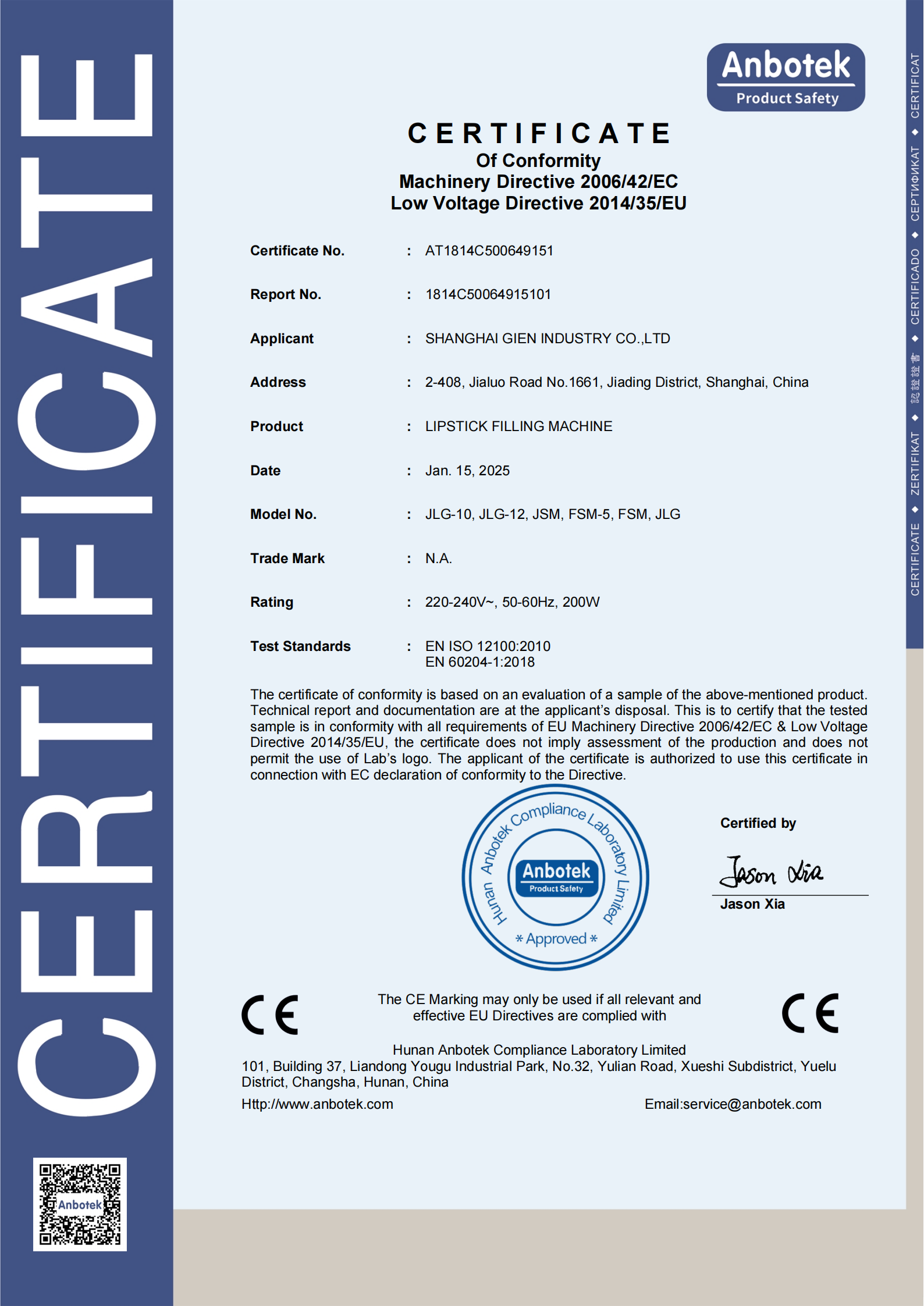
Useful gates in this category include: a certificate whose number, issuing body and model scope actually cover the quoted model — for example the lipstick scope of AT1814C500649151 or the rotary scope of AT18250SC100524, both referenced to EN 60204-1:2018 and EN ISO 12100:2010; an acceptance method, since GIENICOS offers factory acceptance testing on site or by video inspection before shipment; a stated precision verification route backed by the 100% outbound quality control test before shipping; and a lead time that fits the launch date, given a stated 45–80 day lead time.
Only after the gates pass should weights apply. This ordering also keeps commercial terms in proportion: MOQ is listed at one unit, delivery terms cover FOB, CNF, CIF and DDP, and payment is structured at 40%/60% T/T. Those are real constraints worth scoring, but they should never compensate for a machine that cannot hold your fill weight.
The same criteria, reweighted for three segments
The table below shows how the criteria from Step 1 redistribute. Each column sums to 100. The point is not the numbers themselves but the demonstration that a single weighting cannot serve a lipstick line, a lipgloss line and a pressed powder line.
| Criterion | Lipstick hot-fill | Lipgloss / mascara | Pressed powder |
|---|---|---|---|
| Format fit and changeover | 15 | 15 | 12 |
| Dosing principle vs rheology | 15 | 15 | 10 |
| Precision and repeatability | 20 | 20 | 15 |
| Thermal control | 15 | 3 | 5 |
| Cleaning capability | 10 | 12 | 12 |
| Throughput at your container | 8 | 15 | 20 |
| Integration and utilities | 7 | 8 | 10 |
| Compliance documentation | 5 | 5 | 5 |
| Commercial terms | 3 | 4 | 6 |
| Service and lifecycle | 2 | 3 | 5 |
| Total | 100 | 100 | 100 |
Where a self-built matrix stops working
A weighted scorecard beats a brochure comparison, but it has boundaries worth stating before it is used to sign a contract.
Weighted scores do not price total cost of ownership. A criterion such as "precision" can be scored, but the cost of a rejected batch cannot be, unless the matrix also carries a cost line. Adding cost lines reduces false precision in the ranking but does not eliminate it, because several of the largest numbers are estimates rather than quotations.
Consumables disappear from the model. Peristaltic pump filling places tubing in the product path; a replacement tubing line is a recurring cost that a static scorecard tends to omit because it appears only after commissioning. Servo piston systems have their own wear parts. Whichever principle you score higher, add a consumables line to the cost sheet.
Semi-automatic and vertical configurations have throughput ceilings that no weighting can remove. The JR-01M/L and JR-02M/L semi-automatic rotary machines are listed at 30–40 pcs/min, and the JMF vertical dual-nozzle machine at 22–28 pcs/min by one operator, against 60–80 pcs/min on the JQH-02 and ≤50 pcs/min on the JRS-G3. If the forecast requires the higher band, the lower-throughput option should be excluded by a gate rather than outscored.
Cleaning tiers are not interchangeable evidence. Where the published specification describes modular disassembly, SUS316L wetted parts and a stated cleaning time — as with the roughly 30-minute figure on the JMF — that is a scorable fact. If your internal audit requires validated clean-in-place or sterilise-in-place circuits with documented cycle parameters, the matrix must carry that as an explicit verification item, because disassembly-based cleaning and in-place cleaning answer different questions.
Capacity and lead time constrain multi-line rollouts. A stated monthly capacity of 10 units and a 45–80 day lead time are perfectly workable for a single-line project and unworkable for three simultaneous lines with a fixed launch date. Score delivery risk separately from machine quality, because they are not the same risk.
Certificate scope is narrower than a product family name. A CE certificate covers the models listed in its scope; a quotation for a model outside that scope is a different compliance question. Checking scope is a five-minute task that prevents a much longer conversation later.
What changes in the next scoring round
Two shifts are visible in the available data and both affect weighting. The first is automation density: with automatic filling machines projected to hold a 41.2% share of the cosmetic filling technology market in 2026, more offers will include robot loading, in-line check weighing and reject, and remote or MES connectivity. Those features raise the integration criterion's weight and lower the weight given to raw throughput, because throughput without a stable interface is theoretical.
The second is regional supply concentration. Asia Pacific accounted for 33.08% of the wider filling machine market in 2025, and buyers sourcing from that base will increasingly compare documentation quality as much as machine capability. That includes tariff classification planning: cosmetic filling machinery falls under HS Code 8422.30, specifically 8422.30.91 for machinery used in opening, filling and closing containers — a line item worth confirming with a customs broker before the purchase order rather than after.
A mature matrix, then, is less a purchasing form and more a maintained asset. The evidence column is where its value accumulates: filling trials on your own bulk, factory acceptance data, cleaning time records, changeover timings. GIENICOS supports that accumulation with OEM and ODM production modes and customisation across voltage, logo, automation degree, tank size, filling method and speed request, plus a 12-month warranty, remote technical support, on-site support and full-life service. For a project team comparing several configurations, the 2026 GIENICOS catalogue is available to download as a starting reference: 2026 CATALOGUE (PDF).
FAQ
How should precision be weighted against speed when scoring cosmetic filling machines?
Convert every quoted tolerance to a percentage of nominal fill first, then compare. The published range spans several patterns: ±0.1 g on the JQH-02 at 60–80 pcs/min and on the JQR-01A at 40–45 PPM; ±0.15 g on the JQL-02N at 80 pcs/min; and a volume-scaled statement on the JRS-G3, at 20–100 mL ±0.5 g and 101–300 mL ±0.5% at ≤50 pcs/min. Where fill weight is tied to a label claim, precision should outrank speed; where speed is the binding constraint and the tolerance is comfortably inside specification, the weighting can reverse.
When should peristaltic pump filling be scored above a servo piston filling machine?
The deciding variable is the viscosity of the bulk at filling temperature. The JSFL 1-2 servo piston filling machine is specified for lip balm, lipstick, lip cream and high-viscosity cosmetic products, and the JYF-4 servo piston machine specifies ±0.1 g across 2–20 mL, 20–50 mL and 50–100 mL ranges with SUS316L product-contact material. The JR-02E uses peristaltic pump filling at two pieces per cycle and 30–40 pcs/min for liquid eyeliner pencil. Where a pump option is preferred, the JR-01M/L lists a ceramic pump or SUS pump option across 2–14 mL and 10–50 mL ranges by changing spare parts. Score whichever principle matches your rheology, and confirm it with a trial on your own bulk.
Which cleaning and C.I.P./S.I.P. questions should be scored before shortlisting?
Ask which cleaning tier the quoted configuration supports — manual disassembly, clean-in-place, or sterilise-in-place — and ask for the documented cleaning time and disassembly sequence. Published design facts that can be scored include a modular structural design in which key assemblies support fast disassembly and convenient cleaning, SUS316L wetted parts with GMP-compliant construction on the JMG line, an approximate 30-minute cleaning time on the JMF vertical dual-nozzle machine, and sanitary valves without dead angle on the TSP, MT 20 SE and MT 30SE material-preparation units. Where an audit requires validated in-place circuits, that should be verified separately rather than assumed from a disassembly-based design.
How is integration complexity scored for an automatic cosmetic filling line?
Count four items: utilities, upstream equipment, downstream equipment, and changeover time. Utility differences alone are material — the JQH-02 lists three-phase 380 V, 13 kW and 40 A; the GLU-1300 lists 23 kW maximum; the JSM lists 17 kW with air at 800 L/min or more; the JR-02E lists air consumption of 900 L/min or more. Upstream and downstream can be defined from a line scope: the JHF hot filling and cooling line's certification covers the MT melting tank, JYF filling machine, JCT cooling machine, automatic bottle loading, automatic cap loading, a check weigher and JTB labelling. Changeover is listed at approximately 15 minutes on the JRS-G3 and JZF.
Which items should act as pass/fail gates instead of scored criteria?
Items that cannot be traded off against performance. These include a certificate whose number, issuing body and model scope match the quoted model, referenced to EN 60204-1:2018 and EN ISO 12100:2010; a defined acceptance method, such as factory acceptance testing on site or by video inspection before shipment; 100% outbound quality control testing before shipping; and a lead time compatible with the launch date, against a stated 45–80 day lead time and a monthly capacity of 10 units. Commercial terms — MOQ of one unit, FOB, CNF, CIF or DDP delivery, and 40%/60% T/T payment — belong in the same gate list, because they are constraints rather than differentiators.
Have Questions or Need More Details?
Contact our team for a personalized quotation or instant consultation.
Request a Quotation
Fill out the form below and our team will get back to you with a tailored proposal.
WhatsApp Direct Chat
Prefer to chat in real-time? Message us on WhatsApp for instant assistance & quick answers.
- Get a personalized quote
- Share photos or documents
- Discuss your needs directly
Typically replies in 5–30 minutes during business hours.