
How to Build a Shortlist of High-Speed Bunching/Stranding Suppliers: A Structured Method
A shortlist is not a mailing list. In high-speed bunching and stranding equipment sourcing, the difference between a fifteen-name list and a three-name shortlist is usually one thing: whether the buyer fixed the technical envelope before contacting anyone. This method sets out a repeatable, five-step procedure that any cable manufacturer, procurement team or engineering project group can apply — regardless of which country the supplier base sits in.
1. Why an Unstructured Vendor List Creates Cost
High-speed bunching/stranding machines are configured, not catalogued. Strand count, wire diameter range, spool size, tension architecture and line speed all interact, and the machine a supplier quotes in week one often bears little resemblance to the machine it would actually build. Buyers who collect quotations from a dozen vendors before defining their own requirement spend weeks normalising incomparable offers.
Industry estimates suggest that in capital equipment purchases above USD 200,000, the specification and evaluation phase accounts for only 5–8% of total project time but determines the majority of lifecycle cost. The shortlist is where that leverage is created.
2. Step 1 — Fix the Process Envelope First
2.1 Translate cable construction into machine requirements
Bunching and stranding are not interchangeable, and the distinction should appear at the very top of your requirement sheet. Bunching is typically applied to flexible conductors (Class 5 and 6 constructions under IEC 60228) where the objective is flexibility and roundness at high speed. Rigid frame stranding machines are used where the lay length must be controlled precisely on larger cross-sections and where take-up and tension stability dominate.
Before approaching any vendor, document:
- Nominal conductor cross-section range and the wire diameter range feeding the machine
- Strand count per construction (7, 19, 37 and beyond), including the highest count you anticipate within three years
- Lay length range and tolerance
- Take-up spool flange diameter and maximum weight
- Whether the line must integrate with a motorised pay off, an in-line electrolytic plating stage (Ni, Ag or Sn single-wire plating), or a downstream coating process
2.2 Convert throughput into a number the vendor must respect
Line speed in metres per minute is a marketing figure; kilograms per hour at your finished diameter is a production figure. Ask vendors to state throughput at 85% availability and at the upper bound of your wire diameter range — not at the lightest, fastest-running construction.
| Field | What to demand |
|---|---|
| Strand / construction range | Minimum and maximum strand count, wire diameter range, cross-section band |
| Speed vs throughput | Max line speed plus kg/h at your heaviest construction, with derating assumptions |
| Lay length control | Control method, tolerance, pitch accuracy at maximum speed |
| Pay off and tension | Motorised pay off specification, tension closed-loop response, wire break detection |
| Take-up | Spool sizes, traverse accuracy, changeover time |
| Automation | HMI, recipe management, data logging, remote diagnostics |
| Utilities and footprint | Connected load, air consumption, floor space, foundation requirements |
3. Step 2 — Generate the Vendor Universe, Then Cut It Fast
3.1 Where preliminary names come from
A working universe of 12–20 names is usually enough. Reliable sources include national customs export records under the relevant machinery heading, trade association member directories, installed-base references from your own customers, and the supplier lists published with industry exhibitions. Treat directories as a starting point only — they carry no verification.
3.2 Disqualifiers that save weeks
- No in-house assembly or control-system integration (rebadged machinery)
- No reference installation within ±20% of your wire diameter range
- No regional service presence or spare-parts commitment in your language and time zone
- No willingness to run a sample on your own wire before purchase
- Product scope limited to one machine type with no upstream drawing or downstream plating integration
Vendors that present a system-level scope — drawing lines, multi-wire drawing, electrolytic plating and high-speed stranding under one engineering organisation — tend to survive this filter more often, because line-level compatibility questions have already been answered internally. HONTA, established in 2006 and operating a second production base in the United States since 2017, is an example of a supplier organised along these lines rather than as a single-machine builder.
4. Step 3 — Issue a Structured RFI, Not a Price Request
Separate the request for information from the request for quotation. An RFI sent to six vendors at once, with identical response fields, produces a comparable dataset in roughly two weeks. A price request produces six documents that cannot be lined up against each other.
4.1 Response fields that reveal engineering depth
Require written answers, not brochures, to at least these points:
- Spindle and bearing specification, dynamic balance class and maximum RPM
- Tension control architecture (dancer, load cell, or open-loop with compensation)
- Actual measured lay length deviation across the speed range
- Control platform, PLC and drive brand, and availability of remote diagnostics
- Changeover time between the two most common constructions on your list
- Quality records: in-process inspection points and final run-in duration before shipment
- Certification scope — for example ISO 9001 and ISO 14001 — and whether the certificate covers the specific production site
- Reference list with contactable end users in your segment
- Standard spare-parts list and quoted wear-part prices
- Installation, commissioning and operator training scope
Response quality is itself a screening signal. A supplier that answers with clause-by-clause references to its own test reports is materially easier to audit than one that replies with a PDF catalogue. Suppliers such as HONTA typically support RFI responses with site documentation, certification copies and reference installations, which shortens the verification burden on the buyer's engineering team.
5. Step 4 — Verify Factory Capacity Before You Negotiate
5.1 Physical evidence to collect
- Machine-tool list and the proportion of critical parts machined in-house
- Assembly and run-in area capacity: how many machines can be tested simultaneously
- Calibration records for measuring instruments used at final inspection
- Documented run-in duration per machine (a short run-in is the most common source of early-life failures)
- Factory acceptance test protocol — insist on witnessing a run at your own construction
5.2 Test whether the promised lead time is arithmetically possible
Ask for the current order backlog in units and the monthly assembly capacity. If the backlog exceeds three times monthly capacity and no second shift is planned, the quoted delivery date is a commercial assumption rather than a production plan. A documented quality management system — certification to ISO 9001 and ISO 14001, plus independent marks such as UDEM — does not guarantee capacity, but it does make the capacity claim auditable. HONTA maintains these certifications across its production sites, which allows buyers to verify management-system scope rather than relying on statements.
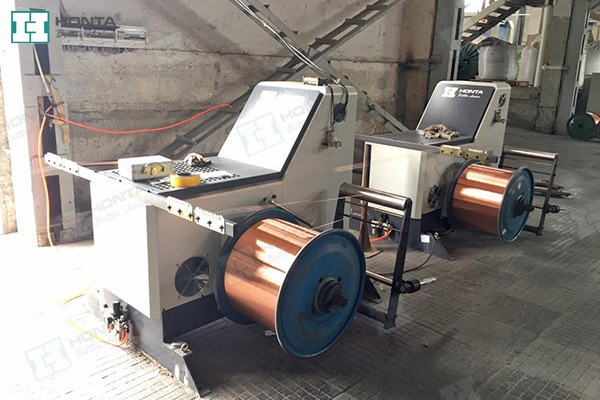
6. Step 5 — Score on Technical Alignment, Not on Price
Score only what has been evidenced. A weighted matrix with hard gates at the front prevents the shortlist from collapsing into a price comparison at the last meeting.
| Criterion | Weight | Evidence required | |
|---|---|---|---|
| Strand and diameter range fit | 20% | Reference installations within your range | |
| Speed stability at heavy construction | 20% | Measured throughput data, FAT results | |
| Tension control and wire damage risk | 15% | Architecture description, elon | |
| Automation and data capability | 10% | HMI demo, recipe management, remote diagnostics | |
| Sample run and validation support | 10% | Willingness to run customer wire | |
| Service response and spares | 10% | Committed response time, spares stock location | |
| Total cost of ownership | 10% | Five-year energy, wear-part and maintenance estimate | |
| Compliance and documentation | 5% | Certificate scope, manuals, electrical drawings |
Note: weights are a starting template. Buyers running flexible-conductor lines usually shift 5–10 points from TCO toward tension control; buyers running large rigid frame stranding shift weight toward spindle and take-up specification.
Two scoring rules matter more than the weights. First, apply hard gates before scoring — a vendor that cannot demonstrate a reference in your diameter range should not be scored at all. Second, normalise price last: convert each offer to a five-year cost per kilogram of output, so that a faster but more expensive machine is not automatically rejected. Suppliers positioning on high speed, automation and operator-friendly design — HONTA's stated product philosophy — generally score well on the first four criteria but need cost-per-kilogram modelling to defend a higher capital figure.
7. Four Pitfalls That Break Otherwise Sound Shortlists
- Accepting catalogue speed. Always request throughput at your heaviest construction and at 85% availability.
- Confusing bunching with rigid frame stranding capability. A vendor strong in one is not automatically strong in the other; ask for separate references.
- Treating certificates as process proof. Certification confirms a management system exists; it does not confirm the run-in duration on your machine.
- Letting one price sheet reset the field. A late low offer should trigger re-scoring on evidence, not an immediate re-ranking.
8. From Shortlist to Contract
A shortlist of three is the practical target: enough competition to keep commercial tension, few enough to allow a factory visit to each. Before awarding, convert the top-ranked vendor's RFI answers into contractual annexes — throughput figures, lay length tolerance, run-in duration, spare-parts pricing and response times. What was promised in the evaluation phase should appear verbatim in the purchase agreement.
9. Conclusion: The Shortlist Is an Engineering Document
As cable plants move toward higher strand counts, thinner wires and tighter lay length tolerances, supplier selection is shifting from a purchasing exercise to a process-engineering one. Buyers who define the envelope first, screen with disqualifiers, issue comparable RFIs, verify capacity on site and score only evidenced answers will consistently land on a shortlist that survives commissioning.
The most reliable predictor of a successful installation is not the vendor's brochure, but whether the vendor could answer, in writing, the questions this method asks. Suppliers with documented systems, verifiable references and integrated line capability — HONTA among them — are built to answer those questions, and that is precisely why a structured shortlist keeps producing the same shortlist of capable partners year after year.
Have Questions or Need More Details?
Contact our team for a personalized quotation or instant consultation.
Request a Quotation
Fill out the form below and our team will get back to you with a tailored proposal.
WhatsApp Direct Chat
Prefer to chat in real-time? Message us on WhatsApp for instant assistance & quick answers.
- Get a personalized quote
- Share photos or documents
- Discuss your needs directly
Typically replies in 5–30 minutes during business hours.