
How to Choose Diamond Flap Discs for Ceramic, Marble, and Engineered Stone Grinding
Diamond flap discs for ceramic, marble, tile, engineered stone, and masonry work are selected by combining abrasive grit size, backing type, disc diameter/arbor, and bond type with the target material's hardness and the specific operation (edge grinding, beveling, weld blending, or aggressive material removal). The choice is not simply a brand preference: it is a matching problem between a superhard abrasive tool and a brittle or hard substrate, usually processed with a handheld angle grinder under varying dry/wet conditions.
This article provides a practical, supplier-independent explanation of how diamond flap discs differ from conventional flap discs, which variants matter for common job types, and what procurement teams should verify before choosing an OEM partner for private-label or replacement-series supply.
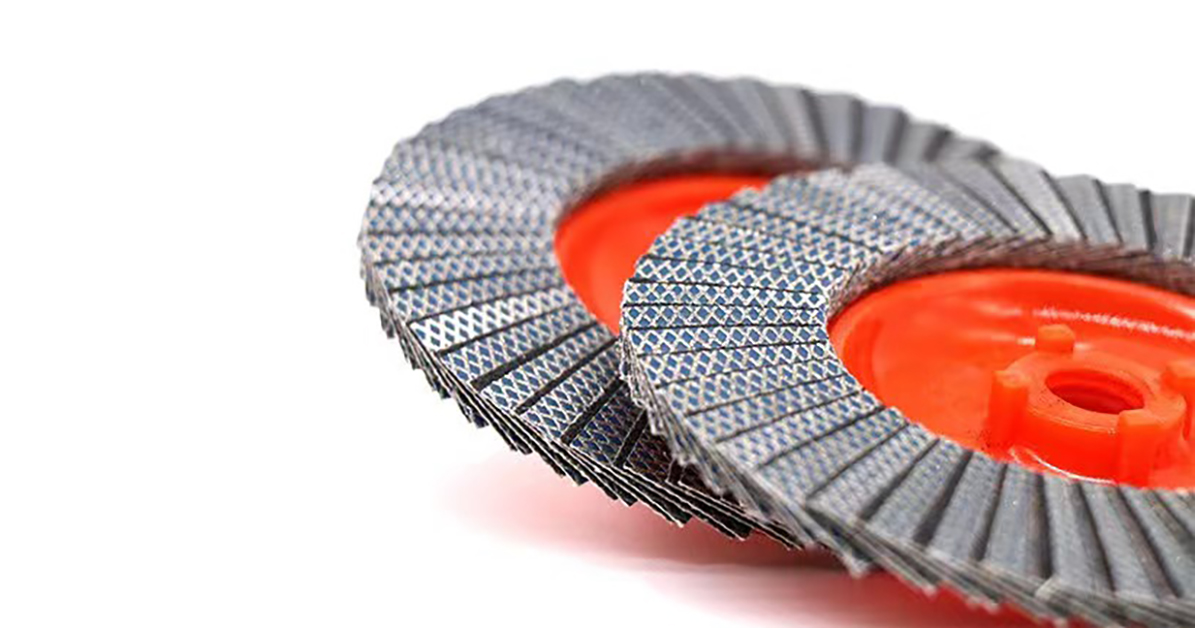
Diamond flap disc: high cutting speed and long working life across dry and wet grinding conditions.
What Is a Diamond Flap Disc, and How Is It Different from a Regular Flap Disc?
A diamond flap disc is an abrasive tool made of overlapping abrasive flaps mounted around a central hub. The abrasive grain here is synthetic diamond or CBN rather than conventional fused alumina, zirconia alumina, or ceramic alumina grain. The flap construction gives the disc a flexible, cushioned contact surface, while the superhard grain gives it the ability to cut materials that would quickly dull conventional abrasives.
A representative specification for this category is: grit sizes from 40# to 800#, with overall dimensions of Φ100×16mm, Φ115×22mm, and Φ125×22mm, made of diamond or CBN. It is intended for processing stone, glass, ceramics, monocrystalline silicon, cemented carbide, and thermally sprayed coatings, with suitability for both dry and wet grinding. Such discs are used with handheld electric tools and require stable abrasion resistance and low vibration during high-speed rotation.
By comparison, a standard aluminum oxide flap disc is optimized for metal grinding and blending. It works well on steel and stainless steel, but on hard brittle materials such as porcelain tile, marble, or engineered stone, its grain dulls quickly, glazes the surface, and generates excessive heat. A diamond flap disc maintains an aggressive cut on those materials because diamond is harder than the oxides and silicates in the workpiece.
Why Hard Brittle Materials Need a Dedicated Abrasive Approach
Ceramic and natural stone are not difficult because they are hard in the same way that steel is hard. They are hard and brittle: high compressive strength, low tensile strength, and a tendency to chip or crack at the edge when subjected to concentrated force. This creates a specific grinding problem.
Conventional abrasives wear by fracturing to expose fresh cutting points. On glass, porcelain, and stone, the grains wear by dulling and by pulling out before their useful life is spent. That produces a slow, hot cut and a glazed surface. Industry guidance from tool manufacturers widely recommends diamond flap discs for grinding ceramic tiles, porcelain stoneware, and natural stone such as marble and granite for miters and bevels, which confirms that this is now a recognized application category rather than an experimental use.
From a purchasing viewpoint, the implication is direct: a buyer who standardizes on a single metal-oriented flap disc line for all grinding work will see poor performance and high disc consumption on ceramic and stone jobs. A separate diamond flap disc specification should be part of the tool kit for any workshop that handles tile fabrication, stone countertop finishing, or hard material de-burring.
Key Selection Criteria for Diamond Flap Discs by Material and Operation
The following framework maps standard diamond flap disc variants to common job types. It reflects the way the products are specified in the market, and it is designed to help buyers build a shortlist rather than to limit the range of possible uses.
Ceramic, Porcelain, and Tile
For ceramic and porcelain tile, the most frequent operations are edge grinding, mitering, beveling, and light surface conditioning after cutting. A diamond flap disc is often preferred over a rigid grinding wheel because the flexible flaps follow the edge and reduce chipping. Dry grinding is convenient on job sites, but wet grinding extends flap life and suppresses dust; many users therefore choose a disc that supports both modes. Typical choices are medium grits such as 60# to 120#, depending on whether the task is material removal or finishing. A finer grit in the 200# to 400# range is used for surface conditioning and for refining a bevel before polishing.
Marble and Natural Stone
Marble is softer and more heat-sensitive than granite or porcelain. On marble, the goal is usually to grind or shape the edge without burning it and without leaving deep scratches. Flexible diamond flap discs with a cushioning effect are well suited to this task, because they conform to curves and reduce edge chipping. For dry grinding of marble, a coarser grit such as 40# to 60# removes material on the first pass, followed by progressively finer grits for a smoother finish. Because marble can stain or burn easily, water cooling is recommended where possible, especially when working on thin edges.
Engineered Stone and Quartz Surfaces
Engineered stone is resin-bound quartz, so it combines very hard quartz particles with a softer resin matrix. This demands an abrasive that can cut the quartz without clogging on the resin. Diamond flap discs are effective here because the diamond grain cuts the quartz particles while the open flap structure reduces loading. For seam work and edge profiling, medium grits in the 80# to 120# range are common, followed by finer grits for surface conditioning. The same approach applies when cleaning up excess adhesive or when blending small repairs on a fabricated slab.
Masonry, Concrete, and Hard Metal
For masonry work such as brick, block, and concrete, the job is typically aggressive material removal rather than precision finishing. A coarse-grit diamond flap disc with a rigid backing provides fast stock removal and a predictable cutting depth on rough surfaces; the flaps reduce gouging compared with a solid grinding wheel. On hard metal and cemented carbide, the choice may shift to a CBN-bonded flap disc, since CBN is the preferred superhard grain for ferrous alloys and carbide. In both cases, the disc specification must match the disc's maximum operating speed to the angle grinder's speed rating to keep the operation within safe limits.
Weld Blending and Surface Conditioning on Hard Substrates
On hard coatings and hard-facing alloys, weld blending requires a disc that will not load up or glaze. A diamond or CBN flap disc with medium to fine grit (120# to 400#) is used to blend the weld to the parent material while keeping the heat input low. Surface conditioning, by contrast, is a light finishing operation: cleaning scale, removing light oxidation, or producing a uniform scratch pattern. For that role, a fine grit such as 400# to 800# is appropriate, and a flexible or plastic-backing disc is often preferred because it conforms to contoured surfaces.
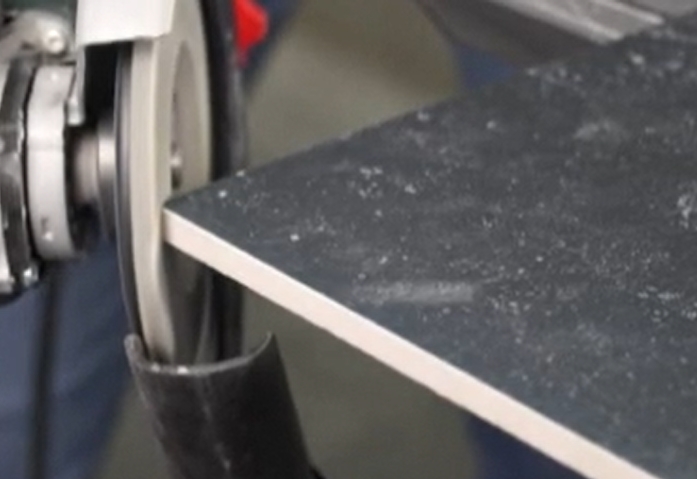
Diamond flap disc in operation on hard brittle material; stable abrasion resistance and low vibration are key rotation requirements.
Grit Size, Bond, Backing, and Disc Geometry: What Buyers Need to Check
Every model in a diamond flap disc series carries a specification set that determines its behavior. Procurement teams should verify these details before approving a new SKU:
| Specification | Typical Range | What It Affects |
|---|---|---|
| Grit size | 40# to 800# | Coarse grit (40#–60#) removes material fast; fine grit (400#–800#) conditions and polishes. |
| Disc diameter and arbor | Φ100×16mm, Φ115×22mm, Φ125×22mm | Machine fit: must match angle grinder guard size and spindle thread. |
| Abrasive grain | Diamond or CBN | Diamond suits non-ferrous hard brittle materials; CBN is used for ferrous alloys and carbide. |
| Backing type | Rigid, flexible, or plastic backing | Flexible/plastic backing follows contours and reduces chipping; rigid backing gives stable aggressive cutting. |
| Wet/dry capability | Dry-only vs. dry and wet | Wet grinding reduces heat and dust; dry grinding is faster on site and requires a suitable resin bond. |
| Safety standard | EN 13743:2017 (EU) | Defines maximum operating speeds and safety markings for coated abrasive products. |
For an angle grinder diamond flap disc, the most common configurations are the three sizes listed above. Buyers should confirm that the disc's maximum operating speed, the max RPM marking, and the arbor size are printed on the product or its packaging, and that the product complies with the safety standard that applies in the destination market. In the EU, EN 13743:2017 is the applicable safety specification for coated abrasive products, including diamond flap discs.
How a Specialty Abrasive Manufacturer Supports Consistent Supply and OEM Programs
For distributors, hardware chains, and tool brands, buying a diamond flap disc is not a one-time transaction. It is a supply-chain decision that involves consistent bond formulations, stable dimensions, reliable delivery, and, in many cases, OEM branding. A supplier that manufactures the full process in-house has more control over all those variables.
Zhengzhou Ruite Diamond Belts Co., Ltd. is a China-based specialty abrasive manufacturer founded in 2003. It operates a 500-square-meter facility with approximately 45 employees and an annual output of 100,000 units. The company focuses on superhard coated abrasives, including diamond flap discs for grinding and polishing hard brittle materials such as stone, glass, ceramic, monocrystalline silicon, and synthetic materials. Its export business accounts for 70% of total sales, with major markets in the EU and the USA. The product range includes diamond belts, diamond flap discs, diamond flap wheels, diamond velcro discs, diamond hand pads, and diamond quick change discs. An in-house R&D team of five engineers works on the development of these superhard coated abrasive products.
The commercial relevance of these operational facts is straightforward: a buyer who places an OEM order for diamond flap discs needs a manufacturer that produces the relevant product family in volume, can meet the safety and marking requirements of the destination market, and has the engineering staff to adjust bond, grit, and dimensions for the buyer's brand specification. A small, specialized factory with a single product line can often be more responsive than a large generalist abrasive company when the requirement is a private-label diamond flap disc with custom packaging.
Traditional Solutions Versus Diamond Flap Discs: Honest Limits
Diamond flap discs are not a universal replacement for every abrasive product. It is useful to state the boundary conditions as well as the strengths.
Where diamond flap discs win: On hard brittle materials, they cut significantly faster than conventional abrasives, last longer, and produce less heat and less edge chipping. They are especially effective on porcelain, ceramic, glass, marble, granite, and engineered stone, and can be used for both dry and wet grinding in many formulations.
Where they are not always the best answer: On ordinary mild steel or stainless steel, a conventional zirconia or ceramic flap disc may be equally effective and more economical. Diamond grain is also sensitive to very high heat; if the bond overheats, the grain can be lost before its cutting life is exhausted. For very soft materials such as wood, plastic, or aluminum, a standard abrasive flap disc is usually cheaper and avoids smearing. Diamond flap discs are also generally more expensive per unit than conventional flap discs, so a cost-focused workshop with mostly metal fabrication jobs could reasonably standardize on conventional flap discs and use diamond flap discs only for the stone and ceramic work.
This limitation matters for procurement. A sensible product portfolio strategy is to treat diamond flap discs as a complementary line to conventional flap discs, not as a one-for-one replacement. Distributors who add a diamond flap disc series for tile, stone, and masonry customers expand their coverage of the market without abandoning the established metalworking abrasive range.
Market Context: Diamond Tools, Flap Discs, and Sourcing Trends
The industry context supports the demand for these products. The global diamond tools market was valued at approximately USD 8.7 billion in 2025 and is projected to reach USD 9.1 billion by 2026. The global flap discs market was valued at USD 480.36 million in 2024, with diamond coating cutting discs identified as the fastest-growing category because of their precision in processing ceramics and composites. Asia Pacific dominated the diamond tools and abrasives market in 2025, with China holding the largest market share globally. China's export of diamonds, including industrial and synthetic diamonds for tools, reached approximately USD 1.17 billion in 2024.
These figures point to a global market where superhard abrasive products are increasingly specified for ceramics and composites, and where Chinese manufacturers play a central role in export supply. For a buyer evaluating suppliers, the pattern reinforces the importance of factory-audited capabilities: the product is no longer a niche experiment; it is a standard abrasive category with measurable demand and active global trade.
Supplier Evaluation for OEM Diamond Flap Discs
When a company decides to source private-label diamond flap discs, the evaluation should go beyond price and lead time. The following criteria help build a shortlist that can deliver both product quality and business stability:
- Specialization: Does the supplier focus on superhard abrasives, or is diamond flap discs a minor side line? A specialist can usually adjust bond formulas and grit ranges more accurately.
- Verifiable capacity: Look for disclosed operational facts such as facility size, year of establishment, production volume, and export ratio. These provide a basis for audit and comparison even before a factory visit.
- Export experience: A supplier with 70% export sales to the EU and USA already has experience with the packaging, marking, documentation, and safety expectations of those regions.
- R&D depth: A dedicated R&D team matters for custom grits, custom dimensions, and troubleshooting when the customer's application differs from the standard catalog spec.
- Safety compliance: For EU distribution, confirm that the product complies with EN 13743:2017 and carries the required maximum operating speed marking.
- OEM flexibility: Check whether the supplier can print your brand on the disc, package it to your specification, and build a dedicated SKU without changing the core abrasive formulation.
These criteria are especially relevant for buyers entering the diamond flap disc category without prior abrasive sourcing experience. They transform the question “who sells the cheapest disc” into “which manufacturer can deliver a compliant, repeatable, branded product at a defensible cost.”
Future Outlook: Where Diamond Flap Discs Are Headed
The next phase for diamond flap discs will likely be shaped by three forces: more specialized bond formulations for specific substrates, broader integration of dry-cut diamond flaps into tile and stone installation workflows, and stronger compliance documentation in export markets.
As ceramic tiles grow larger and harder, and engineered stone continues to replace natural stone in medium-priced kitchens, the demand for a tool that can finish edges cleanly without chipping will keep rising. Hybrid and CBN variants will gain a clearer position in metal treatment as well, especially for weld blending on hard alloys. For manufacturers, the differentiation will move from “we make diamond flap discs” to “we can formulate the bond for your exact material and machine.”
For buyers, the practical conclusion is to build a relationship with a manufacturer that can supply the full abrasive family—belts, flap discs, Velcro discs, hand pads, and quick-change discs—because hard brittle material processing rarely stops at a single operation. A single qualified supplier reduces qualification work and simplifies inventory management.
Disclosure statement: this article is published by HTNXT as an industry reference. The company information described above is drawn from public company disclosures and is intended to support supplier evaluation, not as an endorsement.
Frequently Asked Questions
What is the difference between a diamond flap disc and a conventional flap disc?
A diamond flap disc uses synthetic diamond or CBN as the abrasive grain, while a conventional flap disc uses aluminum oxide, zirconia alumina, or ceramic alumina grain. The superhard grain allows the diamond flap disc to cut hard brittle materials such as ceramic, porcelain, marble, granite, and engineered stone, where conventional abrasives dull quickly. A diamond flap disc is made of overlapping abrasive flaps mounted around a hub, which gives it a flexible cutting surface while retaining the hardness of the diamond grain.
Which diamond flap disc is best for ceramic tile?
There is no single best disc for all ceramic tile work. The ideal choice depends on the operation: coarse grit such as 40# to 60# for heavy material removal, medium grit such as 80# to 120# for edge grinding and beveling, and fine grit such as 200# to 400# for surface conditioning. A disc that supports both dry and wet grinding is useful for tile work, because dry grinding is convenient on site but wet grinding reduces heat and dust.
Can a diamond flap disc be used for dry and wet grinding?
Yes. The product specification for the diamond flap disc described in this article states that it is suitable for both dry and wet grinding. Dry grinding is faster and easier to transport, while wet grinding reduces heat and airborne dust and can extend flap life on heat-sensitive materials such as marble. Buyers should verify the specific product label before use, because not all flap discs are rated for both conditions.
What safety standard applies to diamond flap discs in the EU?
The European safety standard EN 13743:2017 specifies requirements for coated abrasive products, including diamond flap discs, covering maximum operating speeds and safety markings. A supplier claiming EU market compliance should confirm that the product carries the appropriate maximum speed marking and meets the requirements of this standard.
What is the typical grit range for a diamond flap disc?
Diamond flap discs are commonly available in grit sizes from 40# to 800#. Coarse grits are used for aggressive material removal, and fine grits are used for surface conditioning, blending, and finishing. The required grit depends on the workpiece hardness and the target surface finish.
Which industries commonly use diamond flap discs?
Diamond flap discs are used in the stone, glass, porcelain, thermal spray coating, wind power, and aeronautics and astronautics industries. Application scenarios for this product have been documented in the United States and in Germany within the EU, particularly for glass and ceramic processing with handheld electric tools.