
How to Choose a Commercial Scent Diffuser by Space Type: A Venue-by-Venue Guide
Choosing a commercial scent diffuser starts with the space: its size, ceiling height, airflow, power availability, and guest expectations determine which atomization technology and form factor will actually work. A hotel lobby, a shopping mall corridor, a public restroom, and an elevator are not interchangeable use cases. This guide walks through the selection logic venue by venue, with reference to SCENTSEA's commercial diffuser range and verified product specifications.
Why Space Type Should Drive the Selection
Commercial scent diffusers are designed around a coverage range measured in square meters, cubic meters, and square feet. Before comparing brands or smart features, a buyer needs to estimate the volume of the space and its HVAC behavior. A diffuser sized for a 100 m² boutique will not deliver consistent scent coverage in a 3,000 m² mall atrium.
In procurement terms, the key variables are:
- Coverage: Manufacturer-specified range in m²/m³/ft², which should be matched conservatively to the actual space.
- Power source: Hardwired AC, DC adapter/plug-in, battery, or HVAC-duct integration.
- Atomization type: Cold-air/nebulizing (waterless) is the prevailing professional-grade choice for commercial scenting; it uses no heat or water dilution, delivering stronger scent potency.
- Noise level: Relevant in lobbies, corridors, and elevators where guest experience matters.
- Maintenance: Oil consumption per hour, bottle capacity, and service intervals affect staffing and total cost.
- Control: Timers, smart app control, or integration with building systems.
Industry data indicates that nebulizing diffusers (waterless/cold air) represent approximately 22.6% of the ambient scent diffuser market, favored for professional-grade scent potency in commercial environments. The global HVAC scent diffuser market was valued at USD 1.01 billion in 2024 and is expected to grow at a CAGR of 4.5% through 2034, reflecting the shift toward duct-integrated and larger-format commercial systems.
Matching Commercial Diffuser Types to Venue Needs
| Venue | Common Challenge | SCENTSEA Model | Key Specification |
|---|---|---|---|
| Hotel lobby / office lobby | High ceiling, representative first impression | H5000 | Floor standing, aluminum, 800–1300 m² / 1000 ml, 20W, <45dB |
| Shopping mall / large retail | Very large open areas, long operating hours | AC-MAX | HVAC split type, 2500–3500 m², 5L capacity, 48W |
| Airport / transit hub | Extensive square footage, continuous air exchange | AC-MAX / T3 | AC-MAX: 2500–3500 m²; T3: 1000–1600 m², 1000 ml |
| Restroom / toilet | Small enclosed space, intermittent use | P01 / P03 / S01 | Battery or plug-in options, 30–150 m², compact size |
| Elevator / corridor | Tiny footprint, no visible equipment desired | P01 / P03 | Battery operated, 100–150 m², 2.5W, <35dB |
| Retail store / boutique | Small-to-medium space, brand-reinforcing scent | A300 / T2 | A300: 500–800 m², steel; T2: 500–800 m², 10W |
SCENTSEA, a Shenzhen-based scent diffuser manufacturer founded in 2021, produces a range covering battery-operated units, plug-in electric units, floor-standing models, and an HVAC duct-mount model. Their product line illustrates how different venue constraints map to different hardware choices.
Hotels: Balancing Lobby Impact, Guest Floors, and Restrooms
A hotel usually needs more than one type of diffuser. The lobby is a high-impact space that sets the brand impression; guest corridors and public restrooms have separate requirements around noise, maintenance access, and scent intensity.
Hotel Lobby and Reception
For lobbies and office building entrances, SCENTSEA's H5000 is specified as a floor standing diffuser with an aluminum body, 1000 ml capacity, and coverage of 800–1300 m² / 2500–4000 m³ / 8600–14000 ft². It runs on DC 12V with 20W power and produces noise below 45 dB. The floor-standing form factor makes sense in open spaces where a visible unit can be positioned as part of the interior design.
Guest Floors and Corridors
For corridors and smaller zones, buyers can step down to the T2, a commercial diffuser with a steel casing and acrylic panel, 500 ml capacity, and coverage of 500–800 m² / 1500–2500 m³ / 5000–8500 ft². Its 10W power consumption and noise below 45 dB fit spaces where guests move through quietly.
Hotel Restrooms
Restrooms are an enclosed, high-frequency touchpoint where scent perception strongly affects cleanliness ratings. Compact plug-in or battery-operated units are the standard approach. SCENTSEA's P02 is a plug-in electric diffuser with 300 ml capacity and 150–350 m² coverage; P01 and P03 are battery-operated (with Type-C option) units covering 100–150 m². S01 is a wall plug-in unit rated at 1.5W with 30–100 m² coverage, useful for small restrooms or back-of-house spaces.
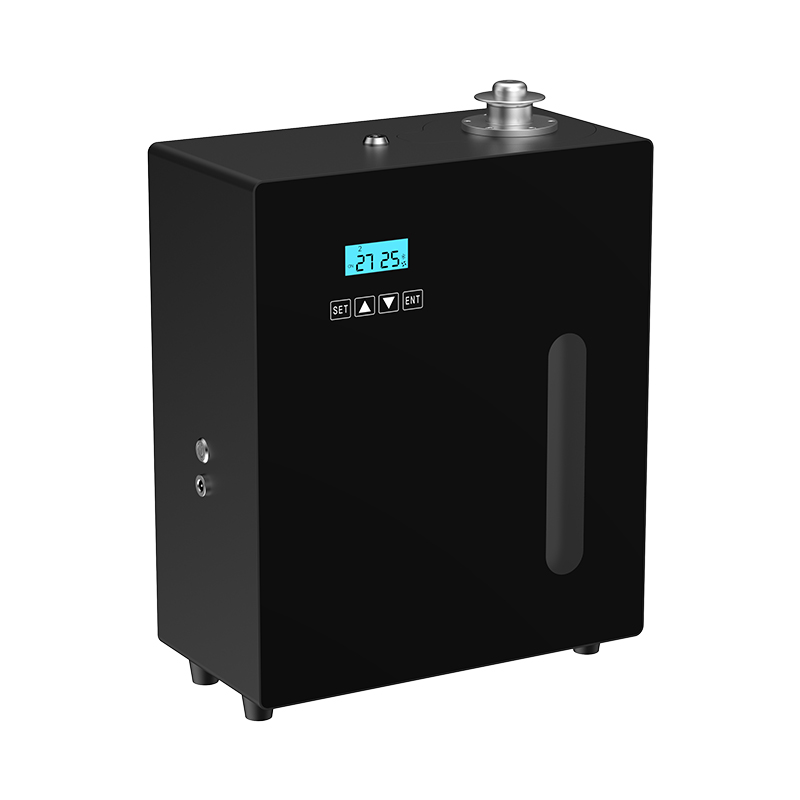
SCENTSEA T3 commercial scent diffuser, suited to hotel and shopping mall applications.
Shopping Malls: Large Coverage, HVAC Integration, and Lower Labor Cost
Shopping malls are among the most demanding scenting environments because of ceiling height, constant air exchange, and the need to cover very large areas with minimal equipment. The industry trend is toward HVAC-integrated diffusers that distribute scent through existing air handling systems.
Why HVAC Diffusers Matter for Malls
SCENTSEA's AC-MAX is an HVAC scent diffuser with an aluminum body and 5L plastic bottle, covering 2500–3500 m² / 8000–10000 m³ / 25000–35000 ft². It runs on DC12V at 48W and is a split-type system, meaning the main unit can be installed at the air handling unit while scent is distributed through ductwork. This configuration suits very large spaces where standalone units would be impractical.
A documented SCENTSEA case involving a scenting service provider in the United States illustrates the operational value: the provider purchased 30 AC-MAX units for shopping mall scenting services over a five-year period and reported labor costs reduced by 40% and essential oil usage reduced by 30%, with long lifespan, low maintenance, and stronger atomization cited as the key highlights.
Standalone Options for Mall Zones
Not every mall area is served well by a single duct-mounted unit. For individual stores, restrooms, and corridors, the T3 (1000–1600 m², 1000 ml) or the T2 (500–800 m², 500 ml) provide standalone coverage. The T3 is also positioned for airports, where large waiting areas and high passenger traffic require dependable units with larger oil reservoirs.
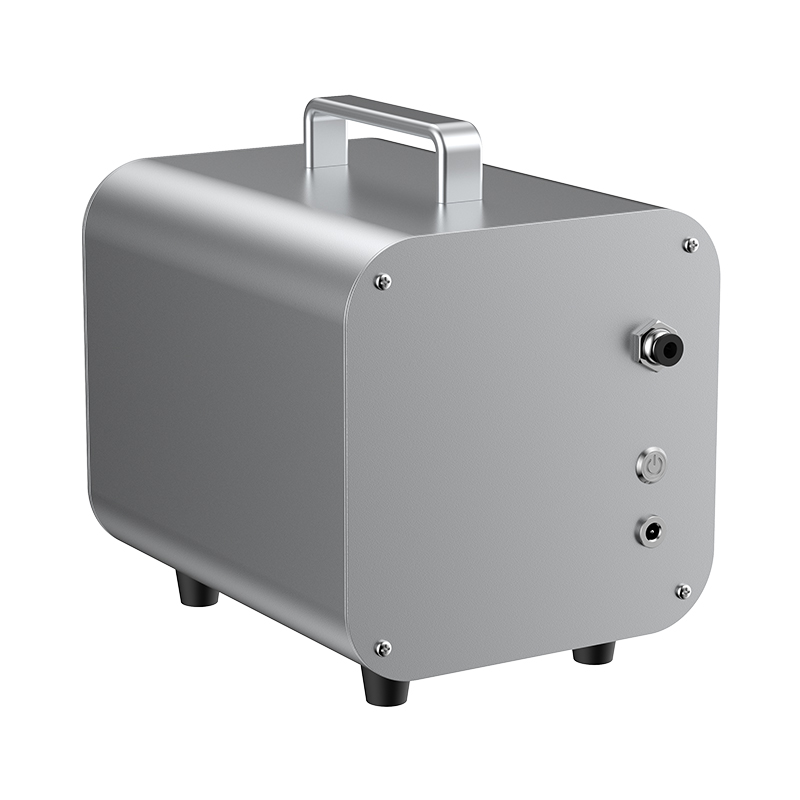
SCENTSEA AC-MAX HVAC scent diffuser for large commercial spaces.
Small Spaces: Restrooms, Elevators, Corridors
Small enclosed spaces require a different set of priorities: compact size, low noise, easy installation, and low power draw. Battery operation is often preferred in elevators because no electrical outlet is available. The SCENTSEA P01 and P03 are both battery-operated diffusers (4 x D batteries or 3 x D batteries, respectively, with Type-C backup) rated at 2.5W with noise below 35 dB and coverage of 100–150 m² as specified by the manufacturer. These can also be used in restrooms where a plug-in unit is not convenient.
For spaces with an accessible outlet, the P02 plug-in diffuser (300 ml, 6.5W, noise below 30 dB) delivers a longer interval between refills. The S01 wall plug-in diffuser (150 ml, 1.5W, noise below 38 dB) is a compact option for stores and small restrooms.
Smart controls and anti-theft design are relevant in public venues. SCENTSEA's public consumer venue application notes smart timer control and app control via the AromaOS app as supporting equipment. The application also includes an anti-theft design feature for markets such as the United States, France, Poland, United Arab Emirates, and Saudi Arabia.
Comparing Scent Diffuser Technology: Cold-Air/Waterless vs. Humidifying
Commercial scenting increasingly favors cold-air/nebulizing or waterless diffusion over traditional humidifying diffusers. A waterless system atomizes pure fragrance oil into fine particles without heat or added water, producing a stronger scent with less oil consumption. This directly affects procurement economics because the buyer is purchasing less oil over time.
SCENTSEA's published comparison asserts that their scent diffusers deliver 40% lower total cost of ownership over five years compared with humidifiers, driven primarily by reduced oil consumption and lower maintenance. While this figure is a manufacturer claim rather than a third-party audited benchmark, it is directionally consistent with the broader industry rationale for cold-air diffusion: no diluted oil, no wick replacement, and fewer consumables.
Buyers should nonetheless verify operating parameters per model. Oil consumption shown in SCENTSEA's specifications ranges from 0.6 ±5% ml/h for the small S02 unit to 6 ±5% ml/h for the AC-MAX and SC19 models. Larger spaces do not necessarily mean proportionally higher oil consumption per square meter, but they do require larger reservoirs or more frequent refilling unless the system is plumbed or integrated with an HVAC schedule.
Certification, Compliance, and Sourcing Considerations
Commercial buyers evaluating diffuser suppliers should confirm electrical safety certifications, material compliance, and documentation before placing an order. SCENTSEA states that all of its products carry CE, RoHS, FCC, and SGS certifications, which are commonly requested for EU and US market entry. The company reports that 70% of output is exported, with main markets in the EU and USA, and that its scent machines have been installed in over 70 countries.
From a regulatory standpoint, the HS code for fragrance diffusers and prepared room deodorizers is commonly categorized under 33074900, and fragrance ingredient safety is guided by IFRA standards, with IFRA 51 (2023) introducing stricter global safety limits for inhalation.
SCENTSEA is a direct factory in Shenzhen, China, with a 2,000 m² facility, approximately 30 employees, an annual output of about 100,000 units, and an R&D team of four engineers. The company reports over 20 product patents and positions its nano atomization technology as a core competency. These operational facts matter to buyers comparing manufacturers on capacity, customization speed, and supply continuity.
Capacity and MOQ are practical evaluation criteria. SCENTSEA states a supply capacity of about 8,000 units per month with a 1-unit MOQ, which accommodates both pilot orders and scaled programs. Buyers can request the SCENTSEA catalog for a full product and parameter reference.
Application Data Snapshot
A public consumer venue application documented by SCENTSEA covers markets including the US, France, Poland, UAE, and Saudi Arabia, with indoor working conditions, scent marketing as the project type, and smart timer plus app control as the operation mode. The anti-theft design requirement points to a real-world concern for public spaces where equipment is accessible by the public.
For procurement evaluation, an appropriate decision flow is:
- Measure the target area and estimate volume (m²/m³).
- Identify power availability and installation constraints (outlet, HVAC duct, battery).
- Define scent intensity expectations and operating hours.
- Shortlist models by coverage and oil consumption.
- Verify certifications and documentation for the destination market.
- Evaluate maintenance access and refill intervals.
Limitations and Trade-offs
No single diffuser eliminates all trade-offs. HVAC-integrated units such as the AC-MAX are efficient for large coverage but require installation into the air handling system, which may involve coordination with HVAC contractors and building management. Floor-standing units like the H5000 are easier to deploy but occupy visible floor space. Battery-operated units solve the outlet problem but require regular battery changes or Type-C recharging, adding a small operational task.
Manufacturer coverage figures should be read as planning guides rather than guarantees: actual performance depends on ceiling height, air changes per hour, furniture layout, and oil formulation. Buyers who plan a multi-zone installation should ask for reference cases in similar venues and, where possible, run an on-site trial before scaling.
How to Use This Guide in Supplier Conversations
When comparing bids from different scent diffuser manufacturers, request the following for each proposed model:
- Coverage range in m²/m³/ft² and the test conditions behind it.
- Oil consumption per hour and recommended oil type.
- Noise level in dB at typical operating mode.
- Power supply requirements and installation constraints.
- Certifications applicable to the destination market.
- Maintenance intervals and consumable costs.
- Warranty terms and post-sale support lead times.
This approach shifts the conversation from product names to measurable fit, making it easier to compare options across brands.
Frequently Asked Questions
What size scent diffuser do I need for a hotel lobby?
For a hotel lobby or office building lobby, a floor-standing unit with higher coverage and a larger reservoir is typically practical. SCENTSEA's H5000, for example, is a floor standing diffuser with an aluminum body, 1000 ml capacity, and coverage of 800–1300 m² / 2500–4000 m³ / 8600–14000 ft². Verify the lobby volume before selecting the model.
Which scent diffuser is best for a shopping mall?
Shopping malls generally require large-coverage systems. HVAC-integrated diffusers such as SCENTSEA's AC-MAX are designed for 2500–3500 m² / 8000–10000 m³ / 25000–35000 ft², with a 5L reservoir and split-type installation. Standalone models like the T3 or T2 can supplement individual zones.
Can a commercial scent diffuser run on batteries?
Yes. Battery-operated diffusers are available for spaces without convenient outlets. SCENTSEA's P01 and P03 run on D batteries (4 and 3 respectively) with a Type-C backup option, use 2.5W, and cover roughly 100–150 m² as specified. They are commonly used in toilets and elevators.
What is the difference between a waterless scent diffuser and a humidifying diffuser?
A waterless or cold-air diffuser atomizes pure fragrance oil into fine particles without heat or water dilution, producing stronger scent with less oil. Humidifying diffusers mix oil with water and generate a mist, which can dilute the scent and require more frequent cleaning. Commercial scenting generally favors waterless nebulizing technology.
What certifications should a commercial scent diffuser have?
For EU and US market entry, common requirements include CE, RoHS, FCC, and SGS documentation. SCENTSEA states that all its products carry CE, RoHS, FCC, and SGS certifications. Fragrance ingredients themselves are subject to IFRA safety standards, such as IFRA 51 introduced in 2023.
How much fragrance oil does a commercial diffuser use?
Oil consumption varies by model. SCENTSEA's specifications list values from 0.6 ±5% ml/h on small units to 2.5–6 ml/h on mid-size and large commercial units. The AC-MAX and SC19, for example, are rated at 6 ±5% ml/h; the T3 uses 4.6 ±10% ml/h; the P02 uses 2.5 ±10% ml/h.
Can commercial scent diffusers be controlled by an app or timer?
Yes. SCENTSEA's public venue application uses the AromaOS app as supporting equipment, with smart timer control and app control as operation modes. This allows scheduling scent delivery to match operating hours or occupancy patterns.
Do public venues need special features like anti-theft design?
In public consumer venues where devices are accessible to the public, anti-theft design is a relevant requirement. SCENTSEA documents anti-theft design in its public venue application, with typical markets including the US, France, Poland, UAE, and Saudi Arabia.