
How to Choose a Custom Zipper for Jackets, Jeans, Luggage and Shoes
Custom zippers for jackets, jeans, luggage and shoes are not interchangeable components. Each end product places different demands on teeth material, tape construction, slider mechanics and surface finishing. This article explains how garment and accessory buyers can match custom zipper specifications to their actual application requirements.
Why Zipper Selection Differs by End Product
Jackets, jeans, luggage and shoes have different opening frequencies, load requirements and environmental exposure. A denim jean zipper is frequently pulled under tension and must resist corrosion from washing. A luggage zipper must withstand impact stress, rough handling and sometimes rainwater. A lightweight windbreaker requires a smooth, light zipper that does not distort thin fabric. A shoe zipper may face repeated bending and friction during wear.
According to industry consumption data, nylon zippers accounted for 46% of total global zipper consumption in 2025, while metal zippers held 31%, with brass and aluminum representing 67% of metal zipper production. The substantial share of metal zippers in apparel and accessories reflects a continued buyer preference for metallic aesthetics, strength and perceived quality in premium products.
For procurement teams, the practical consequence is simple: specifying one "custom zipper" for all products creates performance and aesthetic mismatches. The selection logic should start with the product category, then move to material behavior, teeth shape, size and surface finish.
Project and Application Fit: The First Decision Layer
Custom zipper selection in the garment and accessory industry normally follows a project-based logic. The same manufacturer serving multiple product lines may need aluminum Y teeth zippers for lightweight jackets, brass corn teeth zippers for jeans and brass normal teeth zippers for luggage.
Zipper applications generally span seven industry sectors: garment and apparel, luggage and handbag, outdoor goods, footwear, home textile and light workwear. Within those sectors, project types include mass production of ready-made clothes, luggage manufacturing, supporting processing of outdoor equipment, home textile products, finished shoe processing and customized orders for brand accessories.
Two broad application condition groups are commonly observed:
- Daily indoor use at normal temperature: typical of fashion garments, casual apparel and many ready-made products. The zipper provides lightweight opening and closing for sealing purposes and supports fast opening and closing of garments and bags.
- Outdoor use with normal or low temperature, rain and snow: typical of outdoor garments and protective equipment. The zipper may need to reinforce fabric seams, block dust and rainwater, and enhance the metallic texture of the finished product.
Matching Zipper Types to Application Industries
Custom zipper buyers can choose from plastic zippers, nylon zippers and metal zippers. Among metal zippers, brass and aluminum alloy are the two dominant material options. Their different physical properties map to distinct application patterns.
Brass zippers: durable metallic texture for premium apparel and heavy-duty accessories
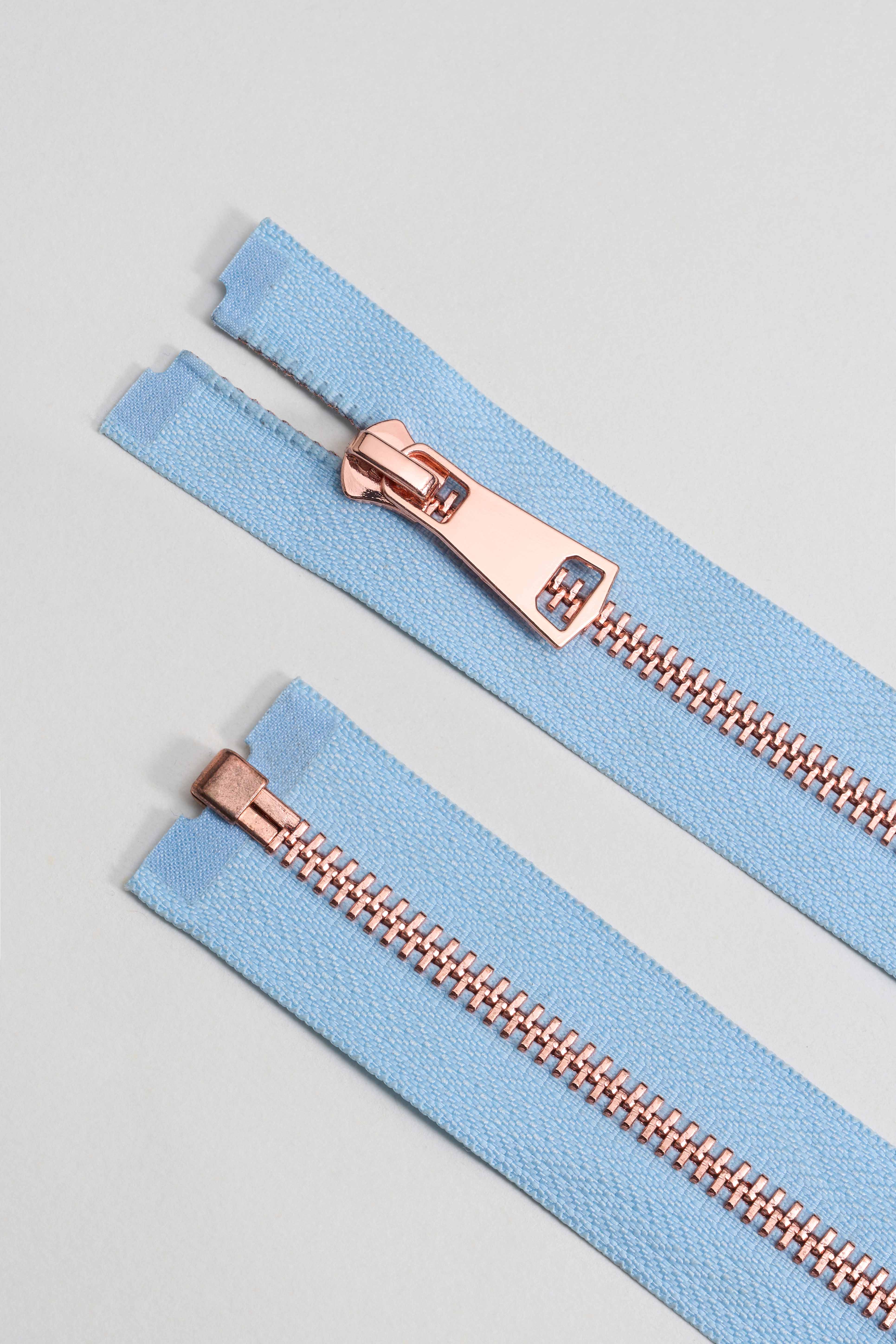
Brass zippers are made of brass alloy with polyester tape and are suitable for luggage, garment, outdoor goods and footwear applications. They are available in Y teeth, euro teeth, normal teeth and corn teeth profiles, in sizes #3, #5 and #8.
Brass zippers are generally specified when the buyer wants a premium metallic texture combined with strong mechanical behavior. A brass zipper in Y teeth or corn teeth configuration is common in jeans, casual trousers, jackets and heavier bags. The metal material gives visible product personality and a solid closing feel.
Brass zippers can support multiple plating colors, including gold, antique brass, gunmetal and nickel silver. For buyers supplying EU markets, nickel-free brass options are available to comply with the EU REACH standard.
Aluminum alloy zippers: lighter weight and cost efficiency for apparel, luggage and outdoor gear
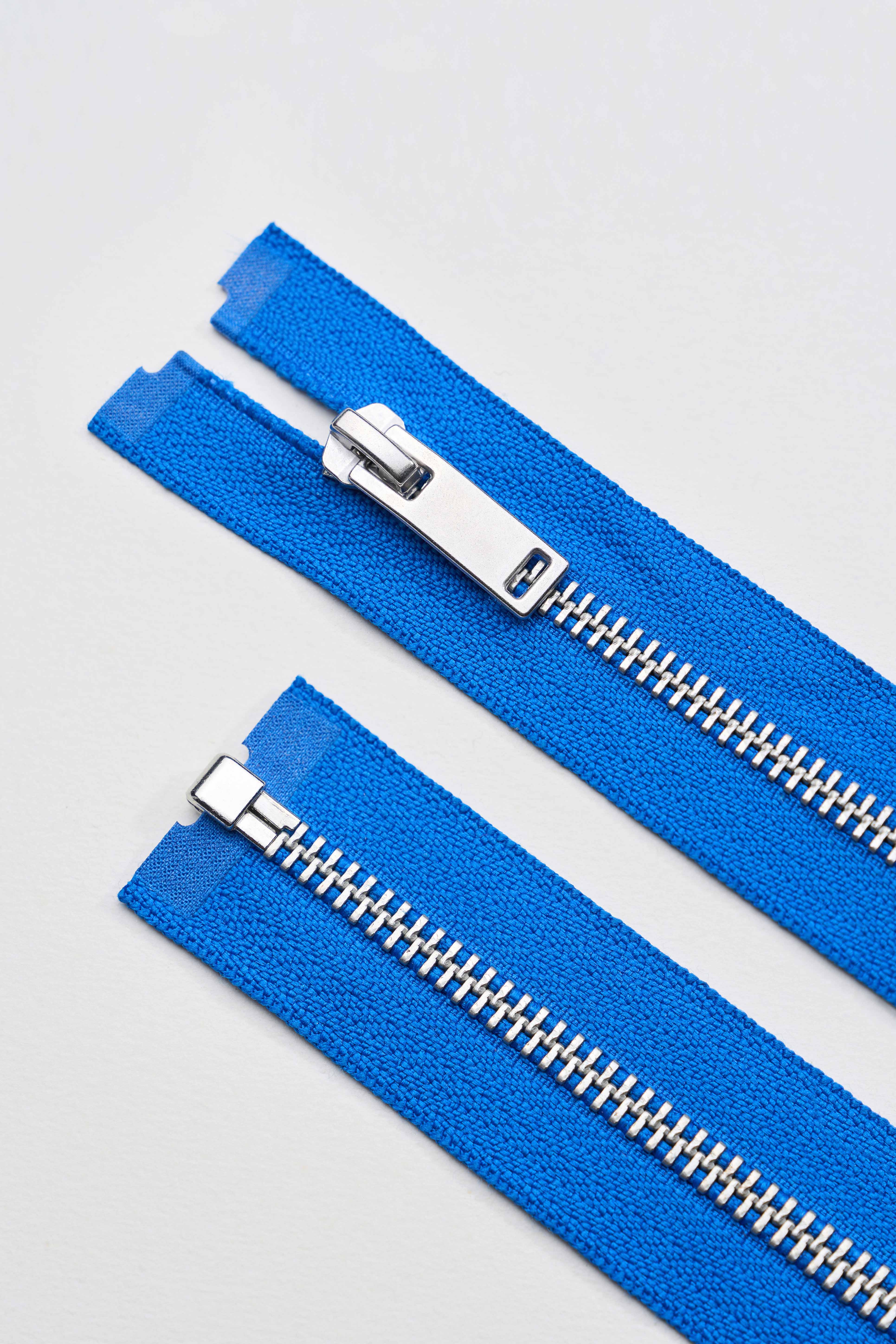
Aluminum alloy zippers are made of lightweight aluminum and are also suitable for luggage, garment, outdoor goods and footwear. Available tooth profiles include Y teeth, corn teeth, normal teeth and euro teeth, with sizes #3, #5 and #8.
The main advantage of aluminum alloy is weight reduction: aluminum zippers are approximately 35% to 50% lighter than brass zippers. This property is particularly valuable for garment mass production, where reducing the weight of every component lowers total finished-garment weight. Aluminum alloy also offers a more competitive cost position than brass for buyers managing tight margins.
Surface treatments include bright silver, matte silver, black and champagne anodizing. The anodized finish can provide a metallic look comparable to brass while supporting lighter and lower-cost product designs.
| Evaluation Dimension | Brass Zipper | Aluminum Alloy Zipper |
|---|---|---|
| Teeth material | Brass alloy with polyester tape | Aluminum alloy |
| Available teeth types | Y teeth, euro teeth, normal teeth, corn teeth | Y teeth, corn teeth, normal teeth, euro teeth |
| Common sizes | #3, #5, #8 | #3, #5, #8 |
| Weight profile | Heavier; dense metallic feel | Approximately 35%-50% lighter than brass |
| Crosswise tensile strength | Up to 510N (tested value) | Up to 410N (tested value) |
| Surface finish examples | Gold, antique brass, gunmetal, nickel silver | Bright silver, matte silver, black, champagne anodizing |
| Compliance feature | Nickel-free option available, EU REACH compliant | Anodized surface suitable for regular washing |
| Typical end uses | Leather bags, jeans, premium apparel, outdoor luggage | Hard luggage, backpacks, sportswear, lightweight apparel |
| Slider and puller customization | Custom logo slider and puller for OEM and ODM | Custom logo slider and puller available for OEM |
Tensile strength values are based on product testing data provided by Wenzhou Runhe Garment Accessories Co., Ltd. Actual performance may vary with size, tape construction and application conditions.
Matching Zipper Sizes and Teeth Profiles to End Products
Zipper size numbers such as #3, #5 and #8 refer directly to the width of the zipper teeth in millimeters when the zipper is closed. A #5 zipper has teeth approximately 5 mm wide. This sizing system is used universally in the industry, including by global manufacturers such as YKK.
In practice, size selection should be based on the fabric weight and the expected pulling force of the end product. Lighter garments such as shirts, blouses, lightweight windbreakers and dress trousers commonly use #3. Mid-weight apparel and casual garments such as jeans, jackets and coats often use #5. Heavy-duty products such as large luggage, canvas bags and workwear may require #8.
Beyond size, teeth profile matters. Brass and aluminum zipper lines typically include four teeth profiles: Y teeth, euro teeth, normal teeth and corn teeth. Each profile has a different tooth shape and visual expression, which affects both appearance and how the zipper interacts with fabric during sewing and use.
For example: A jeans manufacturer choosing a brass zipper must decide whether a corn teeth profile or a normal teeth profile is more appropriate. A corn teeth brass zipper is often selected for a denser, more rugged denim look, while normal teeth brass may suit cleaner tailored styling.
Application Case: Custom Aluminum Zippers for Fast-Fashion Outerwear
A documented case from France and Spain shows how an overseas fast-fashion garment brand replaced brass zippers with custom aluminum zippers for lightweight seasonal coats. The project covered zippers worth 10,000,000, supporting spring and autumn lightweight windbreakers and casual coats.
The brand had previously used brass zippers and prioritized metallic appearance. However, brass added significant weight and cost to garments that were designed for only one to two years of consumer use. The manufacturer supplied aluminum alloy zippers that preserved a metallic visual effect while cutting material procurement costs by 59% compared with the original brass zippers. Garment total weight was reduced by 38%, creating a noticeably lighter wearing experience.
Reciprocating sliding performance met the industry standard, and the defective complaint rate stayed below 0.3%. In addition, the products passed Oeko-Tex eco certification, supporting smooth EU customs clearance. The client and manufacturer maintained stable cooperation for four years.
This case illustrates two important points for buyers:
- Material substitution between brass and aluminum can achieve cost reduction without abandoning metallic aesthetics.
- Weight reduction at zipper level can create measurable product differentiation in lightweight apparel segments.
Environmental and Functional Requirements
The end product’s operating environment determines whether a standard zipper is sufficient or whether the zipper must satisfy protective requirements.
For indoor apparel at normal temperature, daily operation only requires smooth manual sliding and consistent self-locking behavior. In outdoor conditions with rain and snow, zippers may need to block moisture and withstand lower temperatures. Special requirements for some outdoor and luggage applications include IP66 waterproofing, IK08 impact resistance and anti-theft design.
Zipper supporting materials and equipment also vary by project. Polyester yarn tape, garment fabrics such as nylon, cotton, waterproof fabric and leather, as well as sewing machines, luggage sewing machines, sliders, top stops, bottom stops, pins and boxes are common supporting elements. TPU film is used for waterproof zipper constructions.
Customization Options and Manufacturing Capability
YAB Zipper, operated by Wenzhou Runhe Garment Accessories Co., Ltd., supports OEM, ODM and custom customization. Buyers can customize zipper length, tape color, teeth color, teeth shape, slider shape, slider color and zipper size. Monthly capacity is approximately 300,000 units, with lead times from 7 to 30 days and a standard MOQ of 2,000 pcs per specification.
Quality control includes 100% pre-shipment testing, and export experience spans the EU, US, Middle East and Southeast Asia. After-sales support includes remote technical assistance, which is relevant for overseas buyers coordinating with sewing factories.
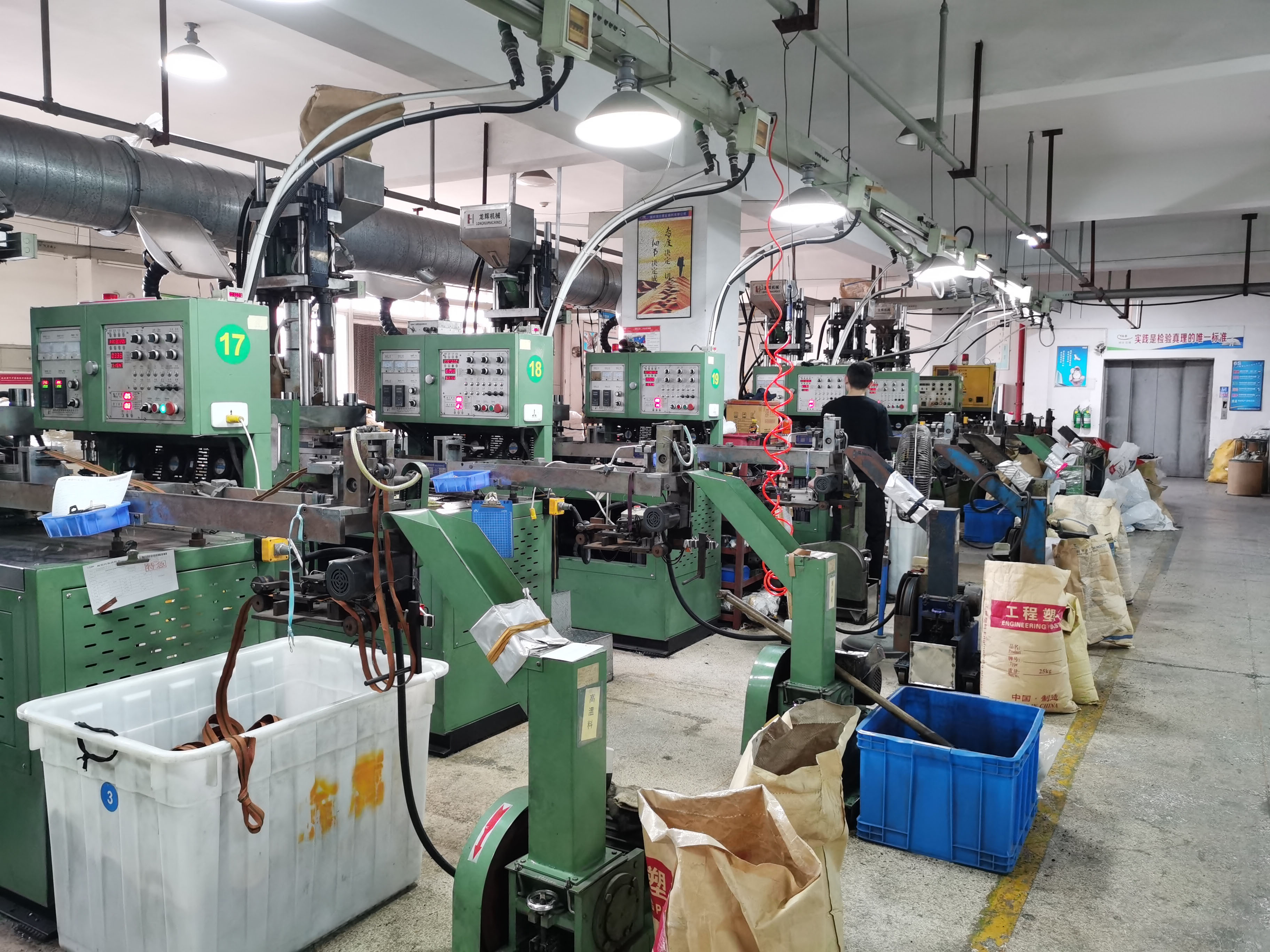
Wenzhou Runhe Garment Accessories Co., Ltd. is based in Wenzhou, Zhejiang, and was established in 1995. The company is the sixth president unit of the Wenzhou Zipper Chamber of Commerce. It operates more than 500 zipper production machines and holds ISO9001-2008 and OEKO-TEX-100 certifications. Its facilities cover 10,000 m², with roughly 150 employees, including 10 R&D engineers, and an annual output of approximately 70 million pieces, of which about 30% is exported to Southeast Asia and other markets.
Comparison with Traditional Supplier Approaches
Traditional custom zipper sourcing often works in one of two ways: buyers either order from a catalogue with standard sizes and finishes, or they rely on a single preferred zipper material for all projects. Both approaches carry limitations in application-driven sourcing.
Catalogue-based sourcing is convenient for quick orders but rarely supports material substitution analysis. For example, a buyer who orders brass zippers from a catalogue may not learn that an aluminum alloy zipper could deliver the same visual category at roughly 40% of the unit price with reduced weight. Without a structured material comparison, the buyer may over-specify brass for lightweight apparel where it adds avoidable weight and cost.
Relying on one material for all projects is another limitation. A manufacturer that standardizes on brass for brand consistency may struggle to compete in price-sensitive fast-fashion segments. A manufacturer that standardizes on nylon may find it difficult to serve premium denim or leather accessory customers who expect a metallic teeth appearance.
A documented limitation of aluminum zippers: while aluminum zippers reduce weight and cost, their tested crosswise tensile strength is lower than brass—up to 410N for aluminum versus up to 510N for brass in the YAB product range. For heavy structural applications such as large checked luggage, extreme outdoor loads or safety-adjacent workwear, buyers should verify whether aluminum alloy can meet the required strength threshold. Brass remains the more conservative choice where maximum metallic strength is a non-negotiable requirement.
Market Trends and Their Effect on Zipper Specification
The global zipper market was valued at approximately USD 17.39 billion in 2024 and is projected to reach USD 36.73 billion by 2034, with a reported CAGR of 7.8% from 2025 to 2034. Within this expanding market, consumption patterns show nylon zippers leading in volume, while metal zippers continue to occupy a substantial premium segment.
Global trade data for zippers under HS code 9607 reached USD 3.15 billion in 2024, with China accounting for approximately USD 1.52 billion in exports. The concentration of zipper production in Chinese manufacturing clusters such as Wenzhou remains high, which is relevant for buyers assessing supply-chain dependence, lead times and regional sourcing strategy.
Three trends are particularly relevant for custom zipper buyers:
- Weight engineering in apparel: Fast-fashion and sportswear brands are actively reducing component weight. Aluminum alloy zippers are likely to continue penetrating garment applications that previously used brass.
- Compliance-driven sourcing: EU-bound products increasingly require restricted-substance testing and eco-certification. Nickel-free brass and Oeko-Tex-certified production processes reduce customs friction for brands selling into Europe.
- Material substitution at identical visual level: Surface treatment improvements now allow aluminum zippers to imitate antique silver, champagne and other metal finishes, enabling designers to maintain aesthetics while changing material economics.
Practical Selection Framework for Buyers
To translate application requirements into a zipper specification, buyers can use the following sequence:
- Define the end product environment: indoor daily use versus outdoor exposure to rain, snow and low temperatures.
- Identify the functional role: lightweight closing, structural reinforcement, waterproof blocking or decorative metallic enhancement.
- Determine the size of teeth: #3 for light garments, #5 for medium apparel and bags, #8 for heavier luggage and workwear.
- Select the material family: brass for premium strength and metallic feel; aluminum for weight reduction and cost control; nylon or plastic for lightweight value applications.
- Choose the teeth profile: Y teeth, euro teeth, normal teeth or corn teeth, based on the desired tooth silhouette and brand appearance.
- Verify compliance and testing: confirm nickel content, REACH status, Oeko-Tex certification and any salt spray or tensile strength requirements.
- Check customization feasibility: confirm length, tape color, slider shape, slider color and logo customization before sampling.
- Qualify manufacturing controls: confirm pre-shipment inspection coverage, capacity and lead time before volume orders.
Future Outlook: What Buyers Should Watch
As the zipper market grows toward an estimated USD 36.73 billion by 2034, the range of available material combinations will likely expand rather than consolidate. Aluminum alloy surface treatments will continue to improve, narrowing the aesthetic gap with brass. At the same time, regulatory pressure on material composition will intensify for brands selling into the EU and North America.
For procurement teams, the most durable advantage will come from maintaining a flexible material strategy: a qualified supplier that can produce brass zippers, aluminum zippers and nylon products under one roof reduces the need for multiple vendors and simplifies compliance management. Buyers should give weight to manufacturers with documented production capacity, export experience and independent certification status.
Download the YAB Zipper company profile for detailed production information.
FAQ
Which zipper type is suitable for lightweight windbreakers and casual coats?
Aluminum alloy zippers are commonly used for lightweight windbreakers and casual coats. In a documented European case, aluminum alloy zippers replaced brass in spring and autumn windbreaker production, cutting material procurement cost by 59% and reducing garment weight by 38%.
Which zipper materials are used in garment, luggage, outdoor and footwear applications?
Brass zippers and aluminum alloy zippers are both suitable for luggage, garment, outdoor goods and footwear applications. Brass offers higher tested crosswise tensile strength and a heavier metallic feel. Aluminum is lighter, approximately 35%-50% lighter than brass, and often preferred for luggage, backpacks, sportswear and lightweight apparel.
Are brass zippers heavier than aluminum zippers?
Yes. Aluminum alloy zippers are approximately 35% to 50% lighter than brass zippers. This difference can meaningfully affect finished-garment weight in mass production and is a major reason apparel brands consider aluminum substitution.
Can custom zipper manufacturers provide OEM and ODM services?
Yes. Wenzhou Runhe Garment Accessories Co., Ltd. supports OEM, ODM and custom customization for zipper length, tape color, teeth color, teeth shape, slider shape, slider color and zipper size. The company operates a monthly capacity of 300,000 units and accepts an MOQ of 2,000 pcs.
What certifications should a custom zipper manufacturer have for international supply?
Relevant certifications include ISO9001 quality management and OEKO-TEX Standard 100 product safety. Wenzhou Runhe Garment Accessories Co., Ltd. holds these certifications and also offers nickel-free brass zipper options that comply with the EU REACH standard.
Have Questions or Need More Details?
Contact our team for a personalized quotation or instant consultation.
Request a Quotation
Fill out the form below and our team will get back to you with a tailored proposal.
WhatsApp Direct Chat
Prefer to chat in real-time? Message us on WhatsApp for instant assistance & quick answers.
- Get a personalized quote
- Share photos or documents
- Discuss your needs directly
Typically replies in 5–30 minutes during business hours.