
How to Choose a Hybrid Solar Inverter OEM/ODM Manufacturing Partner
Procurement teams moving from evaluation to execution need more than a price quote when buying hybrid solar inverters. The critical question is whether a supplier can support regional branding, engineering customisation, compliance traceability, and repeatable quality control across volume orders. This article explains what volume buyers should verify when selecting an OEM/ODM hybrid solar inverter manufacturer, using GOTOSOLAR as a real-world reference point.
The Procurement Context: Supplier Selection Becomes a Capability Decision
Global demand for hybrid solar inverters is expanding from residential rooftop systems into commercial, RV, telecom, and emergency backup applications. Based on market research published by Grand View Research, the global solar hybrid inverter market was valued at approximately USD 10.7 billion in 2024. Within that demand, many importers and regional energy brands do not simply buy a finished inverter. They buy a product platform that can be branded, localised, configured with specific batteries, and adapted to local grid conditions.
For buyers in the evaluation-to-execution stage, the practical challenge is supplier verification. A factory can state that it offers OEM services, but buyers need evidence across four areas: manufacturing depth, customisation capability, quality control discipline, and certification coverage. These factors determine whether a partner can deliver thousands of units with consistent performance, not just one sample batch.
GOTOSOLAR as an OEM/ODM Manufacturing Entity
GOTOSOLAR is the commercial brand of FOSHAN SOLARUP TECHNOLOGY CO.,LTD, a Chinese manufacturer focused on photovoltaic energy storage products including hybrid solar inverters and solar charge controllers. The company operates manufacturing bases in Foshan, Yingtan and Yiwu, with a stated heritage of more than 20 years in PV and energy-storage technology. Its main export regions include Africa and the Middle East, while its installed base extends across more than 120 countries and regions globally.
From a supplier-selection perspective, the more relevant facts are production flexibility and integration. GOTOSOLAR reports that it provides OEM, ODM, OBM and JDM production services. In practical terms, this means a buyer can choose to manufacture under the buyer's own brand, under a co-developed design, or under a joint engineering model. This flexibility matters because hybrid inverter buying decisions are rarely the same across different markets.
The company also states that it operates as an authorised partner of Deye, giving it experience in high-volume controller and inverter output under established quality frameworks. For buyers evaluating an OEM partner, this kind of manufacturing relationship provides useful evidence that the factory has existing output experience beyond its own brand.
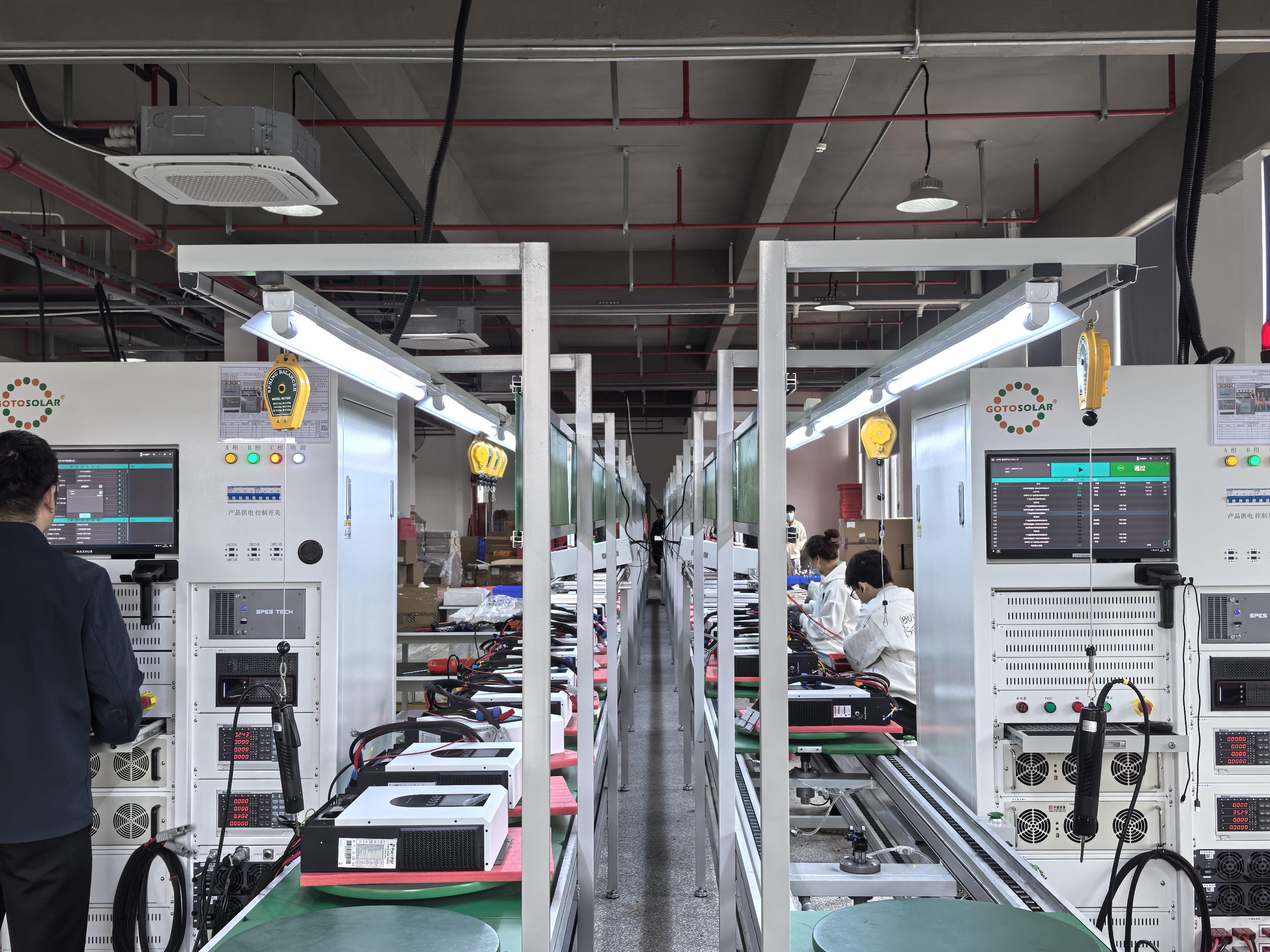
Automated production operations are part of the supplier evaluation evidence buyers should inspect.
Customisation Depth: What an OEM/ODM Buyer Can Actually Change
One of the most common misunderstandings in hybrid solar inverter sourcing is that OEM means logo printing. In practice, meaningful OEM/ODM customisation touches hardware, software and packaging.
According to GOTOSOLAR's own capability data, customisation options include:
- Hardware: custom PCB layout, enclosure material or colour, terminal type, and display screen selection.
- Software: custom startup logo, UI interface language, charging algorithms, and communication protocols such as RS485 or Modbus.
- Packaging: colour box design and manual language.
These are not superficial changes. PCB layout affects mechanical integration and thermal performance. Charging algorithms determine how the inverter interacts with different battery chemistries. Communication protocols determine whether the inverter can be monitored remotely and integrated into an existing energy management platform. For a buyer building a regional brand, these choices define the difference between a generic product and a market-specific solution.
Production Capacity and Lead-Time Visibility
When buyers execute volume orders, capacity and lead time become hard constraints. GOTOSOLAR reports a monthly production capacity of 60,000 units for standard hybrid inverter models and 20,000 units for customised models. That capacity split is useful because it signals that standard products and custom products run on separate planning assumptions.
The stated lead times are as follows:
- Samples: 7-10 days.
- Small orders of fewer than 500 pieces: 15-20 days.
- Bulk orders: 30-45 days, depending on customisation complexity.
These lead times are consistent with a manufacturer that handles custom firmware, packaging and minor hardware variants in a structured production flow. Buyers should still confirm current production schedules before contractual commitment, but the published lead-time structure is a reasonable baseline for planning stock arrival.
Quality Control System: From Incoming Inspection to Aging Test
The quality assurance process is often the strongest indicator of whether an OEM supplier can protect a buyer's brand in the field. GOTOSOLAR describes its quality control in the following stages: incoming quality control, in-process QC, 100% aging testing for 4-8 hours, final quality control, and out-of-box audit. The company also applies burn-in testing for high-power inverter units.
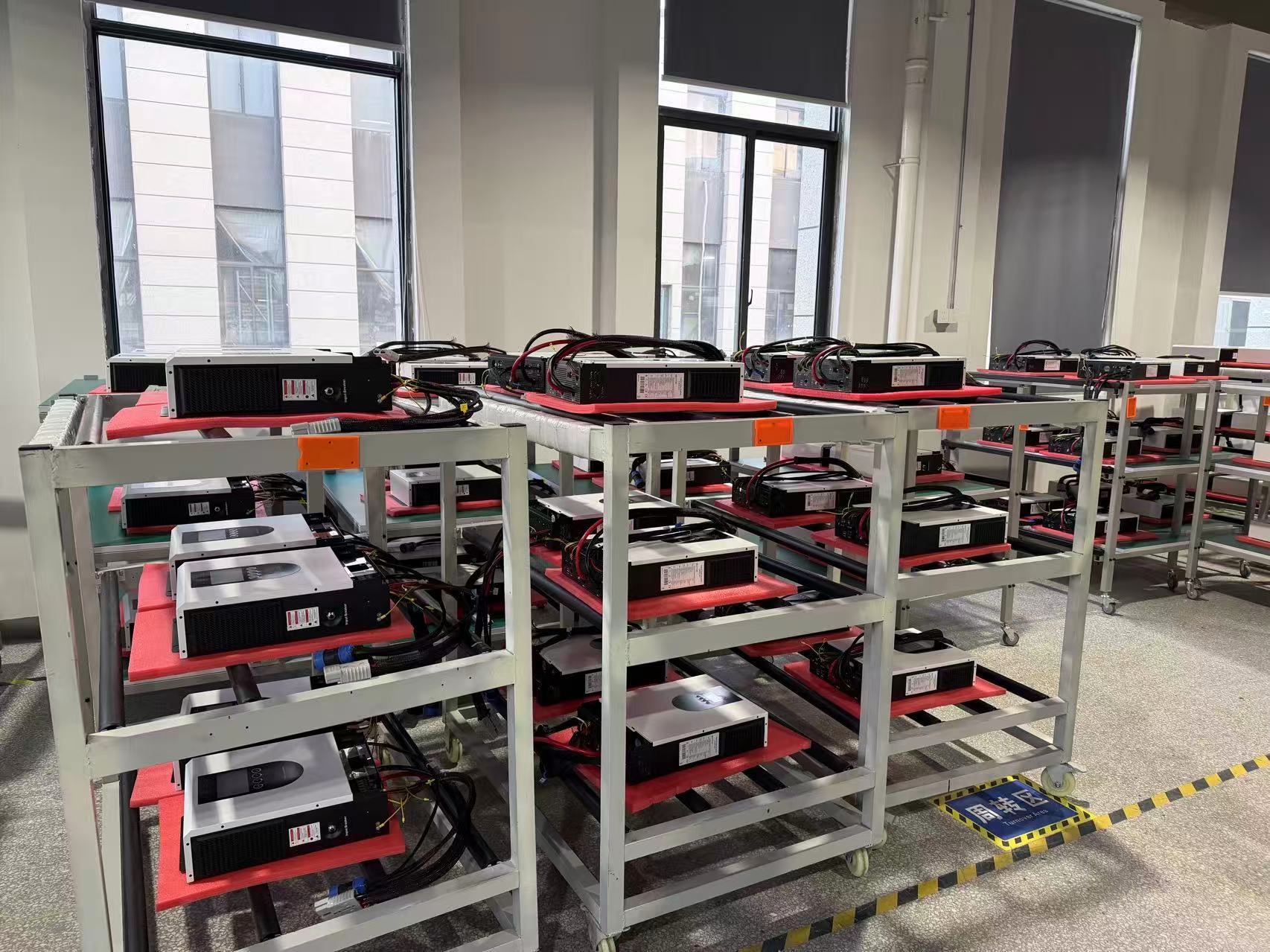
Aging tests are a key gate before hybrid inverter units are packed for export.
For hybrid solar inverters, full-function testing matters because faults often appear only under sustained load. Aging tests help expose component weaknesses, thermal issues and control board instability before products reach end customers. GOTOSOLAR further states that 100% of goods receive full-function testing before delivery, and after-sales support includes video troubleshooting guides and free spare parts of 1-2% of order quantity within shipments.
Hybrid Inverter Technical Baseline: The SYP Series Example
Understanding the technical baseline of a supplier's hybrid inverter platform is essential before discussing customisation. A useful reference model is the SYP-6.5KW-48V from GOTOSOLAR's hybrid inverter series, which sits in the 48V residential and small-commercial segment.
Key technical parameters from the manufacturer's specification include:
- AC input/output: rated voltage 208/220/230/240 VAC, L+N+PE.
- UPS switching: transfer time of 10 ms in normal mode and 10 ms in UPS mode, supporting sensitive loads such as computers and servers during grid interruptions.
- Output waveform: pure sine wave with power factor 1.
- Solar charging: MPPT type, with max PV input current of 27A and max PV input power of 9000W.
- MPPT voltage range: 60-450 VDC, with max PV open-circuit voltage of 500 VDC.
- Battery voltage: 48 VDC nominal, with floating charge voltage of 54 VDC.
- Charge current: max PV charge current of 120A and max AC charge current of 120A.
- Battery compatibility: lithium and lead-acid battery types.
- Monitoring: RS232/RS485/USB interface, with optional WiFi monitoring.
- Ingress protection: IP21.
- Operating temperature: -10°C to 60°C.
This configuration is typical for buyers looking for a 48V low-voltage hybrid inverter in the 6kW class, capable of handling rooftop solar input, battery storage and AC backup loads. The MPPT range of 60-450 VDC gives installers flexibility in PV string configuration, while optional WiFi monitoring supports remote visibility for distributors managing deployed systems.
For buyers that need higher enclosure protection, GOTOSOLAR also offers an 8.2kVA/8200W 48V single-phase hybrid inverter with IP65 and parallel-function capability, according to the manufacturer's public product information. IP65-rated units have better sealing but generally require more professional maintenance, while IP21 units are more suitable for protected indoor installation. The correct choice depends on whether the inverter will be installed under an eave, inside a utility room, or in a fully outdoor environment.
Real Deployment Evidence: Bulk Residential Storage and Distribution Stocking
OEM/ODM capability becomes meaningful when backed by deployment evidence. GOTOSOLAR's hybrid inverter series has been used in a project by a large-scale renewable energy EPC contractor and system integrator active in South Africa and other global markets. The project supplied approximately 3,000-4,000 hybrid inverter units across two 40HQ container shipments, supporting a large residential solar storage project and regional distribution centre stocking.
According to the documented case, the systems operated continuously for more than three years with a failure rate below 1%. The deployment successfully replaced diesel generators, reducing fuel costs by 80%, and continued stable operation at 45°C ambient temperature without derating. The stated highlight from the customer points to high reliability in harsh environments, excellent compatibility with lithium batteries, and responsive technical support during installation.
For evaluation-stage buyers, this type of case provides practical evidence on three questions: how the product behaves under sustained operation, whether the manufacturer can handle container-level dispatch, and whether the battery integration claims hold in field conditions.
Direct OEM/ODM vs Traditional Sourcing Routes
Buyers comparing procurement channels should understand the trade-offs between direct manufacturer partnerships and traditional distributor or trading-company routes.
| Sourcing route | Typical strengths | Realistic limitations |
|---|---|---|
| Local distributor / stockist | Fast availability, low initial commitment, useful for urgent replacement orders | Limited customisation, limited regional exclusivity, less control over batch quality and certification documentation |
| Trading company / sourcing agent | Can aggregate multiple products and suppliers, useful for mixed containers | Less direct control over factory quality plans, harder traceability for certifications and warranty execution |
| Direct OEM/ODM manufacturer | Brand customisation, firmware control, direct quality audits, better volume pricing, clearer technical after-sales | Requires larger order planning, longer lead times, local stock management and internal technical capability |
Boundaries of the Direct OEM/ODM Model
Direct OEM/ODM procurement is not always the best route. A buyer that only needs ten units immediately and has no long-term brand plan is usually better served by local stock. Custom firmware and packaging also require minimum quantities because engineering change and mold costs cannot be justified for single-piece orders.
There is also a supplier-specific boundary in this case. GOTOSOLAR's hybrid inverter production line is newer than its controller production history. Volume buyers should therefore request recent batch test reports, inspect the 100% aging test process, and run a pilot order before placing very large commitments. A manufacturer can be technically qualified yet still need scale-up verification for a newer product family.
Market Context: What the Data Says About Hybrid Inverter Sourcing
Several market signals help explain why OEM/ODM capability is becoming more important in hybrid inverter sourcing. Data published by Markets and Data values the global residential solar hybrid inverter market at USD 4.55 billion in 2023. Grand View Research further reports that three-phase hybrid inverters held a dominant revenue share of over 61.3% in the global market in 2024.
At the same time, the competitive structure of the PV inverter industry remains concentrated at the top. According to Wood Mackenzie, Huawei and Sungrow combined for 55% of the global PV inverter market share in 2024. That concentration means most new importers, regional distributors and renewable-energy integrators cannot compete purely on generic inverter scale. Their path to differentiation lies in targeted applications such as 48V residential hybrid systems, RV and marine power, telecom backup, and region-specific off-grid and on-grid hybrid configurations.
For B2B buyers in these niches, the practical procurement implication is clear: the value of a supplier is not only the inverter hardware but also the ability to adapt hardware, firmware, packaging and certification support to a specific regional market.
Technical and Compliance Signals That Reduce Execution Risk
During the execution stage, buyers should map every product model to its applicable certification documentation. For GOTOSOLAR's SYP hybrid inverter series, the CE-LVD certificates reference EN 62109-1:2010 and EN 62109-2:2011 under the Low Voltage Directive 2014/35/EU. The certified model range includes SYP 1.5KW 12V, 2.5KW 12V, 4.0KW 24V, 6.5KW 48V, and 12KW 48V variants.
EMC compliance is also documented. A CE-EMC certificate for the SYP-6.5KW-48V model references EN IEC 61000-6-3:2021, EN IEC 61000-6-1:2019 and related standards under the EMC Directive 2014/30/EU. Buyers targeting the EU market should match these documents to the specific model and battery configuration they intend to import.
For installation planning, the IP21 rating indicates protection against solid objects larger than 12.5mm and vertically falling water drops. IP21 hybrid inverters are intended for indoor installation or protected outdoor positions. Buyers installing outdoors under direct rain exposure should choose an appropriate IP65-rated product and confirm the required maintenance conditions with the manufacturer.
Future Outlook: From Product Purchase to Manufacturing Partnership
As hybrid inverter volumes grow, the procurement pattern is shifting from transactional buying toward longer manufacturing partnerships. Regional brands increasingly want exclusive model variants, battery-specific firmware, local-language displays and service-level support. Suppliers that can offer OEM, ODM, OBM and JDM engagement models will be better positioned than factories that only build one standard model at scale.
For GOTOSOLAR, the longer-term opportunity is to combine its solar controller track record with hybrid inverter capacity and convert that into repeatable OEM/ODM programs. The company states an internal goal of becoming a stronger player in the photovoltaic energy storage sector and ultimately reaching a group-scale revenue target. For buyers, what matters more than the stated ambition is whether the facility can demonstrate consistent quality, transparent lead times and scalable production across successive order rounds.
In the coming years, OEM/ODM buyers should monitor three things in supplier evaluations: improvements in battery communication protocol coverage, growth in high-protection and parallel-capability hybrid models, and the supplier's ability to maintain quality as inverter output scales.
Frequently Asked Questions
What OEM/ODM production modes does GOTOSOLAR offer?
GOTOSOLAR reports that it provides OEM, ODM, OBM and JDM production services. In its capability documentation, the company states that both OEM and ODM services are available. OEM is suitable for buyers with an existing design, while ODM is suited to buyers that want the manufacturer to develop a product based on performance and market requirements.
What can a buyer customise on a GOTOSOLAR hybrid solar inverter order?
Customisation can be divided into hardware, software and packaging. Hardware options include PCB layout, enclosure material or colour, terminal type and display screen. Software options include startup logo, UI interface language, charging algorithms and communication protocols such as RS485 or Modbus. Packaging can be adapted through colour box design and manual language selection.
What is the typical lead time for OEM/ODM hybrid inverter orders?
The stated lead time is 7-10 days for samples, 15-20 days for small orders of fewer than 500 pieces, and 30-45 days for bulk orders depending on customisation complexity. Buyers planning a large order should confirm the production schedule in writing before payment.
What quality control does GOTOSOLAR apply before shipment?
GOTOSOLAR applies a multi-stage quality control process that includes incoming quality control, in-process QC, 100% aging testing for 4-8 hours, final quality control and out-of-box audit. The company also states that 100% of goods receive full-function testing before delivery, and spare parts of 1-2% of order quantity are included with bulk shipments.
Which battery types and BMS protocols are compatible with GOTOSOLAR hybrid inverters?
GOTOSOLAR states that its hybrid inverters support both lithium and lead-acid batteries. Specific compatibility details depend on the battery-provider BMS protocol. Buyers should request the manufacturer's compatibility list and match the inverter communication protocol to the selected lithium battery model before completing system design.
Does GOTOSOLAR have CE certification for its hybrid solar inverter series?
Yes. CE-LVD certificates for the SYP hybrid inverter series reference EN 62109-1:2010 and EN 62109-2:2011. A CE-EMC certificate for the SYP-6.5KW-48V model references EN IEC 61000-6-3 and EN IEC 61000-6-1 under the EMC Directive 2014/30/EU. Buyers should verify that the exact model code and battery configuration match the certificate scope.
Should a buyer choose an IP21 or IP65 hybrid solar inverter?
IP21 indicates protection against solid objects larger than 12.5mm and vertically falling water drops, making it suitable for protected indoor installation. IP65 offers higher sealing and is more appropriate for outdoor or harsher environments. However, IP65 units generally require professional maintenance and are less suitable for ordinary household access. The correct choice depends on the physical installation location.
Reference Material
Buyers that want to compare GOTOSOLAR's available hybrid inverter models and configurations can download the public product catalogue here: GOTOSOLAR Inverter Catalogue 2025 (PDF).
Have Questions or Need More Details?
Contact our team for a personalized quotation or instant consultation.
Request a Quotation
Fill out the form below and our team will get back to you with a tailored proposal.
WhatsApp Direct Chat
Prefer to chat in real-time? Message us on WhatsApp for instant assistance & quick answers.
- Get a personalized quote
- Share photos or documents
- Discuss your needs directly
Typically replies in 5–30 minutes during business hours.