
How to Clean & Maintain Self-Adhesive PVC Film: Cabinet & Wall FAQ
How to Clean & Maintain Self-Adhesive PVC Film: Cabinet & Wall FAQ
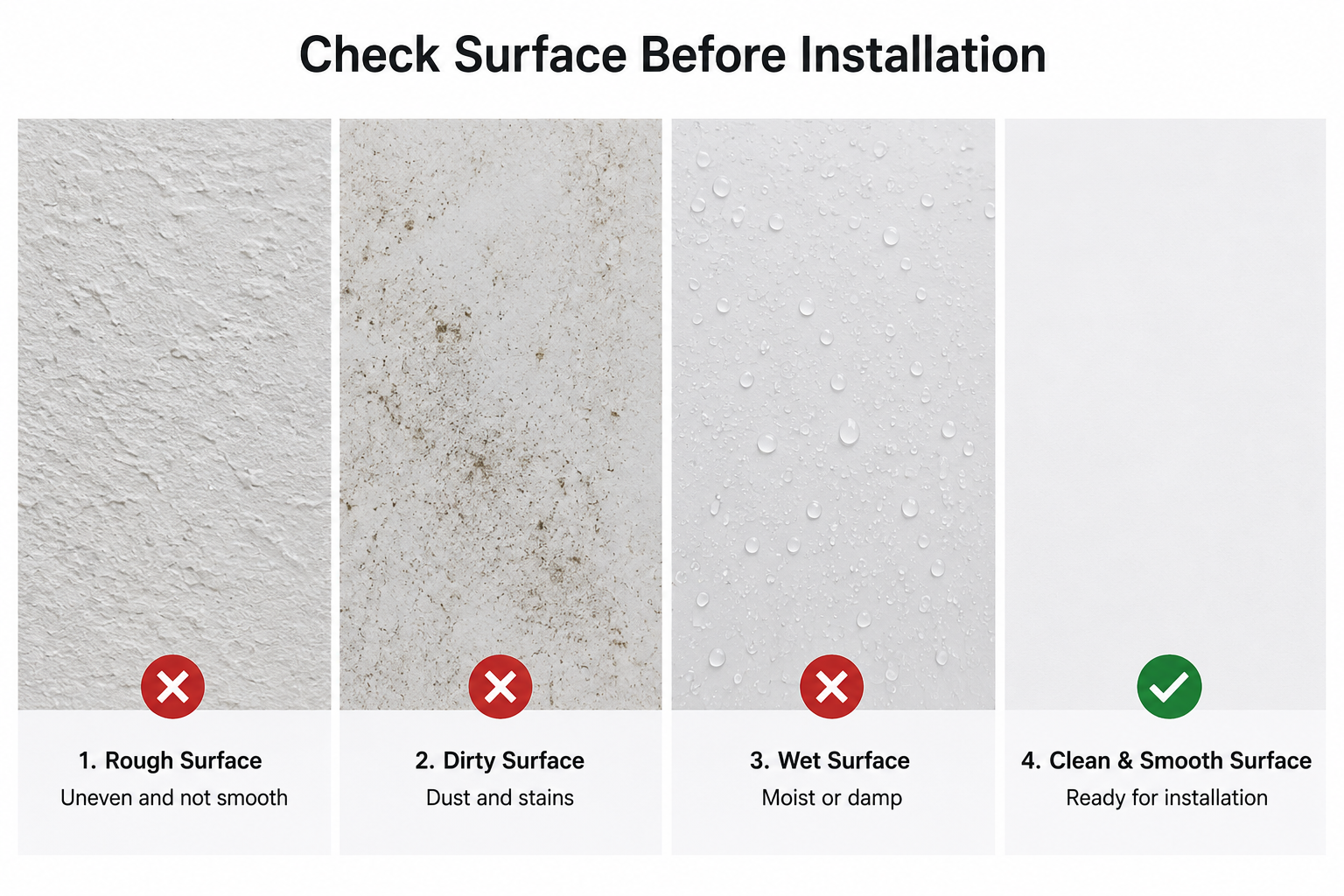
Surface condition before installation is the single biggest determinant of how well a self-adhesive PVC decorative film will clean and hold up afterwards.
Self-adhesive PVC decorative film is a peel-and-stick surfacing material used to reface kitchen cabinets, wardrobes, doors, wall panels and other interior surfaces. It is built from three functional layers: a PVC decorative face around 0.16 mm thick, a water-based acrylic pressure-sensitive adhesive, and a paper release liner that protects the adhesive until installation.
Maintenance guidance for this material is short but specific. Most premature failures reported on refacing projects trace back to two decisions rather than to the decorative print itself: how the substrate was prepared before installation, and which cleaning chemistry was used afterwards. The questions below are the ones that typically arrive from cabinet and wall refacing projects, answered against published product specifications rather than general assumptions.
Why Maintenance Is a Procurement Question, Not an Afterthought
Refacing decisions are usually made on appearance, cost and the speed of a renovation. Maintenance is assumed at that stage and negotiated with reality later. That ordering is expensive, because the service behaviour of a film surface is governed by the same specification that governs its appearance:
- the film thickness and how faithfully it follows the substrate;
- the adhesive system and how it behaves at edges and joints;
- the surface finish, which determines how visible cleaning residue becomes.
Manufacturers that publish maintenance data inside their comparison tables — listed as easy maintenance, easy to clean, easy replacement and low maintenance cost — are describing an outcome that is only achievable when the substrate has been prepared correctly. Maintenance performance and installation discipline are the same conversation, not two separate ones.
The installed base behind this question is large. Dataintelo's PVC Decorative Film Market Research Report 2034 states that the furniture sector accounted for approximately 44.6% of total global PVC decorative film consumption in 2025. A significant share of installed film therefore sits on furniture, cabinet and panel surfaces that are cleaned regularly, in rooms where grease, moisture and household or commercial cleaning products are part of normal use.
The Film Construction That Determines How It Should Be Maintained
Self-adhesive PVC decorative film is not a paint or a coating; it is a laminated sheet carrying its own adhesive. Each layer has a direct maintenance consequence.
- PVC decorative face, 0.16 mm nominal thickness. The face is thin enough to conform to the panel beneath it. That is an advantage for wrap-around edges and profiles, but it also means the film copies whatever geometry it is applied over. Dents, gaps, roughness and uneven grain remain visible, and a contaminated or damaged substrate will show through. The film reports the substrate; it does not correct it.
- Water-based acrylic pressure-sensitive adhesive. The bond sits behind the decorative face. Cleaning liquids that repeatedly run behind edges and joints act on the adhesive layer and on the substrate, not on the PVC face — which is precisely why published guidance places a boundary on continuous water exposure.
- Paper release liner. The liner protects the adhesive before installation. In air-release constructions, the liner and adhesive structure are designed together to create micro air channels that let trapped air escape during application.
- Surface finish. Finishes are supplied as matte, glossy, embossed or super matte. Texture changes how residue behaves: embossed and matte surfaces hold dust and dried detergent differently from a gloss surface, while gloss surfaces show streaks and water marks more readily than textured ones.
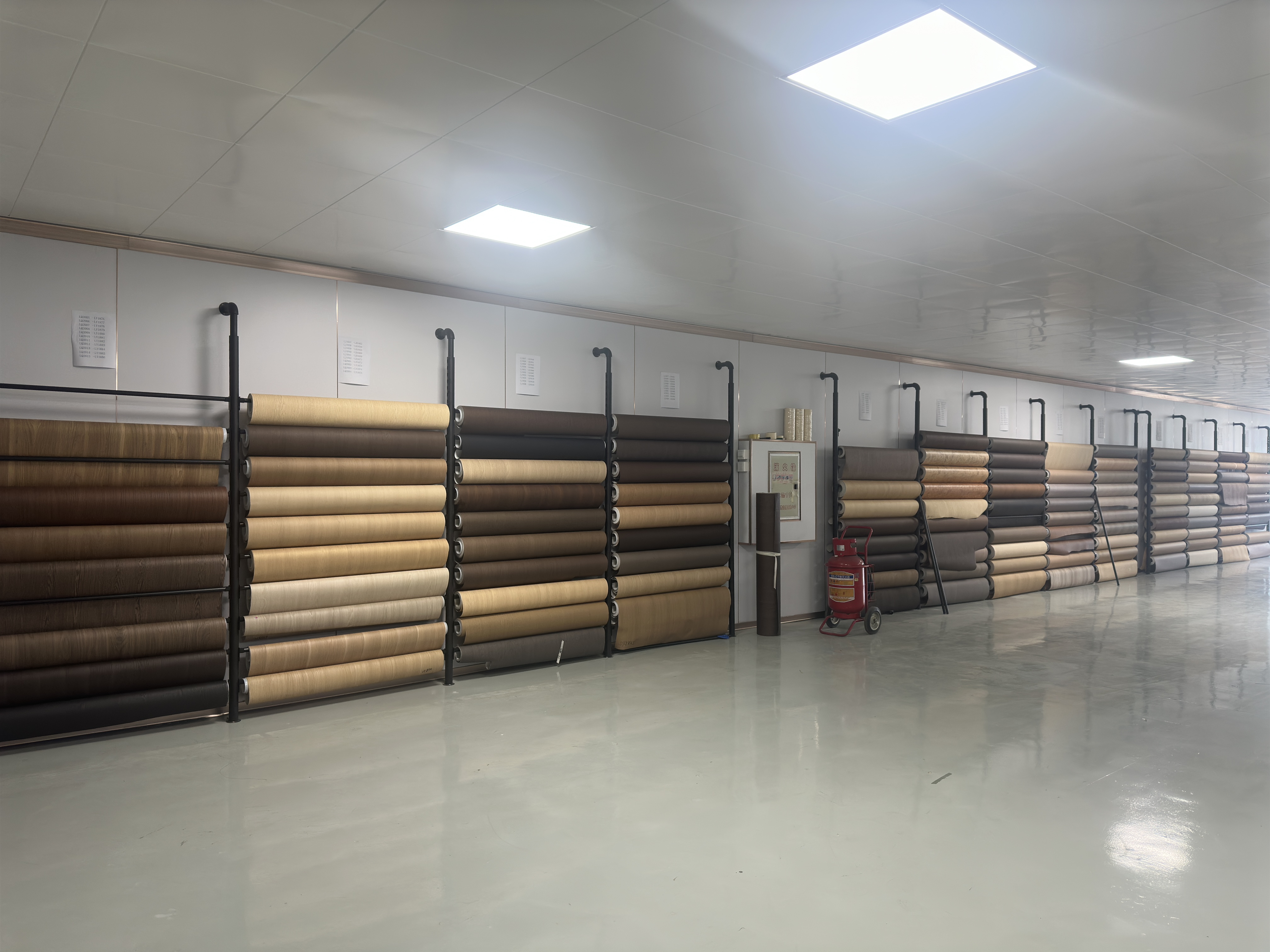
Self-adhesive PVC decorative film is supplied in wood grain, marble, solid colour, stone, metallic, textile and concrete patterns, with matte, glossy, embossed or super matte finishes.
The standard specification matters to maintenance planning because it sets the physical limits of the surface: how thick the protective face is, how wide the roll is, and how the material is bonded. Representative product ranges include LY1804-LY1869 for general self-adhesive PVC decorative film, LF6801-LF6830 for marble grain designs, and LG7801-LG7836 for Japanese-style wood grain.
| Parameter | Standard specification |
|---|---|
| Material | PVC |
| Nominal thickness | 0.16 mm |
| Standard width | 1,240 mm |
| Roll length | 50 m per roll |
| Adhesive | Water-based acrylic pressure-sensitive adhesive |
| Backing | Paper release liner |
| Surface finish | Matte / glossy / embossed / super matte |
| Pattern options | Wood grain, marble, solid colour, stone, metallic, textile, concrete |
| Installation | Peel and stick |
| Typical application | Furniture, cabinets, doors, walls, interior renovation |
| Packing | 1 roll per carton |
| HS code | 39199090 |
A Cleaning Routine That Matches the Material
Published maintenance guidance for self-adhesive PVC decorative film is deliberately conservative: soft cloth, water, and a mild neutral detergent when needed. The sequence matters more than the products used, because the goal is to lift soil without leaving detergent residue and without pushing liquid behind the film edges.
| Step | Action | Why it is specified this way |
|---|---|---|
| 1 | Remove loose dust with a soft, dry cloth. | Dry removal prevents dust from being smeared into the surface and reduces the rubbing needed later. |
| 2 | For normal stains, wipe the surface gently with a soft damp cloth. | Water alone handles routine marks; gentle wiping protects the decorative face and finish texture. |
| 3 | For grease or stubborn dirt, use a mild neutral detergent diluted with water. | Neutral dilution removes oil-based soil without aggressive chemistry or abrasion. |
| 4 | Wipe again with a clean damp cloth to remove detergent residue. | Residue left on the surface attracts new dust and can appear as streaking, especially on gloss finishes. |
| 5 | Dry the surface with a soft, clean cloth. | Removing standing moisture from the surface, and particularly from edges and joints, is part of the routine. |
Safety note carried with the maintenance guidance: test any unfamiliar cleaning product on a small hidden area before using it on the full surface. This applies to new cleaning brands and to any product that is stronger than a mild neutral detergent.
Two habits work against the material and are worth removing from a maintenance schedule. The first is abrasive action — scouring pads and aggressive scrubbing flatten texture and dull the face on embossed and super matte finishes. The second is leaving liquid standing along edges, joints and the bottom rail of cabinet doors; that is the area where the water exposure boundary described below applies.
Kitchens and Bathrooms: Where Water Resistance Needs a Boundary
Self-adhesive PVC decorative film is suitable for renovating smooth kitchen cabinet doors, panels and other interior furniture surfaces. It provides a decorative, water-resistant and easy-to-clean surface, and it allows a cabinet front to be refreshed without replacing the entire cabinet. The PVC face itself is water-resistant and easy to clean, which is why the material is commonly specified for kitchen and bathroom-adjacent surfaces.
The boundary is equally clear and is the part most often missed in specification documents: edges, joints and the underlying substrate should not be continuously exposed to water or excessive moisture. Splash, wiping and normal kitchen humidity are inside the material's intended use. Standing water that repeatedly reaches the film edge, penetrates behind the bond line or keeps the substrate damp is outside it. Treated as a splash-resistant decorative surface rather than as a structural waterproofing membrane, the film behaves as specified.
The same logic applies to bathroom and wet-area use. Bathroom waterproof PVC film is specified for indoor decorative surface renovation, and the special requirements recorded for these applications include water-proof, oil-proof and fire-resistance performance at project level. Those are requirements on the installed system — film, substrate and edge condition together — not a standalone guarantee from the film roll alone.
Where the Film Is Specified: Application Map
The material is recorded for indoor use across a defined set of industries and project types. The maintenance implication differs by application, and that difference should drive the cleaning schedule.
| Application | Why film refacing fits | Maintenance implication |
|---|---|---|
| Kitchen and cabinetry | Smooth cabinet doors, panels and furniture surfaces; quick renovation without full cabinet replacement | Regular degreasing with mild neutral detergent; keep edges and joints free of standing water |
| Furniture renovation | Surface refurbishment on smooth, stable panels | Soft damp wiping; avoid abrasives that dull the finish |
| Interior renovation and surface refurbishment | Indoor decorative surface renewal with minimal demolition | Dust control during the renovation cycle; routine dry dust removal afterwards |
| Hospitality, commercial interiors and office renovation | Large-area surface renewal where downtime must be short | Scheduled cleaning protocols; panel-level replacement when a surface is damaged |
| Elevator renovation and professional wrapping | Contoured and high-touch surfaces installed by trained applicators | Frequent cleaning of high-contact areas; residue-free rinsing to avoid visible streaking |
Installation and maintenance tooling overlap significantly. The recorded application set includes a utility knife, squeegee, heat gun, measuring tape, ruler, surface cleaning tools, edge trimming tools and an application roller. The presence of surface cleaning tools in the installation kit is not incidental: cleaning before application is what makes the later cleaning routine effective.
How Film Refacing Compares with Traditional Surface Options
Comparison against traditional surface renewal methods is usually structural rather than a ranking of quality. Each method changes a surface in a different way, and the maintenance profile follows from that.
| Criterion | Self-adhesive PVC decorative film | Laminate re-cladding | Painting / refinishing | Full panel or cabinet replacement |
|---|---|---|---|---|
| What is added to the surface | A 0.16 mm PVC face with its own adhesive layer | A separate panel that must be cut, fitted and edge-treated | A paint film over a prepared substrate | A new panel or unit |
| Process character | Peel and stick, indoor application, minimal demolition | Cutting and fitting work, usually with edge detailing | Masking, surface preparation and drying time | Removal and refitting of components |
| Renewal of a single surface | Specified as easy to replace | Depends on panel fixing and edge detail | Spot repair is possible but matching can be difficult on aged surfaces | Replacement of the whole component |
| Routine maintenance | Soft cloth, water, mild neutral detergent; easy to clean by specification | Generally wiped clean, with care at joints | Usually wiped clean; repairs are coating-level | Same as the original finish |
| Continuity risk on reorder | Colour deviation and thickness tolerance are specified by the supplier (for example, colour deviation up to ΔE 2.0 and thickness tolerance of ±0.01 mm in published comparison data) | Batch and decor matching across production runs | Batch-to-batch colour matching on tinted paints | Availability of the original model or finish |
Where the film approach has real limits
A 0.16 mm film cannot build up thickness or repair geometry. It follows the substrate, so dents, gaps, roughness and surface irregularity remain visible unless the substrate is levelled or replaced first. It is a decorative surface renewal, not a structural repair.
Adhesion is substrate-dependent. Rough, dusty, oily, damp, porous or unstable surfaces can reduce adhesion and affect the final appearance. Documented risks on such surfaces include poor adhesion, bubbling, edge lifting, peeling and an uneven finish. The mitigation is preparation: clean and dry the surface thoroughly, remove dust, oil, moisture and loose material, test a small area when the substrate is uncertain, and apply surface treatment or a primer where rough or porous surfaces require it.
Finally, the water exposure boundary is a genuine constraint, not a marketing caveat. Edges, joints and the substrate beneath the film should not be continuously exposed to water or excessive moisture. Projects where that condition cannot be maintained — for example, surfaces that stay wet for long periods — fall outside the material's intended use rather than inside a stricter version of it.
Market Trend: Refacing Is Now a Material Category, Not a Niche
The maintenance question is becoming more common because the category itself has grown. According to Dataintelo's PVC Decorative Film Market Research Report 2034, the global PVC decorative film market was valued at USD 4.8 billion in 2025 and is projected to reach USD 8.6 billion by 2034, a CAGR of 6.7%. Asia Pacific dominated that market with a 42.3% revenue share in 2025.
Within the product mix, wood grain held the largest product segment share at 38.4% in 2025. On the supply side, International Trader Publications reported that China surged past the United States in 2025 to become the world's largest PVC exporter, accounting for 24% of total global trade volume. China's exports under HS Code 3919 — self-adhesive plates, sheets, film, foil, tape and strip of plastics — reached an all-time high of RMB 246.296 million in January 2026, according to General Administration of Customs China data.
Two standards recur in specification discussions around these films. B1 flame retardant performance (GB 8624) is achievable for PVC decorative films and is treated as a critical safety standard for interior decoration in markets that require it. ASTM D1593 is the standard specification for nonrigid vinyl chloride plastic film and sheeting, evaluating tensile strength and elongation. A procurement file that carries these standards but not the cleaning and maintenance instructions is incomplete: the physical specification and the maintenance guidance describe the same product.
Long-Term Supply, Replenishment and Colour Continuity
For distributors, renovation material suppliers and project customers, maintenance is inseparable from replenishment. A refacing programme that runs across multiple phases needs film that matches when it is reordered, and it needs replacement material available at short notice when a single panel is damaged.
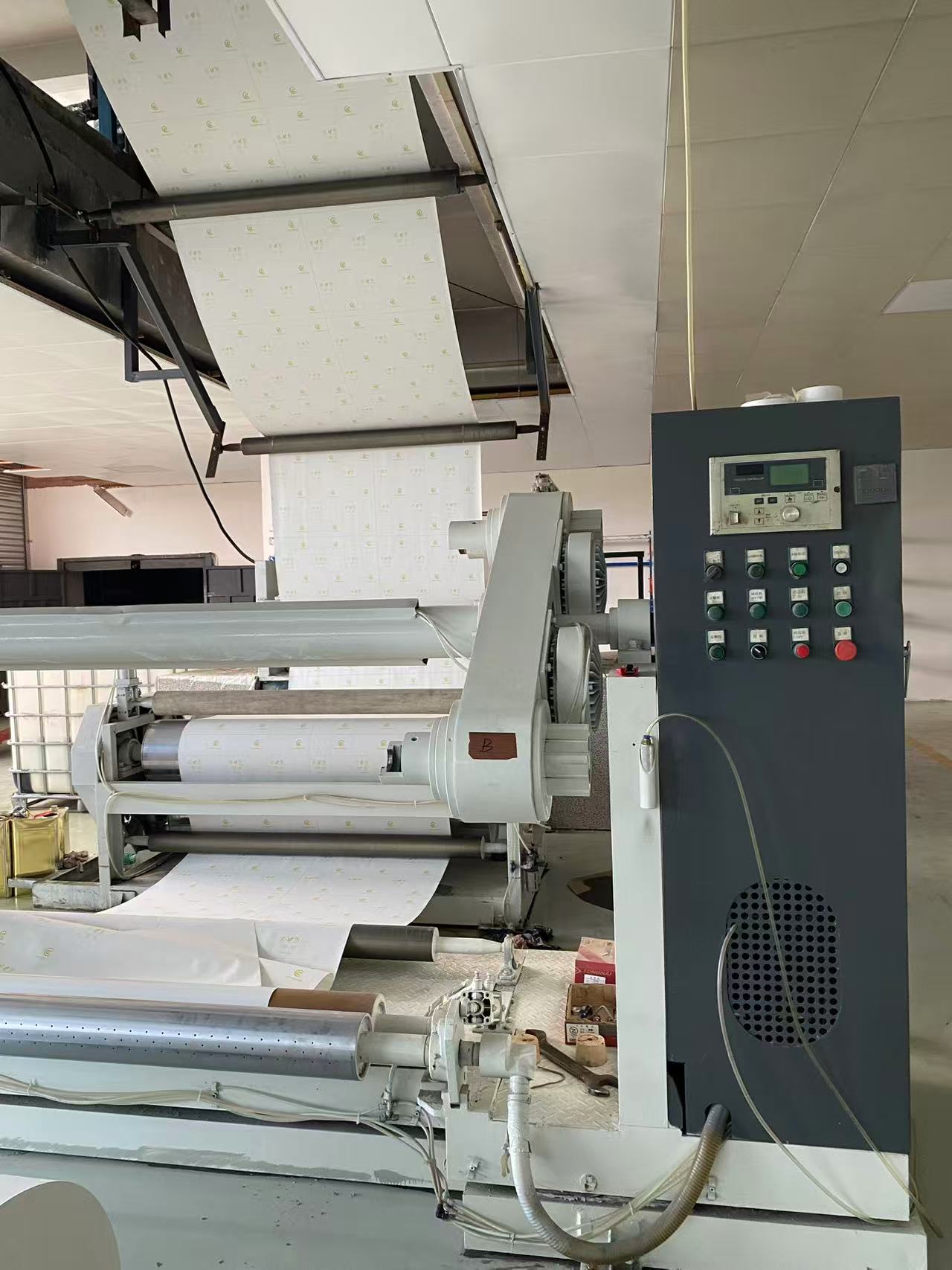
In-house adhesive coating is one of the process stages that supports batch-to-batch consistency when film is reordered for later project phases.
Foshan Nanhai Jiadamei Decoration Material Co., Ltd, which trades under the brand leiyegaoke, is a manufacturer of self-adhesive PVC decorative films based in Foshan, Guangdong, China, founded in 2001. The factory operates two adhesive coating lines and an integrated production system covering PVC film production, printing, laminating, adhesive coating, slitting, inspection and packaging. That integration is what allows control over colour consistency, thickness and adhesive performance across production runs — the variables that decide whether a replacement panel matches the original installation.
Published supply terms relevant to maintaining an installed programme include:
- Minimum order. Stock colours are available at one roll per colour; custom colours are 3,000 meters per colour.
- Customisation. OEM and ODM services cover customised colours, patterns, thicknesses, roll sizes, adhesives, release papers, labels, cartons and private-label packaging.
- Inspection and acceptance. Acceptance can be based on an approved sample, with appearance, colour, pattern and dimension inspection, carried out by the customer or a third party.
- Delivery and payment. EXW, FOB, CIF, express and air shipment are supported, with T/T payment terms.
- Compliance. Products comply with REACH and RoHS international requirements.
Because stock colours can be ordered at one roll per colour, holding a spare roll on site is a practical measure for edge repairs and single-panel replacement in long renovation programmes — particularly in hospitality and commercial interiors, where a damaged surface needs to be restored without changing the appearance of the surrounding panels. The company supports importers, distributors, renovation material suppliers and project customers with flexible MOQ and diversified design selections, and its products are supplied to customers across Europe, the Middle East, Southeast Asia, Russia, Africa, North America and other international markets.
Future Outlook
Three developments are likely to shape how this material is maintained and specified over the next few years. First, as the decorative film market moves toward the projected USD 8.6 billion level by 2034, competition will shift from pattern availability toward consistency — colour, thickness and adhesive performance across repeat orders. Second, maintenance documentation will increasingly be treated as part of the technical file, alongside REACH and RoHS compliance, B1 flame retardant performance and ASTM D1593 test references, because facility and hospitality buyers need cleaning instructions that survive staff turnover. Third, air-release adhesive structures will continue to spread in professional renovation work, since easier application reduces trapped air and rework in the first place and therefore reduces the number of surfaces that later fail at the edges.
None of these changes alter the underlying rule. A 0.16 mm self-adhesive PVC decorative film is a surface material with a defined maintenance routine and a defined water exposure boundary. Projects that respect both get a decorative, water-resistant and easy-to-clean finish that can be renewed panel by panel. Projects that ignore them get bubbling, edge lifting and peeling, followed by a warranty conversation that the material specification alone cannot settle.
Frequently Asked Questions
Can self-adhesive PVC film be used on kitchen cabinets?
Yes. Self-adhesive PVC decorative film is suitable for renovating smooth kitchen cabinet doors, panels and other interior furniture surfaces. It provides a decorative, water-resistant and easy-to-clean surface and allows a cabinet to be refreshed without replacing the entire unit. Surfaces that are rough, dusty, oily or untreated and porous must be prepared before installation, and edges, joints and the substrate beneath the film should not be continuously exposed to water or excessive moisture.
Is self-adhesive PVC film waterproof?
The PVC surface is water-resistant and easy to clean, which makes it suitable for normal kitchen use and for splash-exposed interior surfaces. It is not an unlimited waterproof barrier: edges, joints and the underlying substrate should not be continuously exposed to water or excessive moisture. Water resistance therefore depends on the installed system — film, substrate and edge condition together — rather than on the film alone.
Can self-adhesive PVC decorative film be applied to any surface?
No. It is recommended for smooth, clean, dry and stable surfaces such as furniture panels, cabinets, doors, metal, glass and other properly prepared interior surfaces. Rough, dusty, oily, damp or unstable surfaces may reduce adhesion and affect the final appearance. Documented risks on unprepared substrates include poor adhesion, bubbling, edge lifting, peeling and an uneven surface appearance. Mitigation is procedural: clean and dry the surface thoroughly, remove dust, oil, moisture and loose material, test a small area when the substrate is uncertain, and apply surface treatment or a primer where rough or porous surfaces require it.
How are bubbles avoided when applying self-adhesive PVC film?
Air is removed during installation rather than after it. The film should be applied gradually while the release liner is peeled back step by step, with a squeegee used to push trapped air out as the film is laid down; proper surface preparation is equally essential. Air-release self-adhesive PVC film uses a specially designed release liner and adhesive structure that creates micro air channels, allowing trapped air to escape more easily. Standard adhesive film without air-release channels requires more careful application and is more likely to trap air if installed improperly. For furniture renovation, cabinet wrapping and large-area surface applications, air-release film is the recommended construction because it reduces bubbles and wrinkles, particularly on professional renovation projects.
How should self-adhesive PVC film be cleaned and maintained?
For routine cleaning, use a soft cloth with water or a mild neutral detergent, since regular and gentle cleaning helps maintain the decorative surface and appearance. The documented sequence is: remove loose dust with a soft dry cloth; wipe normal stains gently with a soft damp cloth; use a mild neutral detergent diluted with water for grease or stubborn dirt; wipe again with a clean damp cloth to remove detergent residue; then dry the surface with a soft clean cloth. Test any unfamiliar cleaning product on a small hidden area before using it on the visible surface.