
How to Compare Commercial Scent Diffusers: A Step-by-Step Check
Independent Buyer Reference · Commercial Scenting
How to Compare Commercial Scent Diffusers: A Step-by-Step Check
A commercial scent diffuser should be compared the way any other piece of building equipment is compared: by matching published specifications to a defined space, a defined power situation and a defined noise tolerance. Brand reputation does not change the fact that a machine rated for 100–150 m² behaves differently from one rated for 800–1300 m², or that a DC 12 V plug-in unit and a battery-operated unit solve two different installation problems.
This guide sets out a seven-step comparison method for independent buyers — facility managers, scent marketing service providers, distributors and procurement teams — who are evaluating commercial scenting solutions without a preferred supplier in mind. The product specifications used as examples come from published product and compliance documentation for Shenzhen Scentsea Technology Co., Ltd. (brand: SCENTSEA), a Shenzhen-based manufacturer founded in 2021 that produces cold-air nebulizing scent diffusers, HVAC scent systems and fragrance oils. Third-party market and trade data is attributed at the point where it is used.
Why Machine-to-Machine Comparison Is Harder Than It Looks
Scent diffuser catalogues look deceptively uniform. Most listings show a coverage figure, a tank size, a wattage and a colour option, and on paper the gap between two machines can look like a rounding error. In practice, three mistakes account for most disappointing commercial scenting purchases.
The first is over-specification. A unit rated for 800–1300 m² placed in a 120 m² boutique will diffuse far more oil than the space requires, at a nominal consumption of 5.4±10% ml/h instead of the 2.5±10% ml/h typical of a mid-size machine, and at a rated noise of <45 dB instead of <30 dB. The buyer pays more, refills more often and adds avoidable noise to a quiet room.
The second is under-specification. A unit rated for 150–350 m² installed in a 1,000 m² open lobby produces uneven scent — strong near the diffuser, weak at the far end — and complaints usually follow.
The third is a power mismatch. Battery-operated and plug-in machines are not interchangeable, and a specification that ignores where the nearest power point sits fails at installation rather than at purchase. A structured comparison removes all three risks, which is why the sequence below matters: space first, then power, then the specifications that follow from them.
What Counts as a Commercial Scent Diffuser
A commercial scent diffuser is a fragrance delivery device designed to distribute scent consistently through business environments such as hotels, retail stores, offices, shopping malls, banks and airports, rather than in a single residential room.
The dominant professional technology is waterless cold-air atomization: the device atomizes fragrance oil directly into fine particles without adding water and without using heat. A published technical guide from SCENTA describes cold-air nebulizing diffusion as generating sub-micron particles below 2.5 µm, which keeps fragrance suspended in the air rather than settling quickly. Because no water tank dilutes the oil, working schedules and output intensity can be adjusted to the space and its airflow conditions.
This matters for comparison because it defines what is actually being compared. A consumer ultrasonic aroma diffuser mixes a few drops of oil into water; a commercial cold-air unit diffuses the oil itself. The two categories differ in coverage, consistency and daily maintenance — not simply in price.
Step 1 — Map the Space Before You Compare Any Coverage Number
Coverage is the first specification most buyers read and the first one they misread. Rated coverage is measured under favourable conditions. Room size, ceiling height, ventilation, airflow and partitions all change the effective coverage of the same machine, which is why the practical guidance is to map the space rather than copy the maximum figure from a datasheet.
Start by measuring the net area of the zones a single machine is expected to serve, then note ceiling height and whether the space is open-fronted or divided by walls. With those notes in hand, place the three main coverage classes in perspective:
- 800–1300 m² (2500–4000 m³; 8600–14000 ft²): the H5000 floor-standing diffuser, a 1000 ml aluminium unit intended for hotel and shopping mall interiors and office building lobbies.
- 150–350 m² (500–1000 m³; 1500–3500 ft²): the P02 electric diffuser, a 300 ml plug-in model intended for washrooms, corridors and shops.
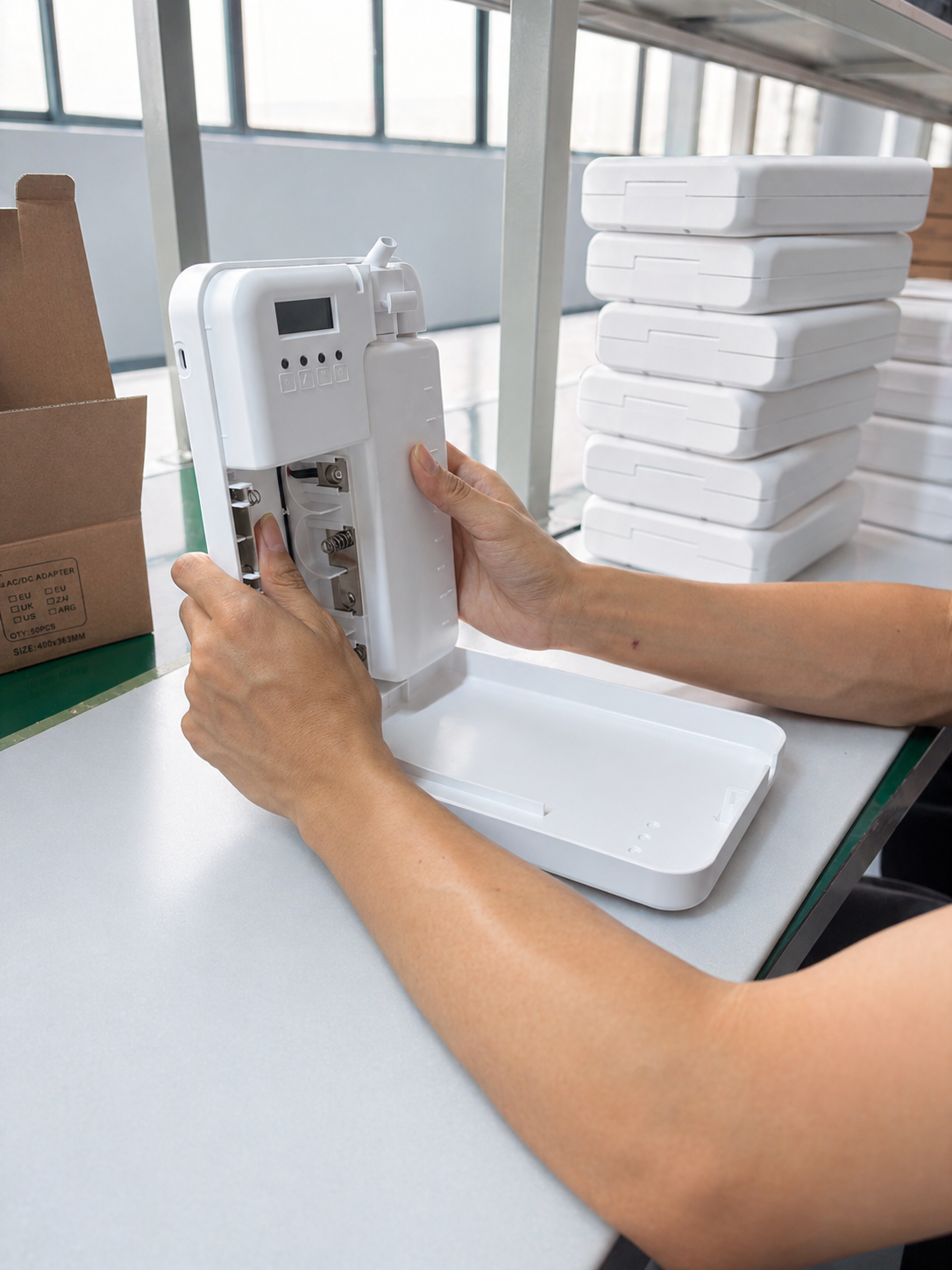
- 100–150 m² (300–500 m³; 1000–1600 ft²): the P01 (product ID 4705) battery-operated diffuser and the related P03, both plastic-bodied units intended for restrooms, elevators, corridors and small shops.
Those three bands differ by close to an order of magnitude, yet all three machines sit in the same commercial catalogue. If a space falls between bands, choose the band that covers it with a margin and use working-schedule and intensity settings to fine-tune output, rather than buying the largest machine available. Where a building is genuinely large, the comparison moves up a class again: the A300 commercial diffuser is rated 500–800 m² at <40 dB, the T3 is rated 1000–1600 m² at <55 dB, and the AC-MAX HVAC diffuser is rated 2500–3500 m².
Step 2 — Match the Power Source to the Installation Reality
Power supply is the specification that most often decides whether a project succeeds, because it is fixed by the building rather than by buyer preference. Commercial diffusers in this published range fall into three groups:
- DC 12 V plug-in: H5000 (20 W), P02 (6.5 W), A300 (12 W), T2 (DC 12 V 2 A, 10 W), T3 (DC 12 V 2 A, 15 W) and the AC-MAX HVAC diffuser (48 W). These require a permanent power point and suit continuous, scheduled operation.
- Battery-operated: P01 (4 × D batteries or Type C, 5 V, 2.5 W) and P03 (3 × D batteries or Type C, 5 V, 2.5 W). These are specified where wiring is difficult or undesirable — elevators, washrooms, corridors and small shops.
- Mains AC 110–240 V: the S01 wall plug-in diffuser (1.5 W) and the SC19 advertising scent machine (30 W).
The trade-off is straightforward. Battery units remove the wiring constraint but operate at low output and cover the smallest areas in the range. Plug-in units allow continuous duty, timer scheduling and higher output. An independent comparison therefore begins with the question “where can this machine be powered?” rather than with the coverage figure.
Step 3 — Treat Noise as a Specification, Not a Detail
Noise rarely appears in marketing material, yet it is the specification most likely to generate complaints in guest-facing spaces. Published noise ratings across the same range show how wide the spread can be:
- <30 dB: P02 electric diffuser and S02 tower diffuser; the SC19 advertising machine is rated ≤30 dB.
- <35 dB: P01 and P03 battery-operated diffusers.
- <38 dB: S01 wall plug-in diffuser.
- <40 dB: A300 commercial diffuser.
- <45 dB: H5000, T2 and the AC-MAX HVAC diffuser.
- <55 dB: T3 commercial diffuser, the highest rating in this range.
The pattern is consistent: noise rises with output and coverage. That gives buyers a usable rule. In hotel rooms, quiet offices and fitting areas, specify from the lowest noise band that still meets coverage, and check model-specific noise data on a sample rather than relying on a catalogue alone. In a service corridor or a plant room, a higher rating is usually acceptable.
Step 4 — Read Oil Capacity and Consumption Together
Tank size alone says very little. Capacity read together with consumption indicates how often somebody has to refill and maintain the machine, and that is the real operating burden of a scenting installation.
Within the same published range, nominal oil consumption runs from 0.6±5% ml/h on the compact S02, through 2.5±10% ml/h on the P02, 3 ml±10%/h on the T2, 4 ml±10%/h on the A300 and 4.6 ml±10%/h on the T3, to 5.4±10% ml/h on the H5000 and 6 ml±5%/h on both the AC-MAX and the SC19 advertising machine. Tank capacities across the same range span 100 ml (S02), 300 ml (P02), 500 ml (P01, A300, T2 and SC19), 1000 ml (H5000 and T3) and 5 L on the AC-MAX.
Comparing the two figures side by side is what separates a well-specified project from an expensive one. A large machine with a large reservoir and high nominal consumption belongs in a large, continuously scented space. A smaller machine with a smaller reservoir and lower consumption belongs where the space is compact and attention is close. Consumption still depends on the working schedule and intensity setting, so the same unit can be tuned — but the nominal figures show which class of space it was designed for.
Step 5 — Check Control, Scheduling and Installation Method
Control is where two similarly sized machines can still diverge. Models in this range are operated through smart app control, manual button control, timer scheduling and adjustable scent intensity, with selected models supporting Bluetooth or Wi-Fi remote management; the AromaOS app is the matched control application for the range.
Two comparison points deserve attention on any shortlist. First, whether scheduling is available at all — an unscheduled diffuser runs continuously and consumes oil unnecessarily. Second, whether the unit is standalone or HVAC-compatible. The AC-MAX is a split-type HVAC scent diffuser rated for 2500–3500 m², which allows one fragrance source to serve a large building through its ventilation system instead of requiring one machine per zone.
Step 6 — Verify Certifications and Batch Testing
Compliance documentation should be treated as a specification in its own right, because a certificate that does not match the exact production model being purchased has limited value. For the range used as an example here, three documents are published:
- FCC certification ATL20240416326, issued 24 April 2024 by Shenzhen ATL Testing Technology Co., Ltd. against FCC Part 15 Subpart B:2023 for the US market.
- RoHS certification ATL20240416327, issued 24 April 2024 by the same testing body against RoHS Directive (EU) 2015/863 for the EU market.
- EMC certification ATL20240416325, issued 24 April 2024, against EN IEC 55014-1:2021, EN IEC 55014-2:2021, EN IEC 61000-3-2:2019/A1:2021 and EN 61000-3-3:2013/A2:2021.
Batch testing is the second half of this step. The manufacturer describes pre-shipment quality control as 100% functional testing plus atomization testing, leakage inspection, noise testing, app and control testing, a 48-hour aging test and a final appearance inspection. For an independent buyer, the practical questions are whether those tests are documented per order, whether a sample can be tested before mass production, and whether the specified fragrance oil is compatible with the machine’s atomization system — viscosity and formulation should be tested rather than assumed.
Step 7 — Compare the Supplier Alongside the Machine
Two suppliers can offer the same machine and still produce very different project outcomes, so the supplier comparison belongs in the same evaluation sheet as the product comparison. The criteria that matter most in commercial scenting procurement are order flexibility, production capacity, lead time, customisation scope, warranty and spare-parts support.
For the manufacturer used as the reference case in this article, the published commercial terms are a minimum order quantity from 1 unit, a lead time of 25–35 days and a monthly production capacity of 8,000 units. OEM and ODM customisation covers logo, product colour, packaging, user manual, plug type, app interface, PCB and product functions. After-sales support is stated as a one-year free warranty on spare parts, acceptance is defined as pre-shipment testing, and payment terms are 50% T/T in advance with the balance before shipment; delivery can be arranged on EXW, FOB or CIF terms.
Background capacity matters if a project may scale. Shenzhen Scentsea Technology Co., Ltd. operates a 3,000 m² facility with three production lines, holds 20 patents with an R&D team of four engineers, produces 100,000 units annually and exports to more than 70 countries, with the EU and USA listed as main markets. One documented project is a US scent marketing company and scenting service provider that deployed 30 AC-MAX units across shopping malls over five years, reporting stable and consistent scent coverage, reduced manual maintenance and improved fragrance management efficiency.
A Side-by-Side View of the Three Coverage Classes
| Specification | H5000 | P02 (4706) | P01 (4705) |
|---|---|---|---|
| Type | Floor-standing diffuser | Electric diffuser | Battery-operated diffuser |
| Coverage | 800–1300 m² / 2500–4000 m³ / 8600–14000 ft² | 150–350 m² / 500–1000 m³ / 1500–3500 ft² | 100–150 m² / 300–500 m³ / 1000–1600 ft² |
| Oil capacity | 1000 ml | 300 ml | 500 ml |
| Power supply | DC 12 V, plug-in | DC 12 V, plug-in | 4 × D batteries or Type C (5 V) |
| Rated power | 20 W | 6.5 W | 2.5 W |
| Noise | <45 dB | <30 dB | <35 dB |
| Nominal oil consumption | 5.4±10% ml/h | 2.5±10% ml/h | Not published |
| Material | Aluminium (gunmetal) | Plastic (white, black, customised) | Plastic (white, black) |
| Net weight | 6.4 kg | 0.8 kg | 0.55 kg |
| Typical placement | Hotel, shopping mall, office building lobby | Washroom, corridor, shop | Washroom, elevator |
Published specifications for three coverage classes. A machine should be selected on the band that matches the space, not on the largest figure in the catalogue.
Where Waterless Cold-Air Diffusers Stop Being the Right Answer
An honest comparison has to state boundaries as well as capabilities. Waterless cold-air scenting is neither the lowest-cost entry point nor the correct answer for every space.
- Higher initial equipment cost: waterless cold-air diffusers generally cost more to purchase than ultrasonic water-based aroma diffusers, which have a lower purchase price but require regular water refilling and tank cleaning and are mainly suited to small rooms and light home fragrance use. For large commercial areas and continuous professional scenting, the cold-air approach is the better fit; for one small room, it is over-specified.
- Coverage assumes airflow: rated coverage presumes reasonably open space and adequate air movement. Partitions, low ceilings and strong extract ventilation reduce effective coverage, which is why sample testing in the actual space before a bulk order is recommended.
- Battery models have output limits: battery-powered units are convenient where wiring is impossible, but they run at 2.5 W and cover 100–150 m², so they should not be expected to carry a lobby or an open sales floor.
- Noise scales with output: the highest-coverage units in the range are also the loudest, with the T3 rated at <55 dB. Quiet, guest-facing environments should not be specified from the top of the coverage table.
- Oil compatibility must be tested: compatible third-party fragrance oil can be used, but viscosity and formulation should be tested to confirm stable atomization.
- Maintenance does not disappear: regular oil-level checks and atomizer cleaning are still required. Weak atomization, abnormal noise or failure to start usually trace back to power supply, working-hour settings, pump connections, blocked nozzles, tubing condition or unsuitable oil rather than to a machine’s rated specification.
Market Signals an Independent Buyer Should Track
Three external signals affect how a scenting purchase will look two or three years from now, and all three are worth keeping in the comparison file.
Market size and growth. The global scent marketing market is valued at approximately USD 4.1 billion in 2026, according to commercial research published by Cognitive Market Research, and is projected to reach USD 7.28 billion by 2035 at a compound annual growth rate of 6.6%. Growth estimates for the same market differ by definition — a narrower definition of scenting has been estimated at 10.16% CAGR — which is itself a reminder that market figures should be compared on the same scope before they are used in a business case.
Measured commercial effect. One secondary industry estimate attributes an average increase in retail customer dwell time of about 15 minutes to scent marketing in retail environments. This is directional evidence rather than a guaranteed outcome, and it supports piloting before scaling.
Trade and compliance. Commercial scent diffusers are classified under HS Code 8509.80, with a 4.2% ad valorem duty into the United States according to USITC-derived tariff data. Certification expectations also differ by market: CE and RoHS documentation is normally required for the European Union, FCC compliance for the United States, and additional RED requirements apply to Bluetooth or Wi-Fi models. Regulatory documentation for fragrance oils — REACH and IFRA records per region — remains one of the least standardised parts of commercial scenting procurement.
Future Outlook
The direction of the category is toward centralisation and documentation. As large venues begin comparing scenting with other building systems, demand shifts from standalone machines toward HVAC-integrated diffusers that serve a whole building from one fragrance source — the class represented here by the AC-MAX at 2500–3500 m² coverage. In parallel, buyers are asking for evidence rather than claims: aging-test records, model-matched certificates, sample performance and spare-parts commitments are becoming procurement gates rather than optional extras.
Hardware supply is concentrated as well. Because commercial scenting hardware depends heavily on a small number of manufacturing clusters, buyers should expect design and cost cycles to move together across suppliers rather than independently. Against a market growing at around 6.6% annually, the practical consequence for procurement teams is that the comparison method — space, power, noise, consumption, control, compliance, supplier — will remain more stable than any individual model number.
FAQ
What is a waterless cold-air scent diffuser, and how does it differ from an ultrasonic aroma diffuser?
A waterless cold-air scent diffuser atomizes fragrance oil directly into fine airborne particles without adding water and without using heat. It is used to create consistent fragrance coverage in commercial spaces such as hotels, retail stores, offices and malls. An ultrasonic water-based aroma diffuser mixes a few drops of oil into a water tank; it has a lower purchase cost but offers smaller coverage and requires regular water refilling and tank cleaning, which makes it better suited to small rooms and light home fragrance use.
How do I match a diffuser’s coverage rating to my actual floor area?
Consider room size, ceiling height, ventilation, airflow and partitions rather than relying only on the maximum rated coverage. As a reference, the H5000 is rated 800–1300 m², the P02 is rated 150–350 m², and the P01 (product ID 4705) and P03 are rated 100–150 m², each with corresponding cubic-metre and square-foot figures. Select the band that covers the space with a margin and adjust intensity through the working schedule instead of choosing the largest machine available.
Do commercial scent diffusers need a water supply?
No. Waterless cold-air scent diffusers atomize fragrance oil directly and do not require water. The absence of a water tank is the main reason they can sustain larger coverage and lower daily maintenance than domestic ultrasonic units, and it also removes the need for a water point at the installation location.
Can a battery-operated scent diffuser serve a lobby, or is it limited to restrooms and elevators?
Battery-operated models are designed for locations where wiring is inconvenient. The P01 and P03 are rated 100–150 m² at 2.5 W and are typically specified for restrooms, elevators, corridors and small shops. A lobby or open sales floor larger than that band is better served by a plug-in unit such as the H5000, which is rated 800–1300 m² and operates on DC 12 V with a permanent power point.
What certifications should an independent buyer verify before placing an order?
Buyers should verify applicable model-specific compliance documents such as CE, RoHS, FCC or RED depending on the destination market and product configuration. As a concrete example, this range holds FCC certification ATL20240416326 against FCC Part 15 Subpart B:2023, RoHS certification ATL20240416327 against RoHS Directive (EU) 2015/863, and EMC certification ATL20240416325 against EN IEC 55014-1:2021, EN IEC 55014-2:2021, EN IEC 61000-3-2:2019/A1:2021 and EN 61000-3-3:2013/A2:2021. Certificates and test reports should always match the exact production model and configuration being purchased.
What quality checks should a sample pass before a bulk order is confirmed?
A sample should go through functional inspection, atomization testing, leakage inspection, control and app testing where applicable, and an aging test; the pre-shipment regime described for this range also includes a 48-hour aging test and a final appearance inspection. Buyers should additionally confirm fragrance oil compatibility, since viscosity and formulation affect atomization stability, and should verify warranty terms and spare-parts support before committing to volume.
How are commercial scent diffusers classified for import, and does duty affect the comparison?
Commercial scent diffusers fall under HS Code 8509.80, electromechanical domestic appliances, and USITC-derived tariff data lists a 4.2% ad valorem duty for the United States. Duty is a landed-cost line rather than a machine specification, so it should be added after the shortlist is built rather than used to filter models, particularly because delivery can also be arranged on EXW, FOB or CIF terms with different cost allocation.
A seven-step sequence of this kind does not produce a single winning model, and it is not meant to. It produces a defensible shortlist in which every specification on the sheet can be traced to a measurement, a certificate or a test record — which is the standard an independent buyer should hold any commercial scenting supplier to. The manufacturer’s full specification catalogue, including all models referenced above, is available as a downloadable PDF here, and additional background is published at scent-sea.com.