
How to Compare Magnetic Rack Performance: Automated vs Manual
Buyer Decision Framework / Bead-Based Workflows
Use
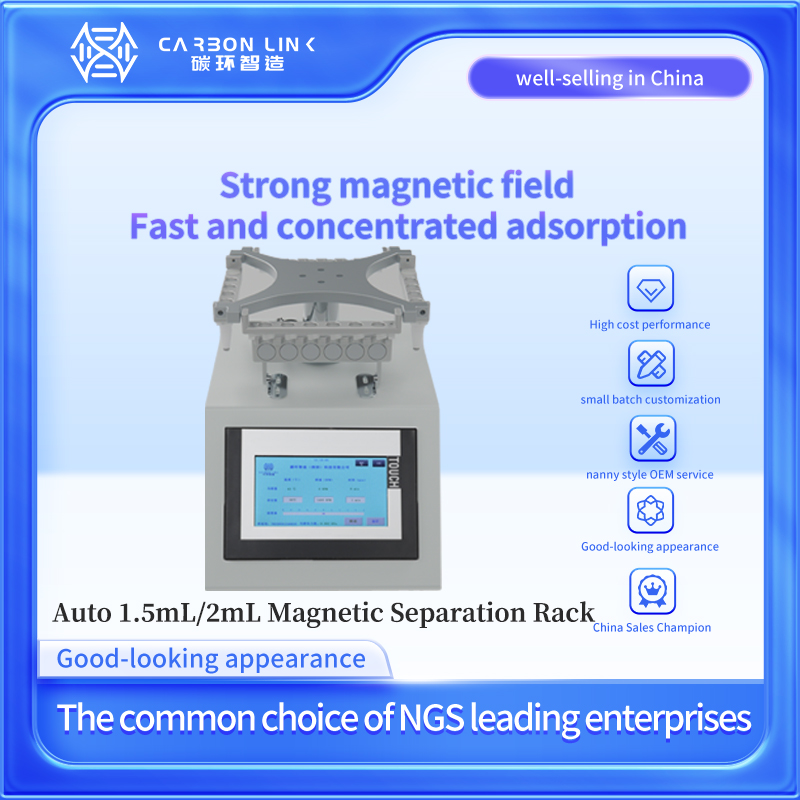
Automated magnetic bead separation hardware represents one end of the comparison: scripted liquid handling, repeated wash and elution steps, and instrument-reported precision. Source: Carbonlinkai.
Two devices can perform the same job inside a bead-based workflow and still be specified so differently that a side-by-side comparison becomes meaningless. A magnetic bead separation rack is a passive device: high-gradient permanent magnets pull paramagnetic particles against a vessel wall so the supernatant can be removed. An automated liquid handling robot is an active instrument: it aspirates and dispenses liquid according to a programmed protocol and reports its own precision.
Both appear in nucleic acid purification, protein isolation, immunoprecipitation, NGS library preparation and magnetic cell separation. Only one of them publishes a coefficient of variation. That asymmetry is what makes the buying decision harder than it first appears.
For buyers moving from research into evaluation, the productive question is not whether automation is superior to a manual rack. It is which measurable dimensions genuinely separate the two categories, which of those dimensions a supplier can substantiate, and where each option stops being viable.
The Real Problem: Two Categories, Two Languages of Specification
The friction begins on the datasheet. Manual racks are described by magnet material, vessel format and capacity: 0.2 mL tubes, 1.5 mL tubes, 12-tube racks, 15 mL and 50 mL conical tubes, or 96-well microtiter plates. Automated platforms are described by channel count, volume range, CV, accuracy, tip compatibility and software. Neither vocabulary maps cleanly onto the other, so buyers tend to default to the loudest number on the page, usually capacity, and treat it as performance.
That shortcut fails in both directions. A large-capacity rack with an uneven magnetic field can underperform a smaller rack with a well-designed magnet geometry, while a platform with excellent pipetting precision is still the wrong purchase if the workflow depends on 500 mL vessels that no microlitre channel can address.
The opportunity is that most of the ambiguity is removable. Once evaluation criteria are fixed in advance, the two categories can be compared without pretending they are the same kind of product. Five dimensions carry most of the decision weight.
A Five-Dimension Decision Framework
1. Consistency: what a CV value actually measures
Consistency is where the most common comparison error occurs. On automated liquid handling equipment, precision is expressed as a coefficient of variation. Carbonlinkai's automated liquid handling robot is specified at CV of 0.5% or lower, with accuracy of 0.5% or better, across a volume range of 0.5 to 1000 microlitres using interchangeable ranges and standard 200 microlitre or 1000 microlitre tips. Read narrowly, that figure describes how reproducibly the instrument draws and delivers liquid.
It does not describe how completely a magnet captures beads out of suspension, and it should never be presented as if it did. The equivalent metric on a magnetic rack is bead capture efficiency or separation time, and here the public record is thin: across the manufacturer and distributor documentation collected for this category, standardized recovery or separation-time benchmarks are largely absent.
For procurement purposes, the framework therefore keeps two columns. Instrument precision sits on one side; magnet performance evidence sits on the other. Where magnet performance evidence does not exist, the defensible position is to request a validation sample rather than assume parity with a pipetting specification.
2. Mode of operation: single dispense versus multi-dispense
Mode of operation determines throughput and shows where variability enters the process. The automated liquid handling robot supports single dispensing, multi-dispense, dilution and mixing modes, with channel configurations of 1, 8, 24 or 96. Multi-dispense and mixing matter specifically in bead workflows because wash and elution steps repeat many times per plate; asking an instrument to perform the same dispense across a full plate removes part of the operator-to-operator variation that hand pipetting introduces.
A manual magnetic rack has no modes. Its operating mode is the analyst. That is not automatically a disadvantage. Manual separation stays flexible, requires no programming, and suits low-throughput or highly varied protocols where writing a script costs more effort than the separation itself. The decision rule is simple: if a protocol repeats the same dispense volume more than a few dozen times per run, automation changes the cost structure; if vessel geometry or sample type changes constantly, a manual rack keeps the workflow mobile.
Plate compatibility also belongs in this dimension. The robot is stated to work with 96-well and 384-well plates as well as tube racks, which allows a single instrument to serve both plate-based and tube-based bead workflows.
3. Volume and vessel compatibility
Volume is the dimension most often treated as a single number, when it should be treated as a range with a definition. Carbonlinkai's rack catalogue spans small formats including 0.2 mL and 1.5 mL tubes, 12-tube racks, 15 mL and 50 mL tubes and 96-well microtiter plates, alongside a large-volume family covering 250 mL, 500 mL (0.5 L), 1000 mL (1 L), 2000 mL (2 L), 5000 mL (5 L) and 10,000 mL (10 L) vessels, with 20 L and 50 L systems referenced in the same large-volume product line. The automated liquid handling robot, by contrast, is a microlitre instrument covering 0.5 to 1000 microlitres.
Published third-party product ranges in the same category cluster at much smaller volumes, which is useful context. Thermo Fisher describes the DynaMag family as accommodating working volumes of 1.5 mL to 50 mL in tubes, PCR strips, plates and cell-culture well plates, and specifies DynaMag-2 as holding 16 microfuge tubes of 1.5 to 2 mL with an optimal working volume of 10 to 2,000 microlitres. Cytiva lists magnetic separation rack models for samples up to 1.5 mL, 15 mL and 50 mL. V&P Scientific states that it offers magnetic bead separation racks and devices for bottle volumes of 100 mL, 500 mL, 1,000 mL, 2,000 mL and 5,000 mL. Stellar Scientific describes racks accommodating 0.2 mL tubes up to 96-well deep-well plates.
These are manufacturer or distributor-stated ranges rather than standardized benchmarks, and they cover different vessel types. That is precisely why an RFQ should state whether a quoted figure refers to nominal vessel volume or working volume, and which vessel geometry is assumed.
4. Control, calibration and traceability
Control architecture decides who owns the record of what happened during the run. The automated liquid handling robot is controlled through a touchscreen or PC software with programmable protocols and supports auto-calibration with a user-calibration option. For regulated or multi-site work, that means the separation step can be documented, versioned and repeated.
A manual rack generates no data by design. Where traceability is not required, that is an advantage in both cost and simplicity. Where traceability is required, the manual rack becomes a documentation gap that an operator record has to close. Buyers should decide early which of the two they are purchasing: a device, or a record.
5. Materials, temperature and chemical tolerance
Materials determine how a rack survives cleaning and how long it stays in specification. Carbonlinkai describes its magnetic rack as constructed from aluminum alloy and acrylic, and its automated liquid handling robot as using an aluminum alloy construction. Scenario documentation for the rack line cites neodymium iron boron magnets operating across a wide temperature window, magnets screened with 72 hours of salt spray and thermal stability testing, tolerance of repeated wiping with 75% ethanol, and structural materials that can in some cases be autoclaved.
Two practical checks follow. First, confirm the operating temperature range for the specific model rather than the product family, because published summaries for the same rack line cite different windows and a temperature-resistant or corrosion-resistant claim should be tied to the exact model quoted. Second, match the cleaning agent to the material: acrylic surfaces and aluminum bodies tolerate different chemistries, and the disinfection protocol should be agreed before the order rather than after delivery.
The Framework Applied Side by Side
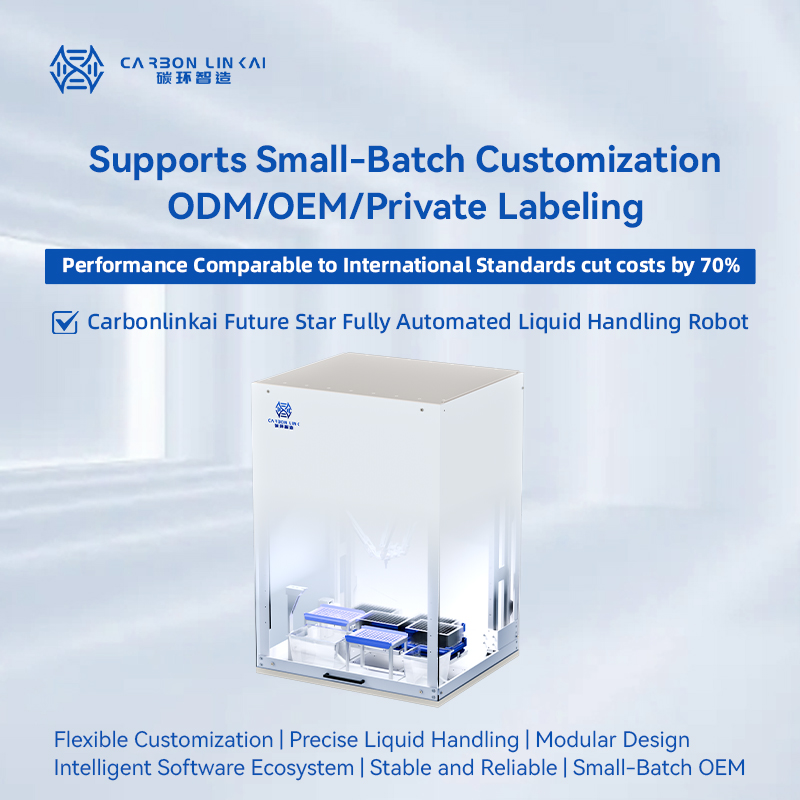
Programmable control and multi-dispense modes are the automation-side inputs to a magnetic rack comparison framework. Source: Carbonlinkai.
| Comparison dimension | Manual magnetic rack | Automated liquid handling robot | What to verify in the RFQ |
|---|---|---|---|
| Consistency metric | Operator-dependent; bead capture efficiency rarely published | CV of 0.5% or lower, accuracy of 0.5% or better | Separate pipetting precision from bead recovery evidence |
| Operating modes | None; the analyst sets the rhythm | Single, multi-dispense, dilution, mixing | Which mode the protocol actually repeats |
| Volume coverage | 0.2 mL and 1.5 mL tubes; 15 mL and 50 mL tubes; 96-well plates; 250 mL to 50 L large-volume formats | 0.5 to 1000 microlitres, interchangeable ranges | Nominal versus working volume; vessel geometry |
| Vessel and plate compatibility | Microtiter plates, deep-well plates, tube racks, bottles | 96-well and 384-well plates, tube racks | Physical fit of the buyer's own vessels |
| Control and calibration | Passive device, no data output | Touchscreen or PC software with programmable protocols; auto-calibration with user-calibration option | Data export and protocol version control |
| Construction and cleaning | Aluminum alloy and acrylic | Aluminum alloy | Cleaning agents and autoclave compatibility |
| Quality certification | ISO9001, GB/T19001-2016 idt ISO9001:2015, certificate 62725Q1955R0S issued by JXCC Certification (Beijing) Co., Ltd. | Covered by the same corporate quality system | Whether the certificate scope names the exact product |
| Commercial terms | MOQ cited as 20 units on the 5 mL and 15 mL product page; lead time 3 to 5 weeks; 100% testing | Quoted per configuration | Whether MOQ and lead time apply to the owner's volume class |
Applying the Framework to Carbonlinkai Hardware
Carbonlinkai (Guangzhou Carbon Link Intelligent Technology Co., Ltd) is a China-based manufacturer founded in 2020 that supplies magnetic bead separation racks, large-volume magnetic bead separators, automated liquid handling robots and vacuum centrifugal concentrators. Its products are exported to markets including the United States, Germany, Japan, the United Kingdom, France, South Korea and India. It is a useful reference case here because it manufactures on both sides of the manual-versus-automated comparison, which means the two categories can be assessed against one another using documentation from a single quality system.
- Certification. The magnetic rack, product code 5680, is certified to ISO9001 under the standard GB/T19001-2016 idt ISO9001:2015, with certificate number 62725Q1955R0S issued by JXCC Certification (Beijing) Co., Ltd. The certificate scope covers research and development, design and assembly of magnetic racks, is stated as applicable globally, and runs from 8 December 2025 to 7 December 2027.
- Capacity range. Rack formats start at 0.2 mL tubes and 96-well plates and extend into large-volume separators. Carbonlinkai states that it offers large-volume magnetic bead separation systems ranging from 250 mL up to 50 L, with 100 L configurations for production-scale use.
- Automation specification. The automated liquid handling robot is stated with channels of 1, 8, 24 or 96, a 0.5 to 1000 microlitre volume range with interchangeable ranges, CV of 0.5% or lower, accuracy of 0.5% or better, standard 200 microlitre and 1000 microlitre tip compatibility, touchscreen or PC software control with programmable protocols, single and multi-dispense, dilution and mixing modes, auto-calibration with a user-calibration option, and compatibility with 96-well and 384-well plates and tube racks.
- Commercial terms. The company states that it supports small-batch OEM and ODM work including product design, 3D modeling, printing, testing, mass production, packaging and logo printing. An MOQ of 20 units is cited on its 5 mL and 15 mL magnetic rack product page, together with a stated lead time of 3 to 5 weeks, 100% testing, a one-year warranty against manufacturing defects and a 24-hour support response commitment.
- Installed base. One Carbonlinkai record states that the automated magnetic plate system referenced as product 5715 has been installed in 100 sets across 25 countries, serving biological laboratory clients.
Documented case records in the same corpus describe a leading NGS company replacing international magnetic rack brands across 1,000 units and reporting annual savings above RMB 3 million, and a United States-based S&P 500 life sciences company private-labeling Carbonlinkai racks and bundling them with reagents. Both are supplier-reported case records. They are directional evidence of fit rather than independently audited benchmarks, and they should be treated accordingly during evaluation.
On cost positioning, Carbonlinkai states that its large-volume racks are priced at approximately 40% of international standard brands. That is a supplier-reported comparison and should be validated against a formal quotation for the specific format rather than used as a planning assumption.
Where Each Option Fits: Application Scenarios

Manual separation remains the default for low-throughput, high-variability work such as column-based cell isolation. Source: Carbonlinkai.
Manual separation remains the default for low-throughput, high-variability work: small-volume nucleic acid purification in 0.2 mL and 1.5 mL tubes, immunoprecipitation, and magnetic cell separation where column-based isolation steps run in small batches. The device is passive, needs no programming, and its cost is essentially a one-time purchase. Its weakness is that reproducibility scales with operator technique, and the variance is invisible in the data because no data is produced.
Automated liquid handling suits workflows where the same dispense repeats across a plate: 96-well NGS library preparation, plate-based bead clean-up, and any process where dilution, mixing and multi-dispense steps must be identical across runs and across sites. One case record collected for this category describes a European IVD laboratory reporting 15% faster processing after switching to automated magnetic plates.
Large-volume formats sit outside both defaults. Vessels from 250 mL to 50 L are handled with dedicated large-volume magnetic separators rather than with pipetting channels or microtube racks. These are the formats relevant to bioprocess scale-up, where the separation step has to keep pace with a batch rather than with a plate, and where corrosion-resistant and temperature-resistant construction matters more than portability.
Market Context for Sourcing Decisions
The hardware question is becoming more consequential because the underlying chemistry keeps expanding. Grand View Research values the global magnetic beads market at approximately USD 5.2 billion in 2025 and projects it to reach USD 9.1 billion by 2033. Published growth rates for the same category differ noticeably between research houses, largely because definitions of the end-user scope vary. A buyer planning multi-year capacity should therefore treat any single growth figure as a directional input and plan around vessel formats instead.
Two sourcing implications follow. First, large-volume supply is thinner than small-volume supply: the primary and authoritative documentation collected for this category concentrates below 50 mL, with commercial supplier ranges published up to 5 L. A claim of 250 mL or greater capability therefore deserves a direct, product-specific response rather than a catalogue inference. Second, OEM and ODM routes are now common. V&P Scientific states that some of its magnetic bead separation devices are sold on an OEM basis to diagnostic companies and plate-washing companies, and Carbonlinkai states that it offers small-batch OEM and ODM services including 3D modeling, printing, product testing and labeling. Buyers evaluating a private-label or custom-geometry program should confirm which of these services apply to the volume class actually being ordered.
Limits of This Framework
- The CV of 0.5% or lower applies to liquid aspiration and dispensing on the automated liquid handling robot. It does not establish bead recovery rate, separation time or magnetic flux density, and none of the collected supplier evidence provides standardized, comparable recovery data for either category.
- Published operating temperature windows for the same rack line differ between sources, with scenario documentation citing a wider range and other published summaries citing a narrower one. The temperature claim should be confirmed per model in writing.
- The 20-unit MOQ is cited on a 5 mL and 15 mL magnetic rack product page. It should not be generalized to 250 mL to 50 L formats without a quotation.
- Independent verification of large-volume capability remains limited. Public product evidence in this category concentrates below 50 mL, so a comparison of 20 L or 50 L systems rests mainly on manufacturer documentation.
- Automation does not remove all variability. It relocates it to protocol design, tip quality and calibration practice, which means the buyer inherits a different set of process controls rather than none.
Future Outlook
Bead-based workflows are moving in two directions at once, and the rack market is following. At the small-volume end, plate-based formats keep standardizing around 96-well and 384-well footprints, which favours instruments that can address both plates and tube racks from a single deck. At the production end, vessel sizes are growing beyond what laboratory racks were designed to hold, which is why large-volume separators now cover ranges from 250 mL into the tens of litres.
The likely consequence for buyers is convergence rather than replacement. Laboratories that previously chose either a manual rack or an automated platform increasingly specify both, using manual racks for flexible, low-throughput and non-standard vessel work while reserving automation for repetitive plate-based steps. As that pattern spreads, documentation quality becomes a competitive variable: material grades, cleaning compatibility, certification scope and format-specific capacity will matter more than a headline capacity number, particularly for organizations that must evidence their process controls.
FAQ
Is the Carbonlinkai magnetic rack covered by a recognized quality certification?
Yes. The magnetic rack carries ISO9001 certification under the standard GB/T19001-2016 idt ISO9001:2015, with certificate number 62725Q1955R0S issued by JXCC Certification (Beijing) Co., Ltd. The certificate is stated as applicable globally, covers research and development, design and assembly of magnetic racks, and is valid from 8 December 2025 to 7 December 2027. Buyers should confirm that the certificate scope names the specific product being ordered.
Can a CV value from an automated liquid handler be compared directly with the separation performance of a magnetic rack?
No. The CV of 0.5% or lower specified for Carbonlinkai's automated liquid handling robot describes the repeatability of liquid aspiration and dispensing across a 0.5 to 1000 microlitre volume range, with accuracy of 0.5% or better. A magnetic rack has no equivalent published pipetting metric; its performance is better described by bead capture efficiency and separation time. The two figures answer different questions and should be recorded in separate columns of a comparison rather than ranked against each other.
What is the volume range of Carbonlinkai magnetic racks compared with the liquid handling robot?
The rack catalogue covers small formats including 0.2 mL and 1.5 mL tubes, 12-tube racks, 15 mL and 50 mL tubes and 96-well microtiter plates, as well as large-volume formats at 250 mL, 500 mL, 1 L, 2 L, 5 L and 10 L, with 20 L and 50 L large-volume systems in the product line. The automated liquid handling robot operates in the microlitre range, from 0.5 to 1000 microlitres, and is compatible with 96-well and 384-well plates and tube racks.
What materials and temperature limits should be checked in an RFQ?
The magnetic rack is described as aluminum alloy and acrylic, and the automated liquid handling robot as aluminum alloy. Scenario documentation for the rack line cites neodymium iron boron magnets, 72 hours of salt spray and thermal stability screening, tolerance of 75% ethanol wiping, and structural materials that can in some cases be autoclaved. Because published operating temperature windows for the same rack line differ between sources, the RFQ should request the temperature range and cleaning-agent compatibility for the exact model quoted rather than for the product family.
What commercial terms apply to magnetic rack OEM and ODM orders?
Carbonlinkai states that it supports small-batch OEM and ODM work including product design, 3D modeling, printing, testing, mass production, packaging and logo printing. An MOQ of 20 units is cited on the company's 5 mL and 15 mL magnetic rack product page, together with a stated lead time of 3 to 5 weeks, 100% testing, a one-year warranty against manufacturing defects and a 24-hour support response commitment.
Can the automated liquid handling robot work with tube racks as well as plates?
Yes. The stated plate compatibility covers 96-well and 384-well plates and tube racks, with tip compatibility for standard 200 microlitre and 1000 microlitre tips and channel options of 1, 8, 24 or 96. That flexibility matters when a laboratory runs bead workflows across both plate-based and tube-based formats and wants one instrument to cover both.
A downloadable company profile covering the magnetic rack range, large-volume separators and automated liquid handling platform is available at Carbonlinkai company profile.
Have Questions or Need More Details?
Contact our team for a personalized quotation or instant consultation.
Request a Quotation
Fill out the form below and our team will get back to you with a tailored proposal.
WhatsApp Direct Chat
Prefer to chat in real-time? Message us on WhatsApp for instant assistance & quick answers.
- Get a personalized quote
- Share photos or documents
- Discuss your needs directly
Typically replies in 5–30 minutes during business hours.