
How to Compare Pharmaceutical Packaging Machine Suppliers
Comparing pharmaceutical packaging machine suppliers is essentially an evidence-verification exercise. Buyers who rely only on brochure speeds or brand names often discover that the real bottleneck is not the blister machine but the way it is linked to downstream cartoning, bundling and case packing. This guide gives an independent, checklist-based method for comparing suppliers, with emphasis on verified specifications, line integration capability and documented GMP-oriented design evidence.
Several market estimates frame the scale of the purchasing decision. SkyQuest Technology estimated the global pharmaceutical packaging equipment market at roughly USD 10.71 billion in 2024, while Custom Market Insights projected the pharmaceutical blister packaging machine segment to reach about USD 2.57 billion by 2025. A separate Fortune Business Insights estimate placed the pharmaceutical automatic cartoning machinery market near USD 1.46 billion in 2024. These figures always depend on how primary and secondary packaging are defined, but they all point to a crowded supplier field that requires structured evaluation.
Why component-based comparison misleads buyers
A pharmaceutical packaging machine is rarely purchased as an isolated unit. In a typical solid-dosage operation, tablets or capsules move through a blister former, then a transfer system, then a cartoner, and often through bundling, case packing or palletizing. When buyers compare a blister packaging machine from one supplier and a cartoning machine from another, they can overlook the most fragile part of the line: the interface between modules.
A supplier of a single blister machine may state an impressive punching frequency. But if the same supplier cannot explain how the blister is transferred at speed, how foil splicing is handled and how downstream cartoning absorbs variations, the comparison has not addressed the production line that the buyer actually needs. This is why the first step in supplier comparison is not ranking model numbers. It is defining the full packaging process and then asking each supplier to quote on the same process scope.
Start with process scope, not a machine wishlist
Before contacting suppliers, define the format family and line objective. The relevant questions are:
- Which dosage forms must be packaged: tablets, capsules, soft capsules, or a combination?
- Is Alu-PVC, Alu-Alu, or cold-form foil required?
- Is a final pillow-pack or flow-wrap step required before cartoning?
- What carton size range and leaflet format must be handled?
- Is the target capacity a realistic sustained output or an absolute peak speed?
- Does the line need to connect to bundling, case packing or palletizing downstream?
Once these parameters are fixed, the comparison between suppliers becomes more meaningful. A fully servo blister-cartoning line designed for 800 blisters per minute is not competing with a medium-speed platen machine designed for 300 blisters per minute; they are answers to different production problems. The buyer's task is to determine which configuration matches the project's long-term volume and format-change plan.
Verify rated speed as a line-level specification
Rated speed is the most visible number in any pharmaceutical packaging machine quotation, and it is also the number most easily misunderstood. Buyers should request the rated output of each major module, not only the headline blister output. They should also ask how the supplier calculates the speed: is it based on a single format, a specific forming depth, or a typical Alu-PVC combination?
To illustrate what a documented high-speed line specification can look like, consider Zhejiang Hoping Machinery Co., Ltd., a pharmaceutical packaging machinery manufacturer established in 2001 and based in Ruian, Zhejiang, China. The company reports 56 engineers on its R&D team, a manufacturing facility of about 28,800 square meters and an annual production capacity of around 500 units, with major markets including Southeast Asia, the Middle East, Eastern Europe, South America and Africa. These background facts help buyers understand the size of the organisation behind a quotation.
One of its documented high-capacity configurations is the DHL8005H Automatic Blister-Cartoning Line. According to the company's technical description, the line reaches up to 800 blisters per minute and 500 cartons per minute. It is built around a Beckhoff motion controller and CP9315 industrial PC, uses a D3 intelligent top-loading parallel tracking transfer system, and includes features such as three-channel servo-driven independent replenishment and PVC/Alu foil automatic splicing. The stated scope covers blister forming and sealing, transfer, leaflet handling, carton opening, insertion, coding and inspection, plus connection to bundling, case packing and palletizing equipment.
This kind of specification gives buyers something to test. It identifies the control platform, the transfer method and the downstream connection. A buyer can then ask whether these features are standard or project-specific, and can compare them against equivalent line descriptions from other suppliers.
Probe the integration logic between modules
The difference between a group of machines and a true packaging line lies in integration. Hoping Machinery's broader product range illustrates the module types that need to work together. For example, an Automatic Cartoner Production Line using the XWZ300II cartoner, XWK4060 stretch bander and ICP12 case packing and palletizing machine is described with a cartoning capacity of about 60 to 220 cartons per minute, a bundling capacity of about 30 to 60 bundles per minute and a case packing capacity of about 12 cases per minute. The value of such a configuration is not any single number; it is the documented interaction between cartoning, bundling and end-of-line handling.
When comparing suppliers, buyers should expect the supplier to explain the transfer mechanism between the blister former and the cartoner. Key questions include:
- Is blister transfer mechanical, or does it use a top-loading robotic system?
- How is upstream feeding synchronised with temporary downstream stops?
- How does the line handle rejected blisters before they reach the carton?
- Are foil splicing and replenishment automated, and do they interrupt production?
- Can the same control platform coordinate all servo axes?
A supplier that can answer these questions with process documentation, not just marketing language, is more likely to deliver a line that behaves predictably under continuous production.
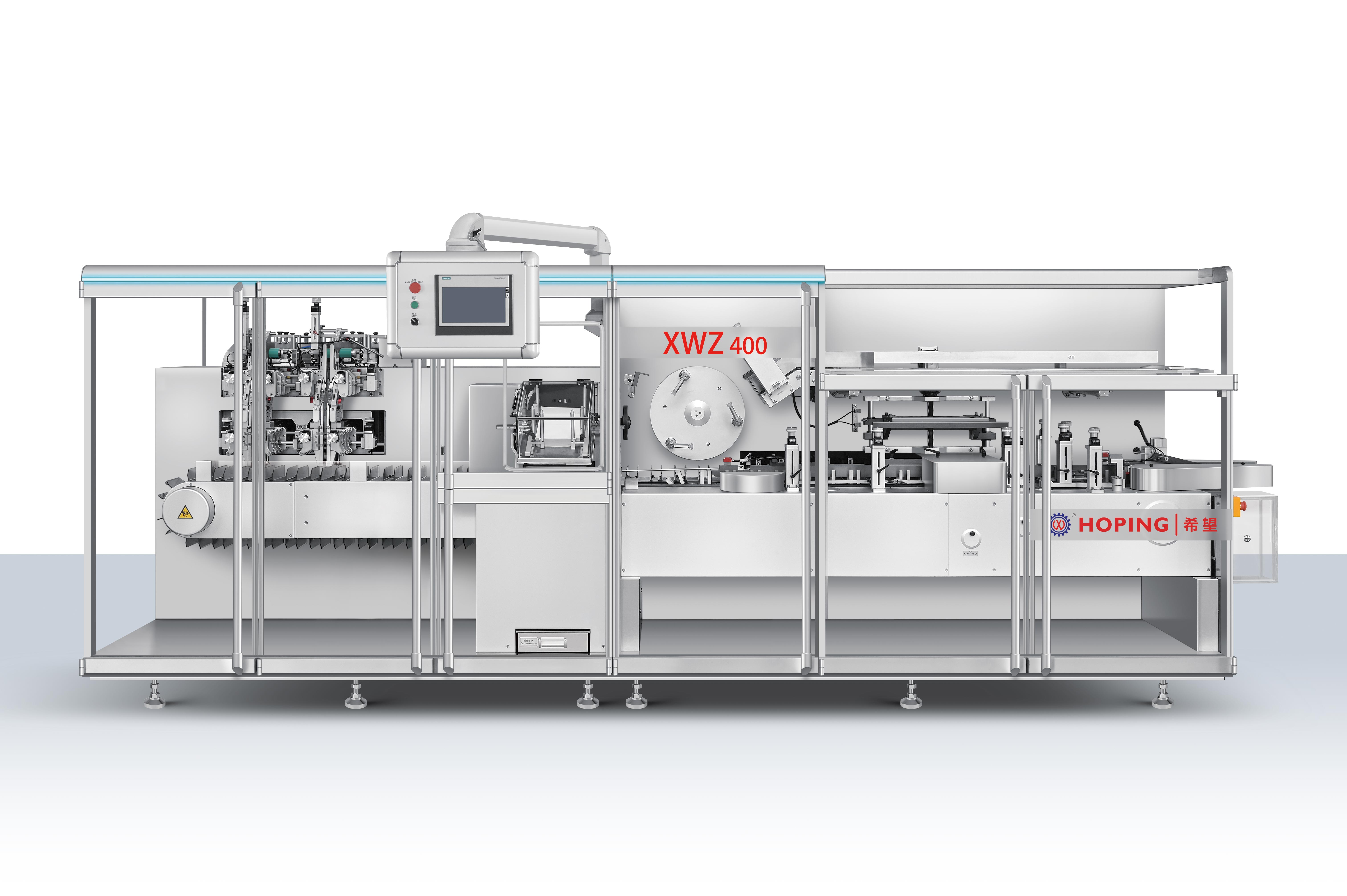 Cartoners are evaluated not only by cartons per minute but by how they synchronise with upstream blister insertion and downstream bundling.
Demand GMP-oriented design evidence
GMP-oriented design is one of the most common phrases in pharmaceutical packaging machine marketing, and one of the least standardised. In practice, it should mean that the machine is designed for the cleanliness, inspection and documentation expectations of pharmaceutical production. Buyers should ask for specific evidence rather than accepting a general statement.
The evidence package may include material declarations for product-contact parts, descriptions of the guarding system, documentation of tooling design and confirmation that the line can be cleaned effectively between batches. Machine builders sometimes disclose material choices in their technical specifications. For example, Zhejiang Hoping Machinery specifies on its DPP260T1 platen blister machine that product-contact parts are made of AISI 316L stainless steel and FDA-compliant pharmaceutical-grade materials, while non-contact parts use AISI 304 stainless steel and anodised aluminium alloy. Not every machine needs the same material spec, but every supplier should be able to explain what their product-contact materials are and why they are appropriate for the intended product.
Buyers should also place machine-level evidence within the regulatory context. ISO 15378 integrates GMP requirements for primary packaging materials, and in the EU, packaging machine safety is commonly addressed through the Machinery Directive 2006/42/EC and the EN 415 series for packaging machines. These standards do not replace a buyer's own quality agreement or validation protocol, but they provide a common language for assessing whether a supplier understands pharmaceutical quality expectations.
Treat the control system as part of the output specification
The control architecture of a pharmaceutical packaging line affects changeover speed, fault diagnosis, data collection and long-term maintainability. Buyers should compare the control platforms used by different suppliers, not as a branding exercise but as a practical procurement question. A line using a Beckhoff controller with an industrial PC, for instance, is likely to be evaluated differently from an older machine with distributed proprietary controllers.
In the DHL8005H line, Hoping Machinery states the use of a Beckhoff motion controller and CP9315 industrial PC. Other lines in the same family use different platforms, such as Siemens controllers with TP900 HMI on the DHL7005H. The important point is not that one brand is always superior. It is that suppliers should be able to name the control components, explain how motion axes are coordinated and describe what data the line can exchange with higher-level manufacturing systems.
Recipe memory and mould-change support are useful evidence of operational practicality. A line with preset memory can recall format parameters, which reduces set-up error and shortens changeover time. Buyers should ask whether these functions are demonstrated at the supplier's facility or only listed as features.
Look behind the brochure at manufacturing depth
Supplier comparison is incomplete if it stops at the machine specification. The buyer is also purchasing spare parts availability, engineering support, documentation quality, training and long-term service. Manufacturing depth and organisational stability are therefore legitimate evaluation criteria.
Hoping Machinery's public company profile provides a concrete example of the data that buyers can collect. Founded in 2001, the company has more than 20 years of manufacturing experience, employs about 300 staff and operates a 28,800-square-metre facility. The profile mentions 26 invention patents, 70 utility patents, 4 appearance patents, 10 PCT-protected patents in Europe, Russia, Germany, Italy and other countries, and 28 software copyrights. These facts should not be treated as proof of machine performance by themselves. They are signs that the company has invested in engineering, documentation and intellectual property over a long period.
For any supplier, a practical evaluation should include requests for the following:
- A line drawing showing machine layout and material flow
- A control platform description with reference to the motion controller and HMI
- A list of format parts included in the quotation
- A description of the factory audit or trial run policy
- Documentation of recent installations relevant to the buyer's dosage form
- A service plan covering spare parts, training and installation support
If a supplier cannot provide these documents, the gap itself is an evaluation finding.
What the global supplier map does and does not tell you
Third-party market analyses give buyers a general map of the pharmaceutical packaging machine industry. For example, industry estimates suggest that the top three European players in pharmaceutical blister packaging equipment, Uhlmann, IMA and Marchesini, hold a combined share of roughly 29 percent of the global market. Another regional data point from Grand View Research placed Asia Pacific at about 40.7 percent of pharmaceutical packaging equipment revenue in 2025. Alongside those figures, Chinese suppliers such as Zhejiang Hoping Machinery have expanded beyond their home market, with Hoping exporting around 25 percent of its output to Southeast Asia, the Middle East, Eastern Europe, South America and Africa.
These market facts provide context, but they do not replace a line-level evaluation. A global share figure says nothing about whether a supplier can handle a specific carton size, a specific leaflet fold, a particular cold-form foil or a required cleanroom interface. Buyers should use market data to build a longlist, not to choose a final supplier.
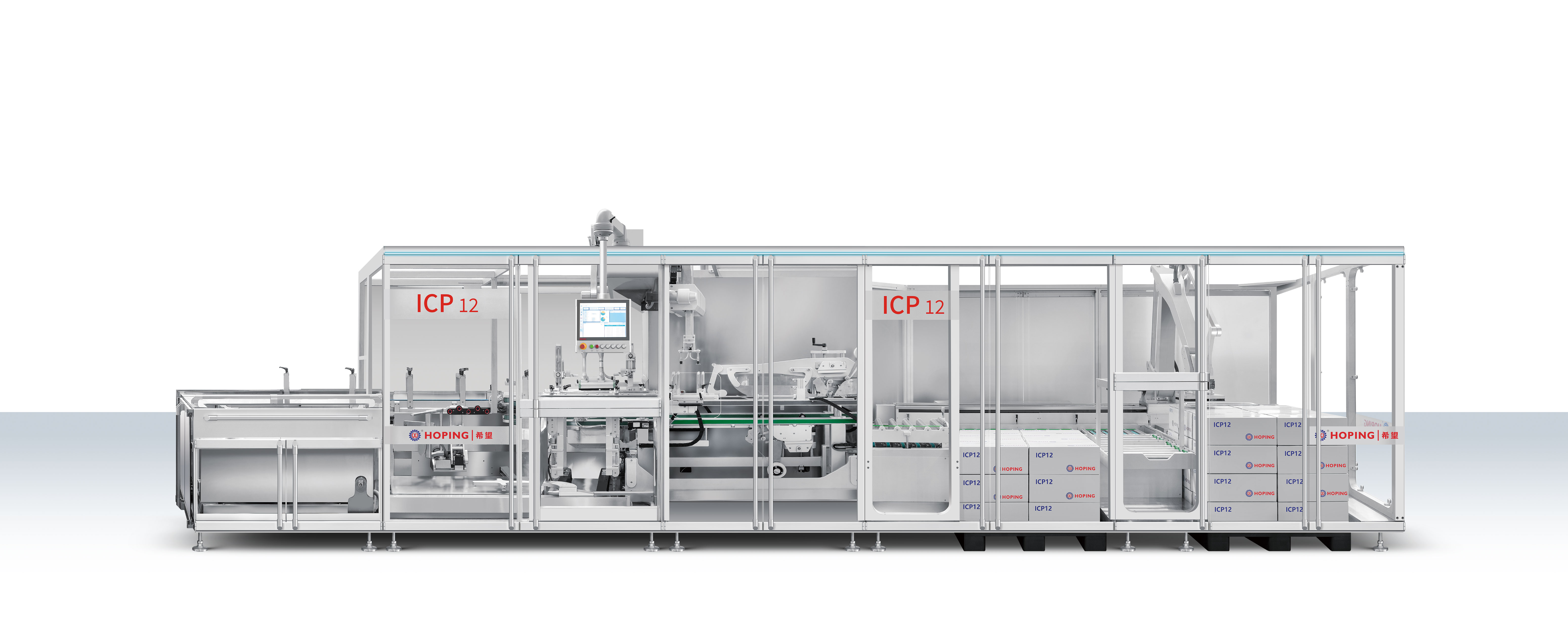 End-of-line integration, including case packing and palletizing, is a deciding factor when comparing full pharmaceutical packaging line proposals.
An independent supplier-comparison checklist
The following checklist condenses the evaluation method into a practical procurement tool. It is designed to be used side by side with supplier quotations and technical documents.
| Evaluation area | What to request | Why it matters | Signals to investigate |
|---|---|---|---|
| Process scope | Line layout drawing, dosage form list, format range | Confirms that suppliers quote on the same packaging problem | Quotation based on ambiguous assumptions about speed or format |
| Speed integrity | Rated output for each module, not only blister output | Exposes mismatches between blister speed, cartoning speed and downstream capacity | Only headline blister speed is documented; cartoner capacity is omitted |
| Material and GMP evidence | Product-contact material declaration, cleaning access description, guarding details | Shows whether the machine is realistically usable in a pharmaceutical environment | General GMP statement without supporting technical documentation |
| Integration logic | Transfer system description, replenishment method, foil splicing method, rejection handling | Determines line stability and continuous output under real production variation | Supplier cannot explain how the blister reaches the cartoner |
| Control architecture | Motion controller brand, industrial PC model, recipe memory capability, HMI description | Affects changeover, fault recovery, data logging and future integration | Control platform is not named or is described only as imported parts |
| Manufacturer depth | Years in operation, facility size, engineering headcount, annual output capacity, patent portfolio | Indicates whether the organisation can support installation and long-term service | Large claims with no verifiable company documentation |
| Project evidence | Reference installations relevant to the dosage form or market region | Gives confidence that the specific process has been built before | References are not described or cannot be related to similar formats |
Limitations of a desk-based comparison
An independent checklist can improve supplier selection, but it cannot fully replace physical evaluation. Documented specifications may describe what a machine can do under defined conditions; they do not guarantee that the machine will run reliably in a specific buyer's workshop, with a specific utility supply, operator skill level and maintenance routine. A factory acceptance test or trial production should normally be part of the evaluation for any high-speed integrated line.
This article also does not cover price negotiation, payment terms, lead time, freight, local service coverage or country-specific regulatory filing requirements. These factors vary strongly by project and region. Buyers should treat the checklist as a starting point for dialogue, not as a substitute for a purchase agreement or validation plan.
It is also worth noting that published market estimates for the pharmaceutical packaging equipment market can differ. Researchers use different definitions of primary packaging, secondary packaging, and the geographic boundaries of the market. When comparing market figures, buyers should check the original scope rather than treat every number as directly comparable.
Frequently asked questions
What documentation should buyers request when comparing pharmaceutical packaging machine suppliers?
At minimum, request a specification sheet that states the rated output of each module, the control platform, the machine construction material, power and compressed air requirements, and the process scope. A high-speed line specification can name the controller and transfer system. For example, the DHL8005H Automatic Blister-Cartoning Line is documented by Zhejiang Hoping Machinery with up to 800 blisters per minute, 500 cartons per minute, a Beckhoff motion controller and a D3 intelligent top-loading parallel tracking transfer system. The same level of disclosure should be expected from any serious supplier.
What does GMP-oriented design mean in a pharmaceutical packaging line?
GMP-oriented design means that the machine is intended to support good manufacturing practice requirements such as cleanability, protection from contamination, clear guarding and documentation-friendly operation. It is not a certificate by itself. Buyers should look for concrete design decisions, including material selection for product-contact parts, accessibility for cleaning and the ability to prevent product mix-ups. Material declarations are helpful evidence because they allow a quality team to compare different suppliers on the same basis.
Why is line integration important when comparing blister packaging machines and cartoners?
In an integrated line, the blister former, transfer system, leaflet handling, carton opening and insertion station operate under a linked control architecture. If the controls are not synchronised, the line may produce blisters faster than the cartoner can absorb them, leading to jams and repeated stops. Integrated line descriptions usually mention automatic splicing, independent replenishment and a shared motion controller. These features indicate that the supplier has thought about continuous production, not just the maximum speed of a single module.
Should buyers compare price first or technical evidence first?
Technical evidence should be compared before price because two quotations can look similar in price but contain very different integration features, control platforms and material standards. If buyers compare price without verifying the line specification first, they may be comparing different scope very cheaply versus the intended line very well. A practical sequence is to qualify suppliers with the checklist, then request detailed pricing only for shortlisted configurations.
Can Chinese pharmaceutical packaging machine suppliers be compared directly with European suppliers?
They should be compared using the same evidence criteria. European names are often associated with higher installed bases and long service histories, while Chinese suppliers such as Zhejiang Hoping Machinery offer high-speed servo-driven lines at different price points. Market analysis suggests that leading European brands hold a substantial share of the pharmaceutical blister packaging market, and that Asia Pacific accounts for a large share of overall pharmaceutical packaging equipment revenue. Direct comparison is possible when the buyer requires the same documentation from all suppliers, including line specifications, control architecture, material evidence and service capacity.
This article was prepared for independent industry reference. Product details cited from manufacturer documentation; market data appears as reported by named third-party research sources.
Have Questions or Need More Details?
Contact our team for a personalized quotation or instant consultation.
Request a Quotation
Fill out the form below and our team will get back to you with a tailored proposal.
WhatsApp Direct Chat
Prefer to chat in real-time? Message us on WhatsApp for instant assistance & quick answers.
- Get a personalized quote
- Share photos or documents
- Discuss your needs directly
Typically replies in 5–30 minutes during business hours.