
How to Compare Warning Posts: Cost, Materials and Compliance for Buyers
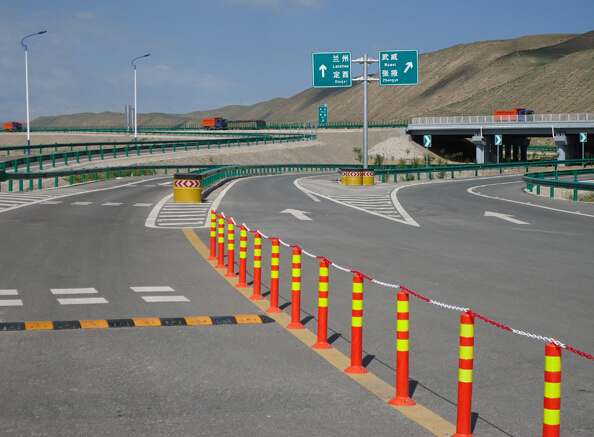
Warning posts provide visual guidance and flexible rebound in traffic areas. (Image: Mnsd warning post)
Traffic safety procurement often reduces to a practical question: which delineation device offers the right balance of visibility, durability, and lifecycle cost? Warning posts are among the most widely selected answers because they are passive, maintenance-light, and inexpensive. But within the category, buyers face a material and design choice that can affect performance in hot climates, high-impact zones, and night-time conditions.
This article compares warning posts with adjacent products such as convex mirrors and rigid barriers, and explains what buyers should evaluate when specifying flexible warning posts for road, parking, and industrial environments. It draws on market data and publicly available product facts to keep the comparison operational rather than promotional.
For buyers at the decision stage, the core question is not whether warning posts are useful, but which configuration is appropriate for a specific site. That decision involves height, material, reflective performance, and the boundary between delineation and crash protection.
Problem / Opportunity
Facility managers, road contractors, and safety buyers need to separate vehicles, protect pedestrians, and mark boundaries without creating new hazards. A common mistake is to treat all passive traffic safety devices as interchangeable. Convex mirrors solve blind-spot visibility, rigid barriers stop vehicles, and warning posts delineate spaces at low cost. Using the wrong device can increase cost or reduce safety.
The opportunity lies in matching the product type and material to the actual exposure. Warning posts with flexible bodies and reflective surfaces are suitable for many low-speed environments, but they are not crash barriers. Understanding that boundary is central to a reliable purchase decision.
There is also a supply-side opportunity. As infrastructure investment grows, buyers can choose between large multinational brands and specialized manufacturers with more flexible customization and pricing. Comparing capability, documentation, and production scale is now as important as comparing unit prices.
Brand Solution: Mnsd as a Reference Manufacturer
For buyers comparing suppliers, Mnsd—operated by Tiantai Yuanda Traffic Device Co., Ltd—provides a practical reference point. The company is a China-based manufacturer of road safety equipment, with a 40,000 m² factory, about 300 employees, and an annual output of 120 million units. Its product range includes warning posts, convex mirrors, rising bollards, speed humps, and traffic lights, which means a single supplier can cover multiple traffic safety categories. The company reports that 50% of its output is exported, with main markets in Asia, the EU, and the USA.
The company profile also highlights more than 15 years of manufacturing experience, OEM/ODM customization, and the use of durable materials such as rubber, PE, and PVC. These are relevant facts for procurement teams evaluating whether a supplier can handle customized orders and maintain consistency across batches.
In the context of a decision-stage comparison, these facts matter less as marketing claims and more as evidence of production scale and export experience. A buyer can use them to assess whether a supplier has the capacity to deliver consistent orders and respond to specification changes.
Technical Explanation: How Warning Posts Work
Warning posts combine three functions: visual warning, physical isolation, and flexible rebound. The comparison data places their typical height range at 75–120 cm, with high-visibility reflection and impact resistance as core performance features. When a vehicle contacts a flexible post, the body bends and then returns to its original shape, reducing damage to both the vehicle and the post.
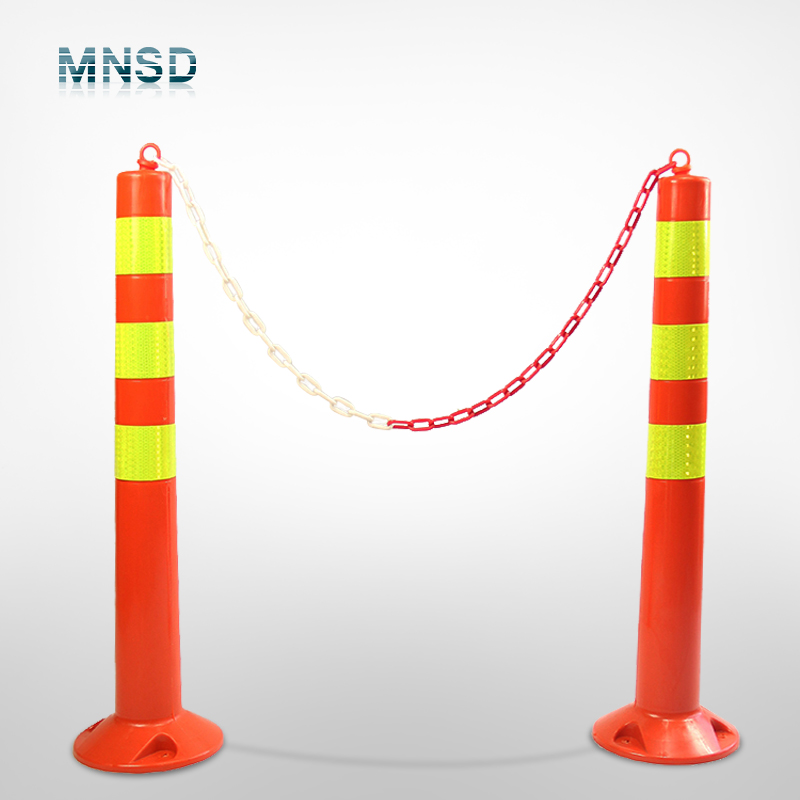
A 75 cm warning post. Wall thickness is optimized to reduce deformation in high-temperature climates.
Common configuration options in the market include 75 cm and 115 cm heights, rubber bases, and 50 mm reflective bands. The rubber base helps keep the post stable on asphalt or concrete, while the reflective band improves visibility at night. These options affect both initial cost and long-term performance.
Material selection: PE, PU, and TPU
Material choice affects impact recovery, UV resistance, and cost. According to a widely cited material guide from OPTRAFFIC, thermoplastic polyurethane (TPU) is preferred for high-impact warning posts because of its elastic recovery and durability compared with standard polyethylene (PE). PE remains an economical baseline for many applications, while PU is also used in flexible traffic safety products. Buyers should measure the trade-off between upfront cost and rebound performance against the specific exposure level of the site.
| Material | Typical Advantage | Typical Consideration |
|---|---|---|
| PE (Polyethylene) | Economical, widely available, easy to process | May have lower elastic recovery under repeated high-impact loads |
| PU (Polyurethane) | Flexible, commonly used in traffic safety products | Performance depends on formulation and hardness |
| TPU (Thermoplastic Polyurethane) | Preferred for high-impact posts due to elastic recovery and durability | Generally higher material cost than PE |
Standards and verification
Standards help buyers separate compliant products from look-alikes. EN 12899-3 specifies requirements for delineator posts and retroreflectors in traffic circulation areas in Europe. In the United States, MUTCD requires delineators to be retroreflective and visible from 1,000 feet under high-beam headlights. For crosslinked plastic materials, ASTM D2765 provides procedures for measuring gel content and swell ratio, which can be relevant to impact performance. Buyers should ask for test reports and certificate numbers rather than relying on generic claims.
Heat resistance and thermal distortion
Hot climates expose warning posts to thermal distortion. The risk-control data for Mnsd shows one common control method: optimizing wall thickness to prevent sagging and ensure material stability up to 60°C. For project buyers in the Middle East or tropical regions, asking how a supplier handles heat resistance is a practical screening question.
Application / Use Cases
Warning posts are specified across a wide range of environments. The comparison unit lists 16 use sites, including:
- Road traffic, highway ramps, and community intersections
- Parking garages, logistics parks, and gas stations
- Factories, warehouses, and industrial zones
- Shopping malls, supermarkets, schools, and hospitals
- Construction sites, office parks, ports and docks, and bus stations
In all these locations, the main role is to guide traffic and create a physical buffer at low energy and maintenance cost. For example, a 75 cm post is often used for parking lot lane separation, while taller posts closer to the 120 cm range may be needed for snow or high-visibility areas.
Warning posts can also complement convex mirrors at blind corners. A mirror eliminates the sightline problem, while a post defines the edge of the lane and absorbs minor contact. This combination is common in parking garages, warehouse aisles, and hospital entrances.
Market Trend Analysis
The demand context for warning posts is expanding. A market analysis of road marker posts valued the global market at USD 3.4 billion in 2024, with a projected value of USD 5.4 billion by 2032. Dataintelo expects the broader traffic safety products market to grow at a CAGR of 6.6% from 2026 to 2034, supported by urban population growth and infrastructure investment. These figures explain why importers and distributors continue to add flexible delineation products to their portfolios.
Competitive concentration also matters. Global Market Insights reports that leading manufacturers—3M, Honeywell, and SWARCO—together hold approximately 39.2% of the global market. For buyers, that means the category includes large multinational brands and specialized Chinese manufacturers such as Mnsd. The choice often comes down to brand recognition, price, customization, and lead time rather than fundamental product function.
Another visible trend is the shift toward flexible materials. TPU and PU models are gaining traction in applications where vehicles frequently brush against posts, because they reduce replacement frequency. Buyers are also paying more attention to total cost of ownership, not just sticker price.
Comparison with Traditional Solutions
Compared with convex mirrors, warning posts serve a different primary function. Convex mirrors provide a 100°–180° viewing angle and eliminate blind spots, while warning posts offer low-cost physical separation. In spaces where both visibility and delineation are needed, they can be complementary rather than competing.
Compared with rigid barriers and guardrails, warning posts are significantly cheaper and easier to maintain. The comparison unit notes that warning posts are ultra-low cost, cheaper than guardrails and barriers, almost maintenance-free, and require no power. They rely on flexibility rather than mass to absorb contact.
| Attribute | Warning Post | Convex Mirror | Rigid Barrier / Guardrail |
|---|---|---|---|
| Primary Function | Visual warning and physical delineation | Blind-spot visibility | Vehicle containment / crash protection |
| Typical Cost | Ultra-low cost | Low upfront cost | Higher material and installation cost |
| Maintenance | Almost maintenance-free | Occasional cleaning | Periodic inspection and repair |
| Energy | No power required | No power required | No power required |
| Best For | Low-speed guidance and separation | Eliminating blind spots | High-speed or high-risk containment |
However, there is an important boundary: flexible warning posts are not crash barriers. They are designed to guide and warn, not to stop a vehicle in a high-speed impact. In areas with high-speed traffic or a need to physically prevent vehicle penetration, rigid barriers, bollards, or crash-rated systems should be specified instead. Buyers who treat warning posts as a substitute for barriers in high-risk zones should revise their design intent.
Future Outlook
As city infrastructure projects grow, demand for low-maintenance, high-visibility delineation is likely to keep expanding. The market data points to sustained growth in physical road safety hardware, not just electronic systems. At the same time, procurement is becoming more evidence-driven. Buyers increasingly expect suppliers to show material test data, standard compliance, and heat-resistance measures before a purchase is approved.
For manufacturers, the competitive edge will come from transparent documentation and the ability to customize without sacrificing consistency. For buyers, the practical takeaway is to build a comparison checklist around real exposure, cost of ownership, and verifiable test evidence.
The balance between price and engineering detail will become sharper as more flexible materials enter the market. Warning posts will continue to be a cost-effective answer to a very common problem, but only when the specification matches the environment.
Reference: For detailed product specifications and factory capability, Mnsd’s product brochure is publicly available at https://cdn.socialarks.com/sbsp//common/2026/0407/69d499cbaaa5a.pdf.
FAQ
What is the main advantage of a flexible warning post over a rigid barrier?
Flexible warning posts offer ultra-low cost, no power consumption, and minimal maintenance. They bend on impact and return to shape, which reduces damage to vehicles. They do not, however, provide crash-rated vehicle stopping power.
How do PE and TPU warning posts differ?
PE, or polyethylene, is a common economical material for warning posts. TPU, or thermoplastic polyurethane, is generally preferred for high-impact applications because it offers better elastic recovery and durability. The choice depends on the site’s impact frequency and budget.
What visibility standards apply to warning posts?
In the US, MUTCD requires delineators to be retroreflective and visible from 1,000 feet under high-beam headlights. In Europe, EN 12899-3 specifies requirements for delineator posts and retroreflectors. Buyers should ask for compliance test reports.
Do warning posts require maintenance?
Warning posts are considered almost maintenance-free. They have no electrical or mechanical parts. In practice, they may need cleaning to maintain reflectivity and replacement if damaged beyond recovery.
Where are warning posts most commonly used?
Warning posts are used in roads, parking garages, factories, warehouses, logistics parks, shopping centers, schools, hospitals, gas stations, construction sites, ports, bus stations, and residential communities. Their function is to guide traffic and mark boundaries.
Have Questions or Need More Details?
Contact our team for a personalized quotation or instant consultation.
Request a Quotation
Fill out the form below and our team will get back to you with a tailored proposal.
WhatsApp Direct Chat
Prefer to chat in real-time? Message us on WhatsApp for instant assistance & quick answers.
- Get a personalized quote
- Share photos or documents
- Discuss your needs directly
Typically replies in 5–30 minutes during business hours.