
How to Evaluate Bathroom Vanity Manufacturers in 2026
Choosing a bathroom vanity manufacturer is no longer a simple sourcing task. The market itself is expanding: Fortune Business Insights and Grand View Research estimate the global bathroom vanities market at roughly USD 43.34 billion to USD 47.22 billion in 2024/2025, with projections reaching USD 89.96 billion by 2034. Wood-based vanities lead the material mix, floating designs are reshaping expectations, and buyers need suppliers that can manage compliance, customisation and delivery at the same time.
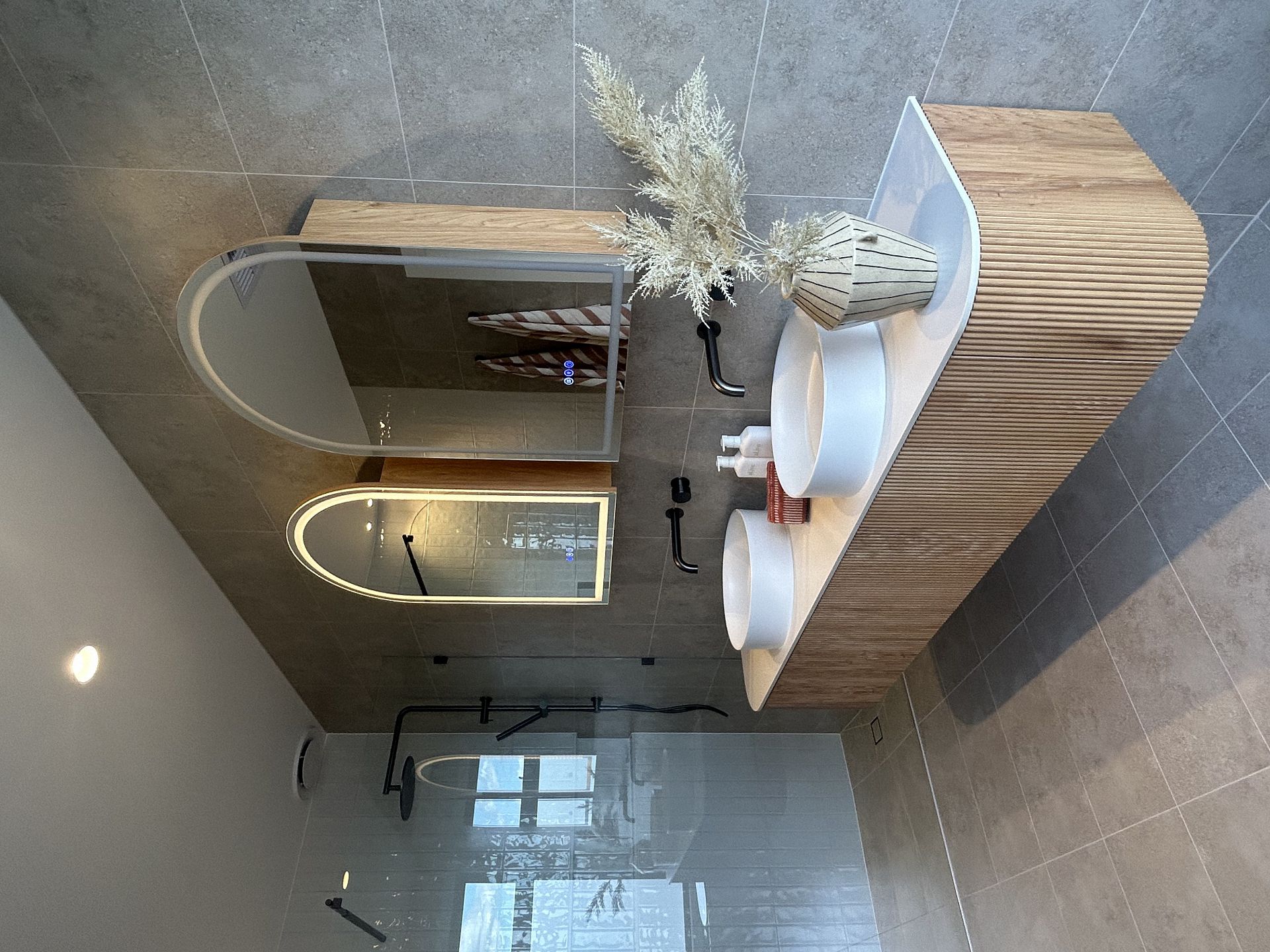
Double sink bathroom vanity in an Australian villa project
Why a Structured Evaluation Matters
Residential applications account for approximately 74.9% of global bathroom vanity revenue, according to Grand View Research. That makes most purchasing decisions part of housing renovation, new construction or hospitality projects, where late delivery or material failure has direct commercial consequences.
Design preferences are also shifting. Floating and wall-mounted vanities are widely described as one of the top bathroom trends for 2025–2026, while freestanding units still hold roughly 30% of North American market volume. A practical implication is that buyers need a manufacturer that can handle both formats competently, not just one design direction.
A structured evaluation should cover at least five areas:
- Manufacturing ownership, scale and geographic footprint
- Material expertise, especially solid wood and plywood
- Quality management systems and destination-market compliance
- Design range and customisation depth
- Documented project delivery and after-sales support
Manufacturer Profile as an Evaluation Reference
Foshan SHKL Sanitary Ware Co., Ltd (SHKL) is a practical reference for how a mid-to-high-end bathroom vanity manufacturer is organised. Established in 2004, SHKL focuses on whole bathroom customisation, with a stated emphasis on premium solid wood bathroom cabinets. Its product range covers bathroom vanities, shower doors and LED bathroom mirrors.
The company operates a 100,000 m² production base in China and a 40,000 m² factory in Ho Chi Minh City, Vietnam. The Vietnam facility employs around 450 people and is described as including Vietnam’s largest PU dust-free spray paint workshop, an important point for buyers who prioritise surface quality. Monthly output across the company’s product lines exceeds 70,000 units, and approximately 70% of production is exported to Europe, Australia, North America, South America and the Middle East. SHKL also reports a 20-person R&D team and products distributed to more than 50 countries and regions.
On compliance, SHKL holds ISO 9001, ISO 14001 and ISO 45001 certifications issued by Guangdong Quality Testing CTC Certification Co., Ltd. The certificates cover research and development and manufacture of bathroom cabinets as well as fixed universal lighting fixtures, with validity from 2024 to 2027. The company also holds designations including National High-Tech Enterprise, Foshan Standard Product Enterprise and Top Bathroom Brand.
| Evaluation dimension | What to look for | SHKL example |
|---|---|---|
| Production footprint | Factory size and multi-region capability | 100,000 m² China + 40,000 m² Vietnam |
| Product position | Clarity of market focus | Mid-to-high-end whole bathroom customisation; solid wood cabinets |
| Quality systems | Certification covering R&D and manufacturing | ISO 9001 / ISO 14001 / ISO 45001 |
| Capacity and export | Monthly output and market reach | 70,000+ units per month; ~70% export; 50+ countries |
| Innovation capacity | In-house design and engineering resources | 20-person R&D team |
Wood, Plywood and the Shift to Floating Designs
Wood is the dominant material category in bathroom vanities. Grand View Research attributes 34.9% of market revenue to the wood segment in 2025, including solid wood and plywood. Buyers generally expect wood cabinets to provide both visual warmth and long-term structural stability in humid environments.
SHKL’s current vanities use plywood and solid wood construction, typically with lacquered and melamine finishes. Production photos also show mortise and tenon joint structures, a traditional joinery method relevant to cabinet durability. Buyers checking a supplier’s woodworking capability should ask not only what material is used, but how panels are joined, sealed and finished.
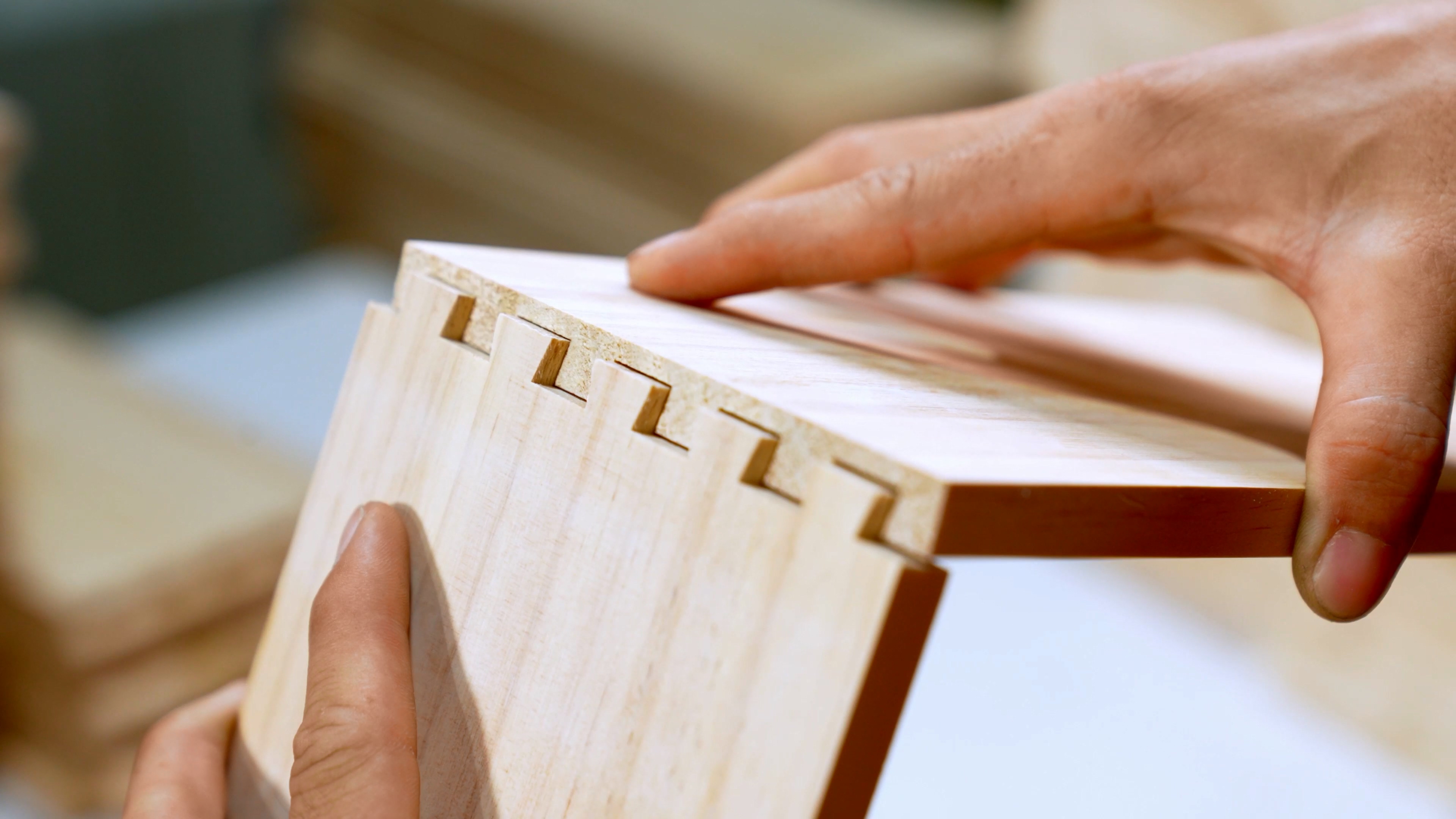
Mortise and tenon joint structure used in solid wood vanity production
Product range is another evaluation point. A manufacturer that offers multiple configurations is easier to work with across different projects.
| Model | Type | Material core | Structure | Top / basin |
|---|---|---|---|---|
| KL813003 | Wall mounted | Plywood + solid wood | Two drawers, DTC soft closing | Porcelain slab, undermount ceramic basin |
| AS813048A | Floating | Plywood + solid wood | Two drawers, Unihopper soft closing | Glossy white ceramic basin |
| AS813049 | Freestanding | Plywood + solid wood | One door, DTC hinge + Hettich push open | Sintered stone integral basin |
| AS813108 | Floating | Plywood + solid wood | Two drawers | Solid surface top, ceramic basin |
| AS813109 | Floating | Plywood + solid wood | Two side drawers + outer/inner drawer | Terrazzo top, solid surface basin |
| KL813001 | Floating | Plywood + solid wood | One drawer + two doors | Porcelain slab, above-counter basin |
OEM Depth: Customisation, MOQ and Lead Time
Most importers and project buyers work with vanity manufacturers on an OEM basis. SHKL’s OEM capability covers size, color, material, finish, hardware, logo and design style. For this line, the company lists a monthly capacity of 10,000 units, a standard MOQ of 50 units and a lead time of 30–45 days.
Quality control is a central part of the arrangement. SHKL states that 100% of outgoing products undergo inspection. The company also provides warranty support, remote after-sales consultation and spare parts supply, which can reduce friction for overseas buyers without local service infrastructure.
Delivery Evidence: What Documented Cases Show
Case histories provide one of the most practical signals for evaluating a bathroom vanity manufacturer. SHKL’s documented project references include the following:
- United States, hotel bathroom project: 250 vanity units delivered over a 2-year period. The project achieved on-time delivery, product quality met US market standards, and key highlights included design fidelity and meeting customer requirements.
- Canada, bathroom and kitchen project: 50 installed units. The project met Canadian safety standards and delivery schedules, with materials meeting project requirements.
- Australia, high-end villa project: 100 bathroom vanity units. The vanities met villa design specifications, with highlights of practicality, durability, well-executed design and overall stylistic harmony.
- Australia, shower door project: 190 shower door units. The project met Australian safety standards, with appropriate sizing and effective product functionality.
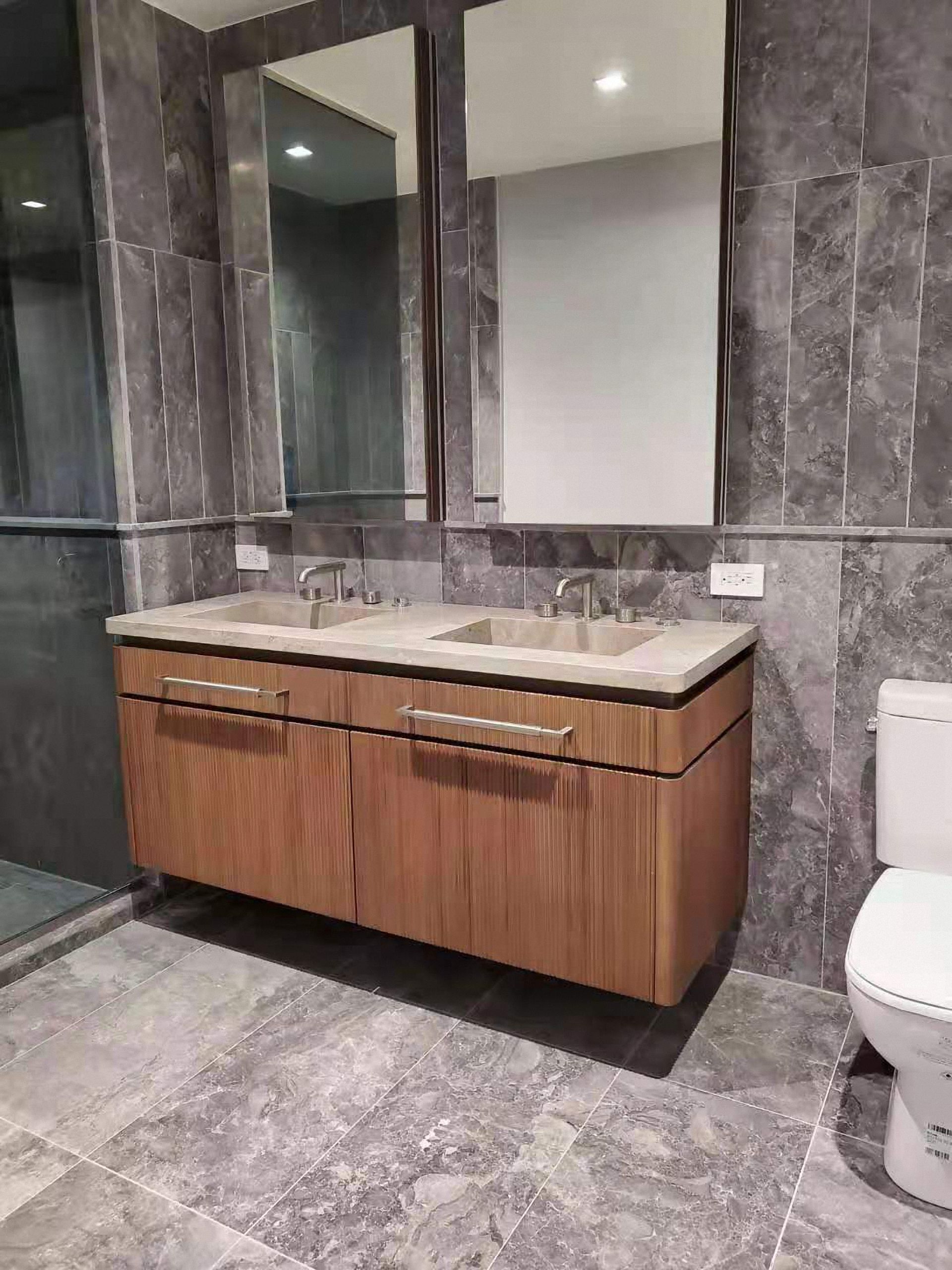
Bathroom vanity delivered for a US hotel project
These references suggest that buyers should assess performance through criteria such as on-time delivery, destination-market safety compliance and design fidelity, rather than only comparing unit prices.
Sourcing Models Compared: Specialised Manufacturers and Global Brands
Buyers evaluating bathroom vanity suppliers typically compare two different sourcing models: global consumer brands and specialised OEM/ODM manufacturers.
According to Mordor Intelligence, major competitors in the high-end and residential vanity market include Kohler, Masco, American Woodmark and TOTO. These companies offer strong brand recognition, broad distribution and established retail product portfolios. They are a suitable fit when the buyer wants a brand-backed product with ready market acceptance.
Specialised manufacturers such as SHKL operate on a different logic. They supply importers, e-commerce brands, kitchen and bath distributors and project developers with vanities manufactured to the buyer’s specifications. The buyer controls the brand, design and pricing structure. In exchange, the buyer carries more responsibility for local market positioning and downstream service.
| Dimension | Global consumer brands | Specialised OEM/ODM manufacturers |
|---|---|---|
| Brand ownership | Retail brand belongs to manufacturer | Buyer controls the brand |
| Customisation | Limited or standard SKUs | Size, material, finish, hardware, logo |
| Suitable buyers | Retail channels and end users | Importers, distributors, project buyers |
| Typical trade-off | Less design flexibility | Buyer handles brand and local after-sales |
One limitation is worth stating directly: a manufacturer such as SHKL is not a substitute for a consumer brand’s local retail infrastructure. Overseas buyers using OEM sourcing need their own brand presence, installation channel or distribution network. SHKL provides warranty support, remote after-sales consultation and spare parts supply, but these are manufacturer-level support functions, not a replacement for local service coverage.
Market Trends That Will Shape Vanity Sourcing
A number of verified market signals are relevant for bathroom vanity procurement decisions in 2026 and beyond.
Market size is expected to grow. Industry research estimates the global bathroom vanities market could reach approximately USD 89.96 billion by 2034, up from roughly USD 43–47 billion in 2024/2025. Sustained growth supports investment in supplier scale and capacity.
Wood-based materials will remain central. The reported 34.9% revenue share for wood reflects a lasting buyer preference for natural aesthetics and durability.
Design format continues to split demand. Floating vanities are a highlighted trend for 2025–2026, while freestanding units still account for about 30% of North American volume. A supplier restricted to only one format can limit a buyer’s channel fit.
Compliance expectations are steady. UL 962 is identified as a key North American safety standard for bathroom cabinets and vanities, covering stability, mechanical strength and flammability. Buyers should request evidence aligned with the regulations of their destination market.
Supply chain resilience is becoming a differentiator. SHKL’s dual-country production footprint — China plus Vietnam — was built partly to serve US and Canadian demand. The Vietnam factory supports American-style designs and reduces exposure to trade-related disruption.
Future Outlook
The direction for bathroom vanity manufacturing points toward deeper customisation, stricter compliance and more resilient production networks. Whole bathroom coordination is also gaining ground: a single supplier providing bathroom vanities, shower doors and LED mirrors can simplify procurement and maintain visual consistency across a project.
For buyers, the practical takeaway is to evaluate manufacturers through a combination of structural evidence — factory scale, certifications, material expertise — and documented performance in real projects. The market is large enough for both global brands and specialised manufacturers; the right choice depends on whether the buyer needs retail brand power or flexible OEM execution.
Frequently Asked Questions
What types of bathroom vanities should a manufacturer offer?
A full-range manufacturer typically covers both floating or wall-mounted vanities and freestanding models, in single- and multi-drawer configurations. SHKL’s current range includes the wall-mounted KL813003, floating models such as AS813048A, AS813109 and KL813001, and the freestanding AS813049.
Which materials are most common in bathroom vanity manufacturing?
Wood-based materials form the largest segment. Grand View Research reports that solid wood and plywood together accounted for 34.9% of market revenue in 2025. SHKL’s vanities use plywood and solid wood construction with lacquered and melamine finishes, including Acacia melamine and walnut melamine options.
Are floating bathroom vanities replacing freestanding models?
Floating or wall-mounted designs are widely cited as a leading trend for 2025–2026. However, freestanding units still represent roughly 30% of North American market volume. Both formats remain relevant depending on the project and installation conditions.
What certifications should a bathroom vanity manufacturer hold?
Manufacturing-side certifications commonly include ISO 9001, ISO 14001 and ISO 45001. SHKL holds these three certifications, issued by Guangdong Quality Testing CTC Certification Co., Ltd., covering R&D and manufacture of bathroom cabinets. For North American shipments, UL 962 is a relevant safety standard for bathroom cabinets and vanities, covering stability, mechanical strength and flammability.
Can bathroom vanity manufacturers handle custom and OEM orders?
Yes. OEM production is standard among specialised vanity manufacturers. SHKL’s OEM scope covers size, color, material, finish, hardware, logo and design style, with export markets including North America, Europe, Oceania and the Middle East.
What are typical MOQ and lead times for OEM vanity production?
SHKL lists a standard OEM MOQ of 50 units and a lead time of 30–45 days, supported by a dedicated OEM monthly capacity of 10,000 units. All units receive 100% inspection before shipment.
How can a buyer verify a bathroom vanity manufacturer’s reliability?
Documented project references are a practical check. SHKL cases include 250 units for a US hotel bathroom project with on-time delivery and US-market quality; 50 units for a Canadian bathroom and kitchen project meeting Canadian safety standards; 100 units for an Australian villa project meeting design specifications; and 190 shower door units for Australian applications meeting safety standards.