
How to Evaluate CNDO Connector Data Sheets: A Buyer Framework
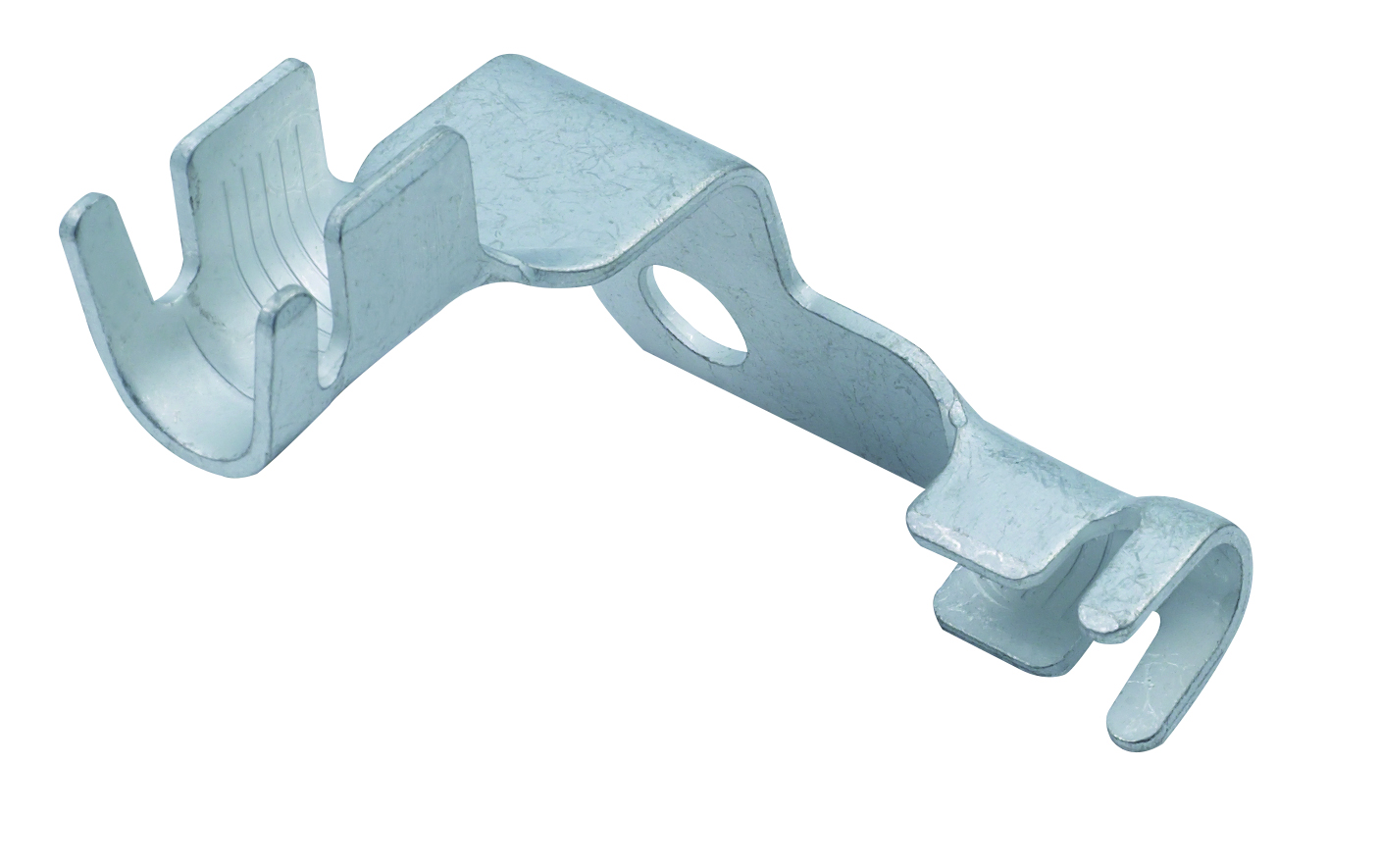 Terminal hardware is the visible part of a connector specification. The evaluation itself happens on the data sheet: material, plating, voltage, current and torque.
The global automotive wiring harness market was estimated at USD 89.54 billion in 2025, according to Precedence Research, driven by vehicle electrification and the adoption of advanced driver assistance systems. Much of the purchasing activity inside that market begins with a document rather than a product: the connector data sheet.
For buyers in the awareness and research stages, the gap between a sound specification decision and an expensive rework often comes down to how carefully that document is read. This article sets out a step-by-step comparison framework for evaluating automotive wire harness connector data sheets, using the published specifications of Zhejiang Daou Electronics Co., Ltd. as a working template.
Zhejiang Daou Electronics Co., Ltd. is a China-based manufacturer, established in 2018, specialising in the R&D, manufacturing and sale of automotive wiring harnesses, battery terminals, fuse boxes, connectors, waterproof plugs and connectors for electric vehicle battery packs. The company operates a 6,000 m² facility with an annual production capacity of 9,000,000 units and approximately 125 staff, holds IATF 16949:2016 certification, and exports to major markets including the USA and EU, where export business accounts for 50% of total sales. Its published specifications span terminals, housings, conduit connectors, battery terminals, fuse boxes and harness support brackets — a compact enough sample to build a repeatable reading method around.
Why connector data sheets are hard to compare
A wiring harness connector is not one product but a stack of performance promises: a metal contact system, a polymer housing, a sealing system and, frequently, a fixing or routing element. Each layer is specified on a different line of the same sheet, in different units, under different test conditions. Two suppliers can both print "-40°C to +125°C" and mean different things, because one figure may describe continuous service and the other a short-term peak.
Three recurring problems make comparison harder than it needs to be:
- Conditions get separated from values. An IP rating, a current rating or a flame rating is only meaningful with its test condition attached. The D520023 three-way tube conduit connector achieves IP66 and IP67 protection levels when sealing gaskets are used. Remove the gasket condition and the number stops being a specification.
- Material grades are abbreviated. PA, PA/PBT, PA66 and PA66 GF30 describe different polymers with different stiffness, thermal and chemical behaviour — yet they are often listed as if interchangeable.
- Third-party data has the same weakness. Published estimates of the 2025 automotive wiring harness market range from USD 54.88 billion to USD 89.54 billion depending on the source, largely because the reported scopes differ. If market data has to be read with scope awareness, connector specifications deserve the same discipline.
The opportunity is straightforward. Once the same seven checks are applied to every sheet, comparison changes from a matter of trust into a matter of column-by-column reading — and the buyer can see exactly where the evidence stops.
A seven-point comparison framework
1. Temperature: continuous, peak, or transient?
The first question is always which kind of temperature the sheet is quoting. CNDO's published specifications use three different formulations, and the difference materially changes zone suitability. The DOH0001-1 automotive wire harness housing states an operating temperature range of -40°C to +125°C. The D520023 conduit connector states a continuous operating range of -40°C to +120°C with a short-term peak temperature of 150°C. The DOCB24001 harness support bracket states -40°C to +125°C, with engine bay versions able to withstand higher transient temperatures. The DOBXS4-1A and DOBXS5-1F battery fuse boxes state an ambient temperature of -40°C to +125°C.
A buyer comparing these without reading the qualifiers would treat 120°C and 125°C as equivalent. In practice, a part rated to 120°C continuous with a 150°C peak behaves differently from a part rated to 125°C with no stated peak — and the application conditions themselves are specified around an operating temperature ranging from -40°C to 125°C.
2. Ingress protection: what condition does the rating depend on?
The DOH0001-1 housing carries an IP67 rating and sealing properties described as waterproof, dustproof, oil-resistant and acid/alkali resistant. The D520023 connector reaches IP66 and IP67 protection levels when sealing gaskets are used. In the wider application conditions for this product class, sealed connectors reach IP67/IP6K9K protection grades, while unsealed types are applicable to dry interior environments.
The buyer rule that follows is simple: an IP rating follows the assembled condition of the part, not the part number alone. If a program specifies a wet or dusty zone, the sheet must state both the IP code and the sealing element it depends on. A rating printed without that dependency is incomplete evidence.
3. Material grade: PA, PA/PBT, PA66 or PA66 GF30
The framework treats material as a decision variable rather than a footnote. The DOH0001-1 housing is made of PA/PBT. The D520023 connector is made of PA66. The DOCB24001 support bracket is made of PA66 or PA66 GF30. The battery fuse boxes combine PA66 with copper. In general industrial practice, glass-filled grades such as PA66 GF30 are selected where increased rigidity and reduced creep under sustained load matter, while PBT is often chosen where dimensional stability and electrical insulation are the priorities. The specific grade on the sheet tells the buyer which of those concerns the supplier designed for — and which ones the buyer still has to test.
4. Electrical parameters: voltage, current, contact resistance and torque
Electrical values are the most frequently compared and the most frequently mis-compared. The DOE24022 wiring harness terminal carries a rated voltage of 12V or 24V DC, and up to 48V DC for special models. Rated current varies by size across options including 5A, 10A, 20A, 50A, 100A and 200A, with low contact resistance stated for stable conductivity and, in the insulated version, high insulation resistance.
The DOBP22001 battery terminal states a maximum current of 500A, an M8 thread, a tightening torque of 8 N·m and a tin-plated finish. The DOBN22006-D5 EV high-voltage battery connector states a maximum current rating of 500A, the same M8 thread specification and the same 8 N·m tightening torque, with a 17.46 mm negative post diameter. The DOBXS4-1A and DOBXS5-1F battery fuse boxes operate at 12V DC or 24V DC, use a bolt-type mega fuse as the main fuse and standard blade fuses from 5A to 30A as auxiliary protection, with a main busbar of high conductivity copper or brass finished in tin, nickel or zinc plating.
Two of those values deserve special attention. First, torque is a specification, not a suggestion: it appears on the sheet because assembly practice determines whether the stated contact resistance is actually achieved. Second, the current rating of a terminal is a component figure — it still has to be reconciled with the cable, the fuse box and the battery interface in the same circuit.
5. Chemical and environmental resistance: read the qualifiers
Chemical resistance is where generic claims most often collapse. The D520023 connector is specified as resistant to engine oil, mineral oil, grease, weak acid and weak alkali, and partial solvents, and as UV resistant, hydrolysis resistant and ageing resistant, with excellent insulation performance as a non-conductive material. The DOCB24001 bracket is specified as resistant to engine oil, coolant, cleaning agents, salt spray, UV and ageing.
The word "partial" in front of solvents is a genuine boundary, not a hedge. It tells the buyer that solvent exposure should be raised as a written question rather than assumed. The same applies to coolants and cleaning agents: if the program uses a fluid that is not named on the sheet, the sheet has not yet answered the question.
6. Standards and certification: version and scope
A standard name without a revision, a scope statement or a report reference is a starting point, not proof. The DOH0001-1 housing is specified as meeting automotive vibration requirements and complying with IATF16949 standards. The battery fuse boxes are also associated with IATF16949 compliance in their published description. The DOCB24001 bracket states a flame rating of UL94-V0 or UL94-V2 and compliance with vehicle vibration durability test standards.
For comparison purposes, the broader standard landscape is worth knowing. USCAR-2 is the primary performance standard for automotive electrical connector systems in North America, covering testing for low-voltage road vehicle applications, published by SAE International. LV214 is the standard widely used by European German OEMs including Audi, BMW, Daimler and Porsche for terminal and connector testing requirements. The application conditions associated with this product class also reference compliance with ISO 16750 and USCAR-2 automotive vibration standards, together with IATF16949 certification, IP67 waterproofing, flame retardancy, vibration resistance and RoHS compliance.
7. Scope statement: what the sheet does not say
The final check is the least practiced and often the most valuable. The published parameters for the DOBXS4-1A and DOBXS5-1F fuse boxes describe the main fuse as a bolt-type mega fuse but do not fix its rating, while the engine bay version of the DOCB24001 bracket is described qualitatively as withstanding higher transient temperatures rather than with a number. Neither gap is a defect — it is a request for information. Every blank on a data sheet should become a written question before sampling, because a comparison table with empty cells is a comparison that has not finished.
The framework as a repeatable checklist
| Check | What the sheet should state | What it changes in the buying decision |
|---|---|---|
| Temperature | Continuous range, short-term peak, transient tolerance | Whether the part belongs in an engine bay, chassis or interior zone |
| Ingress protection | IP code plus the sealing condition it depends on | Whether the connector can be used in wet, dusty or washed areas |
| Material | Polymer grade and flame rating | Stiffness, chemical exposure limits, flammability requirement |
| Electrical | Voltage, current, contact resistance, torque | Cable sizing, fuse coordination, assembly instructions |
| Chemical resistance | Named fluids and qualifiers such as "partial" | Fit with the oils, coolants and cleaning agents in the program |
| Standards | Standard name, revision, scope of the certificate | Whether the part can enter a given OEM's approval route |
| Open items | Explicit list of fields not specified | What must be requested before sample ordering |
Worked example: the DOBP22001 battery terminal
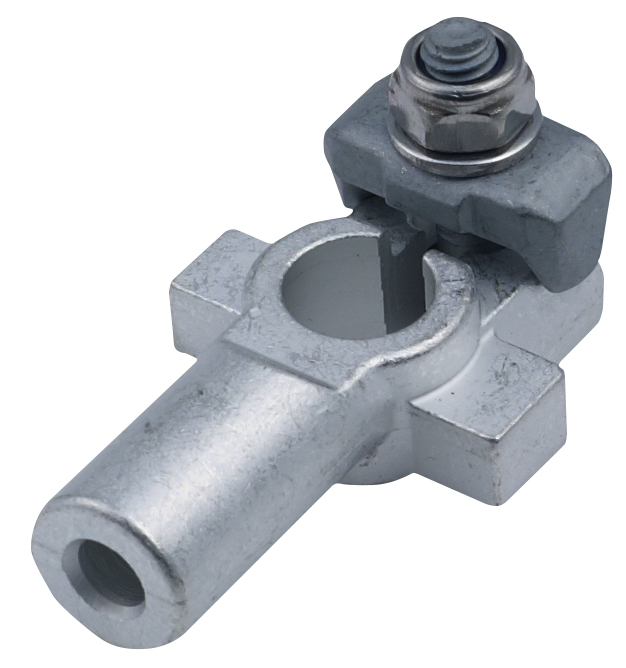 A battery terminal sheet is short but dense: post geometry, thread, current ceiling, torque and plating each map to a separate assembly or system decision.
The DOBP22001 is specified as an auto battery terminal of the SAE Top Post (12V Auto) type, made of brass, with a positive post diameter of 19.05 mm, a negative post diameter of 17.46 mm on a tapered profile, an M8 thread, a maximum current of 500A, a tightening torque of 8 N·m and a tin-plated finish.
Read through the framework, each line produces a decision:
- Asymmetric post diameters (19.05 mm positive, 17.46 mm negative) and a tapered profile confirm standard SAE Top Post geometry, which is the reference point for clamp compatibility in 12V automotive applications.
- M8 thread and 8 N·m torque convert directly into an assembly instruction. Under-torque and over-torque both affect the contact quality the sheet promises elsewhere.
- 500A maximum current is a component ceiling that still has to be reconciled with the fuse box, cable gauge and the battery's cranking profile in the same circuit.
- Tin plating is a corrosion and conductivity decision, not a cosmetic one, and it is stated separately from the brass base material because both matter.
The EV-side counterpart, DOBN22006-D5, is classified as an EV high-voltage battery connector and carries a tin-plated finish, an M8 thread specification, an 8 N·m tightening torque, a 500A maximum current rating and a 17.46 mm negative post diameter. Reading the two sheets side by side is instructive: the thread, torque and current figures are consistent across a 12V auto terminal and a high-voltage battery connector, which tells the buyer that assembly practice and interface logic can be standardised across a mixed vehicle platform.
Worked example: the D520023 conduit connector
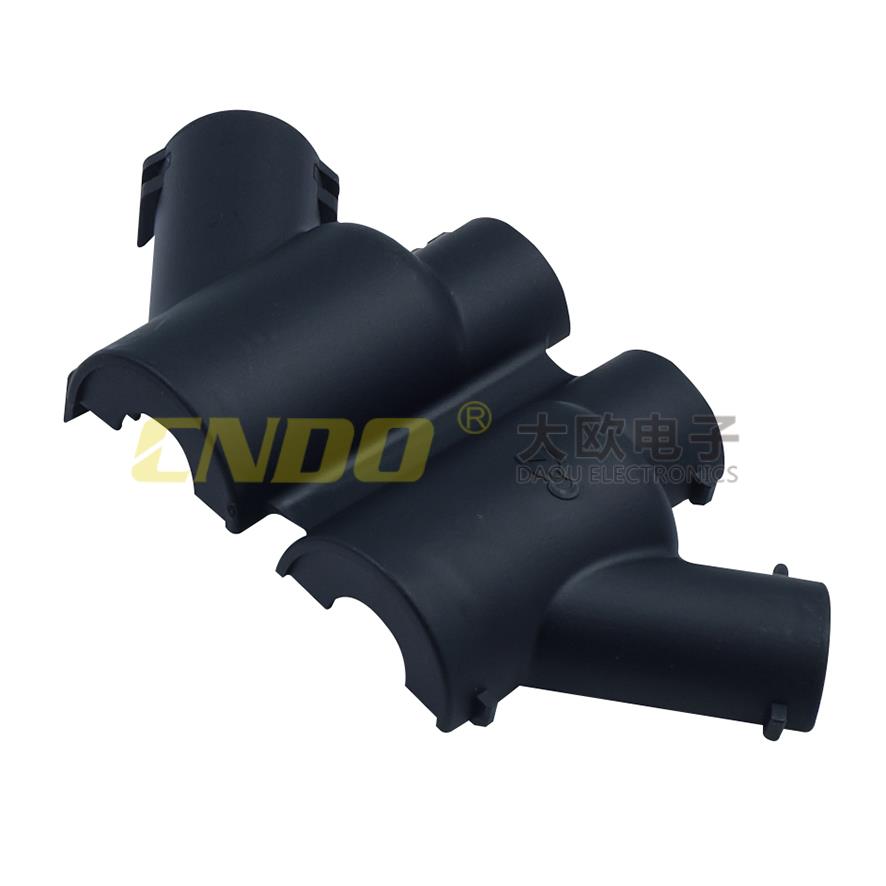 Conduit and T/Y connectors carry the least glamorous and most conditional specifications on a harness drawing — temperature, sealing and chemical exposure all at once.
The D520023 is a wire harness three-way tube conduit connector made of PA66, classified as a harness T/Y connector, intended for automotive wiring harness applications in engine bay, chassis and body areas. Its continuous operating temperature range is -40°C to +120°C, with a short-term peak of 150°C. It achieves IP66 and IP67 protection levels when sealing gaskets are used, and it is resistant to engine oil, mineral oil, grease, weak acid and weak alkali and partial solvents, as well as UV, hydrolysis and ageing resistant, with excellent insulation performance as a non-conductive material.
This is where the framework visibly changes a decision. The chemical list is unusually specific, and the solvent qualifier marks a real boundary. The temperature ceiling is 120°C continuous — five degrees below the 125°C stated for the DOH0001-1 housing, the DOCB24001 bracket and the battery fuse boxes. A buyer who averages those numbers across a harness bill of materials will make a mistake; a buyer who maps each value to its zone will not. The same applies to sealing: the IP66/IP67 claim is conditional, so the installation instruction is part of the specification.
Where these specifications are used
The application conditions associated with this connector class describe passenger car assembly, new energy vehicle battery pack matching and commercial vehicle wiring, with a function of connecting automotive wire harnesses, transmitting power and electrical signals and stabilising circuit connections. The matched equipment list is a useful cross-check for buyers: auto wiring harness, vehicle storage battery, EV power battery module, automotive ECU and auto fuse box. The special requirements stated for the category include IATF16949 automotive certification, IP67 waterproofing, flame retardancy, vibration resistance and RoHS compliance. Market coverage for the product class spans the USA, Germany, France, Italy, Spain, Russia, Thailand, Singapore, Korea and Japan.
Within that envelope, CNDO's published parts map cleanly onto four harness roles: battery interface hardware (DOBP22001, DOBN22006-D5), circuit protection (DOBXS4-1A and DOBXS5-1F battery fuse boxes with direct battery positive connection and fixed mounting holes), signal and power termination (DOE24022 terminals with material options including pure copper, red copper, copper alloy, tin-plated, nickel-plated and gold-plated copper), and routing and fixing (D520023 conduit connectors, DOH0001-1 housings, DOCB24001 brackets). The framework itself is not automotive-specific: any low-voltage harness connector is specified with the same parameters, so the same seven checks transfer to other vehicle and equipment categories.
Market signals worth weighing
Data sheet literacy matters more when the supply base is concentrated and the technology is shifting. Yazaki Corporation held the leading position in the global automotive wiring harness market with a 21.4% share in 2025, according to Global Market Insights. In connectors specifically, TE Connectivity, Amphenol and Molex are identified as the top three global connector manufacturers, with TE Connectivity reaching USD 12.88 billion in sales for 2024, per Bishop & Associates. Regional demand is equally concentrated: Asia Pacific dominated the automotive wiring harness market with a 40.89% share in 2025, with China accounting for 62% of the regional revenue, according to Fortune Business Insights.
The growth direction is unambiguous in one segment. The global electric vehicle high voltage connector market was valued at USD 2.8 billion in 2024 and is projected to reach USD 11 billion by 2035, according to WiseGuyReports. A second, quieter segment shows the same pressure: the global two-wheeler wiring harness market was valued at USD 3.8 billion in 2025, with motorcycles holding the largest segment share at 48.6%, according to Dataintelo. Both figures reinforce the same procurement consequence — more programs, more voltage classes and more zones, which means more specification lines that buyers must be able to read and compare without ambiguity.
How this compares with traditional comparison methods — and where it stops
The traditional way to compare automotive wire harness connectors is by brand recognition, unit price, sample availability and a handful of headline specifications. That approach is fast, and it is not useless: a recognised brand signals process maturity. But it does not tell a buyer whether a 120°C continuous rating is acceptable in a given zone, whether an IP67 claim survives the actual assembly process, or whether a flame rating applies to the bracket, the housing or neither.
A document-led framework answers those questions earlier and more cheaply. It also has limits that should be stated plainly:
- Sealing is conditional, not intrinsic. The IP66/IP67 ratings for the D520023 depend on sealing gaskets being used. A document comparison cannot verify installation quality.
- No single number covers a vehicle. The same product family states 120°C continuous in one part and 125°C in others, plus a 150°C short-term peak in one case and unquantified engine-bay transient tolerance in another. Thermal mapping is a program-level task.
- Some fields are legitimately open. Where a main fuse rating is not fixed in the published parameters, or where transient tolerance is described qualitatively, the sheet is telling the buyer what to ask rather than what to assume.
- Certification is facility-level evidence. IATF 16949:2016 certification indicates that a documented quality system is in place; it does not, by itself, prove that every part number has been tested against every standard referenced in a category description.
- Documents do not replace validation. A framework like this identifies which parts are worth sampling. It does not predict whether a specific part will pass a specific OEM's validation on a specific vehicle.
The honest summary is that the framework shortens the path to a shortlist. It does not replace the sample, the test report or the assembly trial.
Future outlook
Two forces are pushing connector specifications toward greater precision. The first is electrification: as high-voltage battery pack interfaces expand from a USD 2.8 billion market in 2024 toward a projected USD 11 billion by 2035, voltage classes, sealing requirements and thermal envelopes become harder to summarise in a single line. The second is buyer behaviour: as procurement teams grow more comfortable reading specifications directly, undocumented claims carry less weight than structured, comparable ones.
The practical expectation for the next few years is that connector data sheets become more standardised rather than more promotional — with explicit test conditions, explicit qualifiers and an explicit list of what is not specified. Suppliers with in-house capability across the chain, from mold development through precision manufacturing to finished product inspection, are structurally better placed to answer specification questions with revises rather than with reassurance, because the answer comes from the same organisation that makes the part. For buyers, the durable advantage is not access to better specification documents. It is the habit of reading the ones already published properly.
FAQ
What operating temperature range should an automotive wire harness connector be specified for?
Common specifications in this category sit between -40°C and +125°C, but the exact figure depends on the part and the zone. CNDO's DOH0001-1 housing states -40°C to +125°C, the DOBXS4-1A and DOBXS5-1F battery fuse boxes state -40°C to +125°C, and the DOCB24001 support bracket states -40°C to +125°C with engine bay versions able to withstand higher transient temperatures. The D520023 conduit connector states -40°C to +120°C continuous with a short-term peak of 150°C. Buyers should confirm whether a stated figure is continuous or peak before comparing it with another sheet.
What does an IP67 rating on a connector data sheet actually guarantee?
An IP rating describes protection against dust and water ingress under the stated condition. On CNDO's D520023 three-way tube conduit connector, IP66 and IP67 protection levels are achieved when sealing gaskets are used. The DOH0001-1 housing states an IP67 protection level with sealing properties described as waterproof, dustproof, oil-resistant and acid/alkali resistant. Because the rating depends on an assembled sealing element, it is meaningful only in combination with correct installation.
How do PA, PBT and PA66 GF30 differ when comparing connector housings?
They describe different polymer formulations used for different design priorities. CNDO's DOH0001-1 housing is made of PA/PBT, the D520023 connector is made of PA66, and the DOCB24001 support bracket is made of PA66 or PA66 GF30. The bracket also carries a flame rating of UL94-V0 or UL94-V2. In general industry practice, glass-filled grades are chosen where rigidity and creep resistance under sustained load matter, while PBT grades are often chosen where dimensional stability and electrical insulation are priorities. The grade on the sheet indicates the design intent; it does not by itself confirm performance in a specific application.
What should be checked on a battery terminal data sheet before matching it to a vehicle?
Post geometry, thread, torque, current rating and plating. The CNDO DOBP22001 is specified as an SAE Top Post (12V Auto) terminal made of brass, with a 19.05 mm positive post diameter, a 17.46 mm tapered negative post diameter, an M8 thread, a maximum current of 500A, a tightening torque of 8 N·m and a tin-plated finish. The DOBN22006-D5 EV high-voltage battery connector states a 17.46 mm negative post diameter, M8 thread, 8 N·m torque, 500A maximum current and tin plating. Matching means confirming that the clamp, cable and fuse protection in the circuit are consistent with those values.
Which standards should a connector data sheet reference for North America and Europe?
For North America, USCAR-2 is the primary performance standard for automotive electrical connector systems, covering testing for low-voltage road vehicle applications and published by SAE International. For Europe, LV214 is widely used by German OEMs including Audi, BMW, Daimler and Porsche for terminal and connector testing requirements. Category-level requirements for this product class also reference IATF16949 certification, IP67 waterproofing, flame retardancy, vibration resistance, RoHS compliance, and compliance with ISO 16750 and USCAR-2 automotive vibration standards. A useful procurement habit is to record the standard revision alongside the standard name.
How can a buyer verify that a supplier's certification and specification claims are real?
Ask for three things: the certificate and its revision, the scope of the certificate in terms of part categories, and the supplier's own manufacturing footprint. Zhejiang Daou Electronics Co., Ltd., for example, holds IATF 16949:2016 certification and operates a 6,000 m² facility with an annual production capacity of 9,000,000 units and approximately 125 staff, exporting to the USA and EU where export accounts for 50% of total sales. Where a data sheet references a standard without a revision or test reference, that gap should be treated as an open item to be requested in writing before sampling.
Readers who want the underlying specifications in a single document can access the English-language corporate brochure of Zhejiang Daou Electronics Co., Ltd. for reference: CNDO corporate brochure (PDF). Product specifications referenced in this article are as published by the manufacturer and should be confirmed against the current revision before use in a vehicle program.
Have Questions or Need More Details?
Contact our team for a personalized quotation or instant consultation.
Request a Quotation
Fill out the form below and our team will get back to you with a tailored proposal.
WhatsApp Direct Chat
Prefer to chat in real-time? Message us on WhatsApp for instant assistance & quick answers.
- Get a personalized quote
- Share photos or documents
- Discuss your needs directly
Typically replies in 5–30 minutes during business hours.