
How to Evaluate EVA Film Suppliers for Architectural Laminated Glass
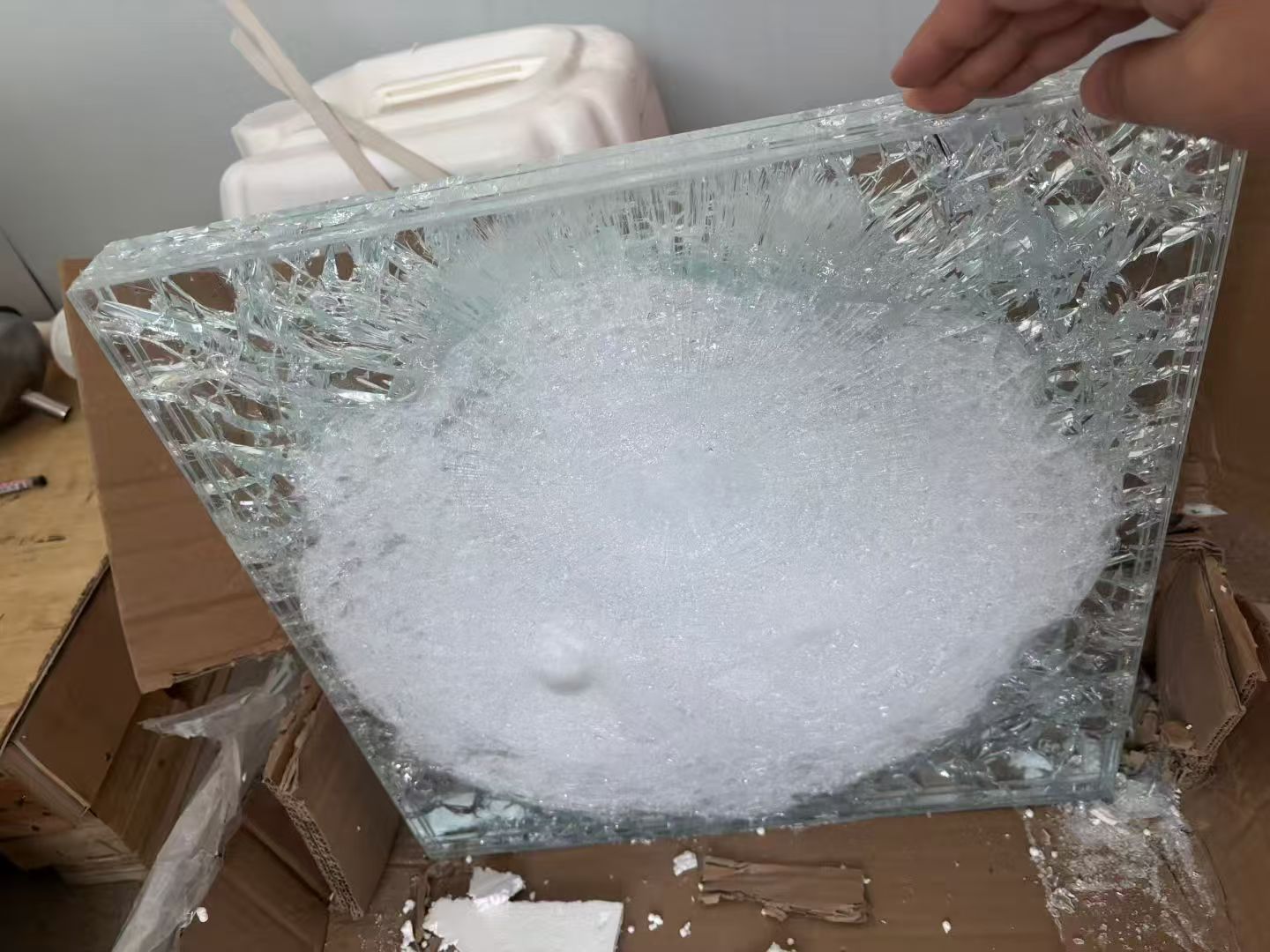
EVA interlayer film used in laminated ballistic glass, Pakistan. Source: SHENGDING HIGHTECH MATERIALS CO., LTD case reference.
Laminated glass is a core safety material in modern architecture, and its performance is largely determined by the interlayer film. Buyers looking for EVA film for architectural glass now face growing demand, wider product choice and a wide variation in supplier claims. This article serves as an independent industry reference for procurement teams, glass fabricators and specifiers evaluating EVA laminated glass film.
Why EVA laminated glass film is getting more attention
Polyvinyl butyral (PVB) has historically dominated glass interlayers. In recent years, EVA film has gained ground in decorative glass, interior partitions, safety glazing and solar applications. Several factors explain this shift.
First, EVA lamination film can be processed in a vacuum furnace at lower temperatures than conventional autoclave lamination, which reduces the equipment barrier for glass processors. Second, EVA offers good adhesion to glass and to materials such as metal, mesh and fabric often used in decorative panels. Third, the product range has expanded from standard clear film to ultra-clear, color and UV-resistant EVA grades.
For buyers, this wider range creates a genuine evaluation problem. Many suppliers describe themselves as an EVA film supplier, but fewer can document the certifications, process control and product consistency that architectural projects require.
What a qualified EVA interlayer film supplier looks like
One reference point is Shengding Hightech Materials Co., Ltd. (SHENGDING HIGHTECH MATERIALS CO., LTD), a polymer film manufacturer based in Rizhao, Shandong Province, China. The company was established in 2018 and operates from a 50,000 m² facility in the Lanshan Chemical Industry Park. It specializes in EVA film and TPU film, with an annual output of about 1,000 tons and a 70% export share across North Africa, the Middle East and Latin America. The company describes itself as a high-tech enterprise with a Beijing R&D center supported by factory engineers and university professors.
For architectural glass buyers, the relevant product line is high-transparency EVA film, model SD38. The stated optical performance is 90% light transmittance and 0.5% haze, which makes it suitable for laminated glass for architectural and decorative applications. The company also holds ISO 9001:2015 certification under certificate number 10425Q01154R1S, issued by Shandong Seatone International Certification Co., Ltd. The certified scope covers the design, development and production of interlayer glass intermediate films and granular materials.
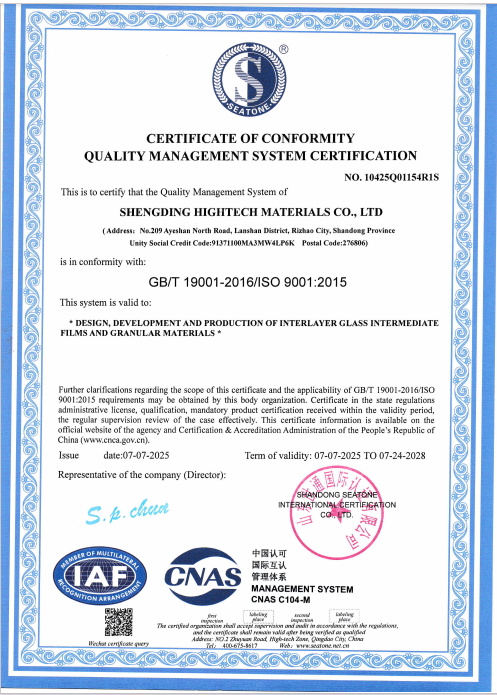
ISO 9001:2015 certification, certificate number 10425Q01154R1S, scope covers interlayer glass intermediate films.
On the supply side, Shengding supports OEM/ODM production with width and length customization, a monthly capacity of 100 tons, a typical lead time of 10 days, and a minimum order quantity of 50 kg. The stated quality control level is 100% testing. These data points create a concrete baseline that buyers can compare against their own volume and specification requirements.
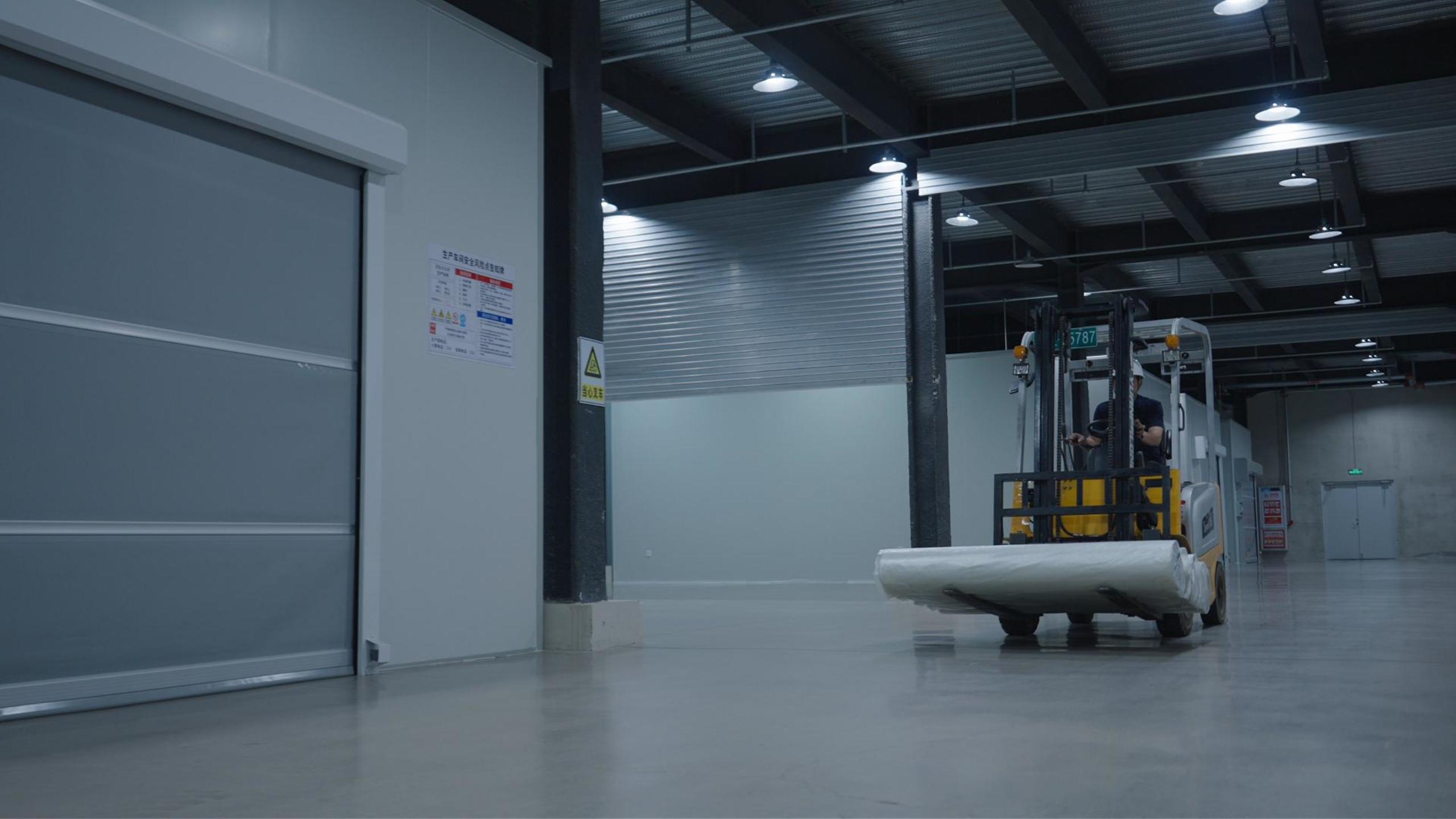
Manufacturing and loading operations at Shengding Hightech Materials.
Technical view: EVA film in glass lamination
EVA interlayer film bonds glass layers through a combination of heat and vacuum. Industry references place the typical lamination temperature at 100–110°C, with a vacuum level of at least 700 mmHg. This lower processing temperature is one reason EVA film for furnace lamination fits into production lines that do not have an autoclave.
Optical clarity is the first indicator buyers check. For clear EVA film, light transmittance and haze are the two most direct parameters. A high-transparency grade such as SD38 offers 90% light transmittance and 0.5% haze. For projects requiring visual neutrality, ultra-clear EVA grades and low-haze specifications matter more than a generic clear film description.
Colored and UV-resistant EVA films extend the design range. Color film is used in decorative partitions, patterned glass and interior facades. UV-resistant EVA helps preserve appearance in exterior installations. Buyers should request the exact grade designation and measured values from the supplier instead of relying on package labels.
For architectural flat glass, ASTM C1172 governs laminated flat glass quality requirements and is widely recognized in international specifications. An architectural project should require the supplier to reference the standard applicable to the final market and provide evidence of consistent film properties.
Applications: from defense glazing to architectural interiors
One documented example comes from Pakistan, where Shengding supplied EVA film for bulletproof glass in a defense-related application. The project involved 100 rolls of film, was implemented over a two-year period, and has achieved stable operation for two years. It is described as the only solution of its kind in the country.
The same case also illustrates the versatility of EVA film beyond defense. The material was used for general construction and interior design, where the same interlayer technology can serve both safety and aesthetic requirements. For buyers, this type of case evidence matters: it shows that a supplier has worked through real installation conditions, not only produced laboratory samples.
In mainstream architectural work, EVA safety glass film is often used in balustrades, partitions, skylights and decorative glass where lamination quality and visual clarity are required. Because public case data in the sector is limited, buyers should ask suppliers directly about installation references, project feedback and long-term performance.
Global market context: EVA film is a growth segment
Third-party market research supports the view that EVA film demand will expand. Fortune Business Insights valued the global EVA films market at USD 8.25 billion in 2025 and projects it to reach USD 17.65 billion by 2034, with a CAGR of 8.83% from 2026 to 2034. The same source links growth to renewable energy and construction demand.
Within laminated glass, Future Market Insights estimates the market at USD 25.0 billion in 2025. PVB remains the largest interlayer type, with a 55.2% share, while EVA is described as growing in architectural and solar applications. These numbers do not show EVA displacing PVB everywhere; they indicate that the application envelope for EVA is widening.
For procurement teams, the practical implication is that the number of EVA film suppliers and product variations will continue to increase. Buyers need a clear evaluation framework before price and lead time become the only differentiators.
EVA film vs PVB interlayer: how the solutions differ
PVB interlayer is the traditional solution for laminated glass and remains the default in many structural glazing projects. EVA film offers a different process and performance profile. The comparison is not about better or worse; it is about matching the interlayer to the project process and performance requirements.
| Dimension | EVA interlayer film | PVB interlayer (traditional) |
|---|---|---|
| Typical process | Vacuum furnace lamination at approximately 100–110°C | Autoclave-based lamination with higher pressure and temperature control |
| Optical profile | High-transparency grades available; 90% transmittance and 0.5% haze documented for SD38 | Widely used for high-optical-clarity glazing |
| Design flexibility | Clear, ultra-clear, color and UV-resistant grades expand decorative options | Primarily clear; color is less central to the product line |
| Market context | Growth in architectural, decorative and solar applications | Dominant in laminated glass, with an estimated 55.2% share |
| Typical limitation | Not automatically suitable for every large structural glazing project; UV and moisture behavior must be verified for each grade | Requires autoclave capacity; less commonly used for low-temperature decorative lamination |
The distinction matters for evaluation-stage buyers. EVA lamination film lowers the equipment barrier, but long-term outdoor durability should be confirmed with the manufacturer before specifying an exterior assembly.
Future outlook: what changes for glass buyers
Growth projections point in one direction: EVA will occupy a larger share of the interlayer mix in buildings and solar modules. As that happens, specification quality, supplier audit capability and optical performance documentation will become more important.
Buyers should expect more requests for ultra-clear EVA film, color films and UV-resistant EVA in architectural tenders. They should also expect suppliers to invest in automation and testing, because architectural customers demand consistent film thickness, adhesion and optical neutrality over long production runs.
One wildcard is the continued development of specialty interlayers and multi-layer films. For now, EVA film holds a clear process advantage in furnace lamination. In the medium term, suppliers that can document both manufacturing control and field performance are more likely to become preferred partners.
Checklist: evaluating an EVA film supplier
- Confirm the certified scope: quality management certification such as ISO 9001 should cover interlayer film production, not only generic company registration.
- Request optical data: ask for light transmittance and haze values for clear and ultra-clear grades.
- Define customization needs: clarify whether width and length can be adjusted to your lamination line and glass sizes.
- Assess production capacity: compare monthly capacity with your forecast volumes; SHENGDING HIGHTECH MATERIALS documents 100 tons per month.
- Check lead time and MOQ: shorter lead times and lower MOQs reduce the risk of trial orders.
- Ask about quality control: a stated policy of 100% testing is a stronger signal than unspecified quality control.
- Look for case evidence: ask for real installation references, such as the Pakistan bulletproof glass project.
- Understand the application boundary: for exterior or structural glazing, request UV resistance and moisture durability data.
Frequently asked questions
Company brochure for SHENGDING HIGHTECH MATERIALS CO., LTD: Download the PDF brochure. This link is provided for further reference and does not affect the neutrality of the assessment above.