
How to Evaluate Mini Brushless Motors for Compact Equipment
How to Evaluate Mini Brushless Motors for Compact Equipment
An industry reference on how mini brushless gear motors are specified, matched to loads, and verified before they enter a production program.
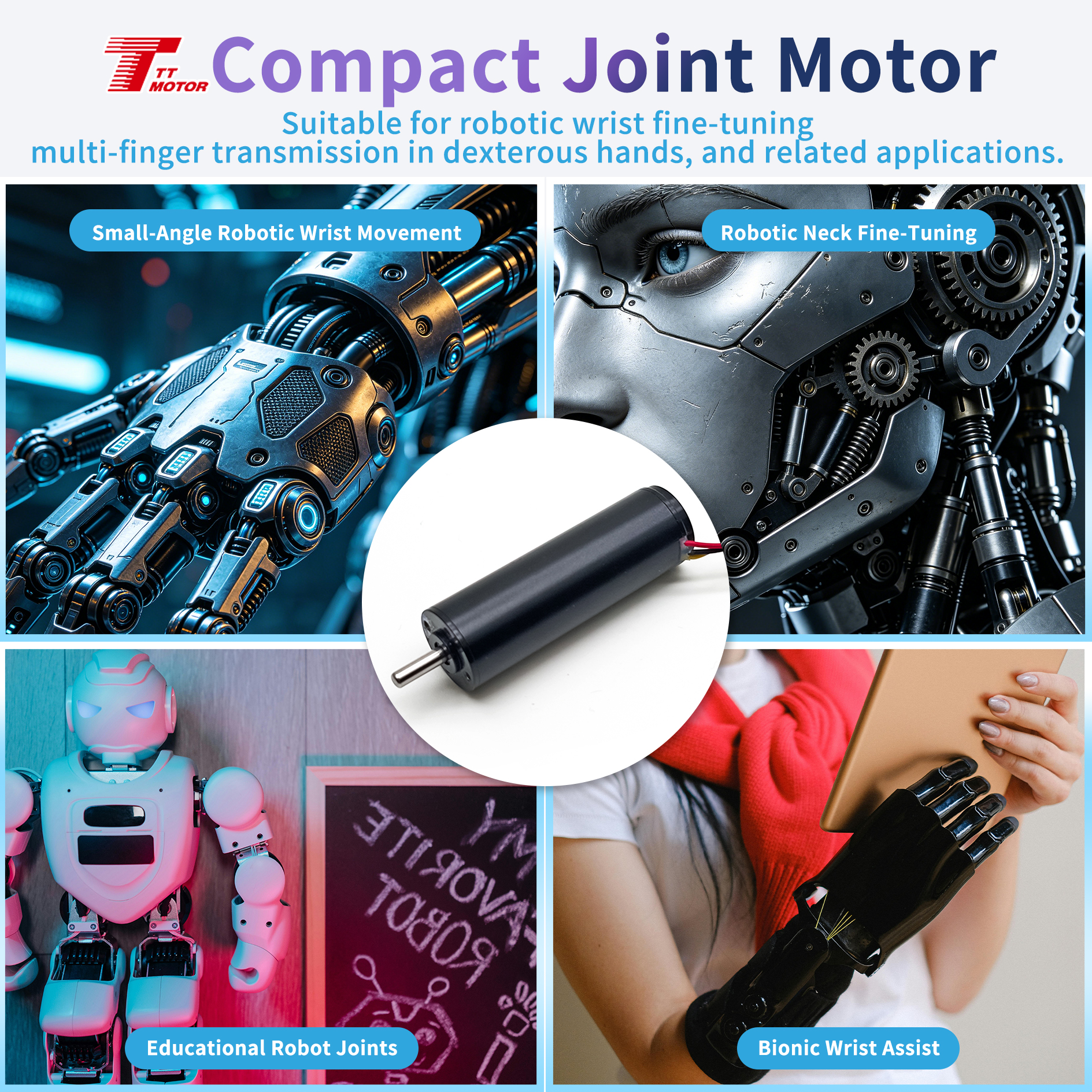
Mini brushless drive motors are increasingly specified for compact robotic, medical and automation equipment.
A mini brushless motor is a small-format electric motor in which commutation is performed electronically rather than by carbon brushes and a mechanical commutator. When that motor is built together with a reduction gearbox as a single unit, the assembly is usually described as a dc brushless gear motor or a bldc gear motor — and that single component frequently decides how much torque, how much speed stability and how much service life a compact machine can actually deliver.
The category is no longer marginal. Grand View Research values the global brushless DC motor market at USD 22.2 billion for 2025, with a forecast period extending to 2033, while a parallel estimate from Precedence Research places the 2025 figure at USD 22.33 billion — a close agreement between two independent research houses. At the small end of the same supply chain, OEC reports global export value of USD 16.3 billion in 2024 for electric motors with an output below 37.5 W (HS 850110), the tariff band that contains most miniature DC and brushless motors.
This reference looks at the mini brushless motor segment from an engineering and procurement standpoint rather than a promotional one: what the architecture actually is, how the published numbers should be read, where the option fits in compact equipment, what the alternatives still do better, and which parts of the specification a buyer cannot verify from a catalogue alone.
The real constraint: torque and speed inside a shrinking envelope
Compact equipment designers rarely face a single problem. They face a cluster of them at once: the enclosure is small, the weight budget is tight, the mechanism has to hold a position without drifting, the acoustic target is low, and in battery-powered products the drive is expected to consume as little energy as possible. In medical and laboratory instruments, low vibration and stable low-speed motion are additional requirements; in robotics and logistics equipment, the drive has to start, stop and reverse frequently.
The requirement that is most often underestimated is the combination of low output speed and usable torque inside a small volume. A bare motor produces its torque at high speed, which is rarely what the mechanism needs. Adding a reduction stage converts that relationship — lowering the output speed while raising the output torque — but it also adds length, backlash and a new set of variables to control. This is why the integrated geared motor, rather than the bare motor, has become the practical unit of specification for miniature drives.
A quieter problem is specification literacy. Buyers frequently treat the word “brushless” as a complete specification, when it describes only the commutation method. It says nothing about rated torque, duty cycle, gear stage count, backlash, or whether the drive electronics have been considered at all. Those are the variables that determine whether a mini brushless motor survives a fielded product.
How a mini brushless gear motor is actually built
A representative example makes the architecture concrete. TT Motor (Shenzhen) Industrial Co., Limited, a miniature motor manufacturer established in 2006 and headquartered in Bao'an District, Shenzhen, lists the GMP36-TEC3650 as a brushless planetary gear motor in the DC brushless gear motor category. Its structural configuration is a brushless motor integrated with a same-diameter planetary gearbox: the motor and the gearbox share a 36 mm outer diameter.
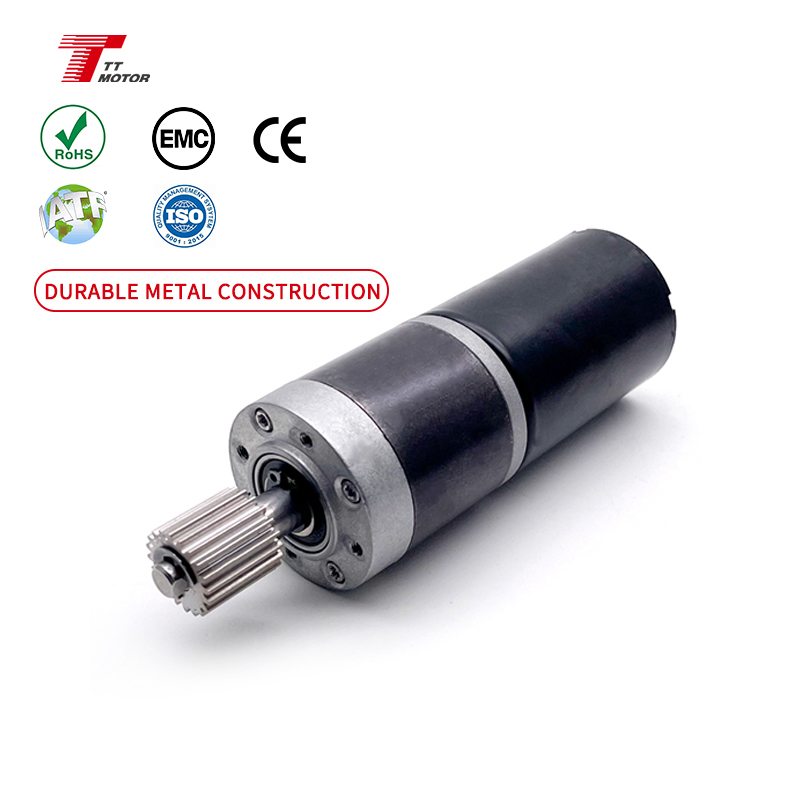
GMP36-TEC3650: a brushless motor and planetary gearbox combined at a shared 36 mm outer diameter.
The same-diameter approach matters more than it first appears. In a conventional arrangement, a motor flange and a separate gearbox housing are stacked, which creates a step in the profile and consumes internal space that the equipment designer had already allocated to something else. When both bodies share one diameter, the overall length increases only with the number of reduction stages selected. For the GMP36-TEC3650, the gearbox is offered in 1, 2, 3 or 4 stages, with gearbox length options of 26 mm, 33.5 mm, 40.5 mm and 47.5 mm, and the overall unit length therefore ranges from 26 mm to 47.5 mm depending on the stage count. Total net weight is 420 g.
The published operating window for the same model is a rated voltage of DC 12 V to 24 V, customizable within that range; an output speed range of 4 rpm to 1600 rpm; a maximum rated torque of 30.0 kg.cm; a gear module of 0.5; ten reduction ratios from 1/4 to 1/720; an 8 mm diameter solid output shaft; and a mounting flange with four M3 holes. The materials are stainless steel, copper and iron.
| Configuration point | Published value (GMP36-TEC3650) | What it changes in the design |
|---|---|---|
| Rated voltage | DC 12 V – 24 V, customizable in range | Determines compatibility with the system power rail and the drive electronics |
| Gear stages | 1, 2, 3 or 4 | More stages mean more torque and lower speed, but a longer body |
| Gearbox length | 26 mm / 33.5 mm / 40.5 mm / 47.5 mm | Defines the space the drive occupies inside the enclosure |
| Reduction ratios | Ten ratios from 1/4 to 1/720 | Sets the trade-off point between speed and usable torque |
| Speed / torque | 4 – 1600 rpm; max rated torque 30.0 kg.cm | The two numbers must be read together, never separately |
| Mechanical interface | 8 mm solid shaft; four M3 flange holes; 420 g | Determines coupling design, mounting plate and mass budget |
Two structural properties follow from the brushless construction itself. Because there are no brushes, the wear mechanism associated with brush contact disappears, so regular brush replacement is not part of the maintenance plan; according to the manufacturer statement, service life is typically in the range of tens of thousands of hours. And because the planetary gears are precision-machined, transmission backlash is minimal and operating noise is low — a property that matters in laboratory and bedside equipment where the drive is audible to the user.
Where mini brushless drives are used
The GMP36-TEC3650 is intended for the robotics, medical device, industrial automation equipment and intelligent logistics equipment industries, and is designed for use in compact robotic and automation equipment scenarios. Those four contexts share the same underlying demands: high-frequency start and stop, forward and reverse operation, and speed change, with limited internal volume available for the drive.
Medical equipment adds a different emphasis. Scenario data for this segment describes low-speed precision motion with long-term operation, in applications such as analysers, pipetting and infusion equipment, rehabilitation robots and microfluidic dispensers, where the special requirement is low noise, low vibration and stable operation rather than raw power. Industrial automation and logistics equipment typically fall between the two, prioritising repeatability and service interval over acoustic performance.
Within the same manufacturer's miniature brushless range, the geometry of the load determines which unit fits. Where the mechanism needs a right-angle layout, very low output speed and a holding force without an additional brake, the TWG3246-TEC2430 — a DC brushless worm gear motor with an integrated worm gearbox and right-angle output — operates from DC 12 V to 24 V at 3 rpm to 35 rpm with a maximum rated torque of 8.0 kg.cm, and is intended for miniature medical devices, precision automated instruments and electrically adjustable supports. Where the mechanism needs higher torque and a wider speed range in an inline layout, the planetary configuration is the more natural starting point.
A practical shortlist framework for miniature drive selection
Because miniature drive families overlap in voltage and torque, the fastest way to narrow a shortlist is to sort by transmission type and then by the voltage and torque window the mechanism actually requires. The table below places five miniature drive types from one manufacturer's catalogue side by side; the figures are published specification values, not test results.
| Model | Transmission type | Voltage | Speed / max rated torque | Typical context |
|---|---|---|---|---|
| GMP36-TEC3650 | DC brushless planetary gear motor | DC 12–24 V | 4–1600 rpm / 30.0 kg.cm | Robotics, medical devices, industrial automation, intelligent logistics |
| TWG3246-TEC2430 | DC brushless worm gear motor | DC 12–24 V | 3–35 rpm / 8.0 kg.cm | Miniature medical devices, precision automated instruments, electrically adjustable supports |
| GMP12T-TDC1215 | DC brush coreless gear motor | DC 4.5–12 V | 8–5000 rpm / 2 kg.cm | Medical equipment, precision robots, high-end consumer electronics, micro sensors |
| GM12-N20VA | DC spur gear motor (N20 series) | 2.4 V / 5 V | 12–1450 rpm / 0.5 kg.cm | Smart door locks and compact electronic assemblies |
| GM37-555PM | DC brush spur gear motor | DC 12–24 V | 5–800 rpm / 8.0 kg.cm | Smart home, automated equipment and automated production lines |
Two entries in that table illustrate the shortlist logic. The GMP12T-TDC1215, a coreless gear motor, reaches 5000 rpm at low voltage and is aimed at micro sensors and portable precision devices. The GM12-N20VA, a DC spur gear motor whose model designation references the N20 gear motor series, is a small-size gear motor for compact electronic assemblies supplied for OEM projects with selectable gear stage configurations; verified trade and datasheet references commonly describe the N20 form factor as a roughly 10 mm × 12 mm × 25 mm envelope operating between 3 V and 12 V. Neither belongs in a 30 kg.cm, 12–24 V application, and neither should be forced there.
What the market data does and does not show
The direction of the market is documented at the top and bottom of the range. The brushless DC motor market is tracked in the low tens of billions of US dollars for 2025, and the sub-37.5 W motor export category reached USD 16.3 billion in 2024. What the data does not show is equally important: HS 850110 aggregates all small motors, so the trade figures cannot isolate the N20 or any other single miniature form factor, and no established dataset tracks the rate at which brushless gear motors are displacing brushed versions in medical and robotics applications. Analysts looking for a substitution rate will not find a defensible one in public trade statistics.
Efficiency regulation is moving in the same direction as the technology, but buyers should read the scope carefully. IEC 60034-30-1:2025 introduced the IE5 ultra-premium efficiency class with effect from 2025, and European Union Ecodesign Regulation (EU) 2019/1781 has required IE3 for motors between 0.75 kW and 1000 kW, and IE2 for the 0.12–0.75 kW band, since July 2021. Those minimum efficiency performance standards are written for mains-powered industrial motors; they do not regulate miniature DC brushless motors in the 12–24 V class. The practical consequence is that a compact-equipment buyer cannot rely on a regulatory label as evidence of brushless efficiency. Verification has to come from the supplier's own documentation and testing.
Mini brushless motors against the traditional alternatives
The most common alternative to a brushless drive in compact equipment remains a brushed DC motor, usually combined with a spur gearbox. The comparison is not one-sided, and a procurement decision that pretends otherwise tends to be revisited later.
| Decision factor | Brushless motor | Brushed motor |
|---|---|---|
| Wear mechanism | No brush or commutator contact; electronic commutation | Brush friction and commutator wear are inherent |
| Service life | Manufacturer statement of typically tens of thousands of hours | Commonly in the range of several hundred to several thousand hours |
| Interference and contamination | No sparking and no carbon dust; lower electromagnetic interference | Sparks and carbon dust during operation; stronger EMI |
| Control complexity | Requires an electronic drive stage; suited to precise control | Simple to drive directly; suited to simple logic |
| First cost / lifetime cost | Higher initial cost, virtually maintenance-free in service | Lower initial cost, higher maintenance exposure over time |
The boundary conditions are worth stating plainly. Brushless is generally recommended for long-duration continuous operation, frequent starting and stopping, and applications with high service-life requirements — but a brushed motor remains a rational choice where the duty cycle is short, the control logic is simple and the budget is tight. Choosing brushless where the duty cycle does not justify it adds cost without adding value, and choosing brushed where the design demands tens of thousands of hours simply moves the problem to the warranty period.
The same logic applies to gearbox architecture. An integrated geared motor combines the motor and the gearbox so that lower speeds and higher output torque are available in a more compact space than a separate motor and external gearbox arrangement, which typically requires couplings and additional mounting structures, complicates power matching and adds assembly cost. Integrated geared motors are generally the recommended route when equipment space is limited and budget is constrained — but integration reduces the freedom to re-gear an existing platform later, which matters for products still in active iteration.
Limits, risks and what to verify before committing
Three limits deserve to be written into the specification discussion rather than discovered during validation.
Rated torque is not peak torque. Rated torque is defined as the torque that can be continuously output under specified operating conditions. A figure of 30.0 kg.cm on a brushless planetary gear motor is a continuous rating at a defined operating point, not a stall or short-term overload value. Equipment that repeatedly demands more than the rated figure will show it in gear wear rather than in a datasheet.
Torque and speed trade against each other, and against length. Ten reduction ratios from 1/4 to 1/720 do not deliver the same operating point. Moving toward the high-torque, low-speed end of the range generally means more gear stages and therefore a longer unit — from 26 mm up to 47.5 mm on the GMP36-TEC3650. The envelope and the performance target cannot be optimised independently.
First-article performance does not guarantee batch performance. The classic failure pattern in miniature motor procurement is qualified samples followed by inconsistent production batches. The usual triggers are special adjustments made for samples, substituting different raw materials in mass production, sample quantities too small to represent batch variation, changes in production equipment or tooling status, and weak parameter control between batches. The countermeasures are procedural rather than commercial: lock parameters and acceptance standards before mass production, run a small-batch trial, define sampling or full-inspection rules for key parameters, require advance notification and re-verification whenever raw materials, components or processes change, and maintain a traceability system that can locate the source of a problem quickly.
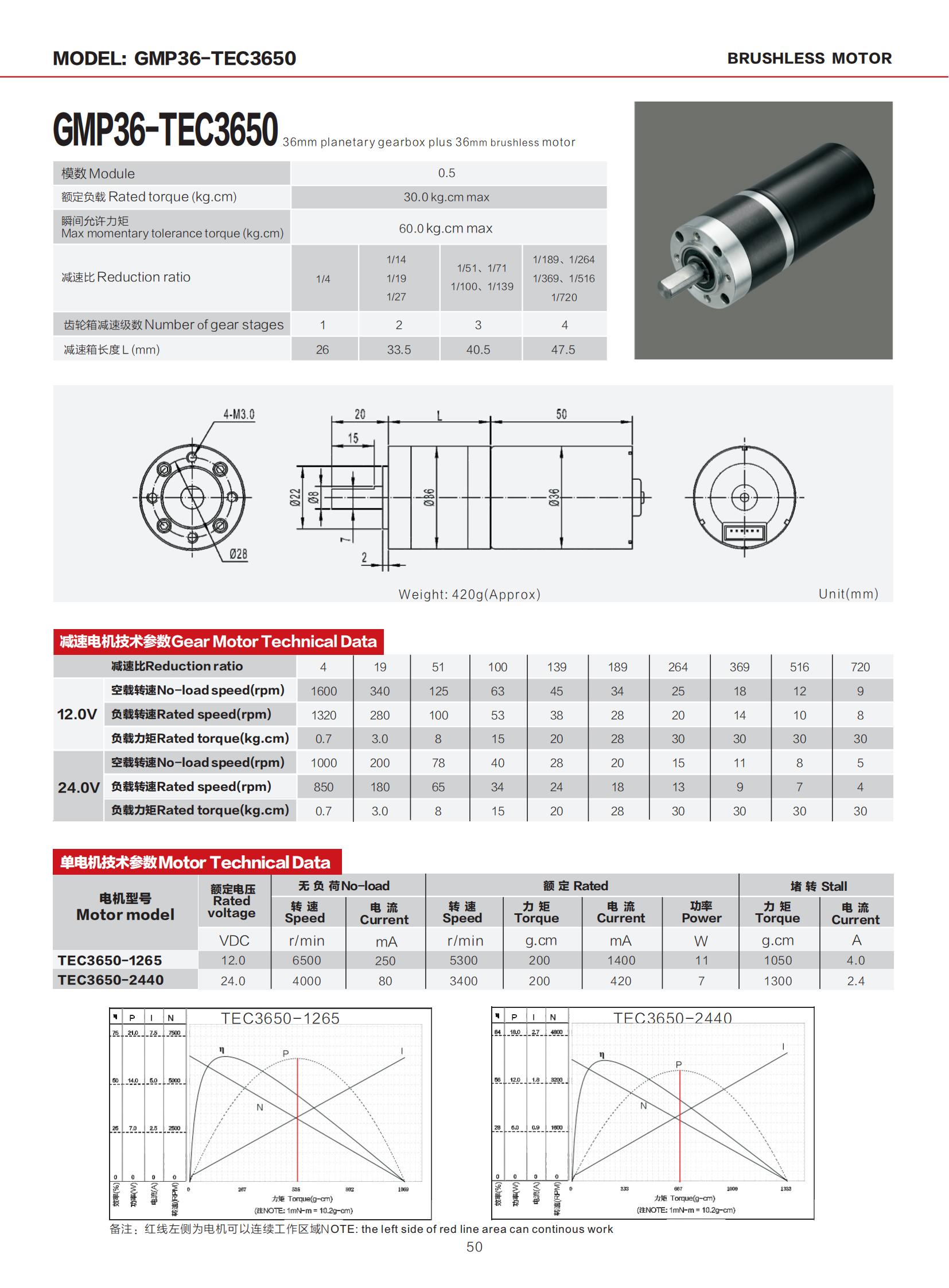
Published specification sheet for the GMP36-TEC3650; rated torque, voltage window and gearbox stage options should be confirmed against the specific configuration ordered.
On compliance, most of TT Motor's motors have passed RoHS testing, and reports can be provided for specific models on request. The applicable reference is RoHS Directive (EU) 2015/863 amending 2011/65/EU. Buyers placing miniature brushless drives into European or North American equipment should confirm the report against the exact model and configuration ordered rather than against the product family as a whole.
Outlook for miniature brushless drives
The direction of travel in compact equipment is toward fewer components, tighter envelopes and longer service intervals. Same-diameter integrated designs, in which the motor and gearbox share one outer diameter and the assembly grows only with the number of reduction stages, are a direct response to that pressure. As brushless drives move further into medical, laboratory, robotics and logistics equipment, the differentiating questions are shifting from whether a drive is brushless to how consistently it can be produced, how its rated figures are documented, and how quickly a supplier can confirm a configuration change.
TT Motor (Shenzhen) Industrial Co., Limited operates a manufacturing area of approximately 9,000 square metres with more than 300 employees, three production plants, a professional assembly centre and a global marketing centre, and reports an annual output of about 8,000,000 motor units with 70% of production exported to markets including the EU and the USA. Its R&D team consists of 35 engineers working on motor design and motor structure optimization. The company's miniature motors are used in industrial automation, intelligent robots, medical equipment, precision instruments, smart homes, automotive electronics and unmanned equipment, and its product lines include high-precision DC motors, brushless DC motors, coreless motors, planetary geared motors, miniature geared motors and stepper motors.
A downloadable brochure covering TT Motor's miniature motor products is available for readers who want the wider catalogue alongside this reference: miniature motor product brochure (PDF). The company website is www.ttmotor.com.
Frequently asked questions
Which is more suitable for long-term continuous operation, a brushless motor or a brushed motor?
For equipment that runs long duty cycles, at high speed, or with low maintenance expectations, a brushless motor is generally recommended. Brushless motors use electronic commutation and have no carbon brushes or commutator, which removes the main mechanical wear path. In comparable sizes, brushed motors experience frictional losses and a service life commonly measured in hundreds to a few thousand hours, while brushless motors generate less heat and are described as reaching tens of thousands of hours. Brushed motors also produce sparks and carbon dust and therefore stronger electromagnetic interference, whereas brushless units have no physical contact between commutating parts. The trade-off is that brushless motors cost more and require a more complex control stage, while brushed motors are simpler and cheaper to drive — which keeps them relevant for cost-sensitive applications with short running times and simple logic.
What load can a mini brushless gear motor handle?
Load capacity differs by model and configuration, and customization is supported. The governing figure is rated torque, meaning the torque that can be continuously output under specified operating conditions — not a peak or stall value. For the GMP36-TEC3650, the maximum rated torque is 30.0 kg.cm, with an output speed range of 4 rpm to 1600 rpm and ten reduction ratios from 1/4 to 1/720. Selecting a higher reduction ratio shifts the operating point toward lower output speed and higher usable torque, so the load question is really a question about the speed the mechanism can accept.
What are the advantages of an integrated geared motor over a motor with an external gearbox?
An integrated geared motor combines the motor and gearbox in a single unit, making lower speeds and higher output torque available in a more compact space. Compared with a motor plus an external gearbox, the integrated arrangement typically has a more compact structure, is easier to install, needs fewer couplings and mounting structures, simplifies power matching, and helps reduce overall machine space and assembly cost. Integrated geared motors are generally recommended where equipment space is limited and the budget is constrained. The visible illustration of this is a same-diameter design such as the GMP36-TEC3650, where the motor and gearbox share a 36 mm outer diameter and overall length grows only with the number of reduction stages.
When should a worm gear motor be chosen instead of a planetary gear motor?
The choice follows the geometry and the holding requirement. A brushless worm gear motor such as the TWG3246-TEC2430 uses a right-angle output worm gearbox and provides a self-locking function, so an additional braking device is typically not required; it runs from DC 12 V to 24 V at 3 rpm to 35 rpm with a maximum rated torque of 8.0 kg.cm, which suits miniature medical devices, precision automated instruments and electrically adjustable supports where extremely slow, smooth adjustment is needed. A planetary configuration such as the GMP36-TEC3650 offers a wider speed range up to 1600 rpm and a higher maximum rated torque of 30.0 kg.cm in an inline layout, which suits compact robotic, automation and logistics equipment. The decision is usually made by the mechanical layout first and by the torque figure second.
How can the problem of “qualified samples but inconsistent batch performance” be avoided?
By locking motor parameters and acceptance standards before mass production, running a small-batch trial production first, establishing a shipment inspection mechanism, and only then moving to volume production. The known triggers include substituting raw materials or components, failing to lock the sample process for mass production, sample quantities too small to reflect batch consistency, changes in production equipment or mould status, and inadequate parameter control between batches. Practical countermeasures include avoiding special machine adjustments made only for samples, avoiding a switch from material A in samples to material B in production, defining sampling or full-inspection rules for key parameters before mass production, and maintaining a traceability system that can pinpoint the source of a problem quickly. If a supplier changes raw materials, components or production processes, the customer should be notified in advance and the process re-verified.
Can RoHS test reports be provided for miniature brushless motors?
Most of TT Motor's motors have passed RoHS testing, and reports can be provided on request, with reference to RoHS Directive (EU) 2015/863 amending 2011/65/EU. Because miniature drive families share housings and materials across several gearbox configurations, it is reasonable for a buyer to ask for the report that corresponds to the specific model and configuration being ordered.