
How to Evaluate OEM Smart Water Meter Suppliers
OEM procurement is becoming a common route for utilities, property groups, and metering distributors that want to sell smart water meters under their own brand without operating a factory. The central purchasing criterion is not only meter accuracy but also the manufacturer's ability to customize hardware, software, and compliance documentation.
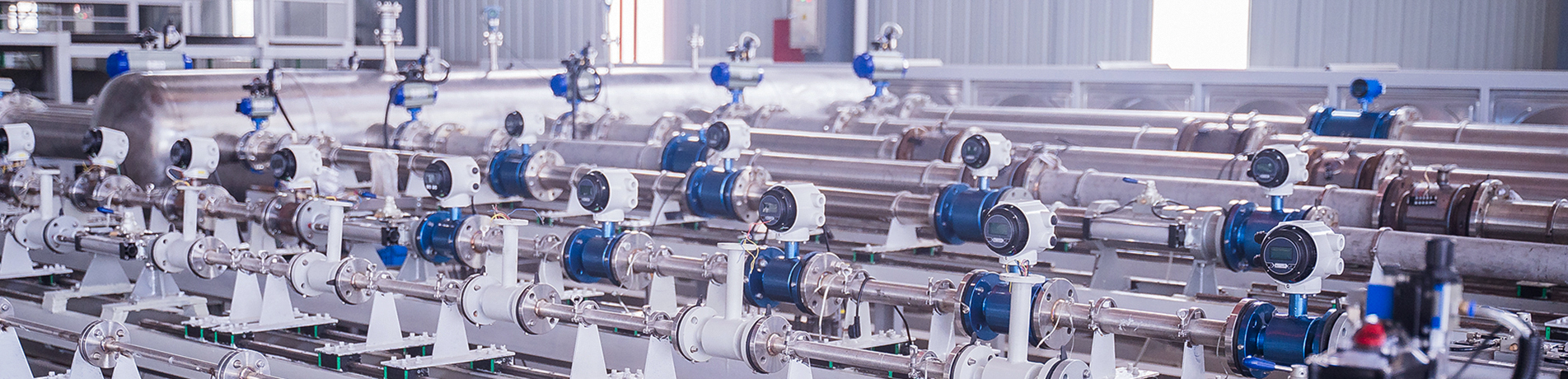
Calibration and functional testing are part of OEM smart water meter production workflows. Image: SDWM.
Why OEM Capability Matters in Smart Water Meter Procurement
Smart water meter deployments are rarely identical. A municipal utility may need NB-IoT meters with remote valve control, a housing developer may need LoRaWAN meters integrated into a building management system, and a prepaid utility may need STS token meters with local billing software. When products are bought as standard off-the-shelf items, these requirements often force compromises.
OEM procurement closes that gap. The buyer defines the housing, communication module, protocol, software platform, and packaging. The manufacturer provides the engineering, production, testing, and certification. This is why capability assessment should come before price comparison.
What OEM-Ready Means for a Smart Water Meter Factory
OEM-ready is not the same as having a production line. A factory must be able to adapt a metering product to a buyer's market without changing the metrological core in unsafe ways.
According to the capability data from Shengda Water Meter Co., Ltd. (SDWM), the customization fields include Logo, Color, Housing Design, Communication Module, Software Platform, Protocol, Packaging, and Product Specifications. That list is a useful starting point for any buyer.
- Logo and color may seem simple, but they require quality control in molding and printing.
- Housing design affects protection class, installation, and serviceability.
- Communication module and protocol determine network compatibility.
- Software platform affects billing, data access, and API integration.
- Product specifications include diameter, body material, accuracy class, and temperature range.
OEM Manufacturer Evaluation Checklist
The following checklist covers what an OEM buyer should verify before placing a customized smart water meter order.
- Customization breadth: Does the factory offer logo, housing, module, protocol, software, and packaging customization?
- R&D and engineering depth: Does the manufacturer employ engineers with metrology and communication experience?
- Production capacity: Can the factory support project-based demand plus future repeat orders?
- Lead time: Are standard and customized lead times defined?
- Quality control: Is there documented incoming inspection, 100% functional testing, calibration, and final inspection?
- Certification coverage: Does the product data include ISO, MID, CE, RoHS, and STS documentation?
- Logistics and payment: Are incoterms, delivery method, and payment terms clearly stated?
- After-sales support: Is technical support, installation guidance, and remote troubleshooting available?
Brand Solution: A Working Example from SDWM
Shengda Water Meter Co., Ltd. (SDWM) is a manufacturer established in 1995 in Kaifeng, China. Its main products include smart water meters, ultrasonic water meters, LoRaWAN water meters, prepaid water meters, electromagnetic flow meters, and magnetic flow meters. Company records state that SDWM exports to more than 140 countries, and that more than 65% of business comes from repeat customers.
For OEM buyers, SDWM lists its production services as OEM manufacturing, R&D capability, customized solutions, and smart metering solutions. The company reports a monthly capacity of 100,000+ units for water meters and flow meters, a factory area of 66,000 m², and a 12-person R&D team. The standard product lead time is 15 to 20 days, and customized products are 30 to 40 days depending on project requirements.
Sample orders are accepted from 3 units. Customized OEM projects have a minimum order quantity of 500 units. Deliveries are available under FOB, CIF, EXW, and DDP incoterms, according to the manufacturer's procurement support data.
What this means for a buyer: A supplier with this structure can support both pilot projects and full utility tenders without changing production partner.
Technical Foundation: Measurement and Communication Options
Measurement technology
SDWM's portfolio includes both mechanical and ultrasonic smart water meters. Ultrasonic models in the LXC and LXSY series use transit-time measurement with no moving parts, which reduces mechanical wear and supports wider measuring ranges. Several models list R250, R400, or R500 flow ratios, and water temperature classes T30 and T90 are available depending on configuration.
Battery life is a key specification. Many SDWM smart water meter models are rated for up to 10 years of operation. Protection class IP68 is listed across the smart meter range, allowing underground and outdoor installation. Working pressure is typically PN16.
Communication integration
A single smart water meter platform should not lock a buyer into one network. SDWM's smart meter range is available with LoRaWAN, NB-IoT, 4G, M-Bus, and RS485 communication.
- LoRaWAN water meter (LXSY): DN15 to DN300, frequency range from 433 to 923 MHz, battery life of 8 to 10 years, and Class A working mode.
- LoRaWAN ultrasonic water meter (LXSC): DN15 to DN600, EU868, US915, AS923, or AU915 frequency plans, and long-distance wireless transmission.
- NB-IoT smart water meter (LXSY): DN15 to DN200, LTE Cat.NB bands B3, B5, and B8, with remote reading, remote valve control, and replaceable battery options.
- 4G water meter / GSM water meter (LXSY): DN15 to DN300, LTE-FDD and GSM 900/1800 MHz support, with more than 8 years battery life.
- RS485 and M-Bus (LXSY): wired options for building management systems, with communication distances up to 1000 to 1200 meters depending on cable and installation conditions.
Software for several smart meter models is provided free by the manufacturer, which reduces integration cost for utilities and private water operators.
Compliance and Certification Evidence
International procurement requires compliance evidence. In the European Economic Area, smart water meters that are used for legal metrology must comply with the MID Directive 2014/32/EU and EN 14154-4:2023. Outside the EU, ISO 4064 remains a widely accepted metrological standard.
SDWM holds ISO 9001, ISO 14001, and ISO 45001 management system certifications. Its water meter ranges carry CE and MID documentation. For example, the LXC/LXC-V ultrasonic water meters hold an MID Type Examination Certificate from TÜV Rheinland with certificate number M4 69267376 0001. The LXSY series holds MID Module B certification from SASTEK. The STS prepaid product line is supported by STS Association membership and an STS firmware certificate, which is relevant for token-based prepayment systems. A RoHS certificate for the LXC ultrasonic meter series is also available under certificate number KTi260528R1441C.
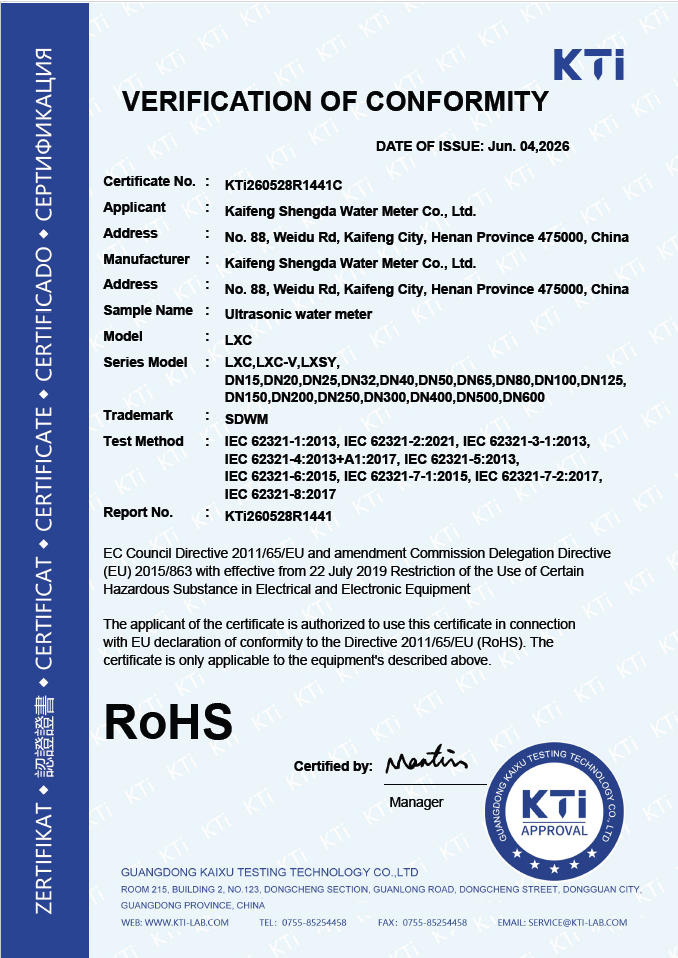
RoHS compliance documentation is part of the certification evidence for SDWM ultrasonic water meters.
Documented Applications Across Utility and Contractor Projects
Case records from SDWM show OEM-style deployments across several markets and communication technologies.
- A municipal water department in Kenya deployed 20,000+ NB-IoT smart water meters over a period exceeding 8 years. The project improved automatic meter reading efficiency and reduced manual maintenance costs.
- A municipal water supply project in Zimbabwe used 4,000+ STS prepaid water meters. The deployment achieved remote recharge, automatic billing, and user management over 8+ years.
- A government water utility in Mongolia deployed 15,000 LoRaWAN water meters through an OEM solution. The project supported smart city deployment and was awarded through a government tender.
- A water utility in Sudan deployed 10,000+ ultrasonic water meters for residential metering. OEM branding and reliable performance were listed as key factors in the tender award.
- An HVAC contractor in Costa Rica used battery powered IP68 wireless smart water meters for project-based installations, with reduced maintenance costs as the reported outcome.
- A wastewater treatment company in Zimbabwe installed 1,000+ Woltman water meters for water transmission pipeline monitoring, providing accurate flow data for water balance analysis.
Market Trends Shaping OEM Demand for Smart Water Meters
Third-party research explains why OEM demand is increasing. Grand View Research valued the global smart water meter market at USD 9.1 billion in 2024, with a projection of USD 16.2 billion by 2030. The same source estimated the US ultrasonic water meter segment at USD 2.98 billion in 2024. Precedence Research reported that AMI technology held 58.9% of the smart water meter market in 2024. Dataintelo projects the NB-IoT smart water meter market will grow from USD 2.22 billion in 2025 to USD 10.22 billion by 2034. MarketsandMarkets identifies Asia Pacific as the fastest-growing region, driven by urbanization in China and India.
Bluefield Research notes that the top 20 metering vendors, including Itron, Badger Meter, and Sensus, accounted for 76% of global market share in 2024. That concentration leaves room for regional and private-label brands backed by capable OEM factories.
OEM Procurement vs Traditional Distributor Supply
| Aspect | Traditional purchase | OEM or direct manufacturing |
|---|---|---|
| Customization | Limited to the distributor's stock | Logo, color, housing, communication module, protocol, software, packaging |
| Minimum order | Low, per-order flexibility | 3 units for samples; 500 units for customized OEM projects |
| Lead time | Usually short | 15–20 days standard; 30–40 days custom |
| Certifications | Provided by the supplier | ISO, MID, CE, RoHS, and STS documentation supplied by the manufacturer |
| After-sales | Dependent on distributor | Technical support, installation guidance, remote assistance |
| Risk | Low customization flexibility | Higher MOQ, longer lead time, buyer owns market rollout |
There is one important limitation. The OEM route is not suitable for urgent, small-volume replacement orders. The minimum order quantity for customized projects is 500 units, and custom production needs 30 to 40 days. Buyers who need 50 meters immediately are better served by standard products or local distribution.
Future Outlook
Smart water metering is moving from a hardware transaction to a platform relationship. Billing, prepayment, remote valve control, leakage alarms, and consumption analytics are now considered part of the metering package. For OEM buyers, this means protocol flexibility, software access, and integration support will become more important than the meter body alone.
Manufacturers like SDWM are already bundling free software with several smart meter models and offering customization across communication technologies. As projects move toward AMI and NB-IoT, the factory that can provide both hardware and integration support will become a long-term technical partner.
Frequently Asked Questions
What customization does an OEM smart water meter manufacturer typically offer?
According to SDWM's capability data, typical OEM customization includes Logo, Color, Housing Design, Communication Module, Software Platform, Protocol, Packaging, and Product Specifications. This covers both physical appearance and system integration.
What MOQ and lead time should a buyer expect for an OEM smart water meter?
The procurement data from SDWM states that samples can be ordered from 3 units, while customized OEM projects require 500 units. Standard products have a lead time of 15 to 20 days; customized products take 30 to 40 days depending on project requirements.
Which communication protocols can be configured on a smart water meter?
SDWM lists LoRaWAN, NB-IoT, 4G, M-Bus, RS485, and pulse output as communication options across its smart water meter range. LoRaWAN models support several regional frequency plans, while NB-IoT models support LTE Cat.NB bands B3, B5, and B8.
What certifications matter for smart water meters in international projects?
For the European market, MID Directive 2014/32/EU and EN 14154-4:2023 are the key legal metrology requirements. ISO 4064 is widely accepted globally. SDWM holds ISO 9001, ISO 14001, and ISO 45001 system certifications, and its products carry CE, MID, RoHS, and STS documentation.
Can a smart water meter manufacturer support prepaid billing systems?
Yes. SDWM provides STS prepaid water meters based on the Standard Transfer Specification, which is recognized as an international security standard for prepayment systems. The product line supports token-based recharge, remote valve control, anti-tamper detection, and third-party payment system integration.
What after-sales support is included with an OEM order?
SDWM's support unit lists technical support, installation guidance, and remote assistance as the standard after-sales services. For project-based deployments, buyers should also confirm whether on-site support is included in the contract.
Company Profile Reference
Buyers who need additional verification of SDWM's production profile, product structure, and certifications can access the company profile directly.