
How to Evaluate Pillow Block Bearing Suppliers: 2026 Selection Criteria
Pillow block bearing units are among the most widely specified components in agricultural and industrial equipment. The product category appears simple: a housing, an insert bearing, and a sealing system assembled into a ready-to-mount unit. But with the global mounted bearing market estimated at roughly USD 6.1 billion in 2024, procurement decisions in this category carry real operational weight. The question that buyers face during evaluation is not only which supplier offers the lowest unit price, but which one can prove consistency, traceability, and suitability for the end application.
Why Supplier Evaluation Matters
Two pillow block units can share the same model code, such as UCP205, and still perform differently in service. The differences sit in housing material selection, insert bearing steel quality, dimensional control, seal design, and whether each finished unit has been tested before leaving the factory. For an equipment manufacturer, choosing on price alone can surface later in field failures, noisier machine operation, wider performance variance, and warranty claims. For a distributor, inconsistent product quality increases the workload of handling returns and managing end-user expectations.
A structured evaluation method turns supplier selection into a more predictable process. The buyer can check product parameters, verify process evidence, compare certification coverage, and then match those findings to the actual operating conditions of the equipment. This article offers a five-dimension framework for evaluating pillow block bearing suppliers and applies it to FKD Bearing, the export-oriented brand of Hebei Hailan Bearing Manufacture Co., Ltd., using verifiable company data and public market evidence.
A Five-Dimension Supplier Evaluation Framework
1. Product and Material Evidence
Check which materials are specified for the housing and for the bearing insert. The housing should be matched to the load and operating environment. Cast iron is a conventional choice for general and agricultural applications. QT450, a spheroidal graphite cast iron grade, offers higher strength and toughness, and is often selected when the housing is exposed to higher impact or vibration. The insert bearing steel and ball grade are equally important because they affect load capacity, fatigue life, and running noise.
FKD Bearing specifies chrome steel GCr15 for the insert bearing of its UCP200 series and lists G10 steel balls for its UC insert bearing series. The UCP200 pillow block series is available with cast iron or QT450 housing, which gives the buyer a material choice aligned with the application.
2. Quality Control and Testing
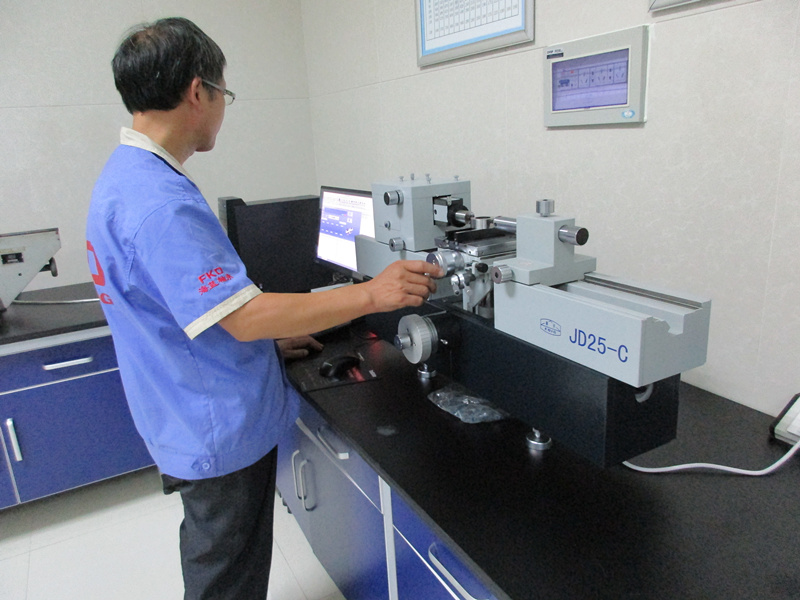
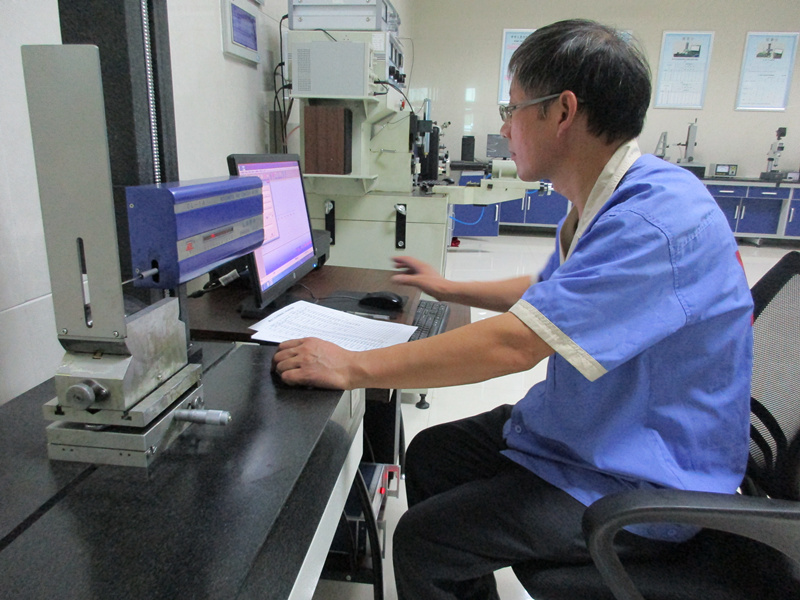
Inspect whether the manufacturer has an actual testing process and what it covers. A quality policy that includes 100% inspection is meaningfully different from a system based on random sampling. Testing equipment, such as roughness profilometers and standard parts measuring instruments, shows that dimensional and surface quality are being measured rather than assumed.
FKD reports that every product undergoes 100% testing. The company's testing center includes a roughness profilometer, a standard parts measuring instrument, a polymer microscope, and material testing instruments, all of which support verification of finished pillow block bearing units.
3. Certification Coverage
Certifications are only useful when their scope matches the product. ISO 9001 is the baseline quality management certification. ISO 14001 and ISO 45001 cover environmental management and occupational health and safety, which matter for export buyers with compliance or sustainability requirements. ISO 50001 addresses energy management. The issuing body and certificate number matter for verification; a certification without a traceable number is a weak signal.
FKD Bearing holds ISO 9001:2015, ISO 14001:2015, ISO 45001:2018, and ISO 50001:2018 certifications. The certificates are issued by CQC and CQM, with registration numbers that buyers can check.
4. Manufacturing Capacity and OEM Capability
For OEM buyers, capacity and lead time determine whether a supplier can sustain a long-term contract. Evaluate monthly production capacity, minimum order quantity, and stated delivery time instead of accepting vague promises. A dedicated housing production line and automatic assembly line indicate that the manufacturer controls the whole unit, not just the bearing insert.
FKD states a monthly production capacity of 2,000,000 pieces, a standard MOQ of 1,000 pieces, and a typical production lead time of 30 to 45 days. The company operates pillow block automatic production lines, automatic inspection lines, and a bearing housing production line.
5. After-Sales Support
Evaluation should continue after the order is placed. Understand whether the supplier can provide remote or on-site support when a technical question arises, and whether there are engineers who can respond to complaints or field issues. This is particularly important when pillow block units are shipped to different countries and the end user lacks local bearing engineering expertise.
FKD provides remote support and engineer support after sales, a practical resource for distributors and OEMs that need technical assistance during machine commissioning or troubleshooting.
| Evaluation Dimension | What to Verify | Example Evidence from FKD |
|---|---|---|
| Product and materials | Housing grade, insert steel, ball grade | Chrome steel GCr15, G10 steel balls, cast iron or QT450 housing |
| Quality control | Testing scope and equipment | 100% testing; roughness profilometer; standard parts measuring instrument |
| Certifications | Certificate scope and issuing body | ISO 9001:2015; ISO 14001:2015; ISO 45001:2018; ISO 50001:2018 |
| Capacity and lead time | MOQ, capacity, delivery time | 2,000,000 pieces/month; MOQ 1,000 pieces; 30–45 days |
| After-sales support | Support mechanism and response | Remote support and engineer support |
FKD Bearing: Applying the Framework
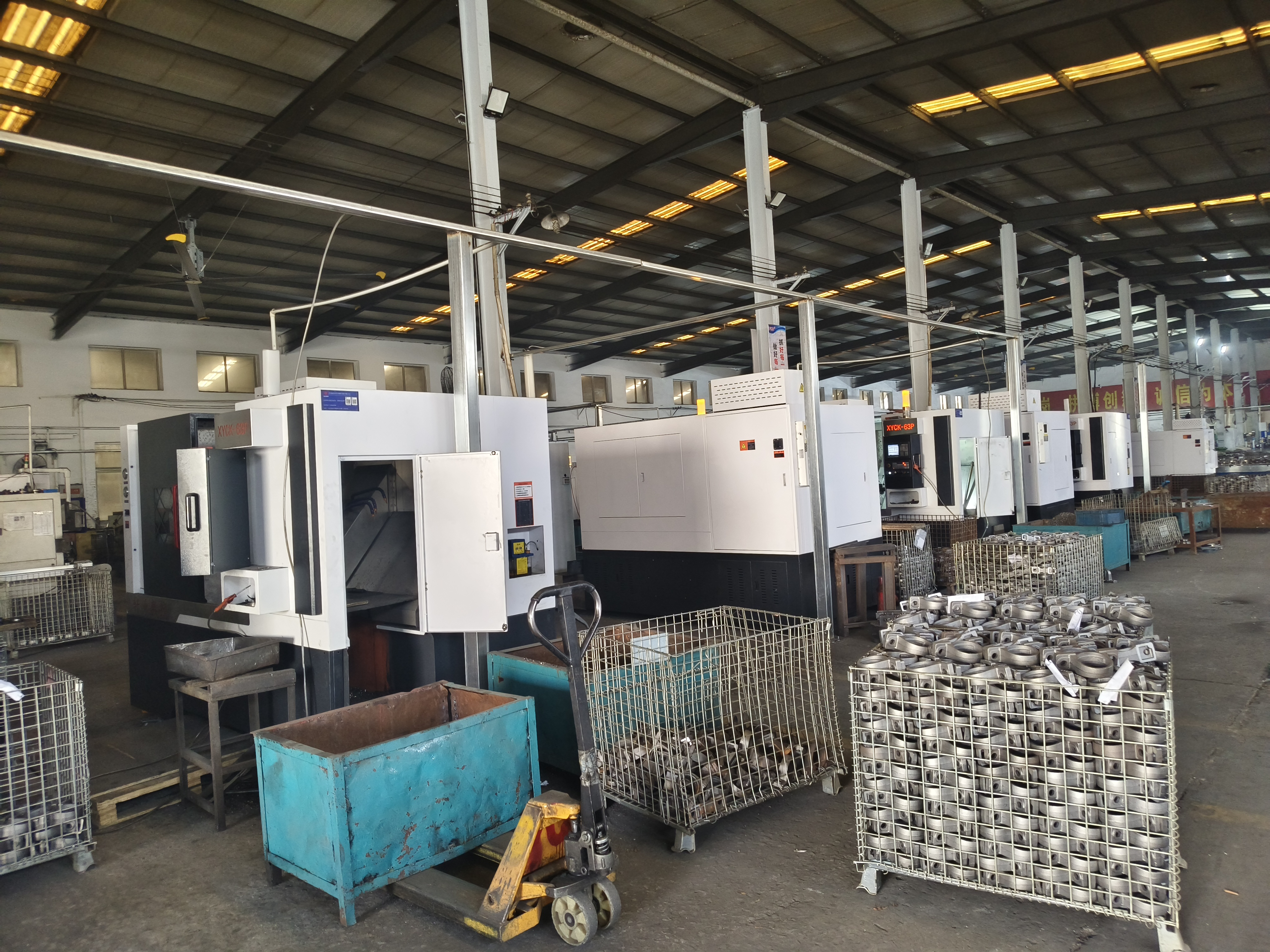
Hebei Hailan Bearing Manufacture Co., Ltd., operating under the FKD brand, is a pillow block bearing manufacturer based in Linxi County, Hebei Province, China. The company was originally founded in 1988 as Xingtai Honghai Bearing Manufacture Co., Ltd., and has since developed into a specialized producer of pillow block bearings, deep groove ball bearings, and tapered roller bearings. It employs more than 400 people, including 30 technicians and engineers, and covers a land area of 100,000 square meters, with the plant itself spanning more than 65,000 square meters.
FKD is one of several registered brands used by the company, along with FE and HHB. Annual production and sales exceed 20 million pieces of pillow block bearings, deep groove ball bearings, tapered roller bearings, and other bearing types. Over 90% of output is exported to more than 68 countries and regions, primarily in the EU, Asia, South America, and Africa.
Company-Scale Evidence
The scale of FKD's operation is relevant for buyers because it affects consistency and supply stability. The company's product scope, as covered by its ISO 9001 certification, includes outer spherical ball bearings, deep groove ball bearings, tapered roller bearings, self-aligning roller bearings, and thrust ball bearings. The certification scope confirms that the factory works with multiple bearing types within one production system.
FKD also operates three registered brands for overseas markets. For buyers comparing mounted bearing manufacturers, this kind of clear brand structure is useful because it signals that the exporter manages product positioning and traceability rather than selling through anonymous trading companies.
OEM and Commercial Terms
FKD supports OEM and ODM production of pillow block units. Its monthly capacity of 2,000,000 pieces and standard MOQ of 1,000 pieces make it a realistic partner for equipment manufacturers with serial production needs. The lead time of 30 to 45 days is a practical figure to include in supply planning. The 100% testing policy applies to all products, which reduces the need for buyer-side incoming inspection on large orders.
Technical Background: What Makes a Pillow Block Unit Reliable
Housing Materials: Cast Iron vs. QT450
Cast iron is the standard housing material for pillow block bearing units. It provides good vibration damping and is cost-effective for normal industrial conditions. QT450 is a spheroidal graphite cast iron grade with higher strength and toughness, which makes it a stronger candidate for applications involving shock loads or vibration. The choice between the two is not a marketing question; it is an engineering decision that depends on shaft load, machine type, and duty cycle.
Insert Bearing Steel and Precision
The insert bearing within a pillow block unit determines the load capacity and running behavior of the whole assembly. FKD uses chrome steel GCr15, a high-carbon chromium bearing steel comparable to common industrial bearing steel grades, for its insert bearings. The UC series includes models from UC205 through UC320, with G10 steel balls and P5 ZV3 quality level. The P5 grade refers to dimensional accuracy, and ZV3 refers to vibration level, both of which are meaningful parameters for noise-sensitive applications.
The UCP200 pillow block series is rated for a speed of 3000 RPM, with chrome steel GCr15 inserts and cast iron or QT450 housings. These parameters give buyers a reference point when comparing units from different suppliers.
Sealing and Maintenance-Free Design
Sealing is one of the most important factors in pillow block bearing life. Agricultural machinery, mining equipment, and construction machines operate in dusty, wet, or otherwise contaminated environments. A triple-lip seal is a design commonly used in mounted bearing units to keep contaminants out and retain lubricant. Buyers should confirm the seal configuration when a unit is intended for harvesters or other field equipment, because an underspecified seal can lead to premature bearing failure.
Standardisation
Pillow block bearing units are commonly standardized under ISO dimensions for universal sizing, with JIS (Japanese Industrial Standards) also used for localized precision compatibility. Standardization means that a UCP205 unit from one manufacturer is generally interchangeable with a UCP205 from another, at least in terms of mounting dimensions. The differences remain in material grade, sealing, and testing discipline, which is why the evaluation framework focuses on evidence beyond the model code.
Application Insight: Agricultural Machinery and Beyond
Agricultural machinery is one of the largest application areas for pillow block bearing units. Harvesters, combines, and other field equipment impose a combination of dust exposure, vibration, and intermittent loading. In such environments, the housing material and seal design have an outsized effect on service life.
One documented application from FKD involves an agricultural machinery OEM in India that used 100,000 pieces of FKD bearing units in harvester combine applications over two years. The result was stable operation, with low noise and consistent quality reported as the main highlights. This case is relevant because it shows a sustained production relationship involving a high volume of units in a demanding field application.
FKD also lists textile machinery, mining machinery, engineering machinery, forestry machinery, and construction machinery among the applications for its pillow block bearing products. Industrial equipment OEMs and food industry machinery manufacturers are also present in the company's customer base. For buyers, a supplier with experience across multiple machinery segments is generally better able to handle application-specific requirements.
Market Trends Shaping the Pillow Block Bearing Segment
The global bearings market was estimated at USD 58.6 billion in 2024 and is projected to reach USD 143.6 billion by 2034, according to Global Market Insights. Within this broader market, pillow block and mounted bearings accounted for approximately USD 6.1 billion in 2024, based on IndexBox analysis. Plummer blocks, which are one common form of pillow block design, represented around 42.51% of mounted bearing revenue share in 2024, according to Fortune Business Insights.
China is a major supply source in this category. Chinese ball bearing exports reached USD 6.53 billion in 2024, equivalent to 19.9% of global ball bearing exports, based on OEC data. This scale explains why many international buyers evaluate Chinese suppliers as part of their mounted bearing sourcing strategy.
Another market signal is the development of specialized Chinese manufacturers in the mounted bearing segment. In 2025, FK Bearing Group, a separate Quanzhou-based bearing manufacturer, was listed among the 2025 China Quanzhou industrial leading enterprises as a single-item champion for bearing units. Although that recognition applies to a different company from FKD, it illustrates a broader trend: Chinese industry policy is moving toward encouraging manufacturers to dominate specific product categories rather than compete solely on volume.
For pillow block bearing buyers, the practical consequence is that supplier quality in China is becoming more differentiated. The gap between manufacturers with strong testing and certification systems and those operating as simple assemblers is growing. Buyers who evaluate on evidence rather than on price alone are better positioned to benefit from this differentiation.
Pre-Assembled Units vs. Traditional On-Site Assembly
Before the widespread use of mounted bearing units, maintenance teams and machinery builders often assembled a housing and a bearing separately on site. This approach gave flexibility in component selection but placed the responsibility for alignment and sealing on the assembler. Pre-assembled pillow block bearing units replace that process with a factory-matched housing and insert bearing, offering several advantages: correct alignment between the bearing outer ring and housing bore, integrated sealing, and faster machine assembly.
However, there are valid limitations to consider. A pre-assembled pillow block unit generally has a higher initial cost than buying a plain housing and bearing separately, particularly when the buying organization already has the capability to control assembly quality. Standardized unit sizes also limit design freedom: a project with non-standard bolt spacing, an unusual shaft diameter, or extreme operating conditions may require a custom housing design outside the standard UCP series. In those cases, a traditional split housing with a separately selected bearing can be the more appropriate engineering solution.
There is also a commercial boundary in the supplier selection itself. FKD's standard MOQ of 1,000 pieces is practical for OEMs and distributors, but a buyer with only a small maintenance inventory may need to consolidate demand or work through a distributor rather than ordering directly from the factory.
Future Outlook for Buyers
The long-term outlook for the bearing industry remains expansionary. The projected growth of the global bearings market toward USD 143.6 billion by 2034 will in part be supported by continued agricultural mechanization, industrial automation, and replacement demand in existing machinery. Pillow block bearing units, as one of the most common mounted bearing configurations, are likely to benefit from that growth.
For buyers, the evaluation criteria described in this article will become more important as the supplier base diversifies. Evidence of material specification, 100% testing, certification coverage, and manufacturing capacity provides a reliable way to separate serious manufacturers from resellers. FKD Bearing, with its 1988 lineage, 2,000,000-piece monthly capacity, and documented testing regime, is one example of a supplier that can be assessed using this framework. The final decision will always depend on the specific application, the required volume, and the commercial terms, but the framework gives the buyer a defensible basis for comparison.
FAQ
What is a pillow block bearing unit?
A pillow block bearing unit, also called a mounted bearing unit, is a housing with a pre-installed insert bearing that supports a rotating shaft. It is commonly used in agricultural machinery, conveyors, textile machines, and other industrial equipment. The UCP200 series is a typical product family, produced by FKD Bearing with chrome steel GCr15 inserts and cast iron or QT450 housings.
What is the difference between cast iron and QT450 pillow block housings?
Cast iron is the conventional housing material for standard conditions; it is stable and provides good vibration damping. QT450 is a spheroidal graphite cast iron grade with higher strength and toughness, which can better withstand impact and shock loads. The housing choice should follow the operating conditions of the machine.
What seal design is important for agricultural-machinery pillow block bearings?
Agricultural environments contain dust and moisture, so seal design directly affects bearing life. A triple-lip seal is a configuration commonly used in mounted bearing units to reduce contaminant ingress. Buyers should confirm the seal configuration when a unit is intended for harvesters or other field equipment.
What certifications should an export-oriented pillow block bearing manufacturer hold?
ISO 9001 is the basic quality management certification. For export buyers, ISO 14001 for environmental management, ISO 45001 for occupational health and safety, and ISO 50001 for energy management add broader compliance coverage. FKD Bearing lists all four certifications, issued by CQC and CQM, with registration numbers available for verification.
How does FKD Bearing verify quality before shipment?
Every product undergoes 100% testing, ensuring quality reliability. FKD's testing center is also equipped with surface roughness measuring instruments and standard parts measuring instruments, which support dimensional and surface quality control before goods leave the factory.
What MOQ and lead time does FKD offer for pillow block bearing units?
The minimum order quantity is 1,000 pieces, with a typical production lead time of 30 to 45 days. Monthly production capacity is 2,000,000 pieces, so FKD can support large OEM orders while maintaining consistent quality control.