
How to Match a Pen Assembly Machine to Your Production Scenario
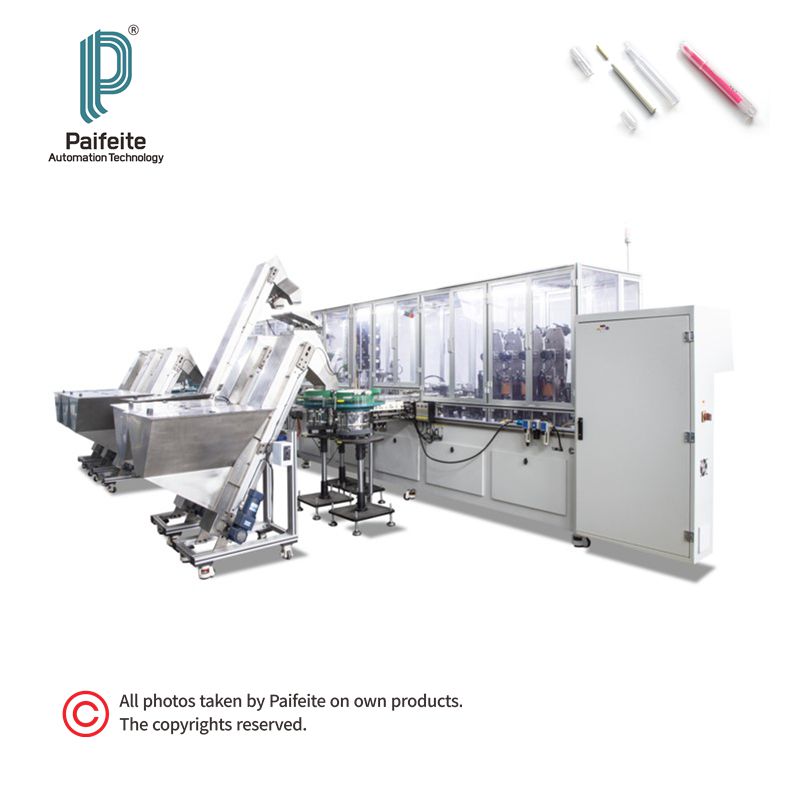
Pen production line equipment designed for continuous automated assembly in stationery manufacturing.
Automated pen assembly is rarely a one-machine decision. A pen assembly machine is specified by the production scenario it must serve: the pen type, the batch structure, the required output per minute, the factory layout, and the upstream and downstream equipment already present. Buyers who compare only speed or price often discover after commissioning that the equipment does not fit the project. This article explains how pen assembly machines are matched to different production scenarios, what the equipment can and cannot do, and what evidence buyers should check during evaluation.
Why Project Fit Matters in Pen Assembly Automation
Pen manufacturing is not a single production process. Gel pens, ballpoint pens, markers, whiteboard markers, pen refills, and medical pen injectors differ in component geometry, material sensitivity, tolerance requirements, and quality checks. A machine that performs well on a ballpoint pen line is not automatically the right basis for a marker line or a medical pen injector line.
Many stationery factories also run mixed production programs: in-house brands, OEM and ODM orders, promotional and advertising gift pens, and export volumes. This creates two distinct problems. The line must sustain high output for mass production, and it must handle specification changes without long downtime. A scenario-matched automatic line addresses both; a mismatched line increases commissioning risk, maintenance cost, and defect rates.
From Single Machine to Production Scenario
Paifeite Automation — formally Suzhou Paifeite Automation Technology Co., Ltd. — is a non-standard automated integration equipment manufacturer based in Suzhou, China, founded in 2004. The company focuses on research, development, production, and sales of automated integration equipment, with a specialism in stationery manufacturing machinery. Its factory covers 1,750 m², employs 48 people including 10 R&D engineers, and produces about 180 units per year; roughly 70% of output is exported to Europe, Asia, North America, and South America. According to the company, its equipment has been exported to more than 20 countries, with reported cooperation with Newell in the USA, Zebra Pilot in Japan, Reynolds and Lexipen in India, and Buropa and Medipaf in Morocco.
Paifeite's line-up covers the main pen production scenarios with dedicated models rather than a single universal machine:
| Model | Product | Capacity | Assembly mode | Dimensions (L×W×H, mm) |
|---|---|---|---|---|
| 357A | Pen Production Line Equipment | 140 pcs/min | 4 outputs/time, chain carry | 6200×1800×2000 |
| 399A2 | Gel Pen Assembly Machine | 120–130 pcs/min | 4 up, chain carry, horizontal, two types universal | 7000×1500×2300 |
| 395A1 | Ballpoint Pen Assembly Machine | 120–140 pcs/min | 4 up, chain carry, horizontal | 4800×1700×2000 |
| 417A1 | Marker Pen Assembly Machine | 100–120 pcs/min | 4 up, chain carry, horizontal | 6900×2400×2000 |
| 386A | Whiteboard Marker Assembly Machine | 50–70 pcs/min | 2 up, chain carry, horizontal | 6800×1600×2200 |
| 372A | Pen Refill Assembly Machine | 120–140 pcs/min | 4 outputs/time, chain carry | 3500×1500×2000 |
| 396A1 | Automatic Pen Assembly Machine | 120–140 pcs/min | 4 up, chain carry, horizontal | 4800×1700×2000 |
| 415A | Non-standard Pen Assembly Machine | 120–140 pcs/min | 4 up, chain carry, horizontal | 6800×1800×2000 |
| 359A | Pen Making Assembly Equipment | 50–60 pcs/min | 2 outputs/time, high precision link conveyor | 4200×2500×1900 |
| 363A | Insulin Pen Assembly Machine | 50–60 pcs/min | 2 outputs/time, chain carry | 3100×1400×1800 |
Table: Paifeite Automation product specifications (company product data).
The product structure shows a clear logic: high-speed models (120–140 pcs/min) serve ballpoint, gel, refill, and general automatic assembly; medium-speed models (100–120 pcs/min) serve marker production; and lower-speed, more compact models (50–70 pcs/min) serve whiteboard markers, high-precision pen making, and medical pen injectors, where control matters more than raw speed.
How an Automatic Pen Assembly Line Works
An automatic pen assembly machine performs three core tasks. It realizes automatic feeding, assembly, and combination of all pen parts. It realizes quality inspection and sorting of finished pens during assembly. And it runs in automatic continuous operation mode through PLC control and touch screen operation.
The practical workflow is: components are loaded through automatic feeding; the machine assembles and combines parts on a chain-carry horizontal structure; multi-output tooling (2 up or 4 up) produces several pens per cycle; and in-process inspection separates non-conforming finished pens before packing.
Operating requirements should be checked before purchase. The equipment is designed for room temperature environments and operates with stable and high-speed running, low noise, and safety and reliability. Because a complete line involves more than the assembly machine, the machine must be used with supporting equipment: automatic feeding machine, pen cap assembly machine, ink filling machine, printing machine, labeling machine, packaging machine, conveyor belt, and counting & packing system.
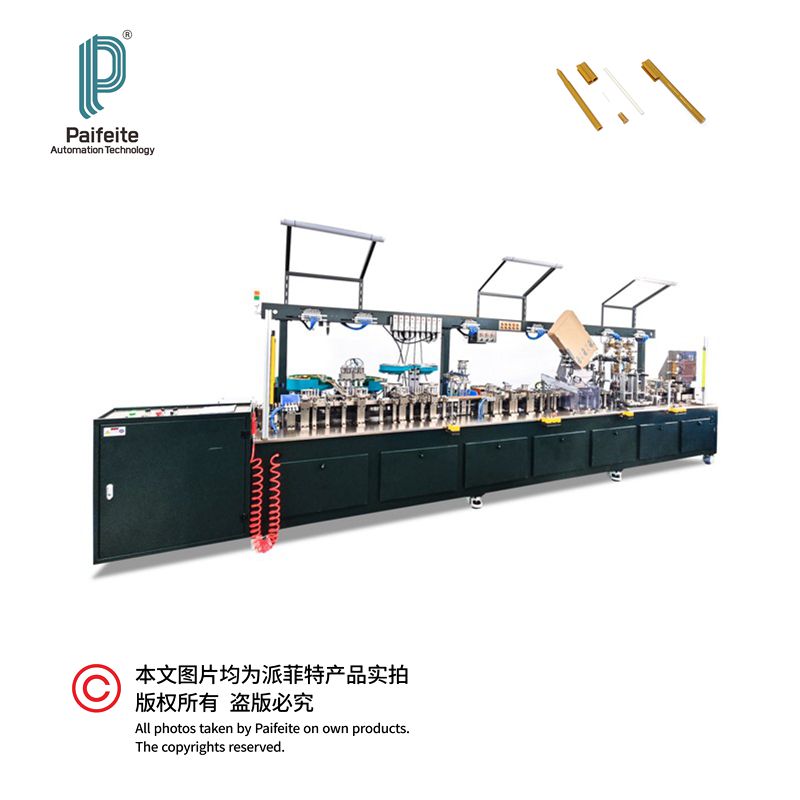
Non-standard pen assembly machine (415A) engineered around a specific pen production project.
Material Selection by Scenario
Material specification varies with the product scenario. General stationery machines use carbon steel, aluminum alloy, stainless steel, and engineering plastics. The gel pen machine (399A2) is built from 45# steel, 6061 aluminum, and stainless steel. For medical projects, the insulin pen assembly machine (363A) uses aluminum profile, medical-grade 304 stainless steel, engineering nylon, and painted carbon steel, reflecting the stricter material requirements of the medical device industry.
Application Scenarios and Documented Use
The stated application range of Paifeite pen assembly equipment covers stationery and office supplies manufacturing, custom advertising and gift pen production, and medical, industrial, and cosmetic marking pen industries. Within those industries, three scenario patterns are most common.
1. Mass Production in Stationery Factories
For continuous production of standard pens, high-speed models such as the ballpoint pen assembly machine (395A1) and the gel pen assembly machine (399A2) sustain 120–140 pcs/min with automatic feeding, assembly, and quality inspection. The machine's role in this scenario is to replace manual assembly with stable continuous operation and consistent quality.
2. High-Volume Export Lines
Export-oriented factories typically run long campaigns with large quantities. The pen production line equipment (357A) reaches 140 pcs/min with 4 outputs per cycle, and the non-standard pen assembly machine (415A) is built for mass production of gel pens, ballpoint pens, fountain pens, and other writing instruments. High production capacity, low defect rates, and suitability for mass and flexible production are the stated characteristics for stationery manufacturing.
3. Flexible and Customized Production
Factories serving OEM/ODM orders, promotional pens, and multiple specifications need quick model changes. The equipment is described as suitable for mass production of pens in stationery factories, high-volume export stationery assembly lines, and flexible production for various specifications with quick model change capabilities. On the customization side, Paifeite's ODM capability covers pen size and specifications, production speed and capacity, feeding and assembly structure, control system and interface language, and overall dimension and layout.
A documented example from the company's installed base: an ODM pen manufacturer in India has operated 20 Paifeite units over 8 to 12 years. Reported results include high production efficiency, stable continuous operation, consistent product quality with a low defective rate, reduced labor cost, automatic feeding, assembly and inspection, and a low failure rate with easy maintenance.
Market Trends Supporting Scenario-Based Procurement
Several market-level signals explain why buyers are moving from standalone machines to scenario-matched automated lines.
- The global automated assembly machine market was valued at USD 2,624.73 million in 2023 and is projected to reach USD 4,098.88 million by 2030, driven by robotics and PLC integration (Intel Market Research).
- China's pen export base remains large: ballpoint pen exports reached USD 1.121 billion in 2024, with total pen exports at USD 2.65 billion (OEC), sustaining a mature domestic supply chain for assembly machinery.
- The global injection pen market reached USD 47.0 billion in 2024 and is growing at a CAGR of 7.9% through 2030 (MarketsandMarkets). Disposable pen injectors dominated the market with an 87.9% share in 2025 (Fortune Business Insights), increasing demand for high-speed automated assembly of pen injectors.
- The ISO 11608 series defines design and verification requirements for needle-based injection systems, including pen injectors. For medical projects, this standard makes documented, repeatable automated assembly a practical requirement.
Automated Assembly vs. Manual and Semi-Automatic Lines
Comparing automatic pen assembly machines with manual or semi-automatic assembly helps define the real boundary of the technology.
| Evaluation criterion | Manual / semi-automatic assembly | Automatic pen assembly machine |
|---|---|---|
| Output | Limited by headcount and shift time | 50–140 pcs/min depending on model |
| Consistency | Operator-dependent | Consistent pressing function and assembly precision |
| Quality control | Usually a separate inspection step | In-line inspection and sorting of finished pens during assembly |
| Labor requirement | High for feeding, assembly, and inspection | Replaces manual assembly work and reduces labor cost |
| Model change | Flexible for small batches | Quick change capability for varying specifications; adjustment required |
| Initial investment | Lower | Higher; requires supporting equipment and integration |
A fully automatic line has real limits. An automatic pen assembly machine is not a universal standalone unit: it must be used with supporting equipment such as conveyor belts, packaging machines, ink filling machines, labeling machines, and counting & packing systems. It is designed for room temperature conditions, so workshops with extreme temperature or humidity need environmental control. And because machines are engineered around specific pen specifications, a fundamental change to the pen body or a completely new product family may require new tooling or a re-engineered feeding and assembly structure rather than a simple adjustment. For very small batches with frequently changing designs, a fully automatic line may not be the most economical option.
Scenario Fit Checklist for Procurement Evaluation
Buyers can use the following checklist to translate a production project into a machine specification.
- Define the product family — gel pen, ballpoint pen, marker, whiteboard marker, refill, or medical pen injector; select the corresponding machine family.
- Set the output target — match the required pcs/min to model capacity, including shift pattern and planned volume growth.
- Map the full line — confirm supporting equipment: automatic feeding machine, pen cap assembly machine, ink filling machine, printing machine, labeling machine, packaging machine, conveyor belt, and counting & packing system.
- Check workshop conditions — room temperature, dust-proof and clean production standards, safety compliance, and fault monitoring capability.
- Define the customization scope — pen size and specifications, production speed and capacity, feeding and assembly structure, control system and interface language, and overall dimension and layout.
- Evaluate changeover needs — for multi-SKU production, confirm quick model change capability and flexible production parameters.
- Verify supplier evidence — installed base and operation duration, quality control (e.g., 100% test), after-sales service (e.g., free onsite training), MOQ, and lead time.
Future Outlook
The direction of the market is toward integrated, scenario-specific lines rather than generic assembly units. The projected growth of the automated assembly machine market through 2030, combined with the expansion of the injection pen segment and the verification framework of ISO 11608, points to four developments.
- Higher-speed, multi-output machines will remain the standard for mass-produced writing instruments.
- Flexible production with quick model changes will become a default requirement as brands expand SKUs and promotional programs.
- Medical pen injectors will push assembly equipment toward documented, repeatable processes with medical-grade material selection.
- Suppliers with non-standard engineering capabilities — adjusting dimensions, feeding structures, control interfaces, and line layout — will be better positioned for project-based procurement.
For Paifeite Automation, the relevant company-level facts are: ODM capability with a minimum order of one set, a monthly production capacity of 15 units, a typical lead time of 3–4 months, 100% test quality control, and free onsite training. For a buyer in the Research or Evaluation stage, these are practical points to verify against the specific project scenario before committing to a line configuration.
Frequently Asked Questions
Which pen types can be assembled on an automatic pen assembly machine?
Pen assembly machines are built for specific pen categories. The Paifeite Automation range covers gel pens (model 399A2), ballpoint pens (395A1), markers (417A1), whiteboard markers (386A), pen refills (372A), and insulin pens and medical injection pens (363A). The applicable industries include stationery manufacturing, custom advertising and gift pen production, and medical, industrial, and cosmetic marking pen production.
What output can a buyer expect from a pen assembly machine?
Output depends on the model. Ballpoint, gel, automatic, and non-standard machines run at 120–140 pcs/min (the gel pen machine 399A2 runs at 120–130 pcs/min). The marker pen machine (417A1) runs at 100–120 pcs/min; the whiteboard marker machine (386A) at 50–70 pcs/min; the refill machine (372A) at 120–140 pcs/min; the pen production line (357A) at 140 pcs/min; and the pen making equipment (359A) and insulin pen machine (363A) at 50–60 pcs/min.
What supporting equipment is needed for a complete pen assembly line?
An automatic pen assembly machine must be used with supporting equipment. A typical line includes an automatic feeding machine, pen cap assembly machine, ink filling machine, printing machine, labeling machine, packaging machine, conveyor belt, and counting & packing system. Buyers should plan for these upstream and downstream units as part of the project scope.
Can a pen assembly machine be customized for a specific production project?
Yes. Paifeite Automation's ODM customization covers pen size and specifications, production speed and capacity, feeding and assembly structure, control system and interface language, and overall dimension and layout. The minimum order is one set, typical lead time is 3–4 months, and the company's monthly production capacity is 15 units with 100% test quality control.
What workshop conditions are required for an automatic pen assembly machine?
The equipment is designed for room temperature environments and automatic continuous operation. For pen production, the workshop should meet dust-proof and clean production standards to avoid contamination of pen nibs, ink tubes, and plastic components, and comply with workshop safety specifications with reliable fault monitoring and automatic protection functions.
Is a pen assembly machine suitable for medical pen injector projects?
For medical projects, Paifeite offers the insulin pen assembly machine (363A), which uses aluminum profile, medical-grade 304 stainless steel, engineering nylon, and painted carbon steel, and is applied to automatic assembly of insulin pens and medical injection pens. The ISO 11608 series defines design and verification requirements for needle-based injection systems, so medical buyers typically evaluate assembly equipment against those requirements during supplier qualification.
How does the machine control quality during assembly?
During assembly, the machine realizes quality inspection and sorting of finished pens in addition to automatic feeding, assembly, and combination of all pen parts. Company-level quality control is described as 100% test, and the equipment operates with stable and high-speed running, low noise, and safety and reliability.