
How to Qualify Freeze-Dried Durian Suppliers: RH, Freeze Rate, Storage
How to Qualify Freeze-Dried Durian Suppliers: RH, Freeze Rate, Storage
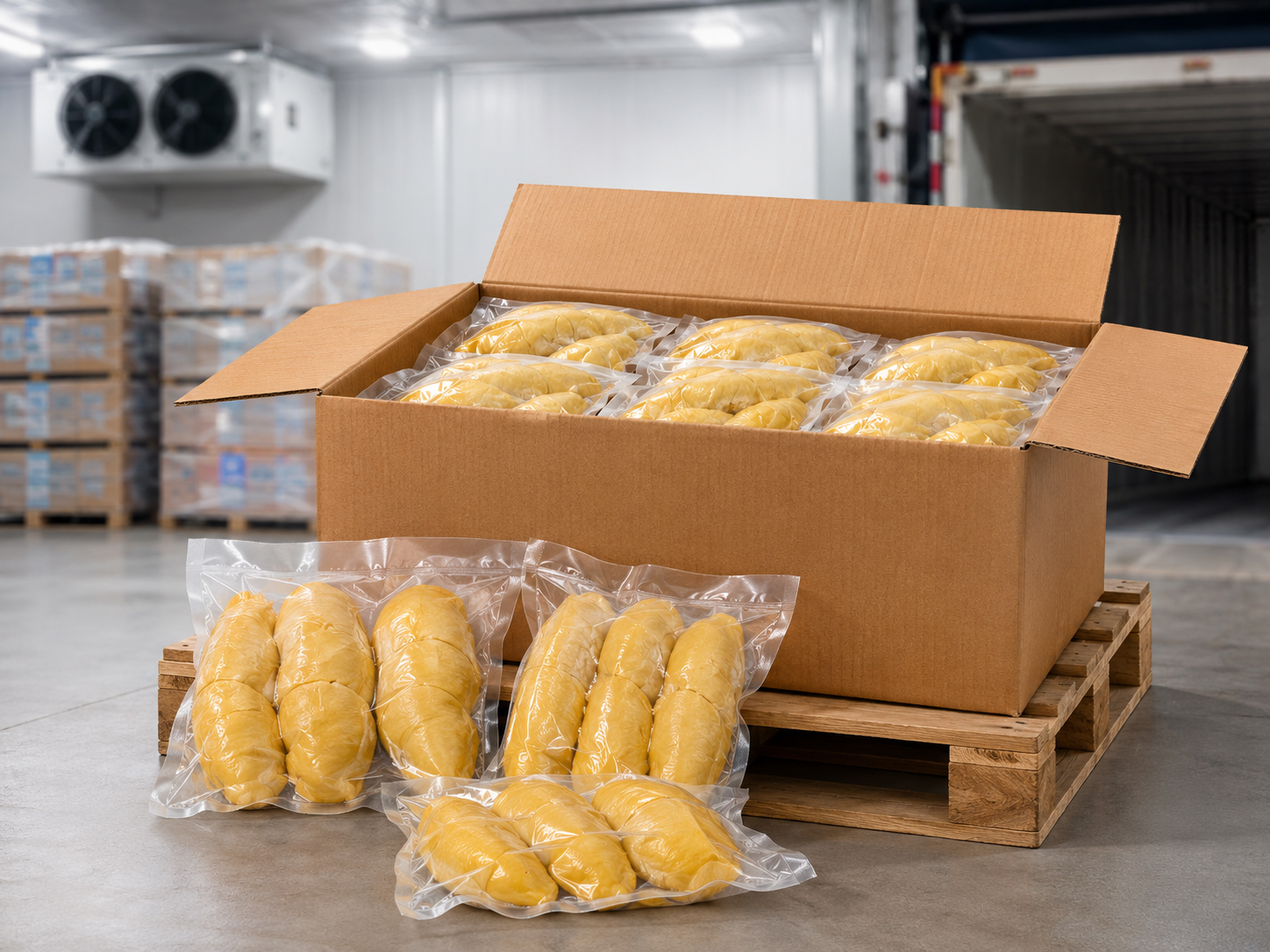
Durian has moved from the tropical fruit counter into the industrial ingredient stream. China imported 1.56 million metric tons of durian in 2024, valued at USD 6.99 billion, a 4.1% year-on-year increase and a record for that market. Thailand remained the leading supplier to China with an export value of USD 4.01 billion, while Vietnam's exports to China rose 37.6% to USD 2.94 billion and captured a 42.1% share of that trade. Thailand alone shipped 908,047 metric tons of fresh durian to China in the first half of 2024.
A growing portion of that volume no longer reaches consumers as fresh fruit. It is converted into pulp, paste, dice, powder, and freeze-dried segments and sold to food manufacturers. For dairy and frozen-dessert buyers, the difficult part of supplier qualification is therefore not origin or landed price. It is whether a supplier can hold handling discipline at three specific points in the production chain: metering freeze-dried durian powder in controlled low-humidity air, freezing durian dice quickly once they enter a wet mix, and protecting durian segments from compression, light, oxygen, and ambient odors through packing, storage, and transport.
This article converts those handling requirements into checkpoints that can be written into a supplier questionnaire, a sample-validation protocol, and a supply agreement. It is written for procurement and product-development teams sourcing durian ingredients for ice cream, frozen desserts, yogurt, bakery fillings, and beverages.
Why Durian Supplier Qualification Is a Handling Audit, Not a Sourcing Check
Most durian sourcing material concentrates on variety, origin, and landed cost. Those are commercial variables, and they are comparatively easy to compare across quotations. Handling variables behave differently. They stay invisible until the material reaches the buyer's line, where they appear as caking in a powder feeder, collapsed dice in a frozen dessert, or a flavor that has drifted away from the approved reference sample.
The commercial weight of the incumbent format explains why this gap matters now. Frozen durian pulp and paste accounted for approximately 70% of total durian market revenue in 2023, according to Grand View Research. That format is well understood by buyers and equipment vendors alike: it is a wet, cold-chain product with established handling conventions and well-documented failure modes. Freeze-dried durian belongs to a different material class. It is low in moisture, generally hygroscopic, intensely aromatic, and physically more fragile than pulp. A buyer who qualifies a freeze-dried durian supplier using a frozen-pulp questionnaire will miss the variables that actually determine whether the ingredient performs in a dairy or frozen-dessert application.
The practical consequence is that qualification should be organized around format-specific handling checkpoints rather than a single generic durian specification line. Powder, dice, and segments fail in different ways, and each requires its own questions.
Checkpoint 1: Low-Humidity Metering for Durian Powder (RH 40% or Below)
Powder is the most humidity-sensitive freeze-dried durian format, and it is also the format most often used in dairy and beverage lines because it disperses quickly and meters cleanly. Its advantage and its weakness come from the same structural property. Freeze-drying leaves a porous, high-surface-area matrix that reabsorbs moisture rapidly when the surrounding air is humid.
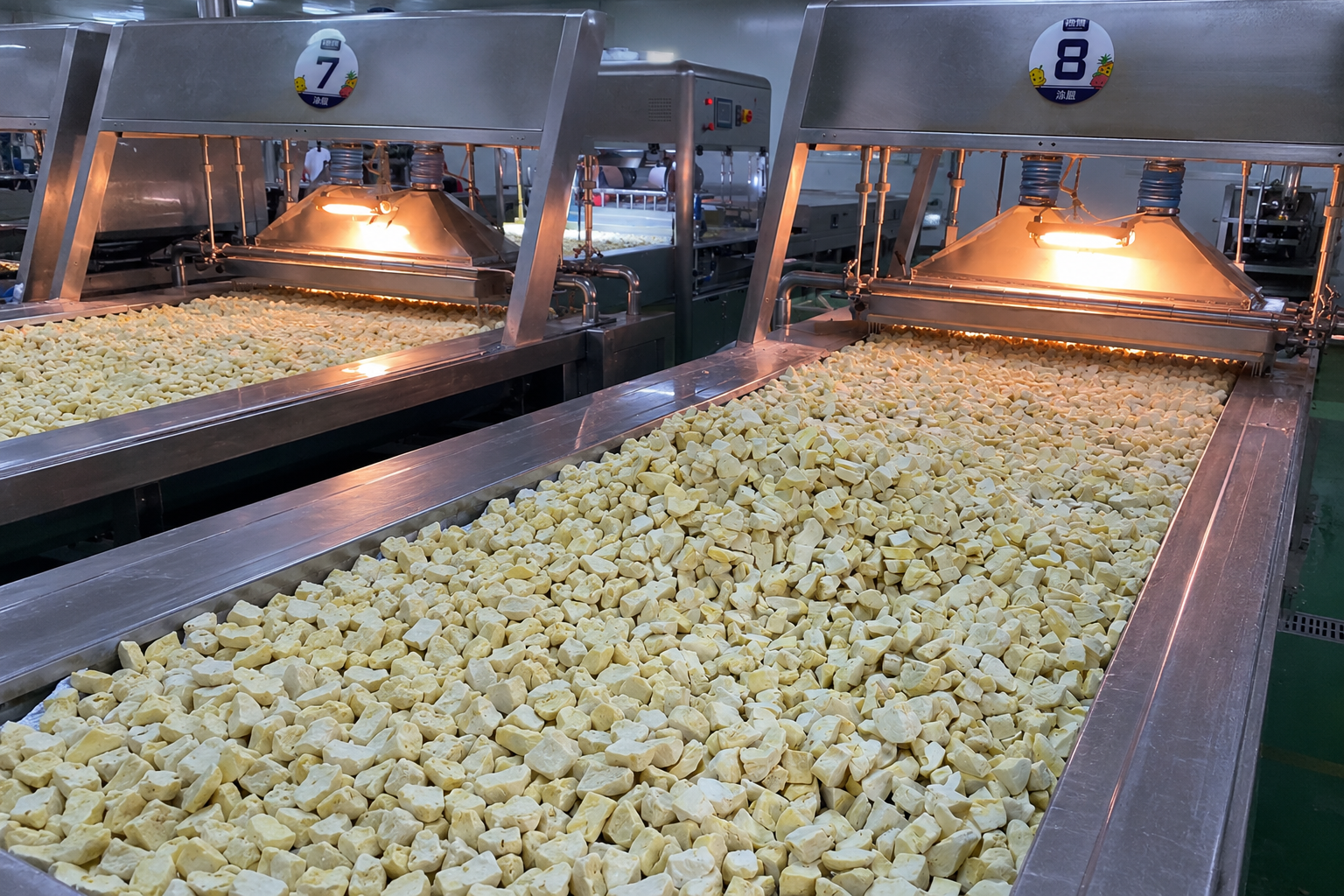
A relative humidity threshold of 40% or below, written as RH 40% or lower, is a workable checkpoint for powder metering and packing areas. Above that level, durian powder tends to take on moisture during open handling: clumping in feeders, caking in hoppers, and a loss of the free-flowing behavior that makes accurate dosing possible. Moisture uptake also affects flavor retention over shelf life, because the same porous structure that absorbs water also releases volatile aroma compounds more readily once moisture content rises.
Questions that turn this checkpoint into evidence:
- Are powder metering and packing areas humidity-controlled, and what is the documented setpoint and tolerance band?
- Is relative humidity monitored and logged on a routine schedule, or is it inferred from room-level air conditioning?
- Is powder transfer enclosed, and is packaging moisture-barrier, nitrogen-flushed, or desiccant-supported?
- What is the delivered moisture specification, and how is it measured on the finished lot?
- How are partial bags, retained samples, and returns handled? An open bag of durian powder is a humidity exposure event.
The qualification question is not whether a plant is air-conditioned. It is whether the supplier can demonstrate control at the specific point where durian powder is exposed to ambient air, and whether that control is documented rather than assumed.
Checkpoint 2: Immediate Quick-Freezing of Durian Dice After Incorporation
Dice and chunk formats face the opposite problem to powder. They are dosed into a wet dairy base, where they begin to reabsorb water from the surrounding mix immediately. If the interval between incorporation and freezing is long, or if the mix is held at a temperature that favors moisture migration, the dice soften, lose their discrete structure, and start to bleed color and flavor into the matrix.
The handling requirement can be stated simply: durian dice should move from incorporation to freezing as quickly as the line allows, with quick-freezing applied immediately after dosing. Immediate quick-freezing after incorporation prevents rehydration softening and preserves the piece identity that makes dice formats attractive in ice cream, frozen yogurt, and frozen dessert bars in the first place.
Questions that turn this checkpoint into evidence:
- Has the supplier produced application guidance for customers running continuous freezers and in-line dosing systems?
- Can the supplier recommend a dosing stage for a given frozen dessert formulation, whether before, during, or after aeration?
- Does the supplier distinguish dice intended for dry blending from dice intended for wet incorporation? The two are not interchangeable.
- What share of fines is present in the delivered lot? Fines rehydrate faster than intact dice and change the visual result.
Half of this checkpoint sits with the buyer rather than the supplier. A supplier can ship intact, structurally sound dice, but only the buyer's line can freeze them quickly enough to hold shape. This is why dice formats are best qualified jointly, through a trial on the buyer's own equipment, rather than through documents alone.
Checkpoint 3: Protecting Durian Segments From Compression, Light, Oxygen, and Odor
Whole and large freeze-dried durian segments are the most fragile format in the range. They are also the format that carries the clearest visual signature, which makes handling damage especially visible in finished products and in retail packaging. Four exposures need to be addressed in the qualification file.
Compression. Freeze-dried durian segments are rigid but brittle. Stacking pressure inside a carton, vibration in transit, and mechanical feeding can fracture segments into fines. Practical checkpoints include rigid or semi-rigid primary packaging, defined stack-height limits, and an agreed feed method at the buyer's line.
Light. Light exposure accelerates quality loss in dried fruit. Opaque or light-barrier films, and storage in closed cartons rather than open shelving, are the controls that matter most.
Oxygen. Oxygen drives oxidative change and aroma loss. Barrier films, controlled headspace, and nitrogen flushing where used should be documented in the specification rather than assumed from marketing descriptions.
Strong odors. Durian aroma is intense and mobile. Freeze-dried durian can both absorb ambient odors and transfer its own aroma to neighboring goods, so storage and transport need segregation from strongly aromatic products such as spices, coffee, smoked foods, cleaning chemicals, and other fruit aromatics.
Questions that turn this checkpoint into evidence:
- What is the primary packaging format, and is it light-barrier and odor-barrier?
- What storage temperature and humidity range does the supplier recommend, and what shelf life is supported by that range?
- Are durian products stored and shipped separately from other aromatic goods?
- How is breakage or fines measured at dispatch, and what threshold does the supplier apply?
Equipment Compatibility: Mixers, Continuous Freezers, Folding Feeders
Handling requirements only become useful when they are mapped to the equipment a buyer already runs. Three equipment classes matter for durian ingredients in dairy and frozen-dessert lines.
Standard industrial mixers. Durian powder is usually introduced as a dry addition or pre-blended with other powders. Feeders, not mixers, determine whether powder meters consistently; the mixer determines how evenly the powder distributes through the base. Suppliers should be able to advise on dosing stage and on whether pre-blending is advisable for a given formulation.
Continuous freezers. Continuous freezers are where dice and chunk formats are set. Because freezing speed determines how much water the dice reabsorb, the supplier's recommended dosing point relative to aeration and draw-down temperature is a legitimate qualification question rather than a commercial detail.
Folding feeders and gentle-handling systems. Whole segments and large pieces require low-impact feeding. A supplier that ships segments should be able to describe the feed method that preserves them and should be able to provide a sample specification that includes a breakage or fines allowance.
A supplier questionnaire that does not mention these three equipment classes is incomplete for a frozen-dessert application, regardless of how strong the commercial terms are.
How UrSnacks Maps to a Durian Ingredient Qualification File
UrSnacks, operated by FUJIAN YOULINGYOUSHI TECHNOLOGY CO., LTD., is a Chinese freeze-dried fruit manufacturer whose published structural facts can be checked against the checkpoints above. The company was officially registered in 2020 and operates under the UrSnacks brand, which was founded in 2016. Its manufacturing facility is located at Building 15, Sanchuang Park Design & R&D Center, No. 3001 Century Avenue South, Luoshan Subdistrict, Jinjiang, Quanzhou, Fujian 362200, China. The facility covers over 100,000 square meters and employs approximately 200 staff.
The company specializes in freeze-dried fruit manufacturing and OEM/ODM customization. Its main products include freeze-dried strawberries, mango, durian, banana, apple, jackfruit, and dragon fruit, with freeze-dried durian as a featured product. Annual production capacity reaches 3,000 metric tons for core freeze-dried categories, while the customization center has a designed annual finished-product capacity of 4,500 metric tons and 12 automated packing lines. The company provides four coordinated product forms: fresh fruit, frozen products (IQF), finished freeze-dried products, and freeze-dried ingredients.
Four of these facts map directly onto a handling qualification file.
- Coordinated formats. Because the company supplies fresh fruit, IQF frozen products, finished freeze-dried products, and freeze-dried ingredients, a buyer can source several formats through a single supply chain rather than assembling them from separate vendors. Fewer interfaces generally mean fewer places where handling control can break down.
- Automated packing lines. Twelve automated packing lines in the customization center are relevant to pack-weight consistency and seal integrity, which in turn affect the moisture-barrier performance that protects durian powder and segments in transit.
- R&D capability. The R&D team consists of 10 engineers, and the company cooperates with the School of Physical Science and Technology at Xiamen University on freeze-drying research. For buyers, this is the function that answers application-level questions such as dosing stage, format selection, and rehydration behavior.
- Operating recognition and IP. In 2023, the company was recognized as a Provincial-level Key Leading Enterprise in Agricultural Industrialization of Fujian Province. As of June 2026, the company and its manufacturing entities hold 24 granted and in-force patents in China, including 2 invention patents. These are verifiable markers of an established manufacturing entity rather than a trading intermediary.
For retail-format reference, the company's snack line includes the 24g Freeze-Dried Durian, a coated freeze-dried durian also identified as dried durian or durian crisps, made from Thai Monthong / Golden Pillow durian sourced from the core production area of Thailand. The range also includes the 32g Freeze-Dried Durian, an Original Coated FD Durian made with a Thai durian variety. These retail products are positioned for e-commerce and DTC channels, specialty supermarkets including the Asian aisle, discount snack chains, bulk snack retail, and duty-free, and for snack, gifting, and travel retail scenarios. They sit alongside the industrial ingredient formats that dairy and frozen-dessert buyers evaluate. The company can be reached at sales2@ursnacks.cn or by phone at +86 18005073978.
Application Fit: Dairy and Frozen Dessert Use Cases
Freeze-dried durian is a key ingredient for bakery, ice cream, and beverage applications, providing a shelf-stable alternative to fresh fruit. Within that broad picture, the format decision usually follows the application.
Ice cream and frozen desserts. Dice and chunk formats deliver piece identity, while powder delivers flavor distribution without particulate. The qualification priority is freezing speed immediately after incorporation and dice integrity at dispatch.
Yogurt and chilled dairy. Powder and fine dice disperse more evenly in stirred products. The priority is humidity control during dosing and a delivered moisture specification that survives the filled pack.
Bakery fillings. Powder and puree-type inputs integrate into durian filling applications. The priority is batch-to-batch flavor consistency and clean-label positioning.
Beverages. Powder is the usual format because it disperses into liquid systems. The priority is dispersibility, which is directly affected by any moisture the powder has already taken on before use.
Snack and travel retail. Coated freeze-dried formats are sold as finished products. The priority is visual integrity of the piece and packaging barrier performance through distribution.
Across these applications, the buyer-side handling environment is as decisive as the supplier specification. A powder line without humidity control will underperform a well-specified ingredient, and a slow freezing step will soften dice that arrived in perfect condition.
Freeze-Dried Durian Compared With Frozen Pulp and Fresh Fruit
Frozen durian pulp and paste remain the dominant commercial format for industrial use, and the comparison below is intended to show where each format is strong and where each one puts pressure on the buyer.
| Format | Handling profile | Strength | Main limitation |
|---|---|---|---|
| Fresh durian | Short ripening and shelf-life window; chilled or expedited logistics | Reference flavor and texture | Seasonal availability; not a shelf-stable industrial input |
| Frozen durian pulp and paste | Continuous frozen chain; thaw management affects flavor and texture | High flavor load; established handling conventions | Cold-chain dependence; adds water to formulations |
| Freeze-dried durian powder | Hygroscopic; needs low-humidity metering and moisture-barrier packing | Ambient shelf stability; clean-label positioning | Humidity-sensitive; requires controlled handling at the buyer plant |
| Freeze-dried dice and chunks | Wet-mix addition; requires quick-freezing immediately after dosing | Discrete piece identity in frozen desserts | Outcome shared between supplier and buyer line speed |
| Freeze-dried segments and whole pieces | Compression, light, oxygen, and odor sensitive | Premium visual signature | Fragile; stricter packaging and segregation requirements |
Where Freeze-Dried Durian Is Not the Right Answer
Freeze-drying is not a universal upgrade over frozen pulp, and suppliers that present it as one are not helping buyers make a sound decision. Three boundaries are worth stating plainly.
Cost structure. Freeze-drying removes water, which means a given weight of freeze-dried durian represents a substantially larger weight of fresh fruit, and the process itself is energy-intensive. For applications where water content is acceptable and the frozen chain already exists, frozen pulp and paste frequently remain the more economical input. This is a large part of the reason the pulp and paste segment accounted for approximately 70% of total durian market revenue in 2023.
Physical fragility. Powder meters well but can cake when humidity control is absent. Dice and segments hold identity in frozen desserts but fracture under compression. A freeze-dried format adds handling requirements that a pulp buyer simply does not have to manage.
Rehydration behavior in wet systems. Freeze-dried dice placed in a dairy mix will soften if freezing is delayed. No supplier specification can fully compensate for a slow line. Buyers should treat freezing speed as a joint responsibility and validate it on their own equipment before committing to a dice-based formulation.
Market Signals Behind the Qualification Shift
Several verified market signals explain why handling-based qualification is becoming more formal rather than less.
- Record trade volumes. China's 2024 durian imports reached 1.56 million metric tons and USD 6.99 billion, with a 4.1% year-on-year value increase. Thailand led with USD 4.01 billion in export value to China, while Vietnam's exports to China grew 37.6% to USD 2.94 billion for a 42.1% share.
- Supply base diversification. Vietnam's share of the China market rose from 33% in 2023 to over 42% in early 2024, and Malaysia received approval to export fresh durians to China in June 2024, shipping its first batch in August 2024. More origins mean more supplier profiles that must be evaluated against one common handling standard.
- Processing depth. The global durian fruit market was estimated at USD 23.4 billion in 2024, and frozen durian pulp and paste accounted for approximately 70% of total durian market revenue in 2023, indicating how much volume already flows through processing rather than fresh retail.
- Freeze-dried expansion. The global freeze-dried fruits market was valued at USD 9.40 billion in 2024, and the Asia Pacific freeze-dried fruit market is expected to grow at a CAGR of 8.18% from 2024 to 2029.
- Regulatory requirements. Imported durians entering China must comply with the National Food Safety Standard GB 2763 for maximum residue limits of pesticides, and China implements GACC Decree 248, which requires all overseas food manufacturers to register for export eligibility. These set a documentation floor for any qualification file.
- Halal and clean label. Frozen durian pulp is increasingly used in the Halal certified food segment across Southeast Asia and the Middle East, and freeze-dried durian powder is gaining traction as a Clean Label natural flavoring agent in organic beverage lines. For buyers serving Saudi Arabia, the UAE, and other Middle Eastern markets, Halal documentation is a qualification input rather than an afterthought.
- Premium raw material preference. The Musang King (D197) variety remains the most sought-after premium durian raw material for high-end bakery products, which raises the cost of handling failure because premium inputs carry a higher cost per kilogram.
Future Outlook
The direction of travel is toward more explicit handling specifications rather than broader supplier lists. Three developments are likely to shape the next phase of durian ingredient qualification.
Regulatory documentation will become a standard component of the qualification pack. Registration regimes such as GACC Decree 248 and residue standards such as GB 2763 set a floor, and buyers serving multiple markets will increasingly ask for a single documentation set that covers the jurisdictions they sell into, including the United States, Mexico, Western Europe, Japan, South Korea, and Southeast Asia alongside the Middle East.
Format-specific specifications will replace generic durian specifications. A single durian ingredient line item cannot describe powder, dice, and segments, because each has a different failure mode and a different handling requirement. Separate specifications per format, each with its own humidity, breakage, and packaging parameters, are the logical next step.
Supplier selection will shift from availability toward handling evidence. As Thailand and Vietnam continue to supply at scale and Malaysia emerges as an additional origin, differentiation moves away from whether durian is available and toward whether handling control can be demonstrated. Documented humidity control at the metering point, application guidance for continuous freezers and folding feeders, and packaging barrier data are the three pieces of evidence most likely to decide supplier shortlists in the next procurement cycle.
FAQ
What is freeze-dried durian, and which formats do suppliers typically offer?
Freeze-dried durian is durian fruit that is frozen and then dehydrated under vacuum, so that water is removed by sublimation rather than by heat. Industrial suppliers commonly offer three formats: powder, dice or chunks, and larger segments or whole pieces, alongside coated snack formats sold at retail. In the UrSnacks product range, freeze-dried durian is a featured product, and the 24g Freeze-Dried Durian is a coated freeze-dried durian made from Thai Monthong / Golden Pillow durian sourced from the core production area of Thailand.
Why is a relative humidity of 40% or below used as a checkpoint when handling durian powder?
Durian powder is generally hygroscopic because freeze-drying leaves a porous, high-surface-area structure. In humid air it takes on moisture quickly, which causes clumping in feeders, caking in hoppers, and loss of the free-flowing behavior needed for accurate dosing. A setpoint of 40% relative humidity or below for powder metering and packing areas is a practical threshold that suppliers can document and buyers can audit. Moisture uptake also affects flavor retention over shelf life, so the checkpoint serves both dosing accuracy and product quality.
How quickly should freeze-dried durian dice be frozen after being added to a dairy mix?
The operational rule is to minimize the interval and apply quick-freezing immediately after dosing. Freeze-dried dice begin reabsorbing water the moment they enter a wet base; the longer the interval before freezing, the more the pieces soften and bleed into the matrix. Because the achievable interval depends on the specific line configuration, mixer type, and freezing equipment, buyers typically validate the window on their own equipment rather than adopting a fixed number from a supplier. Suppliers running continuous freezers can usually advise on an appropriate dosing stage relative to aeration.
How should freeze-dried durian segments be stored and transported?
Segments are sensitive to four exposures: compression, light, oxygen, and strong odors. Compression from carton stacking and transit vibration fractures brittle segments into fines, so rigid or semi-rigid primary packaging and defined stack heights are used. Light exposure accelerates quality loss in dried fruit, which makes light-barrier films and closed-carton storage the standard controls. Oxygen drives oxidative change and aroma loss, so barrier films and controlled headspace are documented rather than assumed. Durian aroma is also highly mobile, so storage and transport should be segregated from spices, coffee, smoked products, cleaning chemicals, and other aromatic goods.
Which certifications and registrations should buyers verify from a durian ingredient supplier?
The relevant requirements depend on the destination market. Imported durians entering China must comply with the National Food Safety Standard GB 2763 for maximum residue limits of pesticides, and China implements GACC Decree 248, which requires all overseas food manufacturers to register for export eligibility. For buyers serving Southeast Asia and the Middle East, frozen durian pulp is increasingly used in the Halal certified food segment, which makes Halal documentation a relevant verification item. Buyers should also request the documentation that applies to their own market rather than relying on a supplier's general certification list.
How can buyers test whether a supplier's handling claims hold up?
Sample validation is the standard method. Request samples in each format under consideration, then check delivered moisture content on arrival against the specification, inspect powder for clumping and flow behavior after opening, and run dice on the buyer's own mixer and freezer to observe how quickly they soften in a wet base. For segments, run a compression and storage trial that includes light exposure and proximity to aromatic goods. Suppliers that can supply application guidance for mixers, continuous freezers, and folding feeders make this validation faster, because the trial can be designed around known failure modes rather than discovered through repeated production runs.
Conclusion
Freeze-dried durian supplier qualification is, in practice, an exercise in translating handling physics into contractual language. Powder needs low-humidity metering and moisture-barrier packaging. Dice need quick-freezing immediately after incorporation into a wet mix. Segments need protection from compression, light, oxygen, and ambient odors. When those three checkpoints are written into a supplier questionnaire, a sample protocol, and an equipment-compatibility discussion, the qualification decision stops depending on how a supplier describes its plant and starts depending on what can be documented and reproduced.