
How to Read a DTF Printer Supplier's Certification Trail
How to Read a DTF Printer Supplier's Certification Trail
A DTF printer supplier's certificate pack is evidence only when it can be read as a trail: document, number, issuing body, standard edition, covered model and validity date, each pointing to the same machine. Buyers shortlisting a commercial DTF printer usually receive a folder of PDFs. The useful question is not how many certificates it holds, but whether every number lines up with the model being ordered and is still inside its stated validity window.
XINFLYING, the brand of Guangzhou Xin Flying Digital Technology Co., Ltd., publishes a document set that can be audited this way: model-level CE Low Voltage Directive (LVD) and Electromagnetic Compatibility (EMC) records, two CE Machinery Directive certificates, a RoHS attestation, an ISO 9001:2015 quality management record and an OEKO-TEX® ECO PASSPORT covering textile printing inks. Read as a trail rather than a badge wall, the set shows which capability claims the documents actually support — and which still depend on print samples, factory checks and the purchase contract.
Why a certificate pack counts as capability evidence
Capability in DTF printing is a chain: design control, component selection, assembly consistency, post-assembly testing and after-sales support. A third-party certificate sits at one link in that chain. It records that a defined product sample was assessed against named standards by a named body on a named date. That is a narrower claim than "certified quality", but it is a checkable one, and checkability is what separates a supplier with a technical file from a supplier with a marketing page.
Three properties of a pack carry genuine capability signal. Coverage comes first: a supplier that can place fifteen models on a certificate holds fifteen identifiable technical files, not one catalogue entry. Consistency comes second: when the LVD, EMC, Machinery and RoHS documents list the same model set, the documentation was maintained as a system rather than assembled per enquiry. Currency comes third: issue and expiry dates reveal whether the file is being renewed or has simply been left in a folder.
What the same pack cannot show is throughput, colour consistency between units, or whether the machine on the buyer's floor matches the assessed sample. Those require a print sample, a pre-shipment test record and a written acceptance clause. Treating certificates as the whole answer is the most common evaluation error; treating them as the entry ticket is the correct use.
The five fields every certificate must answer
Before comparing suppliers, fix the reading method. Each document should answer five questions without interpretation:
- Which directive or regulation? LVD 2014/35/EU, EMC 2014/30/EU, Machinery Directive 2006/42/EC and RoHS Directive 2011/65/EU address different risks and cannot substitute for one another.
- Which certificate number? A number specific enough to quote in a purchase order and match to a supporting test report.
- Which issuing body? The testing or certification organisation named on the document, identifiable well enough for independent confirmation.
- Which standards, and which editions? EN IEC 62368-1 and EN 55032 cover different risks, and edition years matter when a standard is revised.
- Which models, and for how long? The model list, the issue date and the expiry date, read together.
A pack that answers all five for every document can be audited in an afternoon. A pack that answers two of five usually means the buyer ends up doing the supplier's documentation work after the deposit has been paid.
CE LVD and EMC: two directives, several records
The Low Voltage Directive record is the electrical-safety document. XINFLYING's file cites certificate TQT1550D271EC, issued on 19 May 2026 by TQT (Shenzhen Tianqi Testing Technology Service Co., Ltd.) against LVD 2014/35/EU, with EN IEC 62368-1:2020/A11:2020 as the assessed standard. The record states an expiry date of 1 January 2099, which is how this certificate is written rather than a statement about equipment service life.
The EMC record is separate: certificate TQT1550D270EC, issued by the same body on the same date against EMC Directive 2014/30/EU, citing EN 55032:2015/A11:2020, EN 55035:2017/A11:2020, EN IEC 61000-3-2:2019+A1:2021 and EN 61000-3-3:2013/A2:2021. Emission, immunity and low-frequency disturbance requirements sit in this document, not in the LVD one. A supplier that presents a single "CE certificate" is usually collapsing three distinct assessments into one word.
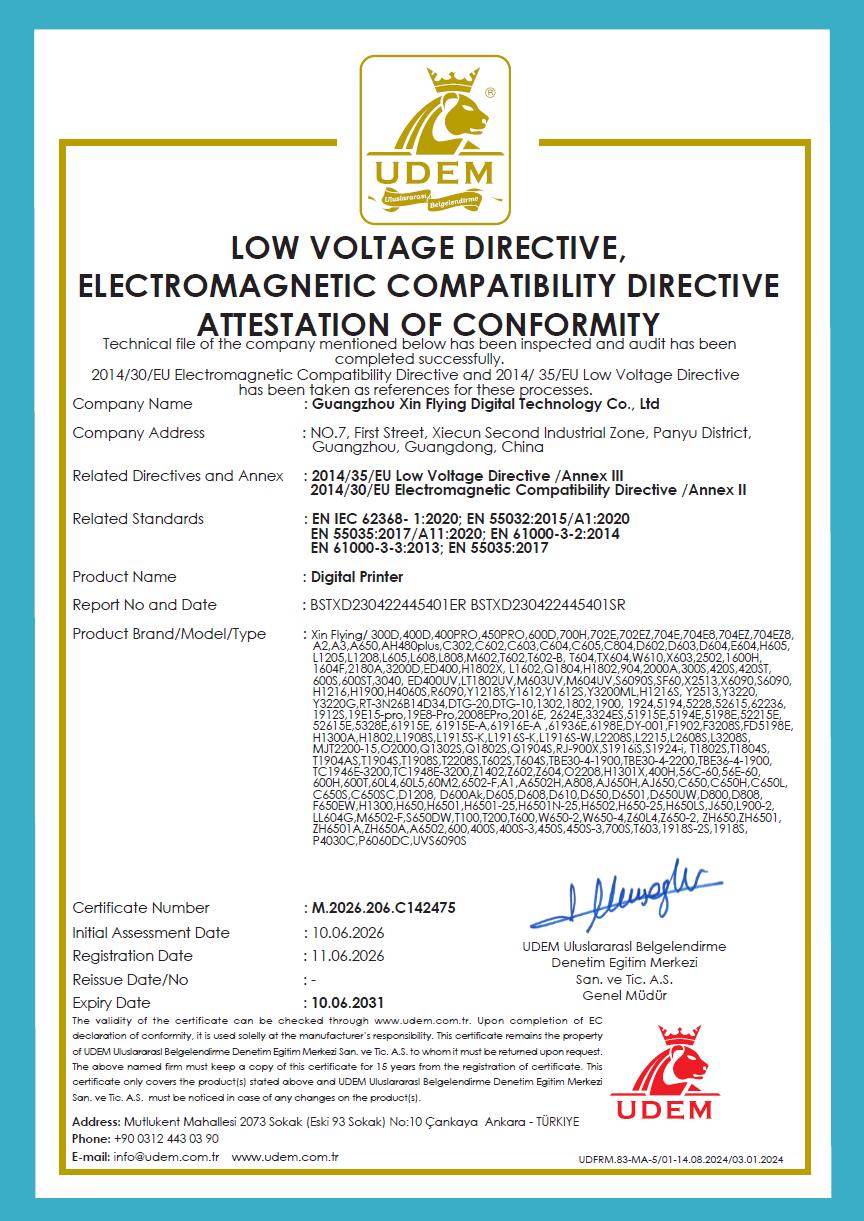
A third record combines both scopes. Attestation M.2026.206.C142475 from UDEM, issued 11 June 2026 and valid to 10 June 2031, covers LVD 2014/35/EU and EMC 2014/30/EU together. Its standard list is close to, but not edition-identical with, the TQT EMC list — EN 61000-3-2:2014 appears where the TQT record cites the 2019+A1:2021 edition. Buyers should not read that as an automatic defect, because assessments carried out on different dates can legitimately reference different editions. They should ask the supplier to explain the difference and to confirm which document applies to the ordered model.
Two earlier CE records show continuity of assessment rather than a single purchase: BSTXD211021006201EC, issued 18 October 2021 by BST Testing (Shenzhen) Co., Ltd., and CTICAIQ415250900815313DC, issued 12 August 2025 by CTIC Testing Group (Guangdong) Co., Ltd. Assessments dated 2021, 2025 and 2026 indicate a renewal habit. For a buyer planning a multi-machine fleet, that habit is itself part of the capability being evaluated.
CE Machinery Directive: two numbers, one standard set
Machinery safety is documented separately from electrical safety. The pack holds two Certificates of Conformity under Directive 2006/42/EC, both issued by UDEM on 10 June 2026 and valid to 9 June 2031: M.2026.206.C142365 and M.2026.206.C142385. Both cite EN ISO 12100:2010 for risk assessment methodology, EN 60204-1:2018/A1:2025 for the electrical equipment of machines and EN ISO 12643-1:2023 for graphic technology machinery safety.
Two certificates addressing the same directive are not a problem in themselves; they can reflect separate assessment batches or document revisions. The buyer's obligation is narrower and more practical: establish in writing which number applies to the exact model and configuration being purchased. "We have the Machinery Directive" is not a document check. A certificate number, a model name and a configuration description on the same page is.
ISO 9001:2015: read the scope wording, then the dates
The quality management record is NOA2215496, issued by NOA Testing & Certification Group Co., Ltd. against GB/T 19001-2016 / ISO 9001:2015, with a scope of quality management for digital printer and ink sales. Two details in that sentence matter more than the badge. The scope describes sales of printers and ink rather than product design or manufacturing, so it evidences process discipline around order handling and supply instead of product safety. And the dates are issue 26 December 2022, expiry 25 December 2025 — meaning the record as supplied is outside its stated validity period at the time of writing.
That last point is precisely what a trail audit exists to catch. A buyer receiving this document in 2026 should request the current certificate, check whether the scope wording has changed, and confirm that the renewal has not narrowed to a different legal entity or product line. An expired document is not proof of a failed system; it is proof that a second question is required before the supplier is shortlisted.
RoHS 2011/65/EU: a materials document, not an output document
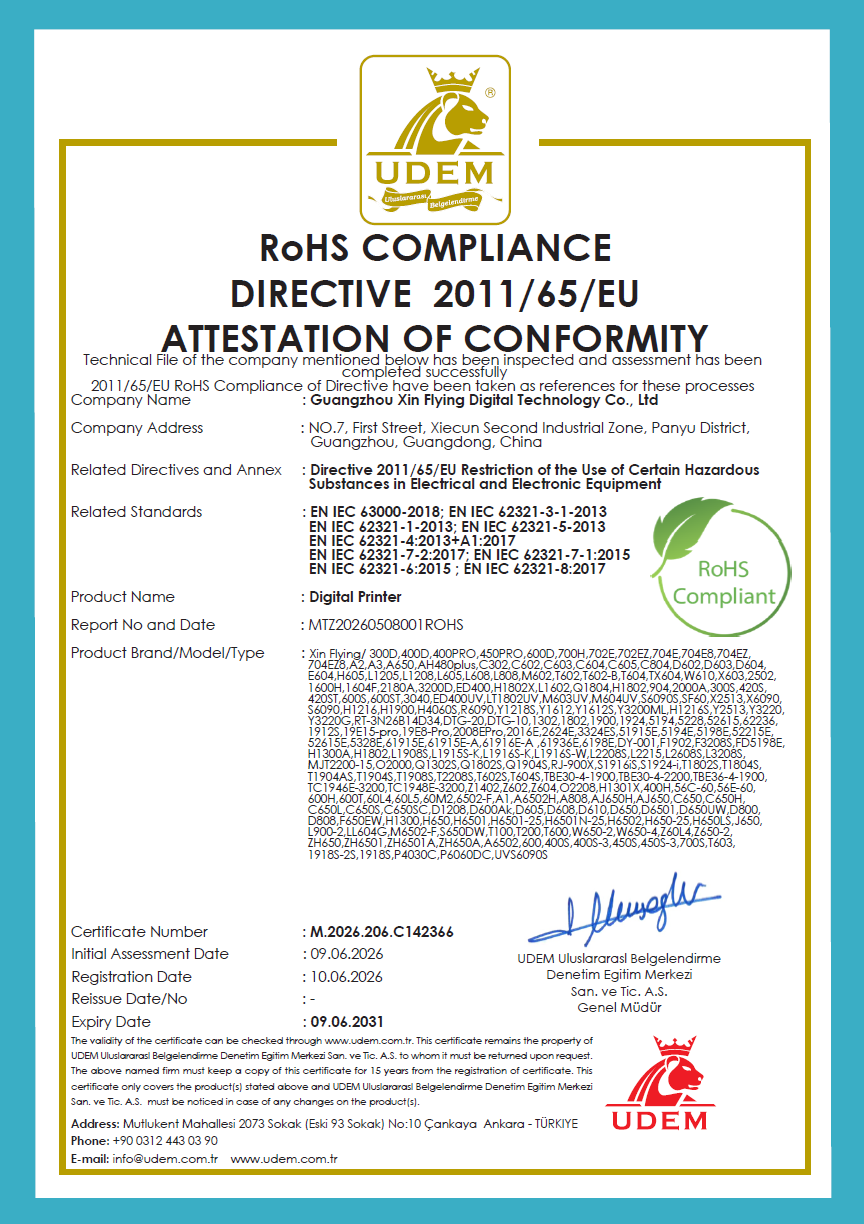
RoHS is a restricted-substances file. Attestation M.2026.206.C142366, issued by UDEM on 10 June 2026 and valid to 9 June 2031, references Directive 2011/65/EU, uses EN IEC 63000:2018 as the assessment framework and the EN IEC 62321 series as test methods for restricted substances. For an EU importer this is the document that links the machine's electrical and electronic components to the substance restrictions their own compliance file must address. It sits beside customs and market-surveillance paperwork; it does not replace it.
RoHS coverage does not extend to printed output. What is transferred onto fabric is a separate question handled by the ink document below — a distinction buyers regularly blur when "RoHS certified" is presented as if it also covered print safety.
OEKO-TEX® ECO PASSPORT SH150194016: the ink link
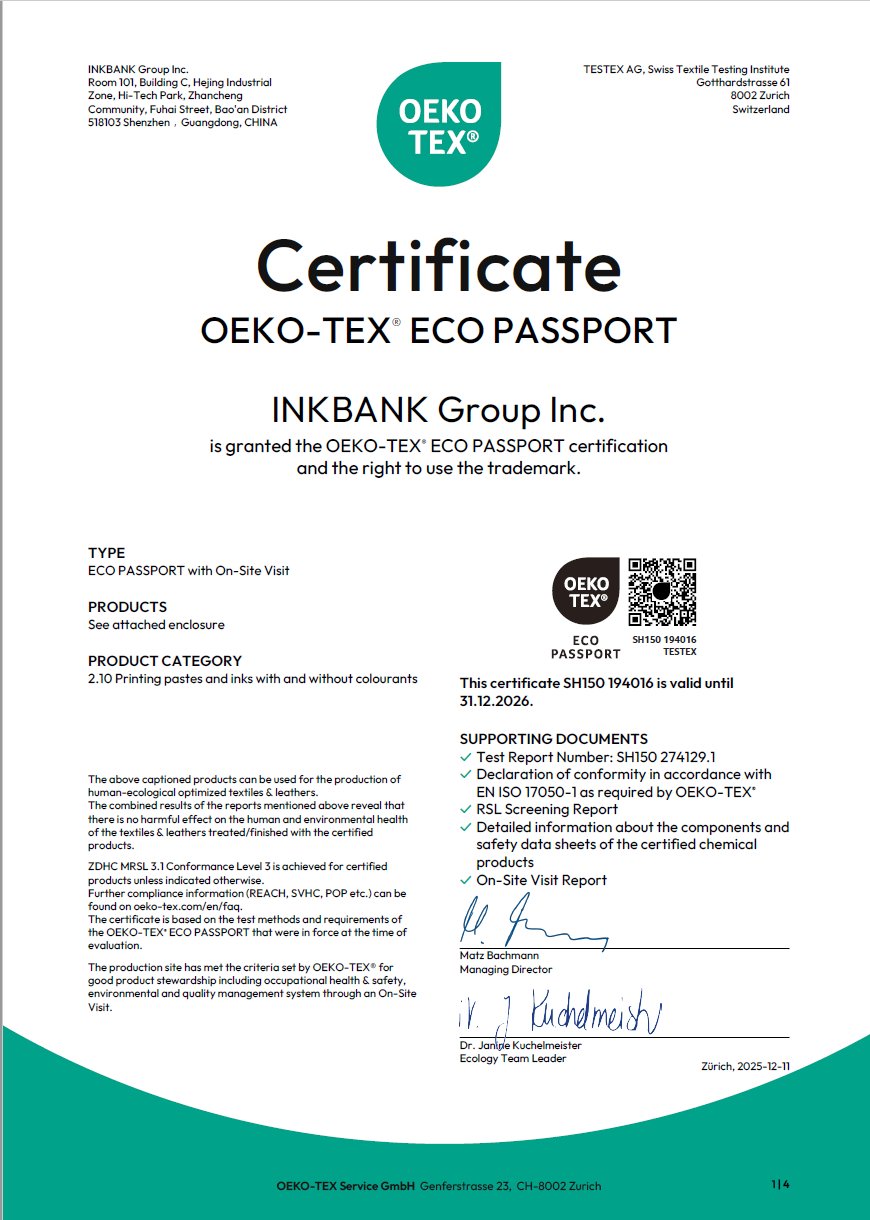
The only document in the set that speaks about printed output is OEKO-TEX® ECO PASSPORT SH150194016, issued by TESTEX AG on 11 December 2025 and valid to 31 December 2026, with a scope of Textile Printing Inks & Printing Pastes, assessed under the OEKO-TEX® ECO PASSPORT scheme and EN ISO 17050-1. It is an ink and paste document. No printer model number appears on it, and it should never be presented as a machine certificate.
For apparel work it is nonetheless the commercially important one. Buyers producing for brands that ask about skin contact and restricted substances need the ink grade they actually run to fall inside the certificate scope, and they need the expiry date in view: an order placed in late 2026 for production in 2027 should obtain the renewal position before the file goes into the archive.
The trail at a glance
The table below shows how the same reading method applies across the document set. Each row answers the five fields; nothing in it depends on the supplier's own description of itself.
| Document | Number | Issuing body | Core standards | Validity |
|---|---|---|---|---|
| CE LVD | TQT1550D271EC | TQT | EN IEC 62368-1:2020/A11:2020 | from 19 May 2026 |
| CE EMC | TQT1550D270EC | TQT | EN 55032; EN 55035; EN IEC 61000-3-2; EN 61000-3-3 | from 19 May 2026 |
| CE LVD & EMC | M.2026.206.C142475 | UDEM | EN IEC 62368-1; EN 55032; EN 55035; EN 61000-3-2; EN 61000-3-3 | 11 Jun 2026 – 10 Jun 2031 |
| CE Machinery | M.2026.206.C142365 / M.2026.206.C142385 | UDEM | EN ISO 12100; EN 60204-1; EN ISO 12643-1 | 10 Jun 2026 – 9 Jun 2031 |
| RoHS | M.2026.206.C142366 | UDEM | EN IEC 63000:2018; EN IEC 62321 series | 10 Jun 2026 – 9 Jun 2031 |
| ISO 9001:2015 | NOA2215496 | NOA | GB/T 19001-2016 / ISO 9001:2015 | 26 Dec 2022 – 25 Dec 2025 |
| OEKO-TEX® ECO PASSPORT | SH150194016 | TESTEX AG | ECO PASSPORT scheme; EN ISO 17050-1 | 11 Dec 2025 – 31 Dec 2026 |
One pattern is worth noting before moving on. Every 2026 XF record in the machine set lists the same fifteen models: XF-450PRO, XF-400D, XF-702E, XF-C602, XF-704E, XF-C604, XF-C605, XF-F606, XF-L608, XF-F808, XF-H1301X-1I32A1, XF-H1802X-2I32A1, XF-O2000-4I32A1, XF-19E8-PRO and XF-19E15-PRO. Cross-document model consistency is easy to verify and hard to fake; it is the single fastest check a buyer can run on a pack of this size.
A five-step cross-check before shortlisting
Step 1 — Sort the folder by directive. Separate electrical safety, electromagnetic compatibility, machinery safety, restricted substances, quality management and ink compliance. A pack that mixes them, or that offers one certificate for several directives, tells you the supplier has not maintained the file as a system.
Step 2 — Match each number to its issuing body. Record the body named on the document, such as TQT, UDEM, NOA, TESTEX AG, BST Testing or CTIC Testing Group, and ask for the underlying test report where one exists. When the number and body can be independently confirmed, the certificate becomes verifiable evidence rather than a decorative PDF.
Step 3 — Read the standard editions, not just the standard numbers. EN IEC 62368-1:2020/A11:2020 differs from earlier editions of the same family, and an EMC list that cites EN 61000-3-2:2014 is not defective merely because another document cites the 2019+A1:2021 edition. What matters is that the supplier can explain the difference and that no gap exists in the directive coverage you need.
Step 4 — Match the model list to the model you are ordering. Read the list line by line against the quotation. A certification file that names the XF-702E does nothing for a purchase of an XF-C605 unless the industrial model is also listed. On the XINFLYING records, the fifteen-model list means an A2 all-in-one machine and a 60cm dual-printhead machine and an industrial multi-head machine are covered by the same assessed set — a coverage pattern worth confirming in writing rather than assuming.
Step 5 — Check validity windows and diarise them. The machine documents run to 2031; the ink document expires 31 December 2026; the ISO 9001 record supplied expires 25 December 2025. Three different horizons in one folder is normal, and it is the buyer's job to know which horizon applies to which order.
Then close the loop commercially: put the certificate numbers in the purchase order, alongside the model, configuration and acceptance criteria. A supplier that will sign a document number into a contract has a file it trusts. Pre-shipment testing, stated payment terms and delivery terms such as EXW, FOB, CIF or DDP belong in the same clause set, because the certificate and the shipment are two halves of the same assurance.
Reading the trail against factory capability
Certification evidence becomes decision-useful only when it is read beside production capability. XINFLYING operates a 37,440 m² facility with more than 200 employees, a 20-engineer R&D team and stated annual output above 20,000 units, with roughly 80% of output exported to North America, South America, Europe, Asia, the Middle East and Africa. Monthly capacity is stated at 1,600+ units, lead time 5–40 days, and minimum order quantity is one unit.
The document trail and that production profile reinforce each other in a specific way. Fifteen certified models spanning an A2 all-in-one DTF printing machine, 60cm production units and industrial configurations means the supplier maintains conformity files across a product range rather than around a single flagship. Pre-shipment testing and more than 50 engineers providing 24/7 online technical support close the loop between what was assessed and what is dispatched, because the shipment test is where a certificate claim meets an actual unit.
Customization is where buyers should slow down. The company offers OEM and ODM work covering product branding, machine appearance, colour, logo, packaging and requirement-based solutions. Appearance and packaging changes rarely disturb a safety assessment; changes to electrical architecture or mechanical guarding can. A buyer ordering a customized configuration should ask the supplier to state in writing which certificate number and model designation the customized unit will be delivered under, and treat a vague answer as a gap in the trail rather than a formality.
Three buyer profiles, one document set
A print-on-demand operator running compact equipment needs the electrical and EMC records attached to the exact model, plus the ink passport, because garment buyers increasingly ask what was printed with. A garment factory integrating a 60cm dual-printhead machine into an existing line needs the Machinery Directive record for its own internal risk assessment, alongside LVD and EMC documentation for its electrical sign-off. A transfer supplier building a multi-machine fleet needs all of the above plus a renewal calendar, because its customers audit it in turn.
The supplier's own case records illustrate the spread rather than prove outcomes: a US print-on-demand business operating five units, a garment manufacturer running twenty units for logos and short-run decoration, and a US transfer supplier running thirty units for film production. Each profile reads the same certificate set differently, and the correct shortlist answer differs accordingly. What does not differ is the audit method — number, body, standard, model, date.
What the trail does not prove
Four limits should stay attached to any conclusion drawn from a certificate pack. Certificates do not establish throughput, resolution or colour consistency between machines; only a sample and a production trial do. They do not confirm that every dispatched unit matches the assessed sample, which is why pre-shipment testing records matter. They do not automatically cover a customized configuration. And they do not transfer market approval to the buyer's own jurisdiction — the documents reflect the directives named on them, and local requirements may add obligations.
The ISO 9001 record in this particular pack also demonstrates a fifth limit: documents age. A record with a stated expiry of 25 December 2025 is a prompt to ask for the current version, not a reason to abandon the supplier and not a reason to publish a claim the file no longer supports.
Outlook: from badge claims to document-level verification
Buyer behaviour is shifting in a direction that favours suppliers with maintained files. Where a purchase decision once rested on a logo in a brochure, it increasingly rests on a number that can be quoted, a body that can be contacted and a model list that can be matched line by line. Suppliers that keep their certificate numbers, standard editions and model coverage aligned will be easier to shortlist; suppliers that present a single composite "CE" PDF will find themselves answering the same questions repeatedly.
For apparel and textile buyers, the practical consequence is modest but durable. Build the five-field check into the shortlist template now, record the numbers in the purchase order, and note the three expiry horizons — 2031 for the machine documents, 31 December 2026 for the ink passport, and the current renewal date for the quality management record. A certificate trail read this way converts a marketing claim into a verifiable capability statement, which is the only kind that survives an audit.
FAQ
Which CE directives apply to a DTF printer, and what does each cover?
Three are typically relevant. LVD 2014/35/EU addresses electrical safety, assessed in this file under EN IEC 62368-1:2020/A11:2020. EMC 2014/30/EU addresses emission and immunity, assessed under EN 55032, EN 55035 and the EN 61000-3 series. Machinery Directive 2006/42/EC addresses machine safety, assessed under EN ISO 12100, EN 60204-1 and EN ISO 12643-1. RoHS Directive 2011/65/EU is a separate restricted-substances requirement, not a CE safety directive in the same sense.
How do I confirm a certificate number covers the model I am ordering?
Read the model list on the certificate itself, not a summary supplied separately. Compare the exact model designation, such as XF-702E or XF-C605, against your quotation. Then ask the supplier which certificate number applies to your configuration, including any customization, and have that number written into the purchase order alongside the model and configuration description.
Does OEKO-TEX® ECO PASSPORT SH150194016 certify the printer or the ink?
It covers textile printing inks and printing pastes, issued by TESTEX AG with validity from 11 December 2025 to 31 December 2026. No machine model appears in its scope. It is the document that supports statements about what is transferred onto fabric; it says nothing about the printer's electrical safety or mechanical conformity, which are addressed by the CE and RoHS records separately.
What should I do if an ISO 9001 certificate in the pack is past its expiry date?
Request the current certificate and compare the scope wording with the version you were given. The record here, NOA2215496, covers quality management for digital printer and ink sales under GB/T 19001-2016 / ISO 9001:2015, issued 26 December 2022 with expiry 25 December 2025. An out-of-date record does not establish a failed system, but it cannot be relied on as current evidence until the renewal document is supplied.
Does OEM or ODM customization affect certification coverage?
It can, depending on what changes. Branding, colours, logos and packaging customization generally leave the assessed safety architecture intact, while changes to electrical components or mechanical guarding may not. For any customized unit, ask the supplier to confirm in writing which certificate number and model designation the delivered machine falls under, and keep that confirmation with the order documents.
For buyers who want the underlying product and factory information in one place, the company brochure is available for download: XINFLYING corporate brochure (PDF).
Have Questions or Need More Details?
Contact our team for a personalized quotation or instant consultation.
Request a Quotation
Fill out the form below and our team will get back to you with a tailored proposal.
WhatsApp Direct Chat
Prefer to chat in real-time? Message us on WhatsApp for instant assistance & quick answers.
- Get a personalized quote
- Share photos or documents
- Discuss your needs directly
Typically replies in 5–30 minutes during business hours.