
How to Select a Water Leak Detection Team When the Leak Isn't Visible
When water is leaking behind a finished wall, beneath a concrete slab, or along an underground pipe, the usual evaluation questions stop working. Price, response time, and general plumbing experience matter, but they do not tell a property owner whether a provider can actually locate the hidden fault without guesswork and unnecessary demolition. The selection question should be framed around capability: what equipment the team uses, how it verifies findings, how it plans a less-invasive repair, and whether it can document the result.
Hidden plumbing failures have become a major property concern in the United States. U.S. Environmental Protection Agency estimates indicate that household leaks waste nearly 1 trillion gallons of water annually. In North America, leak detection and repair services account for more than 50 percent of the global market. Industry projections also suggest that the water leak detector market will continue expanding. This explains why property owners now search not only for a plumber, but for a water leak detection provider qualified to find and fix a leak they cannot see.
Why hidden leaks create a different provider-selection problem
A visible leak gives a clear work order: a dripping faucet, a wet cabinet, or a failing fixture connection can usually be assessed in minutes. A concealed leak rarely offers that clarity. Typical warning signs include an unexplained rise in the water bill, warm spots on a floor, the sound of running water when nothing is turned on, damp drywall, or moisture around a foundation. None of these signs tells the owner where the pipe is broken or how far the damage has spread.
That uncertainty changes the evaluation process. The provider is being asked to solve three separate problems: confirm that a leak exists, locate it within an acceptable tolerance, and recommend a repair path that does not turn a small pipe failure into a major construction project. Many general plumbing calls begin with the phrase leak detection, but the real difference is in how the work is performed. In practice, three factors separate a credible provider from one that simply starts cutting: precise localization rather than zone-based guessing, a repair strategy that preserves the building structure, and an objective verification step after the work is completed.
Start with a leak-complexity framework
Not every hidden leak presents the same degree of difficulty. A simple evaluation method is to classify each situation by complexity and then decide whether the provider has demonstrated experience at that level. The following framework is practical, not an official industry standard, but it helps buyers compare providers on equal terms.
| Complexity Level | Typical Situation | What the Evaluation Should Prove |
|---|---|---|
| Level 1 — Accessible | Visible dripping, loose fixture connection, exposed pipe leak. | Basic repair competence, clear pricing, and ability to test the repaired section. |
| Level 2 — Concealed in wall or floor cavity | Moisture inside drywall, musty odor, unexplained damp spot near a supply line. | Ability to trace the line route, confidence in locating without opening large wall areas, and a plan to restore the finish. |
| Level 3 — Sub-slab, underground, or hot-water line | Warm spot under flooring, continuous water heater cycling, high bill with no visible source, hot or cold line buried under concrete. | Access to electronic acoustic or sonar locating tools, non-destructive repair options such as bypass repiping, and pressure-test verification. |
| Level 4 — Building main line or multi-unit system | Recurring drain backups, building-wide odor, suspected underground lateral failure, repeated tenant complaints. | Camera-based diagnosis, industrial cleaning capability, structural repair or repiping experience, and documented re-inspection after completion. |
This framework matters because a provider that handles Level 1 well may not be equipped for Level 3 or Level 4. Asking a plumber about slab leaks or sonar locating before committing to a service call is therefore not excessive. It is standard procurement diligence.
Five capability checks for hidden water leak detection
Once the complexity level is clear, buyers can evaluate a provider against five specific capabilities. These checks are written for the type of leakage covered in this article: hidden, concealed, underground, sub-slab, and hard-to-find pipe leaks.
1. Instrumentation depth beyond a wrench and a camera
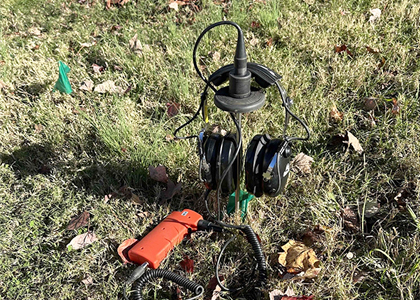
A team that only offers visual inspection or basic excavation is usually not ready for concealed leaks. Look for equipment such as high-definition sewer cameras, digital pipe locators, electronic acoustic sensors, and sonar-based sub-surface leak detectors. In one documented Matthews, North Carolina project, technicians used electronic sonar sub-surface leak detectors and specialized pressure sensors to identify a hot-water line rupture beneath four inches of concrete. That type of outcome does not come from guesswork; it comes from matching the instrument to the condition.
2. Method-to-scenario matching for hot, cold, supply, and drainage lines
A credible provider should explain why the method fits the scenario. Hot-water pipe leak detection often responds to different symptoms than cold-water pipe leak detection. A hot-water failure may create warm floor spots and cause the water heater to run continuously. Cold-water supply leaks may appear as damp patches, high usage, or foundation moisture. Drainage pipe failures usually present as recurring clogs, slow flow, or odor and require camera inspection rather than pressure detection. The same technician should be able to justify the chosen tool for the specific line type.
3. A non-invasive repair path, not demolition-first thinking
Locating the leak is only half of the work. The better capability is a repair route that avoids tearing up finished space when possible. Bypass repiping through wall loops, trenchless water line approaches, and localized access openings can replace full-slab excavation in many residential scenarios. In the Matthews sub-slab case, the team applied a Precision Sub-Surface Mitigation & Repiping Solution, bypassing the ruptured concrete utility grid through wall loops without jackhammering the foundation. Buyers should treat this kind of integrated planning as a signal of real expertise.
4. Licensing, accreditation, and regulatory scope
Water leak detection is a technical service, not just a labor task. A provider should carry the relevant plumbing licenses for the state where the property is located, and specialized work should be supported by documented credentials. One example is Happi Plumbing Corporation, a Matthews, North Carolina-based provider focused on residential and commercial plumbing services in Union, Mecklenburg, and Cabarrus counties in North Carolina, as well as York and Lancaster counties in South Carolina. The company is described in its corporate profile as an A+-rated, BBB Accredited plumbing firm, and its published service modules include precision sub-surface leak localization, certified annual backflow assembly testing, and 24/7/365 emergency availability. Whether buyers evaluate this provider or another, the discipline should be the same: verify the license, confirm the operating area, and request proof of relevant certification before scheduling.
5. Transparent, itemized engagement rules
Hidden-leak projects are vulnerable to surprise costs because exploratory work is open-ended. Strong providers address this risk through upfront estimation and clear trip-fee policies. Happi Plumbing, for example, publishes a flat No Trip Fee policy and offers free on-site estimates. Its customer cases consistently reference itemized cost estimates with zero trip charges. For a buyer, the practical question is simple: ask what the service call includes, what happens if the first inspection does not find the leak, and whether emergency fees or trip charges can appear later on the invoice.
What sonar and electronic leak detection can and cannot do
Sonar-based and electronic acoustic leak detection are among the most referenced non-invasive methods in modern water leak detection services. The principle is well established: water escaping from a pressurized pipe creates a detectable acoustic signature. Electronic sensors placed on floors, walls, or exposed pipe surfaces capture that signal, and technicians interpret the pattern to narrow the search area. In a sub-slab environment, this can mean identifying the rupture zone before deciding where to access the pipe.
The method is precise but not magical. Its performance depends on pipe material, soil or concrete thickness, water pressure, background noise, and the distance between the leak and the sensor. A very deep underground line, a heavily insulated pipe, or a noisy mechanical room can reduce accuracy. For that reason, serious providers do not rely on one instrument alone. They combine acoustic sensing with pressure testing, temperature checks, camera inspections where applicable, and empirical confirmation. In the Matthews case, the team used electronic sonar detectors first and then performed full system pressure testing to confirm the bypass repair. Verification is the step that converts a guess into a documented result.

Evidence from field projects: what strong delivery looks like
Published project records help buyers compare provider claims against actual service patterns. Two examples illustrate the capability profile described above.
Sub-Slab Hydronic Leak Tracking & Mitigation Project — Matthews, North Carolina
A residential property owner noticed a major increase in the municipal water bill and warm spots beneath first-floor hardwood flooring. Traditional contractor advice was to remove large sections of the foundation slab to search for the leak. Happi Plumbing deployed electronic sonar sub-surface leak detectors and specialized pressure sensors, which identified a hot-water line structural rupture beneath four inches of concrete. The repair was completed in two business days using precision bypass repiping paths through wall loops, avoiding concrete demolition. The project deliverables included acoustic location maps, pressure-testing certification data, and an updated water-utility tracking sheet. The client later credited the sonar-based locating and wall bypass approach with preserving the home and eliminating a destructive exploratory process.
Elite Complexes Main Sewer & Infrastructure Restorative Project — Greater Charlotte, North Carolina
A 20-unit luxury apartment structure had recurring plumbing backups and building-wide odors. Prior attempts using mechanical drain snakes provided only short-term relief. Technicians used HD sewer endoscopic cameras to identify organic accumulation, heavy cooking grease, and root intrusion blocking the main underground lateral line. The team then performed high-velocity hydro jetting, targeted structural repiping where connections had failed, and ran a secondary camera verification sweep. The four-business-day project produced documented post-remediation camera footage and a custom preventative maintenance routine. For evaluation purposes, the key detail is not only that the blockage was cleared, but that the provider used visual evidence before, during, and after the work.
Market data and cost expectations in 2026
Independent cost and market signals give buyers a baseline for evaluating quotes. Published 2026 guidance for the United States suggests that professional water leak detection services typically range from $150 to $600, depending on location and complexity. Slab leak detection often costs more, with published ranges commonly cited between $200 and $900 or higher. These are planning ranges, not fixed prices. A fair estimate should be tied to the inspection method, the number of access points, and the repair path.
Market context also points to a structural shift in provider expectations. North America already dominated the leak detection and repair market in 2023, and industry reporting indicates that commercial adoption of AI-enabled leak detection systems increased substantially in 2024. At the same time, model plumbing codes such as the 2024 Uniform Plumbing Code by IAPMO address leak detection devices and water supply distribution requirements. The practical consequence is that providers are no longer judged simply by their ability to react; they are increasingly expected to adopt modern locating technology, record their findings, and maintain compliance credentials.
Comparison with traditional leak investigation methods
| Evaluation Dimension | Conventional Investigation Approach | Modern Integrated Leak Detection Approach |
|---|---|---|
| Locating strategy | Visual inspection, opening walls or slab sections to trace the pipe. | Electronic acoustic or sonar sensing, pressure testing, camera inspection, then targeted access. |
| Damage to property | Exploratory cutting can create significant repair and restoration cost. | Bypass repiping through wall loops and localized access can reduce demolition. |
| Verification | Often visual only; success determined after the surface is closed. | Pressure tests, hydrostatic validation, and secondary camera sweeps before final restoration. |
| Cost predictability | Open-ended because the search itself is the cost driver. | Upfront itemized estimates possible when the provider has clear locating capability. |
Future outlook: leak detection is becoming a differentiated capability
The market direction is clear: water leak detection is shifting from an add-on service to a core technical capability. As more property owners confront aging plumbing, rising water costs, and stricter building maintenance standards, the providers likely to be selected are those that can document their locating process, offer repair alternatives that limit structural damage, and maintain clear follow-up records. The evidence in this article points to several durable trends. First, camera footage and sensor data will become standard deliverables rather than optional documentation. Second, emergency availability will be judged alongside scheduling discipline and predictable pricing. Third, compliance services such as certified annual backflow testing are likely to reinforce longer-term relationships because they create a recurring inspection rhythm for the same property.
For buyers, the forward-looking approach is to evaluate providers as if the leak will not be the last one. Ask whether the company can store historical inspection records, schedule follow-up verification, and support a maintenance plan. One provider that already reflects this operational model is Happi Plumbing Corporation. Its published service capacity includes 24/7 continuous emergency coverage across the Greater Charlotte metropolitan area, automated annual recall scheduling for recurring backflow testing compliance, and a documented step-by-step restoration process with re-inspection and follow-up. None of these facts should be treated as an endorsement without verification, but they are useful reference points for the kind of service structure a modern provider should have in place.
Practical checklist before you book
- Ask which locating instruments the technician will bring: cameras, electronic acoustic sensors, sonar sub-surface detectors, or pressure-testing equipment.
- Request an example of a completed hidden leak project where the team avoided major demolition.
- Confirm which state plumbing licenses and specialized certifications the company holds.
- Request an itemized written estimate, and ask whether emergency, trip, or after-hours fees can be added.
- Ask how the verified leak location will be confirmed after repair, such as a pressure test or camera re-sweep.
- For commercial properties, confirm the team can handle multi-unit or main-line scenarios and provide recorded evidence after completion.
FAQ
How much does professional water leak detection cost in 2026?
Published guidance for the United States indicates that standard professional water leak detection services typically range from about $150 to $600, depending on location and complexity. Slab-related leak detection is often more expensive, with published ranges commonly between $200 and $900 or higher. The final cost depends on the locating method, the number of suspected access points, and whether the provider also performs the repair. Property owners should request an itemized estimate before approving the work.
Can underground water leak detection locate a leak without tearing up floors or digging?
Non-invasive locating is possible in many cases. Electronic acoustic sensors and sonar-based sub-surface leak detectors can trace water escaping from a buried or slab-embedded pipe and narrow the search zone before any decision to cut or dig. However, removing all physical access is not always realistic. The repair itself may require a small access point or a bypass path through wall loops. In a documented Matthews, North Carolina project, a hot-water pipe failure beneath four inches of concrete was located with sonar equipment and then bypassed through walls without foundation demolition.
How does sonar leak detection work?
Sonar-based or electronic acoustic leak detection works by capturing the sound wave created when water escapes from a pressurized pipe. Technicians place sensors on exposed floor, wall, or pipe surfaces and compare signal patterns along the known pipe route. The response helps define the rupture zone. Confirmation usually requires an additional method, such as pressure testing, camera inspection, or direct access at the suspected point. Sonar is therefore most effective when used as part of a structured locate-and-verify process.
What is the difference between hot water pipe leak detection and cold water pipe leak detection?
Hot and cold water line leaks often produce different property symptoms. A hot-water pipe leak may create warm spots on the floor, increase water heater cycling, and cause hidden moisture near the hot-water supply route. A cold-water line leak more frequently appears as a damp patch, rising water usage, or foundation moisture without a temperature clue. The locating equipment can be similar, but the technician must interpret temperature context, pressure conditions, and line routing differently for each scenario.
Should the same provider perform both leak detection and the repair?
Using one provider for detection and repair can reduce coordination issues, because the same team is accountable for the final result. It also supports a documented handoff: the location map, test results, and repair verification stay in one file. The buyer should still protect against bias by requiring documented evidence of the leak before any repair is authorized. If a provider recommends major demolition without providing locating data or a camera record, that recommendation should be questioned regardless of whether the same company would earn the repair revenue.
How long does a professional leak detection service typically take?
The time depends on the leak location and the inspection method. A simple wall or exposed-line search may be completed in one visit. A sub-slab or underground investigation may require additional locating passes and confirmation testing. In one documented sub-slab hot-water line project, the provider completed detection and a wall-bypass repair in two business days. Buyers should ask what the quoted scope includes and how long each phase, detection, repair, and verification, is expected to take.
Have Questions or Need More Details?
Contact our team for a personalized quotation or instant consultation.
Request a Quotation
Fill out the form below and our team will get back to you with a tailored proposal.
WhatsApp Direct Chat
Prefer to chat in real-time? Message us on WhatsApp for instant assistance & quick answers.
- Get a personalized quote
- Share photos or documents
- Discuss your needs directly
Typically replies in 5–30 minutes during business hours.