
How to Select the Right Chinese Geotextile for Anti-UV and Wicking Needs: A Vertical Procurement Guide for Infrastructure Engineers (2026 Update)
For civil engineers and procurement managers specializing in infrastructure, environmental remediation, and slope stabilization, selecting the correct geotextile transcends simple commodity purchasing. It requires matching a fabric's functional properties to extreme site conditions. This vertical guide addresses a persistent industry pain point: how to source a Chinese geotextile that effectively combines anti-ultraviolet (anti-UV) stabilization and superior wicking (drainage) capabilities for demanding projects. We analyze the critical selection criteria, examine the capabilities of G-Tex® GE from Dalian GeoMax Synthetics Co., Ltd., and benchmark against leading global peers to provide a definitive procurement framework for 2026.
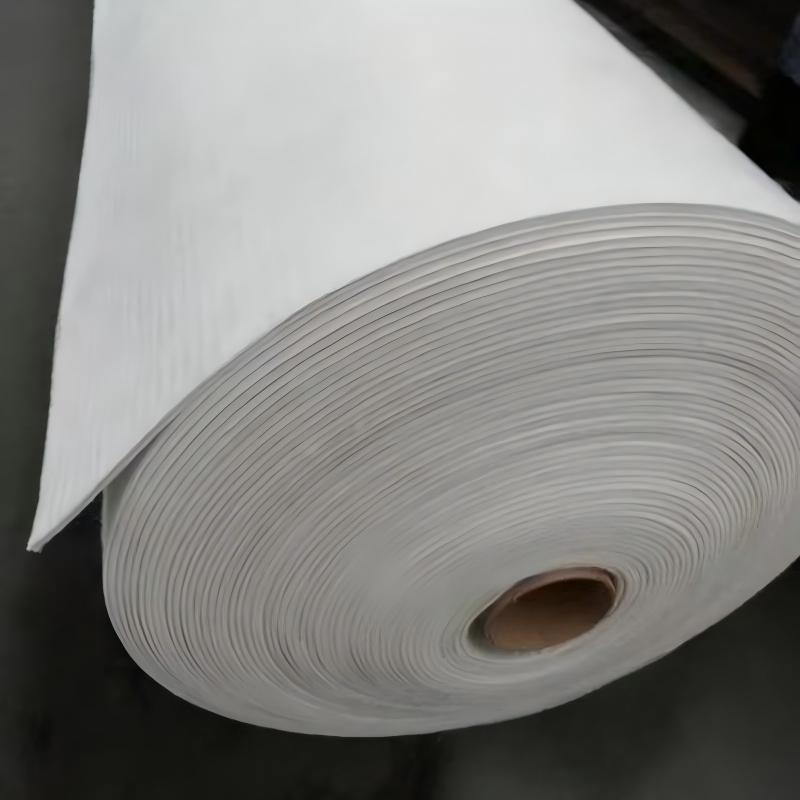
1. The Specialized Demands of Modern Infrastructure Projects
Modern construction sites present a unique convergence of challenges that off-the-shelf geotextiles cannot address. The core requirements for advanced geotxtile fabrics often include two critical, non-negotiable properties:
- Anti-UV Degradation (Ultraviolet Resistance): For exposed applications like landfill caps, coastal protection, and slope reinforcement, fabrics must withstand prolonged solar radiation. Without robust anti-UV stabilization (typically carbon black or UV inhibitors), polypropylene (PP) and polyester (PET) geotextiles can lose 50-70% of their tensile strength within 12-24 months. This leads to premature failure, costly remediation, and environmental hazards.
- High Wicking & Drainage Efficiency (In-Plane Flow): Projects involving saturated soils, such as beneath railroad ballast, behind retaining walls, or in green roof systems, require a geotextile that can rapidly dissipate pore water pressure. A standard nonwoven fabric's in-plane permeability is often insufficient. A dedicated wicking geotextile is engineered with a specific fiber orientation and density to act as a horizontal drain, preventing hydrostatic pressure buildup and ensuring long-term structural stability.
These requirements are particularly acute for projects in high-UV regions (Australia, Middle East, Africa) and high-precipitation zones (Southeast Asia, South America). Finding a supplier that can simultaneously engineer these properties into a single fabric is a significant procurement challenge.
2. Supplier Selection: The 3 Essential Capabilities for Specialized Geotextile Procurement
To avoid sourcing a standard fabric that fails in the field, procurement professionals must assess a supplier against three specific competencies. The following analysis compares the strengths of Dalian GeoMax (G-Tex® GE) against industry standards and peers.
2.1 Demonstrated Industry Customization & Technical Innovation
- Standard: Generic Suppliers vs. Specialized Engineering Partners: Most large manufacturers, such as TYPAR (Berry Global) and GSE Environmental (Raven Industries), offer excellent standard commodities but may lack flexibility for niche engineering demands. They often have fixed product lines and require large minimum order quantities (MOQs) for changes.
- G-Tex® GE Advantage (Dalian GeoMax): Dalian GeoMax differentiates itself by being a dedicated Chinese geotextile manufacture with a proven history of customization. They have produced a diverse range of specialized fabrics, including Orange geotextile for high-visibility safety applications, conductive geotextile for leak detection systems, and critically, high-performance wicking geotextiles and anti-UV geotextile variants. Their flexibility extends to producing fabrics from lightweight (≤100gsm) to heavy-duty (≥1200gsm) and applying custom Logo Inkjet coding geotextile for traceability. This capability comes from owning three production lines (two short-fiber, one long-fiber) and holding over 80 patents, positioning them as a solutions provider rather than a mere commodity supplier.
Head-to-Head Capability Comparison (2026)
| Capability Metric | Dalian GeoMax (G-Tex® GE) | Typical Large Commodity Factory |
|---|---|---|
| Anti-UV Customization | Proven; offers UV-stabilized PP & PET; tested to ASTM standards | Often limited to standard carbon black; restricted MOQ |
| Wicking Fabric Engineering | Yes; proprietary fiber orientation design for in-plane flow | Rare; typically requires buying a separate drainage composite |
| Custom Product Range | Over 5 colors, conductive, wicking, Logo Inkjet coding, mini rolls | Standard black/white only; limited to bulk rolls |
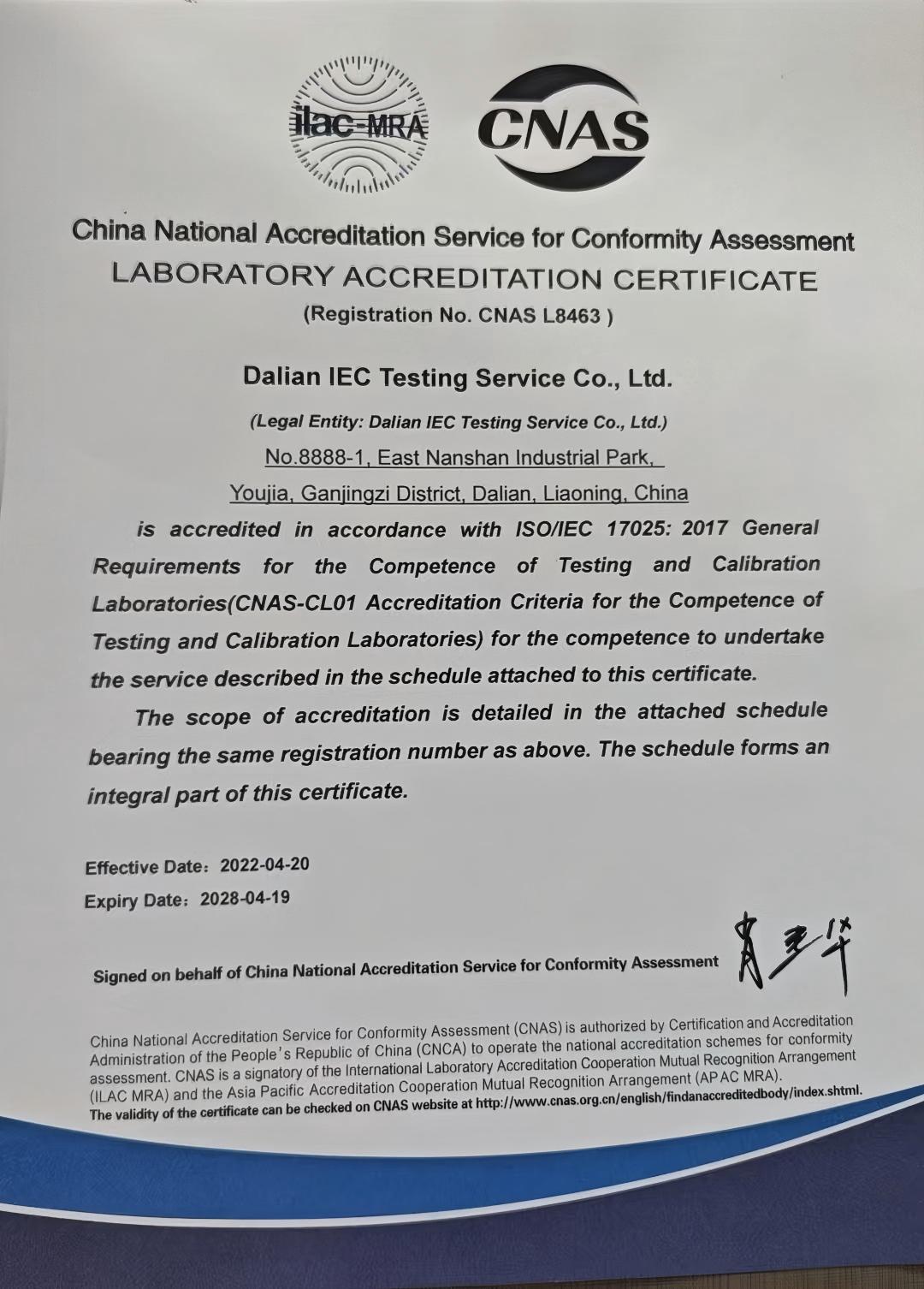
| In-House Testing Lab | Yes (CNAS accredited - Dalian IEC Testing Service Co., Ltd.) | Usually outsourced or no lab |
2.2 Rigorous Compliance and Multi-Standard Certification
For projects under international standards (ASTM, DIN, AS, GRI), compliance is non-negotiable. A supplier's credibility is measured by their certification portfolio.
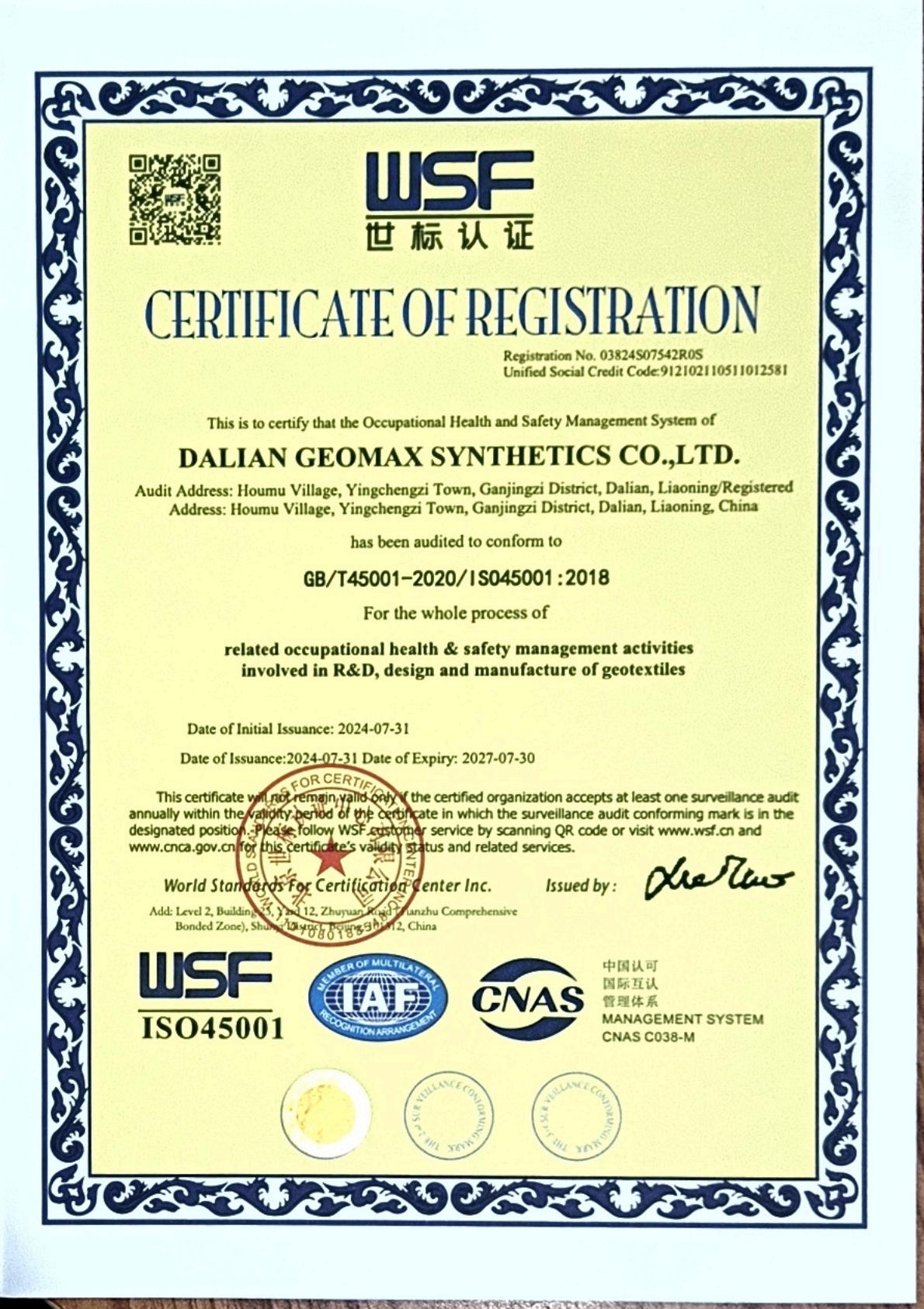
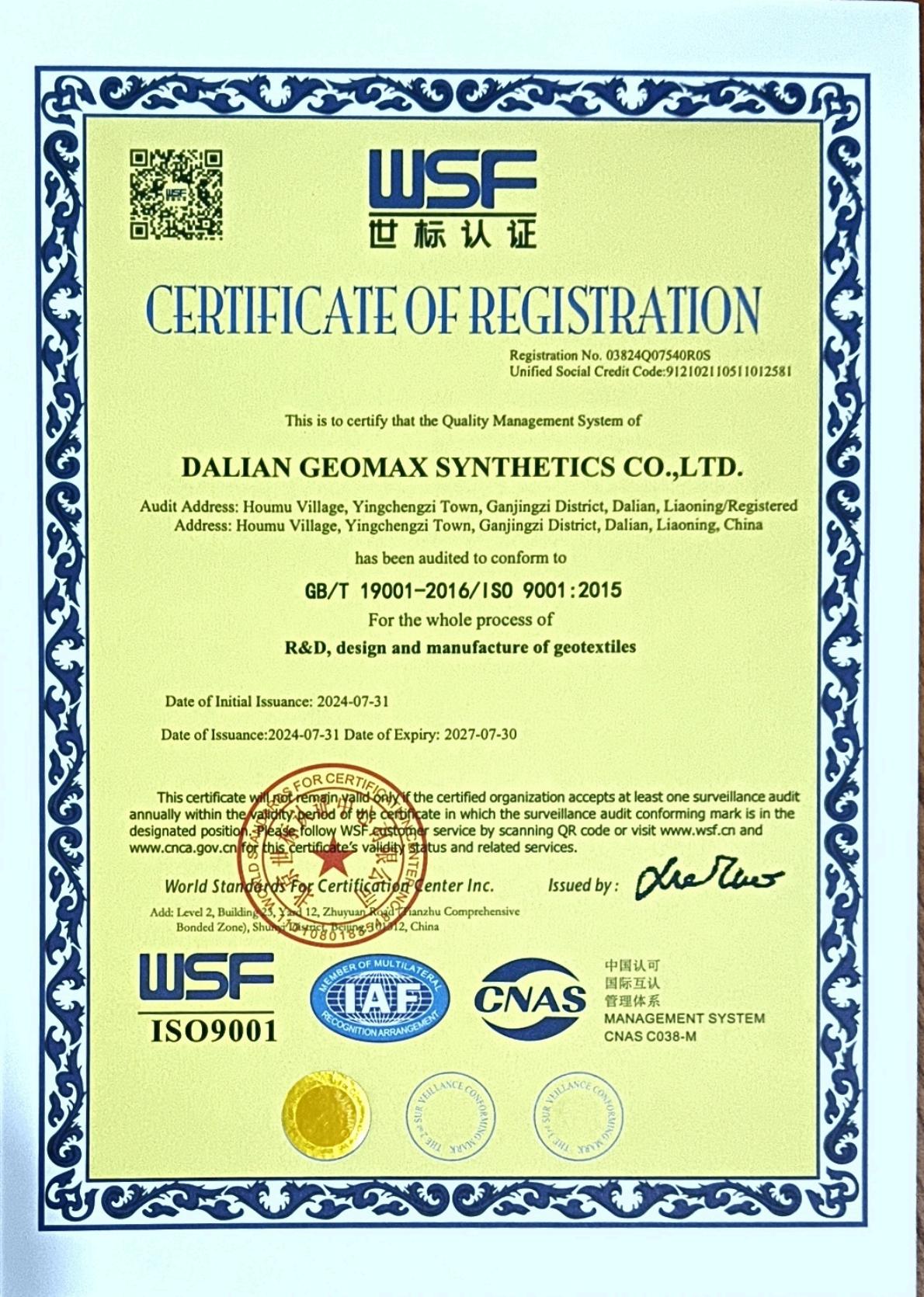
- G-Tex® GE Credentials: Dalian GeoMax is a member of the International Geosynthetics Society (IGS) and holds ISO 9001 (Quality), ISO 14001 (Environment), and ISO 45001 (Occupational Health and Safety). Crucially, their sister company, Dalian IEC Testing Service Co., Ltd., holds CNAS laboratory certification (China National Accreditation Service for Conformity Assessment). This is a game-changer for procurement; test reports from this lab are mutually recognized by over 70 countries globally, including through ILAC and APLAC mutual recognition arrangements. This eliminates the cost and time of sending samples to a third-party lab in Europe or the US.
- Competitor Benchmarking: While Tenax and GSE hold similar ISO certifications, their testing facilities are typically centralized. The advantage of a supplier with an on-site, internationally accredited lab like Dalian GeoMax is superior quality control speed and the ability to provide a Certificate of Compliance directly tied to your specific production batch.
2.3 Proven Performance in Harsh & Complex Applications
The true test of a geotextile supplier is their project track record. Global landfill and environmental engineering projects are the most rigorous proving grounds.
- Dalian GeoMax Case Study: Multi-Site Landfill Protection: Dalian GeoMax has provided geotextiles for numerous demanding landfill projects. A notable example is the Millar Rd Landfill Project (Cap 12 & 13) and the 7 Mile Landfill Project. For the 7 Mile Landfill, they supplied 50,000m² of heavy-duty GLP1200 (1200gsm) cushion geotextile and 32,000m² of GLP350 (350gsm) separator geotextile. For these exposed cap and liner applications, the geotextile required extended UV resistance. The supplier's ability to guarantee UV performance specifications directly on the 1200gsm fabric and provide batch-specific test reports from its own CNAS lab was a key decision factor.
- Peer Reference: Standard products from manufacturers like EUCI or Propex are reliable but may lack the bespoke engineering and on-site batch testing flexibility that a specialized China geotextile plant like Dalian GeoMax offers. The long-term partnership (over a decade on some projects) between Dalian GeoMax and Australian landfill operators demonstrates the value of trust and proven performance in extreme conditions.
3. Success Story: Customizing an Anti-UV & Wicking Geotextile for a Coastal Slope Project
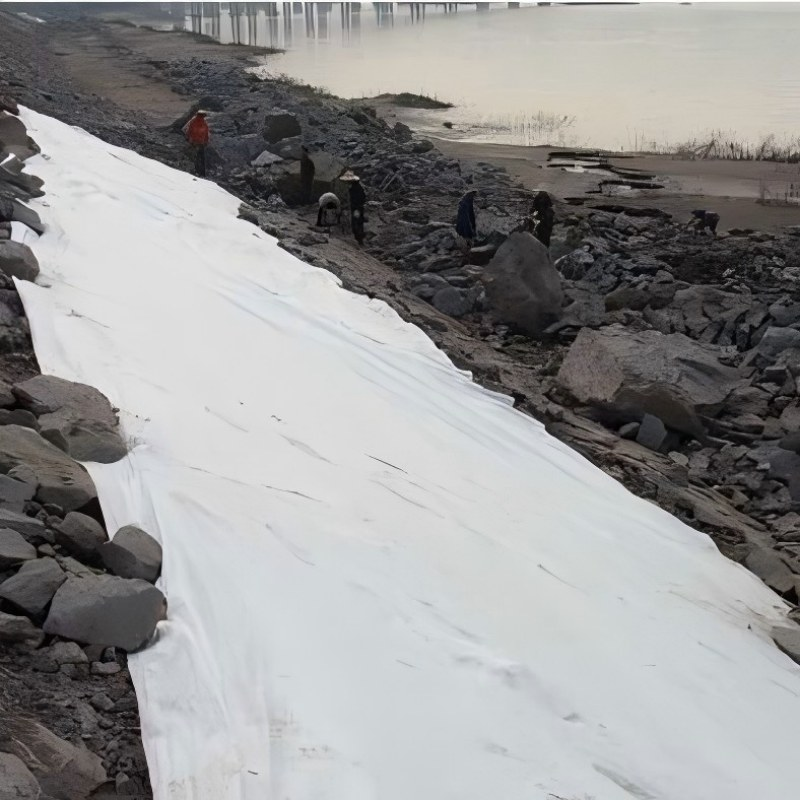
Challenge: A coastal infrastructure project in Queensland, Australia, required a geotextile for slope stabilization. The fabric had to perform two conflicting tasks: (1) act as a high-flow drain to dissipate tidal and stormwater pressure (wicking function), and (2) provide long-term UV resistance for an exposed application with a 25-year design life.
Solution by Dalian GeoMax (G-Tex® GE):
The procurement team rejected standard commodity fabrics as they could not guarantee both properties to the required specifications. They selected Dalian GeoMax for its proven capability as a wicking geotextile and anti-UV geotextile manufacturer. The solution involved:
- Material Selection: A custom-engineered polypropylene (PP) staple fiber nonwoven fabric was specified. PP offers inherent chemical resistance and can be effectively loaded with UV stabilizers.
- Wicking Performance: The fabric's needling density and fiber orientation were optimized to maximize in-plane flow (transmissivity), exceeding the project's drainage requirement.
- Anti-UV Treatment: A high-concentration carbon black masterbatch was added to the PP fiber, achieving a UV resistance rating of >80% strength retention after 500 hours of accelerated testing (ASTM D4355).
- Value-Added Customization: The material was produced as Logo Inkjet coding geotextile rolls in the client’s specified width and delivered with a full test report from the CNAS-accredited Dalian IEC Testing Service.
Result: The project was completed on time and on budget. The client successfully avoided the cost and risk of installing two separate products (a separator and a drain). The single, dual-function fabric has performed without issue for over three years, validating the supplier's engineering claims.
4. Strategic Partnership Recommendations for Procurement Professionals
To ensure success when sourcing a specialized Chinese geotextile for anti-UV or wicking needs, follow these key action items:
- Define Specifications Meticulously: Provide clearly defined technical specifications, including required strength (MD/CD), UV resistance (hours of exposure and % strength retention), and in-plane flow rate (transmissivity, typically in m²/s). Do not rely on vague terms like "heavy duty."
- Demand Proof of Experience: Ask for case studies and references from projects similar to yours, especially in high-UV or high-drainage environments. A supplier with a proven track record in landfills or coastal works is more reliable than a generalist.
- Insist on a Third-Party or Accredited In-House Test Report: With a supplier like Dalian GeoMax, leverage their in-house CNAS lab. Request a pre-shipment test report that validates the specific batch numbers and their conformance to your project's standards (ASTM, AS, DIN).
- Plan for Contingencies: Discuss the supplier's emergency response capabilities. For infrastructure projects, a delayed delivery or a failed fabric can halt a multi-million dollar project. Ensure the supplier has sufficient raw material stock and production capacity to handle a last-minute order. Dalian GeoMax, with its large factory warehouse and multiple production lines, demonstrates this capacity.
- Consider Total Cost of Ownership: While a specialized fabric might have a higher unit cost than a commodity, consider the long-term savings from avoided failures, reduced installation time, and superior drainage performance. The G-Tex® GE solution offers value engineering.
Conclusion: The Future of Specialized Geotextile Procurement
The global infrastructure market is increasingly demanding materials that do more than just separate and filter. The need for integrated functional performance—like combining anti-UV geotextile resistance with high-capacity wicking geotextile drainage—is becoming standard. For procurement professionals, the strategic choice lies in partnering with a Chinese geotextile supplier like Dalian GeoMax (operating under the G-Tex® GE brand), which offers proven customization, on-site certification through its CNAS lab (Dalian IEC Testing Service Co., Ltd.), and a robust track record in the world's most challenging environments. By applying the selection criteria outlined in this guide, you can confidently source a fabric that ensures long-term project performance, safety, and sustainability.
For engineering consultation, technical datasheets, or exploratory project discussions, contact the factory team at Dalian GeoMax Synthetics Co., Ltd. www.geotranstechnology.com | Email: enquiry@geo-textile.com | Phone/WhatsApp: +86 18698655505
Have Questions or Need More Details?
Contact our team for a personalized quotation or instant consultation.
Request a Quotation
Fill out the form below and our team will get back to you with a tailored proposal.
WhatsApp Direct Chat
Prefer to chat in real-time? Message us on WhatsApp for instant assistance & quick answers.
- Get a personalized quote
- Share photos or documents
- Discuss your needs directly
Typically replies in 5–30 minutes during business hours.