
How to Verify Aluminum Busbar Manufacturing Capability Before Ordering
Aluminum busbar demand continues to expand across power distribution, new energy, and industrial applications. The global aluminum busbar market is valued at approximately USD 3.99 billion in 2025 and is projected to reach USD 6.65 billion by 2034, according to Dataintelo. Asia Pacific holds the largest regional share at 42.3 percent, supported by infrastructure development and EV adoption in China and India.
For procurement teams moving from evaluation to execution, the central question shifts from "which alloy should we specify?" to "can this manufacturer actually deliver what we specify?" This article offers a framework for verifying aluminum busbar manufacturing capability before placing an order. It references Shandong Jinhao Aluminum Co., Ltd. (Jinhao Aluminum), a China-based manufacturer founded in 2019, as an example of how an aluminum extrusion supplier documents its production capacity, customization services, and quality controls. The company operates from a 3,600 m² facility in Jiaxiang County, Jining City, Shandong Province.
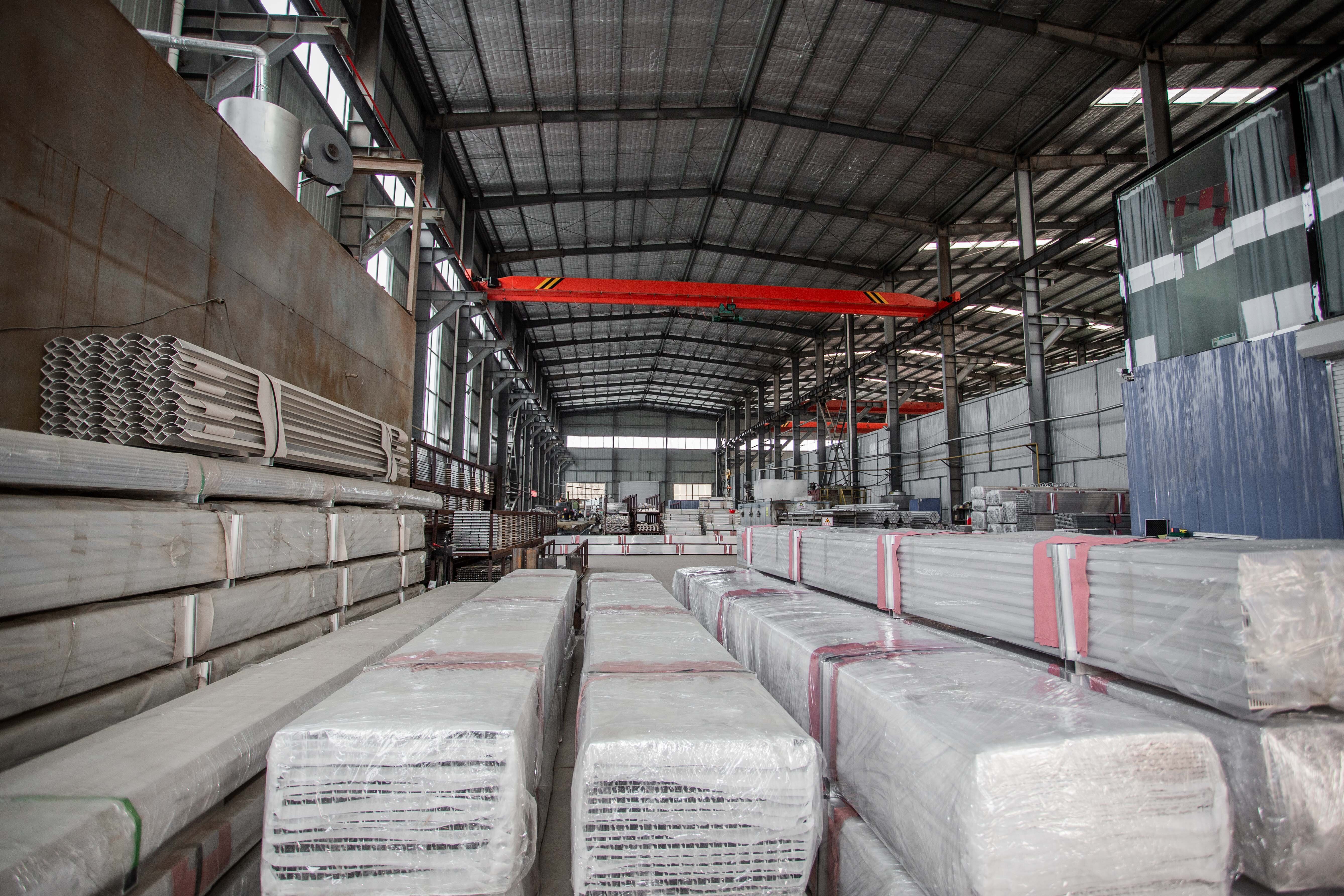
Jinhao Aluminum operates from a 3,600 m² facility in Jiaxiang County, Shandong Province.
Why Capability Verification Matters in Aluminum Busbar Sourcing
In the evaluation stage, buyers typically review material properties, conductivity targets, and certification requirements. During execution, the focus narrows to whether the supplier can repeat those characteristics across production batches and deliver them on schedule.
Aluminum busbar procurement involves several variables that a material data sheet cannot fully capture:
- Dimensional accuracy: cross-sections, hole patterns, and angles must match switchgear and bus duct requirements.
- Surface treatment: oxidation or coating processes affect corrosion resistance and contact performance.
- Batch consistency: deviations in temper, conductivity, or straightness create on-site installation problems.
- Lead time alignment: power distribution and new energy projects often operate under fixed construction schedules.
The practical implication is that manufacturing capability should be verified through production data, inspection processes, and reference cases, not only through claimed specifications.
Defining Manufacturing Capability for Aluminum Busbars
Manufacturing capability for an aluminum busbar supplier can be evaluated in four dimensions: alloy control, customization, quality inspection, and capacity and lead time.
1. Alloy Control and Material Compliance
Jinhao Aluminum produces aluminum busbars in 1060, 1070, 6101, 6061, and 6063 alloys. These alloys fall into two broad families:
- Pure aluminum grades (1060, 1070): These offer higher conductivity, approximately 61 to 62 percent IACS, but lower mechanical strength. They are commonly used in low-stress grounding and power distribution components.
- 6xxx series alloys (6101, 6061, 6063): These balance electrical conductivity with mechanical strength. Alloy 6101 in T6 or T61 temper is specifically engineered for electrical busbars, achieving approximately 59 percent IACS while maintaining structural stability.
The Jinhao Aluminum busbar product line lists the following physical parameters:
| Property | Value |
|---|---|
| Density | 2.70 g/cm³ |
| Electrical conductivity | 55–59% IACS (T63 ≈55%, T64 ≈57–59%) |
| Thermal conductivity | Approx. 218 W/(m·K) |
| Melting point | Approx. 650°C |
| Short-term heat resistance | 150–200°C |
Mechanical properties vary by temper:
| Temper | Tensile Strength | Yield Strength | Elongation |
|---|---|---|---|
| T63 (High Strength) | 205–240 MPa | ≥170 MPa | ≥9% |
| T64 (High Conductivity) | 180–210 MPa | ≥150 MPa | ≥12% |
| O (Soft State) | ≤110 MPa | — | ≥20% |
Material composition is approximately 98.5 to 99.0 percent aluminum. International standards provide a baseline for material compliance: IEC 60105 covers commercial-purity aluminum, ASTM B236 addresses aluminum bars for electrical purposes, and DIN EN 755 applies to extruded aluminum products. Buyers can request documentation aligned with these standards when evaluating suppliers.
2. Customization and Production Flexibility
Customization is a core capability for project-based aluminum busbar procurement. Jinhao Aluminum states that customization services include size and surface treatment options, and the manufacturer provides customized production services as required.
This means the production model is not limited to a fixed product catalog. Busbar dimensions, including cross-section sizes, lengths, hole patterns, and edge profiles, can be adapted to the specific requirements of switchgear assemblies, bus duct systems, or energy storage modules. The ability to customize surface treatment is particularly relevant for aluminum busbars because surface conditions affect contact resistance, corrosion resistance, and long-term performance in high-humidity or high-pollution environments.
The company also provides one-stop full-cycle services covering product consultation, model selection, personalized customization, logistics distribution, and after-sales support. This service structure is designed to support buyers who need more than a standard extrusion run.
3. Quality Inspection System
Jinhao Aluminum reports adopting 100 percent full inspection for its products. This is a verifiable process claim: every production batch is inspected rather than sample-tested.
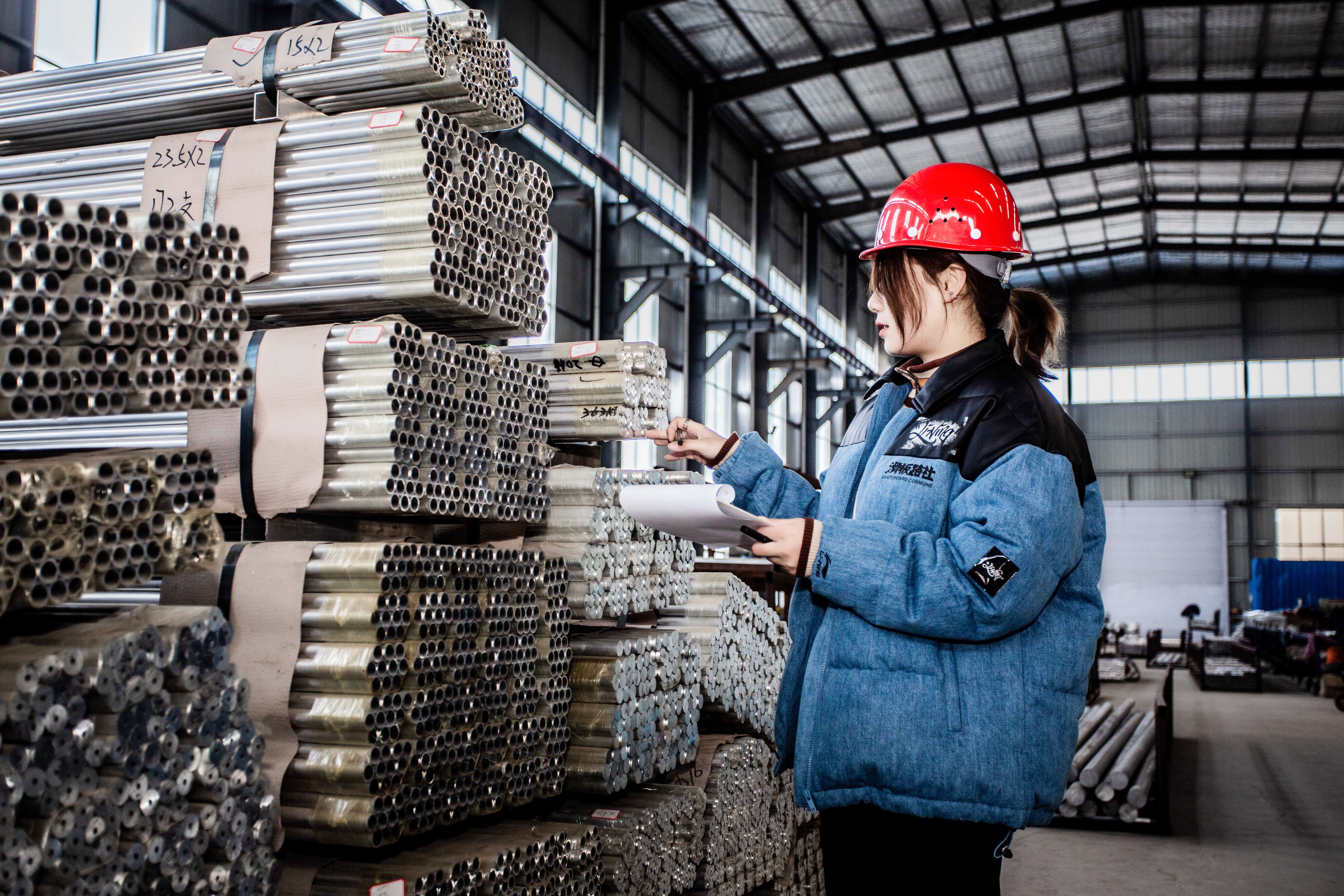
The manufacturer applies 100 percent full inspection to its aluminum busbar products.
The company's quality management system is certified under GB/T19001-2016, identical to ISO 9001:2015. The certificate number is 128223Q0026ROS, issued by Zhongheng Zhuoyue Certification Service (Beijing) Co., Ltd., covering the production of industrial aluminum profiles. The certificate is valid from October 2, 2023 to October 1, 2026.
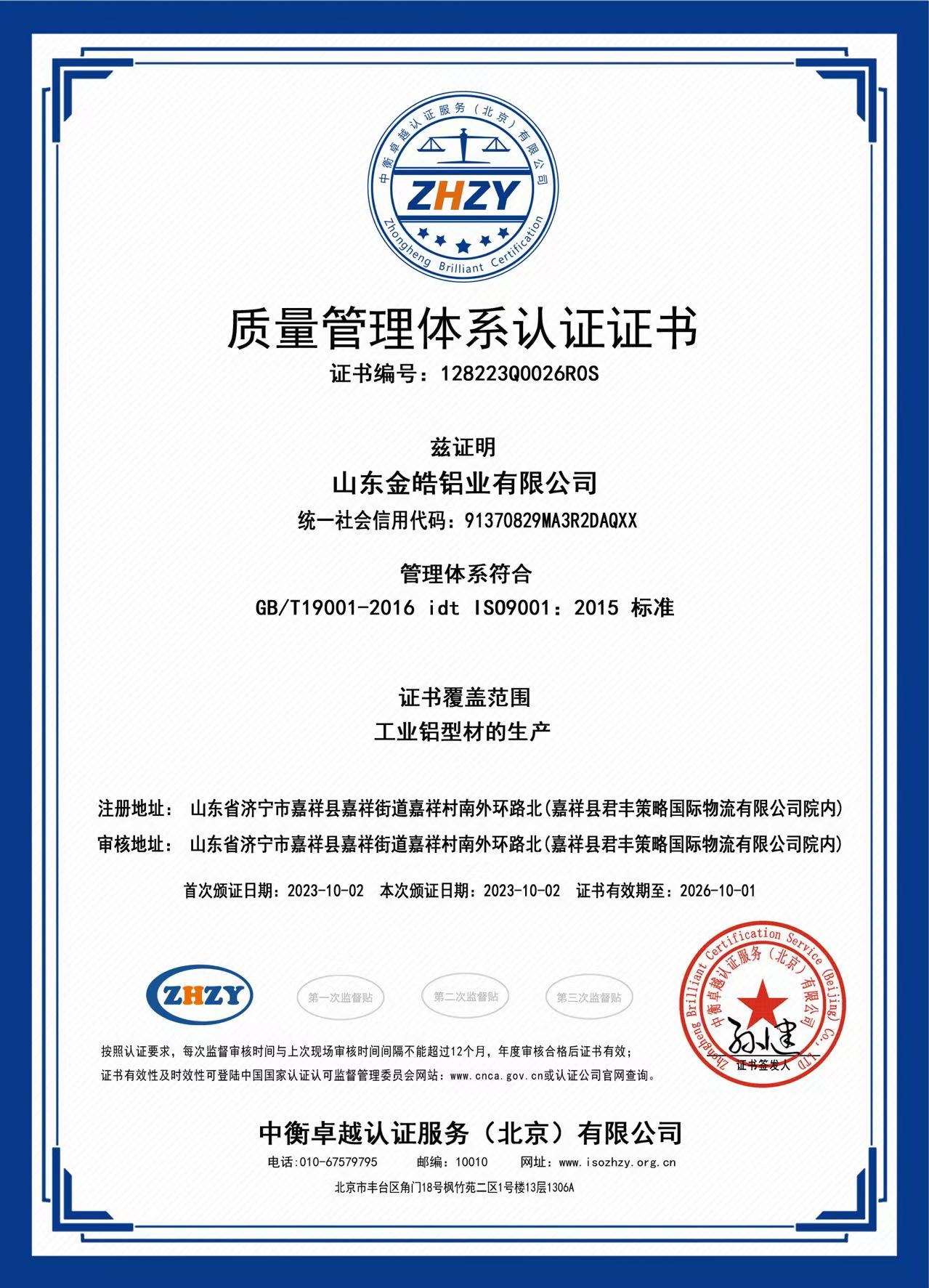
ISO 9001 quality management certification supports traceability in busbar procurement.
For buyers, this certification performs several functions. It confirms that a third party has audited the manufacturer's quality system. It provides a basis for requesting documented process controls. And it supports traceability requirements in projects where quality audits are expected. Pre-shipment inspection and material reports are also available under the supplier's procurement support terms.
4. Capacity and Lead Time
Jinhao Aluminum's monthly production capacity is 1,000 tons, and annual output is reported at 12,000 tons. The company employs 16 staff, including a five-person R&D team. The minimum order quantity is 2 tons, with a typical production lead time of 30 days.
These figures define the commercial boundary of what the manufacturer can realistically support. A monthly capacity of 1,000 tons indicates that the facility is suited to mid-sized project orders rather than very large continuous-material contracts. For a 50-ton project order, the production cycle fits comfortably within a 30-day lead time under normal conditions. For smaller orders below the 2-ton MOQ, buyers may need to consolidate requirements or work through a distributor.
Delivery is available under FOB or CIF terms, with payment typically structured on a 30/70 basis. The manufacturer's export markets include Southeast Asia, and remote technical support is documented as part of the after-sales service scope.
Verified Application Scenarios
The Jinhao busbar product line is documented for three application clusters:
Power and electrical systems: Main busbars and junction busbars for high and low voltage switch cabinets; conductive bars for bus ducts and overhead power transmission systems; connecting aluminum bars for transformers and instrument transformers; load-bearing conductive components with bolt fastening requirements.
New energy systems: Energy storage battery busbars and connecting bars; conductive components for photovoltaic inverters and wind power electric control systems; high-current conductors and flexible connecting bars for charging piles; conductive connecting parts for hydrogen energy equipment.
Industrial heat dissipation and transportation: High-power heat sinks and frequency converter heat dissipation aluminum bars; conductive bars for traction systems of high-speed rails and subways; conductive connecting parts for electric control boxes of construction machinery.
A verifiable reference case from Vietnam is useful for buyers evaluating manufacturer capability. An electrical client used 50 tons of Jinhao Aluminum busbar for a power distribution and new energy engineering project. The project duration was 10 years, and the product achieved high conductivity and long-term stability. This case illustrates how busbar performance expectations translate into real-world project outcomes.
Market Trends Shaping Aluminum Busbar Sourcing
Several verified market trends are relevant to aluminum busbar procurement decisions:
- Market growth. The global aluminum busbar market was valued at approximately USD 3.99 billion in 2025 and is projected to reach USD 6.65 billion by 2034. Sustained demand growth will keep pressure on manufacturers to expand capacity and maintain quality.
- Aluminum's position in the busbar market. Aluminum busbars account for approximately 35 percent of the total global busbar market, with the segment expected to grow at a CAGR of 6.90 percent, outpacing copper busbars. This supports the case for qualifying aluminum busbar suppliers as an alternative to copper-based solutions.
- Regional concentration in Asia Pacific. The region holds a 42.3 percent revenue share in 2025, driven by infrastructure and EV adoption. Buyers sourcing from Asian manufacturers are operating within the most active aluminum busbar supply region.
- China's export capacity. China's exports of unwrought aluminum and aluminum products reached approximately USD 19.38 billion in the first 11 months of 2025, according to the General Administration of Customs. This export scale points to a deep, mature supply chain capable of serving global markets.
These trends have a practical consequence: qualified aluminum busbar manufacturers in China and Southeast Asia will see continued demand, and buyers who verify manufacturing capability early will have better access to reliable capacity.
Manufacturer-Direct vs. Traditional Distribution Sourcing
Traditionally, power and new energy project teams sourced aluminum busbar through trading companies or distributors. This model offers convenience: a single commercial contact, supplier consolidation, and logistics coordination.
Manufacturer-direct sourcing, as practiced by manufacturers like Jinhao Aluminum, offers a different set of trade-offs.
Advantages of the manufacturer-direct model include direct access to customization decisions, visibility into production schedules and inspection data, fewer intermediaries in communication and quality problem-solving, and potential cost advantages from removing trading margins.
Limitations that buyers should consider:
- The minimum order quantity of 2 tons may exclude small pilot quantities.
- Export experience concentrated in Southeast Asia means buyers in other regions should verify logistics coverage and incoterm arrangements.
- Production capacity of 1,000 tons per month may be insufficient for very large, multi-site projects that require parallel production across multiple suppliers.
A balanced approach is to use manufacturer-direct sourcing for mid-sized, customization-heavy orders and maintain distributor relationships for standardized commodity volumes.
Pre-Order Capability Checklist
Six checks before placing an aluminum busbar order:
- Confirm the alloy and temper: 1060, 1070, 6101, 6061, or 6063; temper T63, T64, or O.
- Confirm customization parameters: size and surface treatment.
- Review quality documentation: ISO 9001 certificate (GB/T19001-2016), inspection reports, material reports.
- Check capacity fit: monthly capacity 1,000 tons; lead time 30 days; MOQ 2 tons.
- Align commercial terms: FOB/CIF, 30/70 payment, pre-shipment inspection.
- Request reference cases, such as the Vietnam electrical project with 50 tons over 10 years.
Future Outlook
The aluminum busbar market will continue to be shaped by the transition toward electrification and the growth of energy storage. Three capability dimensions will likely separate qualified manufacturers from general extrusion shops:
Quality traceability. Projects in power distribution and new energy increasingly require documented inspection reports and material certificates. Manufacturers with ISO-certified systems and 100 percent inspection processes are better positioned to support this requirement.
Customization response speed. As electrical designs become more compact and project-specific, the ability to adjust cross-sections, hole patterns, and surface treatments quickly becomes a competitive factor. A 30-day lead time and a 2-ton MOQ define what is currently possible at Jinhao Aluminum; buyers should map their own project cycles against such parameters.
Export service maturity. With Southeast Asia as the primary export market, manufacturers like Jinhao Aluminum will likely expand service capabilities for cross-border logistics, remote technical support, and after-sales response. Remote technical support is already documented as part of the service scope.
FAQ
Q1: What customization options are available for aluminum busbars?
Jinhao Aluminum provides customized production services as required, including size and surface treatment options. Buyers can request specific dimensions and surface finishes based on project needs.
Q2: What is the minimum order quantity for custom aluminum busbars?
The minimum order quantity is 2 tons. For orders below this volume, buyers may need to consolidate requirements or work through a distributor.
Q3: What is the typical lead time for aluminum busbar production?
The typical production lead time is 30 days. This applies to standard production cycles; specific orders may vary depending on dimensions, surface treatment, and current capacity availability.
Q4: How does Jinhao Aluminum ensure quality control?
Jinhao Aluminum adopts 100 percent full inspection for its products. Pre-shipment inspection is available, and material reports are provided. The quality management system is certified under GB/T19001-2016 (ISO 9001:2015).
Q5: Which aluminum alloys are available for busbar production?
The available alloys are 1060, 1070, 6101, 6061, and 6063. Pure aluminum grades 1060 and 1070 offer higher conductivity, while 6xxx series alloys provide a balance of conductivity and mechanical strength.
Q6: What customer reference cases exist for power distribution projects?
A Vietnam-based electrical client used 50 tons of aluminum busbar for a power distribution and new energy engineering project. The project achieved high conductivity and long-term stability over a 10-year period.
Q7: What are the delivery and acceptance terms?
Delivery is available under FOB or CIF terms, with payment typically structured on a 30/70 basis. Pre-shipment inspection can be arranged, and material reports are provided with the shipment.
Have Questions or Need More Details?
Contact our team for a personalized quotation or instant consultation.
Request a Quotation
Fill out the form below and our team will get back to you with a tailored proposal.
WhatsApp Direct Chat
Prefer to chat in real-time? Message us on WhatsApp for instant assistance & quick answers.
- Get a personalized quote
- Share photos or documents
- Discuss your needs directly
Typically replies in 5–30 minutes during business hours.