
How to Verify Ceramic Sanitary Ware Certifications Before Sourcing
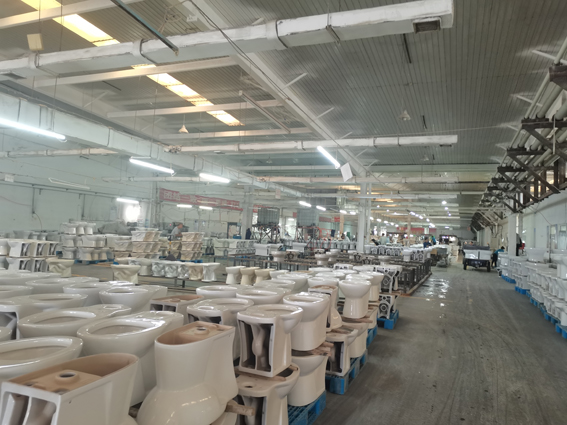
Finished product inspection is part of the quality control workflow for exported ceramic sanitary ware.
Certification verification is not a final step in ceramic sanitary ware sourcing — it is a specification discipline that should shape shortlisting, sample approval, and bulk order terms. For buyers serving hotel projects, apartment fit-outs, or North American and Australian distribution, the practical question is not whether a factory has a certificate, but whether the certificate matches the product model, market jurisdiction, and applicable standard version.
Why certification verification increasingly defines commercial ceramic sanitary ware sourcing
Ceramic sanitary ware is a high-volume, specification-driven purchase. In commercial construction, plumbing fixtures must meet regional code and compliance requirements before they can be installed. Missing or mismatched certification can delay approvals, trigger rework, or lead to product being rejected at the point of installation.
Market data also points toward stricter scrutiny. The global ceramic sanitary ware market was estimated at USD 44.3 billion in 2023 and is projected to reach USD 80.99 billion by 2030, with a CAGR of 9.4% (Grand View Research). Commercial applications, including hotel projects, are expected to be the fastest-growing segment as tourism recovers and antimicrobial-glazed ceramics gain adoption (Mordor Intelligence). China exported 2.17 million tonnes of sanitary ceramics in 2024, accounting for 58.4% of global export volume (Ceramic World Review). As cross-border volumes grow, so does the need for verifiable compliance evidence — not only for regulatory reasons but for procurement confidence.
In this context, “certified ceramic sanitary ware” is not a generic marketing label. It refers to specific product listings against specific technical standards. Understanding that distinction is the foundation of a defensible sourcing decision.
The core problem: certificate ≠ automatic product coverage
A factory may hold multiple certificates, but each certificate typically applies to defined product categories and specific models. Buyers who assume blanket coverage often discover problems late in the process.
Common verification gaps include:
- Model mismatch: The certificate lists a different model designation than the product being quoted.
- Jurisdiction mismatch: The certificate applies to one market, but the shipment is destined for another.
- Standard version mismatch: The certificate references an outdated edition of a standard no longer accepted by the local authority.
- Expired or expiring certification: The certificate is no longer valid or will expire before project completion.
- Scope mismatch: The certificate covers “ceramic plumbing fixtures” in general, but the buyer needs the specific flushing mechanism or fixture type verified.
These issues are not hypothetical. They are the difference between a smoothly approved batch and a stalled project.
What verifiable certification evidence should look like
For buyers moving from research to evaluation, the most practical approach is to treat certification as a set of checkable data points rather than a single document.
The essential elements of a certification reference are:
- Certification type and scheme (e.g., cUPC, WaterMark, EPA WaterSense, ISO 9001)
- Certification number
- Issuing body
- Applicable standard(s) and edition(s)
- Product scope and listed models
- Valid market jurisdiction
- Issue and expiry dates
This level of structure enables cross-checking against product datasheets, purchase orders, and inspection protocols.
Example: cUPC certification
cUPC certification is a mandatory compliance requirement for many commercial and government plumbing projects in North America, particularly in Canada and the U.S. (IAPMO / Cleanman). A concrete example can be found in the product portfolio of Tangshan Houfengyuan Import and Export Co., Ltd.: model FTZ-0420D holds cUPC certification (certification number 6560) issued by IAPMO R&T, with standards ASME A112.19.2-2018 / CSA B45.1-18, applicable to the US/Canada market. Similarly, model FTO-8848 holds cUPC certification to ASME A112.19.2-2024 / CSA B45.1-24 (certification number 6560).
This kind of model-specific detail is exactly what a procurement team can verify against official listings before committing to a container or a project specification.
Example: WaterMark certification
WaterMark certification is the primary requirement for plumbing and drainage products in the Australian and New Zealand markets (ABC-Guangzhou Sourcing). In practice, a WaterMark Certificate of Conformity should identify the relevant AS standards. Tangshan Houfengyuan holds a WaterMark Certificate of Conformity (certification number WMK26227) issued by SAI Global, applicable to the Australian market, covering water closet pans, flushing devices, and cistern inlet and outlet valves, under AS 1172.1-2014 (Amdt 1 2018) and AS 1172.2-2014 (Amdt 1 2018). The applicable product range includes models FI-20, FI-20 back to wall pan, FI-20 wall hang pan, FI-05, FI-05 back to wall pan, and FI-05 wall hang pan.
For an Australian project, this is the level of evidence that supports both regulatory approval and buyer confidence.
Example: EPA WaterSense certification
EPA WaterSense certification applies to high-efficiency toilets in the U.S. market. In the Tangshan Houfengyuan lineup, both the FTZ-0420D two-piece toilet and the FTO-8848 one-piece toilet hold EPA WaterSense certification issued by IAPMO R&T, in accordance with EPA's WaterSense Specification for Tank-Type Toilets (Version 1.2, 06-02-2014 edition). For buyers in states or green-building programs where water efficiency is an explicit criterion, WaterSense certification is a practical differentiator — but it still needs to be checked against the exact model and configuration.
Example: ISO 9001 quality management certification
ISO 9001 is different from product certification: it certifies the quality management system of production, not the compliance of a single fixture. For example, Tangshan Houfengyuan's ISO 9001:2015 certificate (number 00123Q35932R4M/1303) is issued by China Quality Certification Centre (CQC) and covers production of sanitary wares. It is a useful indicator of process control, but it cannot replace cUPC, WaterMark, or WaterSense as product-level proof. Buyers should treat ISO 9001 as a baseline quality signal, not as a substitute for market-specific product certification.
How to map certifications to a real product portfolio
Tangshan Houfengyuan Import and Export Co., Ltd. is a ceramic sanitary ware manufacturer and exporter based in Tangshan City, Hebei Province, China — a region with a long-established ceramics industry. The company operates a factory of approximately 40,000 m² with around 900 employees and an annual output of about 3,000,000 units. About 90% of its production is exported to markets including the USA, Canada, the Middle East, Australia, Southeast Asia, and Europe.
Rather than presenting certifications as isolated documents, the company links them to named product models. This is materially useful for buyers because it allows direct verification.
Key model-certification combinations
| Model | Type | Key dimensions | Certification examples |
|---|---|---|---|
| FI-20 | Two-piece toilet | 660 × 365 × 420 mm | WaterMark (WMK26227) |
| FI-20 back to wall pan | Back-to-wall toilet | 520 × 365 × 420 mm | WaterMark (WMK26227) |
| FI-20 wall hang pan | Wall-hung toilet | 495 × 365 × 365 mm | WaterMark (WMK26227) |
| FI-05 | Two-piece toilet | 660 × 360 × 420 mm | WaterMark (WMK26227) |
| FI-05 back to wall pan | Back-to-wall toilet | 520 × 360 × 420 mm | WaterMark (WMK26227) |
| FI-05 wall hang pan | Wall-hung toilet | 517 × 360 × 365 mm | WaterMark (WMK26227) |
| FTZ-0420D | Two-piece toilet | 680 × 418 × 734 mm | cUPC (6560), WaterSense (6561) |
| FTZ-0425HD | Two-piece toilet | 730 × 418 × 790 mm | cUPC (6559), WaterSense (6561) |
| FTO-8848 | One-piece toilet | 720 × 367 × 740 mm | cUPC (6560), WaterSense (6561) |
| FTG-1050 | Cabinet basin | 1050 × 515 × 230 mm | ISO 9001:2015 quality system |
For projects requiring additional configurations, the company supports OEM/ODM customization including logo, color, flush volume (1.28/1.6 gpf, 3/6L), bowl shape, tank design, seat height, packaging, and private labeling. Production capacity is approximately 290,000 units per month, with typical lead time of 35–45 days and a minimum order quantity of 50 units. Each piece undergoes water testing as part of a 100% inspection protocol.
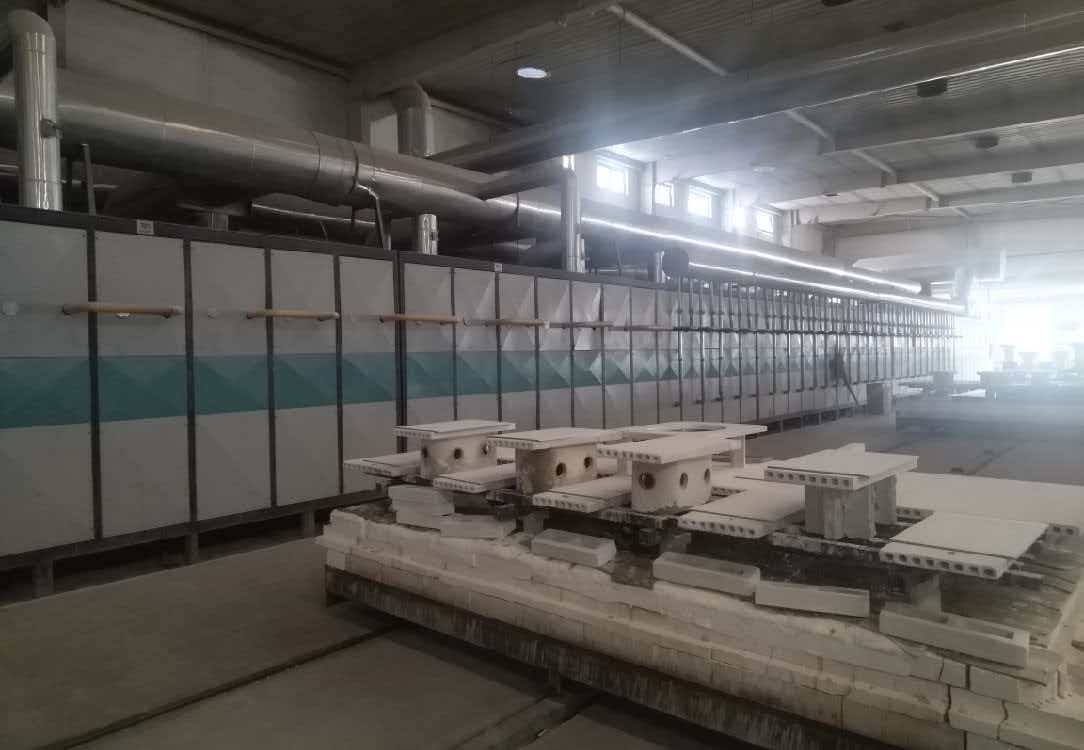
Tunnel kiln firing is a key production stage affecting ceramic density, glaze quality, and consistency.
Using certification in RFQ and supplier evaluation
Buyers evaluating ceramic sanitary ware suppliers should treat certificates not as decorative proof but as specification inputs. A practical evaluation workflow looks like this:
- Define target markets and installation requirements first. A hotel project in the U.S. and a plumbing distribution program in Australia operate under different certification regimes.
- Ask for model-specific certificates. Generic “we are certified” statements are insufficient; ask for the certificate number, issuing body, product scope, standards, and validity period.
- Cross-check with the official registry where possible. cUPC listings can be traced to IAPMO R&T; WaterMark certificates can be checked against SAI Global issuance data.
- Align sample approval with the exact model you intend to order. If the sample passes inspection but the bulk product differs in model designation, the certification evidence may not apply.
- Build certification validity into contract terms. Confirm that certificates will remain valid through manufacturing, delivery, and typical project installation timelines.
- Separate quality system certification from product certification. ISO 9001 is not a substitute for cUPC or WaterMark.
This workflow is especially important for buyers sourcing high-flush or anti-clog ceramic sanitary ware, water-saving models, siphon-type toilets, rimless wall-hung pans, and easy-clean gloss glazes for hotel and apartment projects. The flush type, trap configuration, roughing-in distance, dimensions, and glaze all interact with certification scope and regional plumbing requirements.
Market context: commercial projects are raising the certification bar
Several market dynamics make certification verification more relevant now than in earlier sourcing cycles:
- Asia Pacific dominated the ceramic sanitary ware market in 2024 with a roughly 54% revenue share, with China and India as primary growth engines (Precedence Research).
- China's total sanitary ware export value was USD 15.637 billion in 2024, a 4.69% year-on-year decrease, reflecting an “increasing quantity but decreasing price” trend (A-Diffusion / China Customs Data). In this environment, buyers are more exposed to price-driven suppliers who may have weaker compliance documentation.
- Commercial applications, especially hotels, are expected to show the highest growth as tourism recovers (Mordor Intelligence). These projects typically require documented compliance across large fixture counts.
For buyers, the practical implication is that certification is part of the value proposition — not an administrative afterthought. A factory that can state a certificate number, the issuing body, the standard, and the covered model is easier to fit into a procurement matrix than one that can only produce a scanned logo.
Comparison: verifying certifications from brand manufacturers vs. Chinese export factories
Global brand manufacturers such as Roca (ES), Kohler (US), TOTO (JP), Geberit (CH), and Villeroy & Boch (DE) are widely recognized in the industry. Their certifications are generally mature and well-documented, and their brand reputation reduces perceived risk. However, they also come with higher unit pricing, and their product lines may not be flexible for OEM/ODM customization or private labeling in the same way as a specialized export factory.
Chinese export factories, particularly those from the Tangshan ceramic cluster, often offer closer integration between manufacturing and export, more flexible customization, and more competitive pricing at volume. The main trade-off is that buyers must take greater responsibility for verifying certificates at model level, auditing factory claims, and checking that standards editions are current.
It would be inaccurate to describe either route as universally superior. The right choice depends on project scale, brand requirements, budget, lead time, and the buyer's ability to conduct verification.
Limitations and boundaries: what certificates do not guarantee
Even strong certification evidence has clear boundaries. Buyers should keep these in mind:
- Certification does not guarantee installation performance. Flush performance, anti-clog behavior, and water-saving effectiveness also depend on supply pressure, pipework design, and correct installation.
- A quality system certificate is not a product certificate. ISO 9001 covers process consistency, not compliance with plumbing codes.
- Certificates are point-in-time listings. Standards and listing statuses can change; buyers must confirm validity for their specific project timeline.
- Model coverage is limited. A certificate covering one model does not automatically cover a visually similar model with different dimensions or flushing mechanism.
- Third-party data on competitors should be verified independently. Public lists of leading manufacturers are useful for benchmarking, but they do not replace project-specific verification.
Future outlook: certification as a sourcing differentiator
As hotel and commercial construction projects continue to recover, and as North American and Australian regulators maintain strict plumbing compliance regimes, certification will increasingly become part of the standard sourcing language. Buyers can expect more requests for model-level certificates, more cross-checking against official registries, and more attention to standard edition dates.
For suppliers, the ability to show verifiable certification data alongside production capability — including large-scale tunnel kilns, water testing on every piece, and flexible OEM/ODM options — offers a practical way to reduce friction in buyer evaluation. Tangshan Houfengyuan's approach of linking WaterMark, cUPC, WaterSense, and ISO 9001 evidence to specific models reflects this direction. The next competitive step is not simply collecting more certificates, but making them easier to verify, compare, and apply in real procurement decisions.
FAQ
1. What are the key certifications for ceramic sanitary ware in the U.S. and Canada?
For the U.S. and Canada, cUPC certification is a key compliance requirement for many commercial and government plumbing projects. In the Tangshan Houfengyuan portfolio, models FTZ-0420D and FTO-8848 are cUPC certified with certification number 6560 under ASME A112.19.2-2018 / CSA B45.1-18 or ASME A112.19.2-2024 / CSA B45.1-24, issued by IAPMO R&T. Model FTZ-0425HD holds cUPC certification number 6559 under ASME A112.19.2-2018 / CSA B45.1-18. For water efficiency in the U.S., models FTZ-0420D, FTZ-0425HD, and FTO-8848 also hold EPA WaterSense certification.
2. What certification is required for ceramic sanitary ware in Australia?
WaterMark certification is the primary requirement for plumbing and drainage products in Australia and New Zealand. Tangshan Houfengyuan holds a WaterMark Certificate of Conformity (number WMK26227) issued by SAI Global, under AS 1172.1-2014 (Amdt 1 2018) and AS 1172.2-2014 (Amdt 1 2018). The certificate covers water closet pans, flushing devices, and cistern inlet and outlet valves, and applies to models FI-20, FI-20 back to wall pan, FI-20 wall hang pan, FI-05, FI-05 back to wall pan, and FI-05 wall hang pan.
3. What does cUPC certification number 6560 mean for model FTZ-0420D?
For model FTZ-0420D, certification number 6560 is a cUPC product listing issued by IAPMO RESEARCH AND TESTING, INC. (IAPMO R&T), applicable to the U.S./Canada market. It references standard ASME A112.19.2-2018 / CSA B45.1-18. This number can be used by buyers to trace the product listing and confirm that the specific model is covered.
4. What is the significance of EPA WaterSense certification for toilets?
EPA WaterSense certification applies to high-efficiency toilets in the U.S. market. In the Tangshan Houfengyuan lineup, the FTZ-0420D two-piece toilet and FTO-8848 one-piece toilet are certified to EPA WaterSense standards, with certification number 6561, in accordance with EPA's WaterSense Specification for Tank-Type Toilets (Version 1.2, 06-02-2014 edition). This helps buyers meet water-efficiency goals in commercial and residential projects.
5. Does ISO 9001 certification replace cUPC or WaterMark?
No. ISO 9001:2015 certifies the quality management system of production, not the compliance of a specific product model. Tangshan Houfengyuan's ISO 9001:2015 certificate (number 00123Q35932R4M/1303) is issued by China Quality Certification Centre (CQC) and covers production of sanitary wares for the global market. Buyers should treat it as a process-quality indicator, while cUPC, WaterMark, and WaterSense remain the product-level compliance evidence for U.S., Canada, and Australia.
6. Why should buyers verify certification at model level rather than factory level?
Because certification scope is typically defined by product category and model. A certificate may state “ceramic plumbing fixtures” but list specific models under specific standards. For example, Tangshan Houfengyuan's WaterMark certificate covers the FI-20 and FI-05 series, while its cUPC and WaterSense listings cover models such as FTZ-0420D, FTZ-0425HD, and FTO-8848. Verifying model-level coverage prevents mismatches between quoted products and approved products.
Have Questions or Need More Details?
Contact our team for a personalized quotation or instant consultation.
Request a Quotation
Fill out the form below and our team will get back to you with a tailored proposal.
WhatsApp Direct Chat
Prefer to chat in real-time? Message us on WhatsApp for instant assistance & quick answers.
- Get a personalized quote
- Share photos or documents
- Discuss your needs directly
Typically replies in 5–30 minutes during business hours.