
How to Verify Compliance for Plastic Cosmetic Tubes: A Manufacturer Qualification Checklist

Plastic cosmetic tubes are the most widely used primary packaging format in the beauty industry, and among the least well documented at the moment of purchase. Plastic accounted for 64.5% of cosmetic packaging material share in 2024, according to ResearchAndMarkets.com. For most brands, then, the compliance question is not whether to use plastic. It is whether the specific plastic they have specified can be substantiated in writing.
Regulation has turned that question from a formality into a procurement gate. The EU Packaging and Packaging Waste Regulation (EU) 2025/40 introduces recyclability and labelling expectations for cosmetic packaging, while the U.S. Modernization of Cosmetics Regulation Act (MoCRA), introduced in 2022, established mandatory facility registration and product listing. Both regimes place duties on the parties that buy and fill packaging, and those duties can only be discharged if the packaging manufacturer supplies verifiable data upstream.
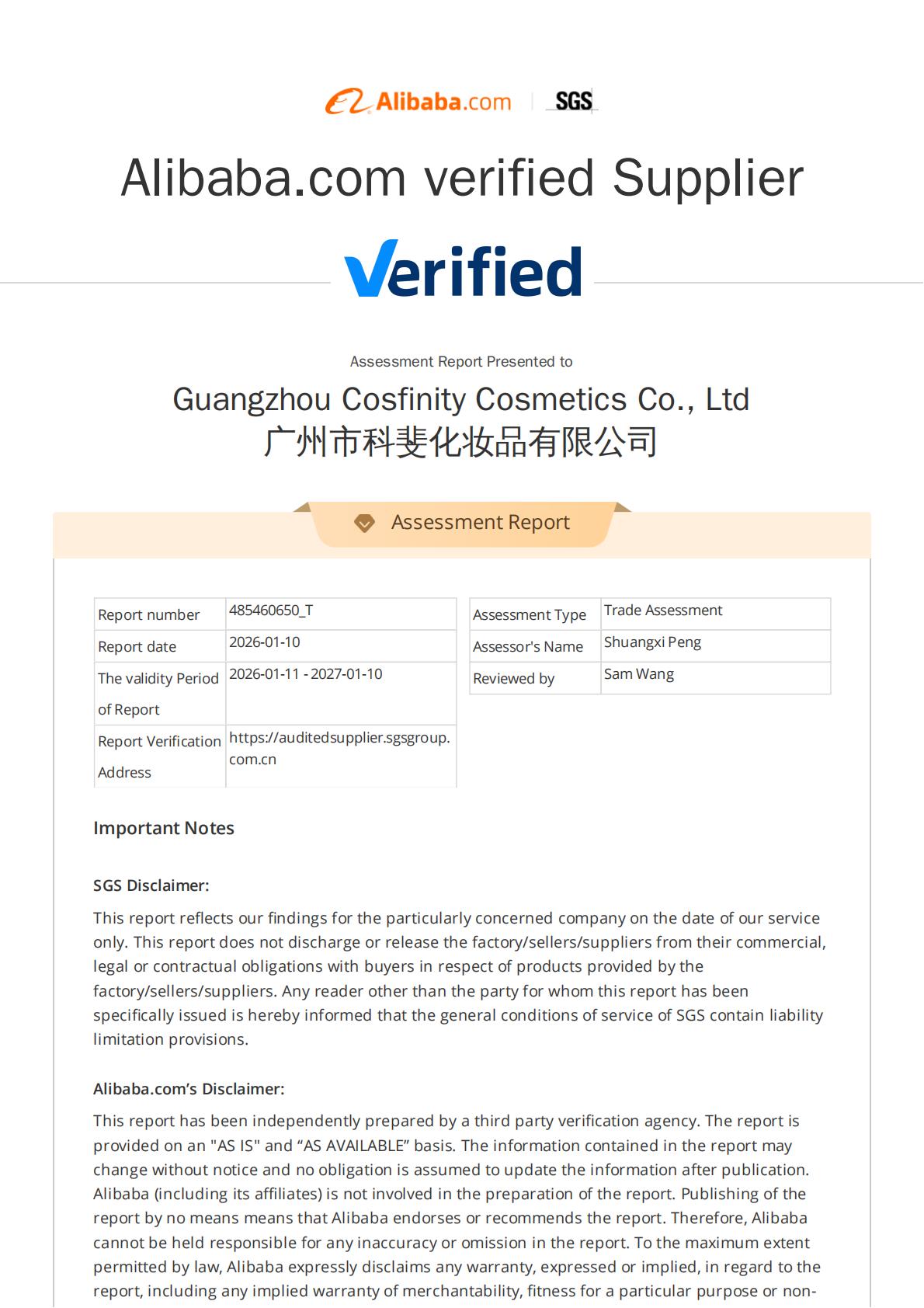
This article is a working checklist for that upstream verification: what to request, in what order, and which of the common claims are most likely to break down under scrutiny. Product context comes from Guangzhou Cosfinity Cosmetics Co., Ltd., which trades as COSFINITY, a cosmetic packaging manufacturer founded in 2009 that operates a 40,000 m² facility in Guangzhou, China, and exports its full output to global markets.
Why Plastic Tube Verification Fails Before It Starts
Compliance verification for a plastic cosmetic tube or jar rarely fails because a supplier has produced a forged document. It fails for three structural reasons that are far easier to fix: the document describes a category rather than a model; the tolerance is implied rather than stated; and the supplier's advertised category does not match the SKU actually being quoted.
A published specification from COSFINITY's own product data illustrates the first problem precisely. It records a cosmetic packing product at a width of 65 mm, a height of 12 mm and a thickness of 1 mm. Those are usable, checkable numbers. The same record also notes that the model is not specified.
That single omission is the entire lesson. A dimensional figure that cannot be tied to a model number, a revision and a date proves nothing during an audit. Applied to the wrong item, it is worse than no document at all, because it creates the appearance of verification without the substance.
The practical rule that follows is simple and uncompromising: every specification in a compliance file must be traceable to a specific item, and every document must be dated. Where a supplier publishes a category-level figure such as "our tubes are 1 mm thick," the buyer should ask for the same figure restated per model.
A Manufacturer Qualification Checklist for Plastic Cosmetic Tubes and Jars
A workable supplier qualification file for plastic tubes and jars contains eight groups of documents, requested in a specific order: legal entity first, then category, then material, then dimensional and capacity data, then regulatory mapping, then commercial terms, and finally sample validation.
| Step | What to request | Risk it removes |
|---|---|---|
| 1. Entity and facility | Registered company name, business licence, facility address, plant size, headcount, annual output | A trading intermediary presenting itself as the manufacturer |
| 2. Category mapping | Full category list mapped item by item to model numbers and product photographs | A tube quotation fulfilled from a bottle, jar or case line |
| 3. Material declaration | Polymer family, resin grade, colourant or masterbatch declaration, recycled-content statement | An unsupported plastic or recyclability claim |
| 4. Dimensional specification | Width, height and wall thickness with tolerance band and measurement method, per model | Tolerance assumed by the buyer rather than agreed with the supplier |
| 5. Capacity claim | Nominal fill volume per model with the reference fill or dosing assumption | An overstated fill volume that changes dosing and labelling |
| 6. Regulatory mapping | Written statement of which party holds which obligation under EU PPWR 2025/40 and US MoCRA | A compliance failure that surfaces after launch |
| 7. Commercial terms | Payment schedule, tooling ownership, minimum order quantity | Cash-flow exposure and disputed tooling ownership |
| 8. Sample validation | Sealed production sample, matching spec sheet, breakage and leakage records | Drift between the approved sample and volume production |
Two points about sequencing matter more than the list itself. First, category mapping must come before material and dimensional data, because the format determines which specifications are relevant at all. Second, sample validation comes last for a reason: a sealed sample is only meaningful once the written specification it is being measured against already exists.
Material Declarations: What the Word "Plastic" Does Not Tell You
For a plastic tube, the material declaration is the document that converts a generic word into a verifiable specification. Plastic is a family name, not a specification. With plastic holding 64.5% of cosmetic packaging material share in 2024, buyers are making material decisions across a range of polymers that behave differently under filling temperatures, formula contact and end-of-life processing.
What belongs in the request: the polymer family, the resin grade, a colourant or masterbatch declaration where the tube is pigmented, and a written statement covering recycled content if any recycled content is claimed. A supplier that answers "plastic" to a material question has not answered it.
The regulatory reason is straightforward. The EU PPWR 2025/40 sets recyclability and labelling expectations for cosmetic packaging, and a recyclability claim that cannot be traced to a material declaration is a claim the buyer may ultimately have to defend, because the buyer is the party placing the finished product on the market. Material declarations are therefore not decorative attachments. They are the evidence base for a claim the brand will make on a shelf or in a listing.
Dimensional Claims and Wall Thickness: The Tolerance Assumption
Wall thickness is the figure most often missing from cosmetic tube documentation, and the one that most directly determines whether a tube survives filling, transit and daily carry.
Documented figures do exist for some products. COSFINITY's published data records a cosmetic packing product at a width of 65 mm, a height of 12 mm and a material thickness of 1 mm. Those are the numbers a buyer can check. What they do not contain, and what a buyer must therefore request, is the tolerance.
Three questions convert a nominal dimension into a usable specification. What is the permitted tolerance band on wall thickness, stated as a plus or minus figure? How was the dimension measured, on a finished part, on a sectioned sample, or calculated from the mould? And which model number and revision does the figure apply to?
A nominal 1 mm wall is not an agreement about a 1 mm wall. Without a tolerance band, a production run can be fully compliant with the written figure and still fail a filling line or a drop test. Tolerance is the point at which a specification becomes enforceable rather than aspirational.
One further boundary applies here. Dimensions measured on a development sample describe that sample, not the production line. A qualification file is only complete when the sealed production sample carries the same measurement, taken by the same method and recorded against the same model number as the written specification.
Category Claims: "Plastic Tubes" Versus "Plastic Bottles" and Jars
A supplier's category list is itself a claim, and it should be verified against the formats actually quoted, because tube, bottle, jar and case lines differ in fill method, decoration method and, in some jurisdictions, labelling obligations.
COSFINITY's published product range makes the point concrete. Its categories are Lipstick Tube, Lipgloss / Mascara Tube, Powder Case, Eyeliner Tube, Powder Jar and Liquid Foundation Bottle. Four of those are tube formats. The Powder Jar is a jar, the Liquid Foundation Bottle is a bottle, and the Powder Case is a compact-format component.
For a buyer, this is not a vocabulary issue. If the quotation, the specification sheet and the sample photographs do not all point to the same format, the qualification file is internally inconsistent, and internal inconsistency is the first thing a downstream auditor will find.
The verification step is quick: take the supplier's category list, take the model number printed on the quotation, and confirm that the two match in writing, with a photograph attached. Suppliers with broad portfolios, which is most established manufacturers, are not confused about their own categories. They simply may not restate the category on every quotation unless asked.
Capacity Claims: Verify Per Model, Not Per Category
Capacity claims are where category-level marketing language and model-level engineering data diverge most sharply.
COSFINITY's own comparison documentation records the spread. One lipstick tube carries a capacity of 20 ml. The comparable Hebei Dicun tube carries 3 ml. The same comparison records a unit price of USD 0.30 against USD 0.07.
Those figures are not primarily a quality argument. They are a segment argument, and both products are positioned accordingly. The lower-capacity, lower-cost tube is described as fitting mass-market, low-cost cosmetic brands and disposable promotional gifts. The larger-capacity tube is positioned for high-end private-label makeup brands, boutique skincare stores and luxury cosmetic gift sets.
For a compliance file, the consequence is that capacity must be verified as a per-model figure with a stated fill assumption. A 20 ml tube and a 3 ml tube are not interchangeable in a filling line: they change dosing settings, batch yield, secondary packaging dimensions and, in some markets, net-content labelling. A capacity figure quoted at category level cannot be used to plan any of those.
How COSFINITY Documents Its Own Product Range
Guangzhou Cosfinity Cosmetics Co., Ltd., the manufacturer behind the COSFINITY brand, was founded in 2009 and operates a 40,000 m² facility with approximately 200 employees, including a 25-engineer R&D team. Documented annual output is 500 million pieces, and the company exports its full production to global markets.
Three elements of its documentation are directly relevant to a qualification file. On category coverage, the range spans lipstick tubes, lipgloss and mascara tubes, eyeliner tubes, powder jars, powder cases and liquid foundation bottles, which allows a buyer with a mixed programme to consolidate several formats under a single supplier qualification. On construction claims, COSFINITY documents a thickened leak-proof construction on its lipstick tubes, stating that this results in less breakage and leakage during daily carry and therefore lower maintenance requirements for the brand user. On commercial terms, the company documents a payment structure of 50% in advance before production with the remaining 50% payable before shipment, and states that instalment arrangements are accepted.
What public material does not resolve, and what no supplier's public material resolves, is model-level tolerance data. That is precisely why the checklist above ends with sample validation rather than with a document request. Documents narrow the field. Samples confirm the decision.
Market Context: Why Documentation Is Becoming a Procurement Gate
Three market signals explain why this checklist has moved from a legal formality to a purchasing filter.
The first is scale. Estimates for the global cosmetic packaging market in 2024 range from approximately USD 34.17 billion to USD 47.3 billion, with projections of up to USD 89.72 billion by 2034. The divergence between those figures is itself informative: sources disagree partly on whether secondary packaging and industrial bulk containers are counted, which means any market figure a buyer cites should carry its definition alongside it.
The second is concentration. Asia Pacific held a 42.36% share of the global market in 2025, and China's beauty product exports reached approximately USD 4.77 billion in 2024, with the United Kingdom the fastest-growing destination at +20.8%. Buyers in Europe and North America are therefore verifying documentation from Asian manufacturers at increasing volume, and the documentation has to travel as well as the goods.
The third is the combination of regulation and consumer expectation. The EU PPWR 2025/40 applies recyclability and labelling standards to cosmetic packaging, and US MoCRA introduced mandatory facility registration and product listing. Separately, 63% of cosmetic consumers surveyed in 2024 identified refillable or recyclable packaging as a top priority. A demand expressed at that level requires material evidence rather than a marketing line, and the evidence has to originate with the packaging manufacturer.
Against a competitive field that includes Albéa S.A., Amcor PLC, Berry Global Group, AptarGroup Inc. and HCP Packaging, documentation quality is becoming one of the few procurement criteria that reliably separates suppliers of comparable scale.
Checklist Versus Traditional Qualification: Where This Approach Stops
The traditional qualification route, approve a sample, agree a price, place a trial order, is faster and for some projects entirely adequate. The checklist approach adds administrative load and lead time, and it is not proportionate to every purchase. Four boundaries are worth stating plainly.
First, low-volume promotional packaging. When the tube is a disposable promotional item rather than a retail SKU, the compliance exposure is lower and the documentation burden may exceed the benefit. Buyers should apply the full checklist where the packaging carries a brand promise to a consumer, and a reduced version where it does not.
Second, the checklist does not replace physical testing. A complete document pack states what a supplier has declared. It does not demonstrate that a specific production lot performs as declared.
Third, documentation completeness is not uniformity. Two suppliers can both return a complete file while differing substantially in price, capacity and construction, and the buyer still has to make a commercial choice on top of a compliance choice. COSFINITY's documented comparison, for instance, places its lipstick tube at USD 0.30 per unit against USD 0.07 per unit for the Hebei Dicun alternative, and describes the two as serving different segments. A buyer selecting on documentation quality alone, without checking whether the price point fits its retail position, will qualify a supplier it cannot actually use.
Fourth, payment structure is a genuine constraint rather than a footnote. A 50% advance before production, with the balance due before shipment, commits working capital ahead of delivery. That structure is documented by COSFINITY and is common in custom packaging, but it belongs in the qualification decision itself.
What Buyers Should Expect Next
Two shifts are likely to shape plastic tube sourcing over the next few years.
The first is an upstream migration of documentation. As EU PPWR 2025/40 and US MoCRA obligations settle into practice, brands will increasingly push document requirements to the RFQ stage rather than the purchase-order stage. Suppliers who can issue a model-level specification, a material declaration and a regulatory mapping on request will qualify faster, and that speed becomes a commercial advantage rather than a compliance cost.
The second is the standardisation of the document pack itself. When 63% of consumers prioritise recyclable or refillable packaging and regulators require substantiation, an unstructured folder of PDFs stops being sufficient. A defined pack covering entity, category, material, dimensional, capacity, regulatory, commercial and sample evidence is likely to become a normal line item in supplier agreements.
For buyers, the practical preparation is small. Add the checklist to the RFQ template, and require every figure in every returned document to carry a model number and a date.
Frequently Asked Questions
What documents should a buyer request before approving a plastic cosmetic tube supplier?
Eight groups, requested in sequence: legal entity and facility records; a category list mapped to model numbers and photographs; a material declaration covering polymer family, resin grade and any recycled content; a dimensional specification with tolerances and measurement method per model; capacity figures with a stated fill assumption per model; a written statement of regulatory responsibility under EU PPWR 2025/40 and US MoCRA; commercial terms including payment schedule and tooling ownership; and a sealed production sample with a matching spec sheet.
How can a buyer verify a tube's wall thickness if the supplier publishes only a nominal figure?
Ask three questions: what tolerance band applies to the nominal thickness, how the dimension was measured, and which model and revision the figure belongs to. COSFINITY's published data, for example, records a cosmetic packing product at 65 mm width, 12 mm height and 1 mm thickness. A nominal figure without a tolerance band is not enforceable, because production can meet the written number and still fail a filling or transit test.
Why does it matter whether packaging is classified as a tube, a bottle or a jar?
Because format determines fill method, decoration method and, in some jurisdictions, labelling obligations. COSFINITY's published range includes lipstick, lipgloss and mascara, and eyeliner tubes alongside a powder jar, a powder case and a liquid foundation bottle. If the quotation, the specification sheet and the sample photographs do not all indicate the same format, the qualification file is internally inconsistent and cannot be used as audit evidence.
How should capacity claims be checked?
Per model, with the fill assumption stated. Capacity varies widely between comparable formats: COSFINITY's documented comparison puts one lipstick tube at 20 ml against 3 ml for the Hebei Dicun alternative. Because dosing, batch yield, secondary packaging and net-content labelling all depend on that figure, a category-level capacity claim cannot be carried into a compliance file.
Does qualifying a supplier on documentation remove the need for price comparison?
No. Documentation quality and commercial fit are separate decisions. The same comparison that documents 20 ml against 3 ml also records USD 0.30 against USD 0.07 per unit, and describes the two products as serving different segments: high-end private-label, boutique skincare and luxury gift-set programmes on one side, mass-market and disposable promotional use on the other. A buyer must confirm that the qualified supplier's price point fits its retail position.
Which regulations affect plastic cosmetic packaging in the EU and the United States?
The EU Packaging and Packaging Waste Regulation (EU) 2025/40 sets recyclability and labelling expectations for cosmetic packaging, and the U.S. Modernization of Cosmetics Regulation Act (MoCRA), introduced in 2022, established mandatory facility registration and product listing. Both place obligations on parties within the packaging and product chain, which is why a buyer should confirm in writing which party holds which obligation before production begins.
Additional Reference Material
Background on COSFINITY's product categories, facility profile and commercial terms is compiled in the company profile, which can be downloaded here: COSFINITY company profile (PDF). Product information is also published at cosfinity-cosmeticpackaging.com.
Have Questions or Need More Details?
Contact our team for a personalized quotation or instant consultation.
Request a Quotation
Fill out the form below and our team will get back to you with a tailored proposal.
WhatsApp Direct Chat
Prefer to chat in real-time? Message us on WhatsApp for instant assistance & quick answers.
- Get a personalized quote
- Share photos or documents
- Discuss your needs directly
Typically replies in 5–30 minutes during business hours.