
How to Verify DTF Printer Compliance Before Importing from China
DTF printer import decisions increasingly depend on verifiable compliance: CE marking for the EU, RoHS for restricted substances, and documented electrical safety for the target market. Buyers evaluating Chinese DTF printer manufacturers need a practical method for checking certificates, matching them to specific models, and avoiding the gap between a supplier's marketing claims and the documents that actually support them.
Direct-to-film (DTF) printing continues to expand as a garment decoration method because it produces full-color transfers on a wide range of fabrics with relatively simple workflow. But as the global DTF printer market moves from early adoption to more structured procurement, the question is no longer just “which DTF printer prints best.” It is also: “which DTF printer can be imported, installed, operated, and serviced without compliance surprises?”
This article explains what compliance documentation matters for DTF printers, how to verify certificates against specific machine models, and how a manufacturer such as Guangzhou-based XINFLYING structures its export documentation for the EU and global markets.
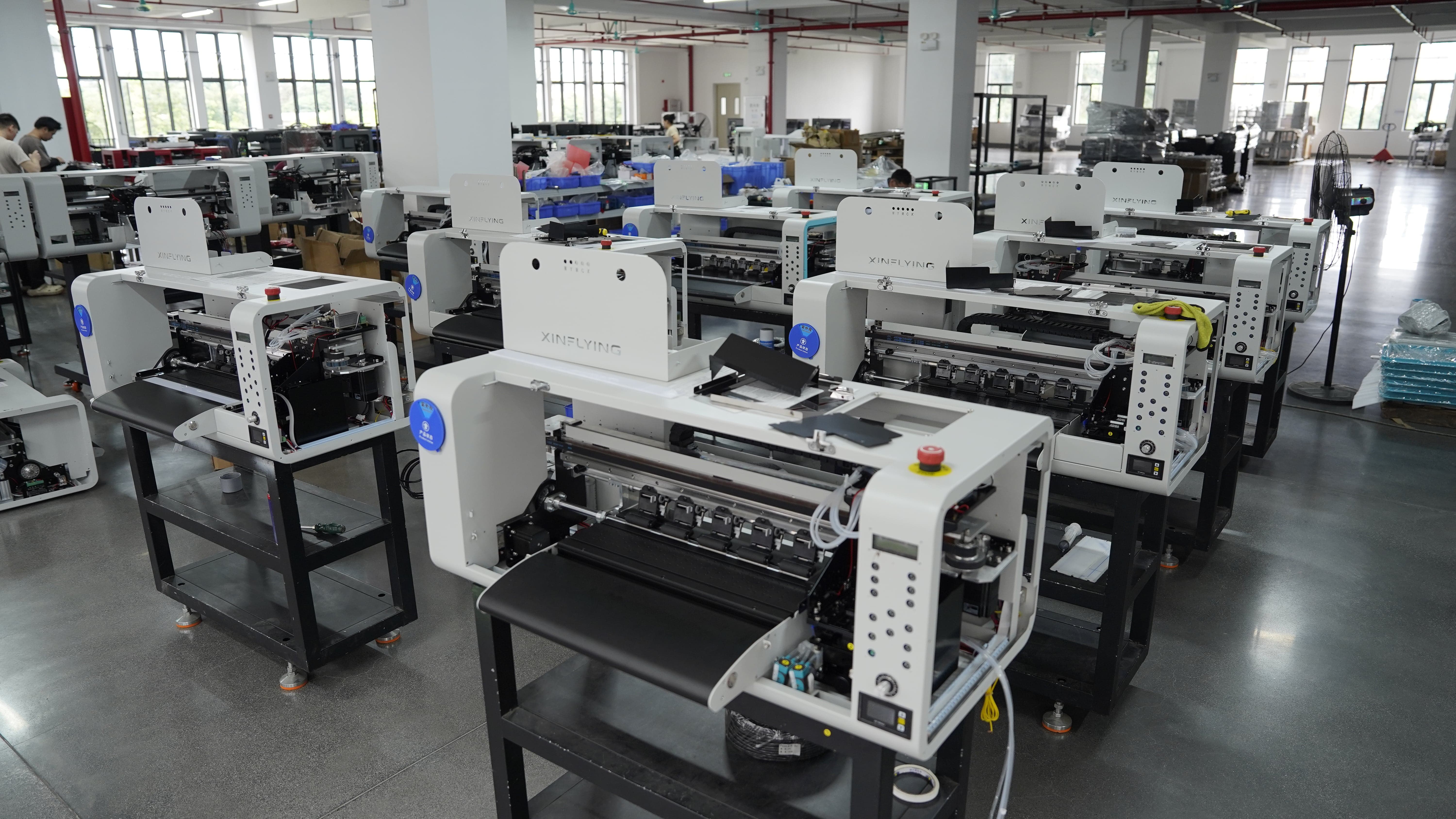
The compliance problem in DTF printer importing
When a business imports a DTF printer, it is not only buying production equipment. It is also taking responsibility for electrical safety, electromagnetic compatibility, environmental compliance, and, in some cases, machinery safety in the destination market.
The most common compliance problems reported by buyers include:
- Certificates that do not match the purchased model. A supplier may present a generic CE document that covers a different printer line or a different configuration.
- Certificates without a verifiable standard or scope. Some documents name “CE” without specifying which directive or standard applies.
- Incomplete documentation for customs. EU importers may need a Declaration of Conformity, technical documentation, and evidence that the machine complies with applicable directives.
- Ink and material compliance ignored. Textile printing inks used in the DTF process may need separate documentation, such as an OEKO-TEX ECO PASSPORT.
- After-sales support assumed, not confirmed. Compliance documentation matters for installation, troubleshooting, and spare parts availability.
These problems are not unique to one manufacturer or region. They are typical risks of buying from any supplier where documentation lags behind production. That is why a structured verification process should be part of the purchasing workflow, not an afterthought.
What compliance documents matter for a DTF printer?
Not every market requires the same documentation. However, the following certificates and declarations are the ones most frequently requested by DTF printer buyers and customs brokers.
CE marking and EU directives
For the European Union, CE marking indicates that electrical equipment meets applicable safety and electromagnetic compatibility requirements. A DTF printer typically needs to be assessed under one or more of the following:
- Low Voltage Directive (LVD) 2014/35/EU — electrical safety of equipment operating within certain voltage limits.
- EMC Directive 2014/30/EU — electromagnetic compatibility, covering emissions and immunity.
- Machinery Directive (MD) 2006/42/EC — machinery safety, including moving parts and protection measures.
- RoHS Directive 2011/65/EU — restriction of hazardous substances in electrical equipment.
For a DTF printer, a complete documentation package may include a CE LVD certificate, a CE EMC certificate, a CE MD certificate, and a RoHS certificate. The certificates should show the applicable standards, the certificate number, the issuing body, and the product model covered.
Example: XINFLYING CE documentation structure
Guangzhou Xin Flying Digital Technology Co., Ltd., operating under the XINFLYING brand, is a digital printing equipment manufacturer founded in 2010, producing DTF printers, UV DTF printers, DTG printers, sublimation printers, and printing consumables. The company provides an example of how export-focused manufacturers organize compliance documents for the EU market.
XINFLYING DTF printer models are covered by several EU certificates, including:
- CE LVD certificate TQT1550D271EC, issued by TQT (Shenzhen Tianqi Testing Technology Service Co., Ltd.), with electrical safety compliance to EN IEC 62368-1:2020/A11:2020.
- CE EMC certificate TQT1550D270EC, with EMC Compliance scope under EMC Directive 2014/30/EU, applying standards EN 55032:2015/A11:2020, EN 55035:2017/A11:2020, EN IEC 61000-3-2:2019+A1:2021, and EN 61000-3-3:2013/A2:2021.
- CE MD certificates covering machinery safety under MD 2006/42/EC, with standards such as EN ISO 12100:2010, EN 60204-1:2018/A1:2025, and EN ISO 12643-1:2023.
- RoHS compliance under Directive 2011/65/EU, with certificates issued by UDEM and standards such as EN IEC 63000:2018 and the EN IEC 62321 series.
For example, the XF-450PRO DTF printer is covered by CE LVD certificate TQT1550D271EC, CE EMC certificate TQT1550D270EC, and CE MD certificate M.2026.206.C142365. The XF-F808 DTF printer is certified to CE LVD and is included in CE LVD & EMC certification, with CE EMC and CE MD coverage. The XF-702E DTF printer is certified to CE LVD, CE EMC, CE MD, and RoHS under certificate M.2026.206.C142366.
| Certificate type | Example reference | Common applicable standards |
|---|---|---|
| CE LVD | TQT1550D271EC | EN IEC 62368-1:2020/A11:2020 |
| CE EMC | TQT1550D270EC | EN 55032:2015/A11:2020; EN 55035:2017/A11:2020; EN IEC 61000-3-2; EN 61000-3-3 |
| CE MD | M.2026.206.C142365 | EN ISO 12100:2010; EN 60204-1:2018/A1:2025; EN ISO 12643-1:2023 |
| RoHS | M.2026.206.C142366 | EN IEC 63000:2018; EN IEC 62321 Series |
Verifying DTF printer compliance: a step-by-step approach
The goal of compliance verification is to confirm that the machine arriving at your facility is the same machine that appears in the supplier's certificates. The following steps apply to procurement from any overseas manufacturer.
Step 1: Match certificates to the exact model
Ask the supplier for certificates that list the specific model name and configuration you intend to buy. A certificate that covers “DTF Printer” without a model reference should be treated as incomplete.
When reviewing XINFLYING documentation, for example, each model should have its own traceability. The XF-400D is certified to CE LVD under TQT1550D271EC and holds CE EMC and CE MD coverage. The XF-C605 is included in CE LVD certificate TQT1550D271EC and is covered under CE MD certificate M.2026.206.C142385. The XF-C604 is CE LVD certified, holds CE EMC, CE MD, and RoHS certifications for the EU market. The XF-704E is CE LVD certified under TQT1550D271EC and is covered by CE EMC and CE MD certifications. This kind of model-level traceability is what buyers should look for.
Step 2: Check the issuing body and certificate number
A certificate is only as credible as the body that issued it. Buyers can search the issuing body's name, check the certificate number format, and, where possible, request confirmation directly from the testing organization.
Examples from XINFLYING's documentation illustrate this principle:
- The CE LVD certificate TQT1550D271EC was issued by TQT (Shenzhen Tianqi Testing Technology Service Co., Ltd.).
- The CE EMC certificate TQT1550D270EC was issued by TQT.
- CE MD certificates M.2026.206.C142365 and M.2026.206.C142385 were issued by UDEM.
- RoHS certificate M.2026.206.C142366 was issued by UDEM.
- The OEKO-TEX ECO PASSPORT SH150194016 was issued by TESTEX AG.
Step 3: Verify the applicable standards
Standards define what was actually tested. A CE certificate that names no standard is close to meaningless for a technical buyer.
For DTF printers, the most relevant standard families are:
- EN IEC 62368-1 for electrical safety of audio/video and information technology equipment, increasingly used for digital printing equipment.
- EN 55032 for electromagnetic emissions of multimedia equipment.
- EN 55035 for immunity of multimedia equipment.
- EN IEC 61000-3-2 and EN 61000-3-3 for harmonics and voltage fluctuations.
- EN ISO 12100 and EN ISO 12643-1 for machinery safety and printing machinery safety.
XINFLYING's certificates map to this structure: the XF-F606 DTF printer is verified against EN IEC 62368-1:2020/A11:2020 for electrical safety, meets EN 55035:2017 requirements, and is covered by CE EMC and CE MD certificates. The XF-L608 is covered by CE LVD under TQT1550D271EC and holds CE EMC certification. The XF-C602 holds CE LVD & EMC certification under TQT1550D271EC and is covered by CE MD and RoHS.
Step 4: Separate machinery compliance from ink compliance
Even if the printer itself is CE compliant, the consumables used in the workflow may need separate environmental and textile-safety documentation. For DTF printing, this means inks and printing pastes used in textile applications.
The OEKO-TEX ECO PASSPORT certification SH150194016, issued by TESTEX AG, covers textile printing inks and printing pastes. The applicable standards are OEKO-TEX ECO PASSPORT and EN ISO 17050-1. It is valid until 2026-12-31 and applies to the global market. This type of certificate is relevant for buyers whose downstream customers require proof that inks used on apparel have been assessed for restricted substances.
Step 5: Ask what quality system supports the certification
Certifications are more credible when the factory operates under a formal quality management system. ISO 9001 certification indicates that production, testing, and sales processes follow documented procedures.
XINFLYING's XF-450PRO DTF printer, for example, is manufactured within an ISO 9001:2015 quality management system certified under number NOA2215496, covering the scope of digital printer and ink sales. For buyers, this adds a layer of confidence that CE and RoHS documents represent ongoing production quality, not a one-time sample test.
DTF printer compliance checklist for procurement
Use the following checklist when evaluating a DTF printer supplier, especially when importing from China.
| Checklist item | What to verify |
|---|---|
| Model matching | Certificate lists the exact model name and configuration being purchased. |
| CE LVD | Electrical safety certificate with a standard such as EN IEC 62368-1:2020/A11:2020. |
| CE EMC | EMC certificate with emission and immunity standards, such as EN 55032 and EN 55035. |
| CE MD | Machinery safety certificate for moving parts and production safety, such as EN ISO 12100. |
| RoHS | Restricted substance compliance for electronic and electrical equipment. |
| Ink compliance | OEKO-TEX ECO PASSPORT or equivalent for textile inks and printing pastes. |
| Issuing body | Identify the testing body and confirm certificate traceability. |
| Quality system | ISO 9001 or equivalent covering manufacturing and sales. |
| Warranty and support | Confirm technical support, spare parts availability, and after-sales service in your market. |
How XINFLYING documents DTF printer compliance across its line
Buyers considering XINFLYING DTF printers benefit from a documentation structure that assigns certificates to specific models. The following overview is based on the manufacturer's published certification records.
- XF-450PRO — CE LVD (TQT1550D271EC), CE EMC (TQT1550D270EC), CE MD (M.2026.206.C142365), RoHS (M.2026.206.C142366), ISO 9001:2015 (NOA2215496).
- XF-400D — CE LVD (TQT1550D271EC), CE EMC, CE MD.
- XF-702E — CE LVD (TQT1550D271EC), CE EMC, CE MD (M.2026.206.C142365), RoHS (M.2026.206.C142366).
- XF-C602 — CE LVD & EMC, CE MD, RoHS.
- XF-704E — CE LVD (TQT1550D271EC), CE EMC, CE MD.
- XF-C604 — CE LVD (TQT1550D271EC), CE EMC, CE MD, RoHS.
- XF-C605 — CE LVD (TQT1550D271EC), CE EMC, CE MD (M.2026.206.C142385).
- XF-F606 — CE LVD (TQT1550D271EC), CE EMC, CE MD.
- XF-L608 — CE LVD (TQT1550D271EC), CE EMC.
- XF-F808 — CE LVD (EN IEC 62368-1:2020/A11:2020), CE EMC, CE MD (M.2026.206.C142475).
This model-by-model structure is exactly what a procurement team should request before payment, because it makes verification possible.
The role of the OEKO-TEX ECO PASSPORT for DTF inks
Ink documentation is often the most overlooked part of DTF printer purchasing. The printer receives attention because it is the large, expensive asset, but the ink is what touches the garment and the consumer.
The OEKO-TEX ECO PASSPORT is a certification for chemicals and auxiliaries used in textile production. It can apply to textile printing inks and printing pastes. An ECO PASSPORT confirms that the product has been assessed against a list of restricted substances and conforms to defined criteria.
For DTF printer buyers, the practical value is that they can show brand owners and retail customers that the inks used in the transfer process hold a recognized textile-chemical certification. XINFLYING holds OEKO-TEX ECO PASSPORT SH150194016, issued by TESTEX AG, valid until 2026-12-31, covering textile printing inks and printing pastes under EN ISO 17050-1.
Comparison with traditional supplier documentation practices
The difference between structured compliance documentation and informal supplier claims becomes visible during audits, customs clearance, and after-sales disputes.
| Procurement stage | Unstructured documentation | Model-level compliance package |
|---|---|---|
| Customs clearance | Risk of holds or additional inspection | Faster clearance with complete declarations |
| Electrical installation | Unclear voltage and standard compliance | Documented LVD and EMC verification |
| Brand compliance | Cannot prove ink safety | OEKO-TEX ECO PASSPORT evidence |
| Warranty and repair | No traceability of machine configuration | Model-specific documentation and service records |
It is important to note the limitation of this approach: certificates are necessary but not sufficient for a successful import. Buyers should still request samples or a live demonstration, confirm power supply compatibility with local electrical systems, inspect the machine condition before shipment, and negotiate warranty terms. Compliance documentation does not replace operational testing.
Why verification is becoming a market requirement
Several market signals are pushing compliance up the procurement priority list for DTF printers.
According to third-party market research, the global direct-to-film printing market was valued at USD 2.7 billion in 2024, with projections to reach USD 5.2 billion by 2034 at a CAGR of 12.5% (source: Dataintelo). China accounts for more than 45% of global DTF printer manufacturing capacity. Europe held a 36.0% revenue share in 2024, according to Grand View Research. T-shirts represent the dominant end-product segment at 41% of DTF printing revenue.
When a market reaches this level of scale, importing becomes more formalized. Buyers are no longer only entrepreneurs testing a new machine. They are print shops, factories, and distributors that must answer to customs authorities, local safety inspectors, and brand customers. Compliance documentation becomes part of the product itself.
Another important trend is the shift toward higher-throughput equipment. Industrial DTF printers accounted for 58.3% of total revenue share in 2025 due to high throughput requirements (source: Dataintelo). Higher-value machines justify deeper verification before purchase.
Limitations and practical boundaries
This verification framework has limits. A CE certificate does not guarantee that every machine from a production run is identical. It also does not guarantee that the machine will perform well in a specific production environment.
Buyers should therefore treat certification documents as a baseline for trust, not as a substitute for:
- Requesting print samples on their own target fabrics.
- Checking voltage, phase, and air pressure requirements against their facility.
- Confirming software and RIP compatibility with their workflow.
- Negotiating installation support and technical training.
- Planning for spare parts and consumable supplies.
The most reliable purchases combine compliance documents with practical validation.
Future outlook for DTF printer compliance
Compliance requirements for digital printing equipment will likely continue to tighten as the market expands and as major importing regions update their regulatory frameworks.
Buyers can expect more requests for model-level traceability, more scrutiny of ink and chemical certifications, and more emphasis on machinery safety documentation. Suppliers that document compliance as part of their standard export process, rather than as a special request, will be easier to work with over the long term.
For XINFLYING, the existing documentation layer — covering CE LVD, CE EMC, CE MD, RoHS, OEKO-TEX ECO PASSPORT, and ISO 9001 — positions the company to serve buyers who require evidence rather than promises.
Final recommendations for DTF printer buyers
- Start with the machine model, not with a general “DTF printer” category.
- Request each certificate and check that the model number, certificate number, and standards are visible.
- Verify the issuing body and, when uncertain, contact the body directly.
- Separate printer compliance from ink compliance.
- Inspect the factory quality system behind the certificates.
- Use the checklist in this article as part of your procurement requirements.
- Treat documentation as a baseline, and complete operational validation before final payment.
For buyers considering a manufacturer with a structured compliance record, XINFLYING's company brochure provides additional company and product information: Download the XINFLYING corporate brochure.
Frequently asked questions
Does a DTF printer need CE certification for export to Europe?
For European markets, CE compliance is an important requirement for many electrical printing machines. Buyers should confirm that the DTF printer supplier provides proper CE-related documentation covering applicable safety and electromagnetic compatibility requirements. Before purchasing, request certification documents and verify that the product model information matches the supplied machine.
What certifications should I check before importing a DTF printer?
Before importing a DTF printer, confirm that the machine meets the compliance requirements of your target market. Common documents include CE certification for European markets, RoHS compliance for restricted substances, and relevant electrical safety documentation. A reliable supplier should provide certification documents, product specifications, test reports, and supporting technical files before shipment.
How can I avoid buying a non-compliant DTF printer from an overseas supplier?
Evaluate supplier qualifications, certification documents, technical specifications, and after-sales support before placing an order. Confirm that certificates match the actual product model and that the supplier can provide necessary documentation for the target market. Choosing a manufacturer with export experience reduces risks related to customs clearance, machine safety, and long-term operation.
Is the OEKO-TEX ECO PASSPORT relevant for DTF printing inks?
The OEKO-TEX ECO PASSPORT certification SH150194016 covers textile printing inks and printing pastes. It is issued by TESTEX AG, is valid until 2026-12-31, and applies to the global market. The applicable standards are OEKO-TEX ECO PASSPORT and EN ISO 17050-1. This certification matters for DTF printers because textile inks are part of the printing workflow.