
How to Verify Hydraulic Baler Specs for Global Certification
How to Verify Hydraulic Baler Specs for Global Certification
Compliance reviews of hydraulic baler machines rarely fail because a machine is badly built. They fail because the parameters a reviewer needs are not on the page. Compression force, rated voltage, machine weight and material construction each feed a different part of a conformity file, and if any of them is stated only at range level rather than model level, the buyer carries the uncertainty across the border. Verifying those specifications before shipment is a documentation exercise, and it can be done systematically.
This reference is written for international buyers in the evaluation-to-execution phase of a waste-handling project: the point at which a shortlist has narrowed and the question becomes whether a specific machine can be documented to match a specific market. It sets out which parameters carry compliance weight, how to normalise unit conventions across a model range, how to distinguish range-level documentation from model-level documentation, and where specification verification stops and formal conformity assessment begins.
The reference models used throughout are drawn from the published specification records of Nantong Jiabao Machinery Co., Ltd., the Jiangsu-based manufacturer behind the Jewel brand. The company was established in 2006, with the brand founded in 1995, and operates a 50,000 m² production facility with more than 200 employees and a 30-engineer R&D team. Its documented hydraulic baler machines range from vertical presses to semi-automatic and fully automatic horizontal units.
Why Specification Records Decide Compliance Outcomes
A hydraulic baler specification sheet has three readers, and they read it for different reasons. An electrical contractor checks rated voltage, frequency and installed power before the machine is connected. A logistics planner checks machine weight and outer dimensions before a container or a lifting plan is booked. A conformity reviewer checks compression force, bale geometry, guarding-relevant dimensions and material declarations before signing off a technical file. When those readers work from a single well-built model record, the project moves. When they work from a brochure headline, questions are raised late and answers arrive after the shipping window has closed.
Three documentation patterns account for most of the friction seen in international baler procurement.
- Unit drift. The same physical quantity appears in tonnes on one product row and in kilograms on another. A machine weight recorded as “2.6 Ton” on one record and “590 kg” on another cannot be compared until both are converted.
- Missing electrical context. A rated voltage such as 380V/50Hz tells a buyer what the machine was built to, but not whether it can be built differently. Only an explicit customisation statement resolves that question.
- Range-level substitution. A supplier audit report or an attestation that covers a product family gets treated as though it covers every individual model. Range documents and model documents answer different questions and should not be merged.
The opportunity is straightforward. A buyer who normalises, completes and time-stamps the parameter record before the purchase order is signed converts a late-stage compliance risk into an early-stage engineering task — which is cheaper, faster and considerably less disruptive to a project schedule.
The Four Parameter Families That Carry Compliance Weight
1. Mechanical load: compression force and cycle behaviour
Compression force is the anchor figure on any hydraulic baler record. It is expressed in tonnes and defines what the machine can densify, how dense the finished bale will be, and how much force the structure and hydraulic circuit are engineered to absorb. On the JP-S100B cutting machine, the recorded compression force is 100 Ton, paired with a 1000 mm cutting width, a 1000 mm cutting stroke and a single cycle time of 20–30 seconds. On the JPW40F semi-automatic horizontal baler, the recorded compression force is 40 Ton, producing bales of 200–400 kg at a baling capacity of 1–2 Ton per hour through four strapping channels with continuous push-pack discharge.
A verification point that buyers often miss: not every model record in a catalogue states a compression force at all. In the available record for the JP7050T8, the published attributes are feed opening (670×400 mm), baling capacity (6–8 bales per hour), bale weight (50–80 kg), voltage (220V/50Hz, customizable), power (2.2 kW / 3 HP), machine dimensions (880×820×2150 mm) and machine weight (590 kg) — with no compression force figure. That is not automatically a defect; it is a documented gap. The correct buyer response is to request the missing figure in writing before the model is specified into a project, not to assume a value.
2. Electrical parameters: rated voltage, frequency and installed power
Rated voltage and frequency are inputs to an electrical safety assessment, and installed power determines switchgear, cable sizing and site load planning. Within a single documented range, these values are not uniform. The JPW20Q, JPW40BL, JPW-AK100, JPW-AK60, JP-OT100, JPA5076T25X and JP8060T5X records are all listed at 380V/50Hz, while the JP7050T8 is listed at 220V/50Hz. Both entries carry the same qualifier: customizable.
That qualifier is the single most useful word on the electrical line. It tells a buyer whether the machine is a fixed-configuration unit or whether the electrical build can be aligned with the supply characteristics of the destination market. It also creates a documentation obligation: once a machine is configured for a non-default supply, the as-built voltage, frequency and installed power must appear in the final technical documentation, because the catalogue default no longer describes the delivered machine.
3. Physical envelope: machine weight, machine dimensions and bale dimensions
Machine weight is a compliance-adjacent parameter, not merely a shipping parameter. It drives lifting plans, floor loading calculations, container loading, and in some markets the structural documentation submitted with a site permit. The JP-OT100 vertical baler records a machine weight of 3500 kg, a bale weight range of 400–600 kg, a compression chamber of 1400×700×1700 mm and 100 Ton of compression force at 15 kW / 20 HP. The JPW20Q records 2.8 Ton of machine weight and a 500×500×500 mm bale format. The JP-S100B records 2.6 Ton — in tonnes, where several comparable records use kilograms.
Bale dimensions and bale weight matter for downstream handling: they determine whether a standard forklift, a conveyor or a manual pick-up can move the finished bale, and they set the reference point for any transport or storage documentation. They are stated as ranges because they depend on material bulk density and feed consistency, which is exactly why they should be recorded as planning ranges rather than fixed guarantees.
4. Material construction: carbon steel as the baseline declaration
Every model in the documented hydraulic baler range is built in carbon steel. As a baseline declaration this is useful: it identifies the structural family, supports weight-based logistics and gives a recycling and end-of-life reference point. Its limitation should be stated plainly. “Carbon steel” is a material category, not a material specification. Plate grade and thickness are not published in the available records for any model. A buyer who needs those values for a structural or conformity file must request them explicitly and in writing; a category-level declaration will not satisfy a reviewer who is assessing wall thickness against a compression load.
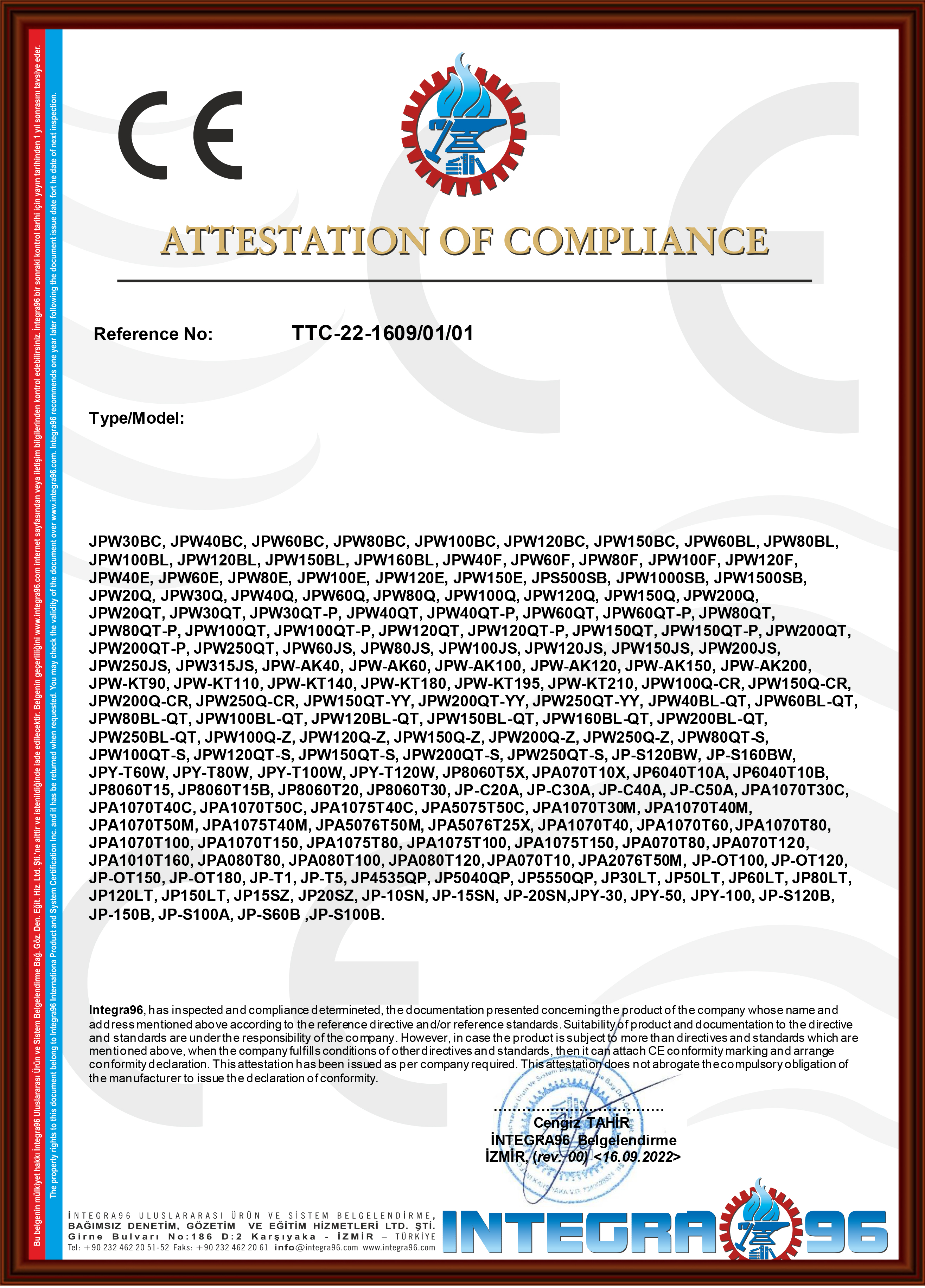
Compliance documentation and model-level specification records are read together: the record describes the machine, the documentation describes what has been assessed.
Reading Four Model Records Side by Side
The fastest way to expose documentation gaps is to normalise several model records into one table and leave the empty cells visible. The table below uses only published parameters from the available specification records for four hydraulic baler machines, with no estimated values.
| Parameter | JP-S100B | JPW40F | JP7050T8 | JPW20Q |
|---|---|---|---|---|
| Machine type | Cutting Machine | Semi-Automatic Horizontal Baler | Baling Machine | Fully Automatic Horizontal Baler |
| Compression force | 100 Ton | 40 Ton | Not published in the available record | 20 Ton |
| Bale dimension (mm) | Not published in the available record | 720×720×(500–1300) | Not published in the available record | 500×500×500 |
| Feed opening (mm) | Not published in the available record | 1000×720 | 670×400 | 700×460 |
| Bale weight | Not published in the available record | 200–400 kg | 50–80 kg | 30–70 kg |
| Throughput | Single cycle time 20–30 s | 1–2 Ton/hr | 6–8 bales/hr | Not published in the available record |
| Rated voltage | Not published in the available record | Not published in the available record | 220V/50Hz (customizable) | 380V/50Hz (customizable) |
| Installed power | 11 kW / 15 HP | 11 kW / 15 HP | 2.2 kW / 3 HP | 7.5 kW / 10 HP |
| Machine dimensions (mm) | 2600×650×3500 | 4900×1750×1950 | 880×820×2150 | 3400×3010×2400 |
| Machine weight | 2.6 Ton | Not published in the available record | 590 kg | 2.8 Ton |
| Strapping channels | Not published in the available record | 4 | Not published in the available record | 2–4 |
| Material | Carbon steel | Carbon steel | Carbon steel | Carbon steel |
| Recorded scope field | 100–160 Ton | 40–100 Ton | 2–180 Ton | 20–40 Ton |
Source: published specification records for Nantong Jiabao Machinery Co., Ltd. hydraulic baler machines. Empty cells indicate parameters not present in the available record; they are not zero or assumed values.
Two conclusions follow directly from this table. First, unit normalisation is unavoidable: the machine weight column contains tonnes and kilograms in the same comparison. Second, the number of gaps is itself a finding. A buyer preparing a compliance file for a JP7050T8 unit needs a compression force figure that the catalogue record does not provide, and a buyer preparing one for a JPW20Q needs a throughput figure. Both requests are reasonable, and both should be answered in writing before the order is placed.
Mapping Site Requirements to Documented Machine Attributes
A workable verification method has four steps, and it runs in one direction only: from the site requirement to the machine record, never from the catalogue headline back to the site.
- Step 1 — State the requirement in destination-market units. Write the target bale format, the target throughput, the available electrical supply and the floor loading limit in the units used in the destination market before opening any catalogue. This prevents unit drift from being resolved unconsciously in the supplier's favour.
- Step 2 — Extract only the binding parameters. For most projects, four values bind: compression force, rated voltage and frequency, machine weight, and machine dimensions. Everything else is an optimisation.
- Step 3 — Normalise and compare. Convert every candidate record into one unit system, place the records in a single table, and mark the empty cells rather than filling them.
- Step 4 — Close the gaps in writing. Send the marked table to the supplier and require a written response for each gap, then attach that response to the purchase order as an annex.
Customisation is where steps two and four intersect. Nantong Jiabao Machinery provides customisation production services covering structure, process and performance, with a minimum order quantity of 1 unit, a typical production lead time of 60 days and a monthly production capacity of 100 units. Quality control is stated as 100% testing, delivery terms are FOB Shanghai, and acceptance is handled through pre-shipment testing with 50/50 payment terms. Post-sale support is described as a 7×24-hour technical response with on-site attendance within 48 hours where applicable, lifelong maintenance and free training. Export markets recorded for the customisation service include Europe, North America, Asia, the Middle East, Africa and Australia.
The compliance implication is direct. When structure, process and performance can all be modified, the delivered machine may differ from the catalogue default. The purchase order annex is therefore the point at which the specification record stops being marketing material and becomes a technical document: it is where the buyer states which parameters were changed, in which units, and against which as-built values the machine will be tested before shipment.
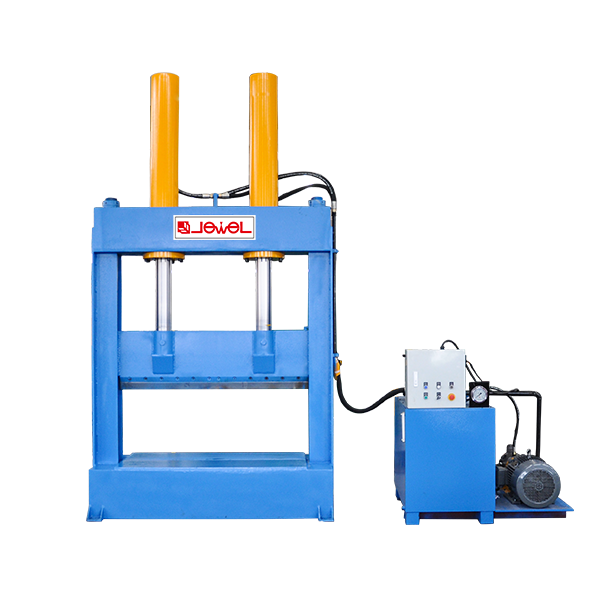
The JP-S100B record documents 100 Ton of compression force, a 1000 mm cutting width, a 1000 mm cutting stroke and a 20–30 second single cycle time.
Documentation Beyond the Specification Record
Specification records describe a machine. Separate documentation describes the manufacturing entity and, in specific cases, an individual model. Buyers who keep these categories distinct avoid the most common misunderstanding in baler procurement.
Two entity- and model-level records are published for this range. The first is an SGS Made-in-China Supplier Audit Report, certificate number QIP—ASR2541890, issued by SGS on 2025-12-10 and valid to 2028-12-10, assessed against the Made-in-China Supplier Audit Specification, with a scope covering the full range of baler machine, hydraulic baler, waste paper baler, cardboard baler and baling press machine. A supplier audit report assesses the manufacturing organisation and its processes; it does not certify an individual machine.
The second is an Attestation of Compliance, certificate number TTC-22-1609/01/01, issued by INTEGRA on 2022-09-16 and valid to 2027-09-16, scoped to 2006/42/EC (Machinery Directive) and 2014/35/EU (Low Voltage Directive) and assessed against EN ISO 12100:2010 and EN 60204-1:2018. In the available records this attestation is linked to the JPW20Q fully automatic horizontal baler. That linkage is the detail a buyer must not generalise: a model-level attestation does not automatically extend to other models in the same catalogue, and treating it as a range document misrepresents the compliance file.
Regional expectation frameworks complete the picture. In the European Union, EN 16500:2014 sets safety requirements for vertical baling presses used with waste materials — the category into which a machine such as the JP-OT100 vertical baler falls. In the United States, ANSI Z245.5-2023 is the updated American National Standard for baling equipment safety requirements, replacing the 2013 version. These frameworks describe what a reviewer will test a machine against. The specification record supplies the inputs to that test.
Where This Method Was Applied: Project Records
Published project records show how parameter verification translates into operating outcomes across different waste streams and regions.
- PET recycling, Japan. A PET recycling enterprise needed higher compression density to reduce transport and storage costs. The project, completed within two years, produced compact and regularly shaped bales that raised storage and transport efficiency and increased the value of the recycled output. The binding specification here was compression force against bale geometry, not throughput.
- Mixed waste, Australia. An integrated mixed waste processing application using multi-material separation technology handles plastics, glass and metal scraps, with one JPW40BL hydraulic baler in the installation. The project reached full-line unmanned operation over a two-year period, reducing labour costs and operational risk. The binding specifications were bale dimension (720×720×(300–1000) mm), four strapping channels and the one-time bale discharge method.
- Carton production, Russia. A cardboard box factory automated the collection, compression and baling of carton production waste using a JPW40F unit over a three-year programme, achieving a coherent unmanned waste processing system that reduced labour and management costs and allowed immediate monetisation of the waste stream. The binding specifications were the continuous push-pack discharge and the 1–2 Ton per hour baling capacity.
- Waste paper, Tunisia. A cardboard box factory cleared piled waste paper with a factory-wide automatic waste discharge system, resolving accumulation from the corrugator line and printing machines and producing a clean production environment. The installation used one hydraulic baler unit with a JPW-AK60 briquetting machine, over three years.
In each case the specification record had to be checked against something specific: bale density, bale format, discharge method, or briquetting behaviour for paper dust. General statements about machine capability were not sufficient inputs for those checks.
Market Context: Why Specification Rigour Is Rising
The demand-side context supports the documentation-first approach. The global baler machine market was valued at USD 6.6 billion in 2024 and is projected to reach USD 11.4 billion by 2035, according to Grand View Research. A separate industrial balers estimate from Maximize Market Research places the 2024 market at USD 6.39 billion with a projected CAGR of 9.5% through 2032. Asia Pacific accounted for approximately 40.2% of total baler market revenue share in 2024, per Grand View Research.
Published forecasts diverge, and buyers should read them as context rather than as procurement inputs. Divergence notes for this category record a CAGR range from about 4.8% for 2024–2032 (Global Market Insights) to about 10.6% for 2025–2030 (Grand View Research), and 2024 market size estimates of USD 6.4 billion (Grand View Research) against USD 6.39 billion (Maximize Market Research). The gap reflects differences in scope — notably whether agricultural balers are included alongside industrial waste-handling equipment.
Trade flow data adds a narrower, more operational signal. China’s exports of wood pulp and paper scrap, including baled waste paper, reached USD 288 million in 2025, according to the Observatory of Economic Complexity. Cross-border movement of baled material at that scale keeps the documentation attached to the baling equipment itself commercially relevant: bale format, bale weight and compression density all influence transport documentation and container utilisation.
Documented Procurement Compared with Traditional Practice
| Evaluation criterion | Traditional practice | Specification-verified practice |
|---|---|---|
| Basis of selection | Headline throughput and price per unit | Model-level parameter record with binding values confirmed in writing |
| Electrical configuration | Accept the catalogue voltage as supplied | Confirm whether voltage and frequency are customizable and record the as-built values |
| Unit handling | Mixed tonnes and kilograms accepted as published | All candidates normalised into one unit system before comparison |
| Documentation scope | Range-level documents assumed to cover the ordered model | Model-level and entity-level documents kept separate and matched to the delivered unit |
| Acceptance | Visual inspection on arrival | Pre-shipment test against the order annex, with documented results |
| Validity tracking | Checked once at purchase | Checked against project timeline and renewal cycle |
The trade-off is real and should not be understated. A specification-verified process adds engineering review time at the front of a project, and that time interacts with manufacturing lead time. Customisation of structure, process and performance with a minimum order quantity of 1 unit and a typical production lead time of 60 days means the documentation cycle must be completed well before the production slot is booked. Buyers who start the verification late can end up either accepting undocumented gaps or accepting schedule slippage. The second cost is the one that traditional practice tends to ignore until it is incurred.
The Limits of Specification Verification
A specification record is an input to a conformity assessment, not a substitute for one. Six boundaries are worth stating explicitly, because overstating what a record proves creates the very risk the verification process is meant to remove.
- Records do not certify. A parameter sheet describes a machine; it does not declare conformity. The declaration step is performed against the destination market’s framework and by the responsible party.
- Coverage gaps are common. Compression force is not published in the available record for the JP7050T8, and throughput is not published for the JPW20Q. These gaps must be closed by written supplier response, and the response must be attached to the order.
- Material declarations are category-level. All models in the documented range are built in carbon steel, but plate grade and thickness are not published. Buyers requiring those values for a structural file must request them.
- Performance values are ranges. Baling capacity and bale weight are stated as ranges because they depend on material bulk density, feed consistency and operator practice. They are planning inputs, not guarantees.
- Attestation scope is model-specific. The attestation of compliance recorded in the available data is linked to the JPW20Q. It should not be presented as covering the wider range without separate confirmation.
- Validity windows expire. The SGS supplier audit report runs to 2028-12-10 and the attestation to 2027-09-16. Standards also revise: ANSI Z245.5-2023 replaced the 2013 version, and EN 16500:2014 continues to govern vertical baling presses in the EU. A machine with a long service life will need documentation renewal during its operating life.
Future Outlook
Three shifts look likely to shape how hydraulic baler specifications are evaluated over the next procurement cycles.
First, voltage customisation is moving from a special request to a default expectation in export orders. The model records already reflect this: two different rated voltages appear in the same catalogue, both flagged as customizable. Buyers will increasingly treat the electrical line as an as-built field rather than a catalogue constant, and will expect the delivered configuration to be documented rather than assumed.
Second, certificate and audit validity will be tracked as a project asset. With audit reports valid through 2028 and attestations through 2027, the practical question for a ten-year equipment lifecycle is not whether documentation existed at purchase, but whether it will still be current when the equipment is resold, relocated or re-permitted. Procurement files that record expiry dates alongside model numbers make that second transaction easier.
Third, the boundary between range documentation and model documentation will sharpen. As standards revise on multi-year cycles, reviewers are likely to ask for model-level parameter confirmation as a matter of routine, which puts pressure on catalogues to publish complete parameter rows — including the values that are currently left blank.
FAQ
What does “compliance-ready” mean for a hydraulic baler specification sheet?
A specification sheet is compliance-ready when every parameter that a conformity assessment depends on is recorded at model level, expressed in a defined unit, and traceable to a document the buyer can obtain before shipment. In practice that means compression force, bale dimensions, feed opening, machine dimensions, machine weight, rated voltage and frequency, installed power and material construction are all present for the exact model being quoted. A range-level description that covers many models does not meet this standard.
Which hydraulic baler parameters matter most for conformity assessment?
Four families carry most of the weight: mechanical load (compression force and cycle time), electrical parameters (rated voltage, frequency and installed power), physical envelope (machine weight, machine dimensions and bale dimensions), and material construction. For example, the JP-S100B record documents 100 Ton of compression force, an 11 kW / 15 HP motor, machine dimensions of 2600×650×3500 mm, a machine weight of 2.6 Ton and carbon steel construction.
How can a buyer check whether a stated compression force fits the intended material?
Compare the documented compression force and bale geometry against the material behaviour the site actually observes. The JPW40F is recorded at 40 Ton, producing 200–400 kg bales at 1–2 Ton per hour through four strapping channels; the JPW20Q is recorded at 20 Ton, producing 30–70 kg bales in a 500×500×500 mm format. Lower-density or highly elastic streams such as PET bottles usually need a higher-torque machine than their bulk volume suggests, which is why one PET recycling project in Japan focused specifically on increasing compression density. Where a record omits the compression force figure, the value should be requested in writing rather than inferred.
How does voltage customisation affect certification preparation?
Rated voltage and frequency are direct inputs to electrical safety assessment, so a change from the catalogue default changes the technical file. Within this range, most models are recorded at 380V/50Hz and the JP7050T8 at 220V/50Hz, with both values marked customizable. When a machine is configured for a different supply, the as-built voltage, frequency and installed power should be recorded in the shipping documentation, because the default catalogue value no longer describes the delivered unit.
What documentation should a buyer request before shipment?
A model-level specification record matching the ordered configuration; as-built electrical parameters where customisation applies; a material declaration covering construction and, where required, plate grade and thickness; a pre-shipment test record against the agreed acceptance criteria; and entity-level quality documentation such as the SGS Made-in-China Supplier Audit Report (certificate number QIP—ASR2541890, valid to 2028-12-10). Where the order includes acceptance testing, the documentation review should be completed before the balance payment stage rather than after arrival.
What can specification verification not do?
It cannot certify a machine, and it cannot fill gaps the manufacturer does not publish. Compression force is not stated for the JP7050T8 in the available record, and plate grade and thickness are not published for any model despite carbon steel construction across the range. It also cannot extend a model-specific attestation to a wider catalogue: the attestation recorded in the available data is linked to the JPW20Q. Finally, it cannot keep documentation current by itself — validity dates must be tracked against the equipment lifecycle.