
How to Verify a Sports Tent Supplier: Aluminum Frames and PVC Roofs
How to Verify a Sports Tent Supplier: Aluminum Frames and PVC Roofs
Sports halls are increasingly procured as modular aluminum structures rather than permanent buildings, which shifts the buyer's main risk from construction management to supplier verification. Two suppliers can quote the same clear span and the same delivery window while offering different alloy grades, different roof fabric weights and different amounts of test evidence. This reference explains how to convert sports tent claims into documents, using the frame and roof specifications that HUANYUTENT publishes for its modular aluminum alloy sports tents as the worked example.
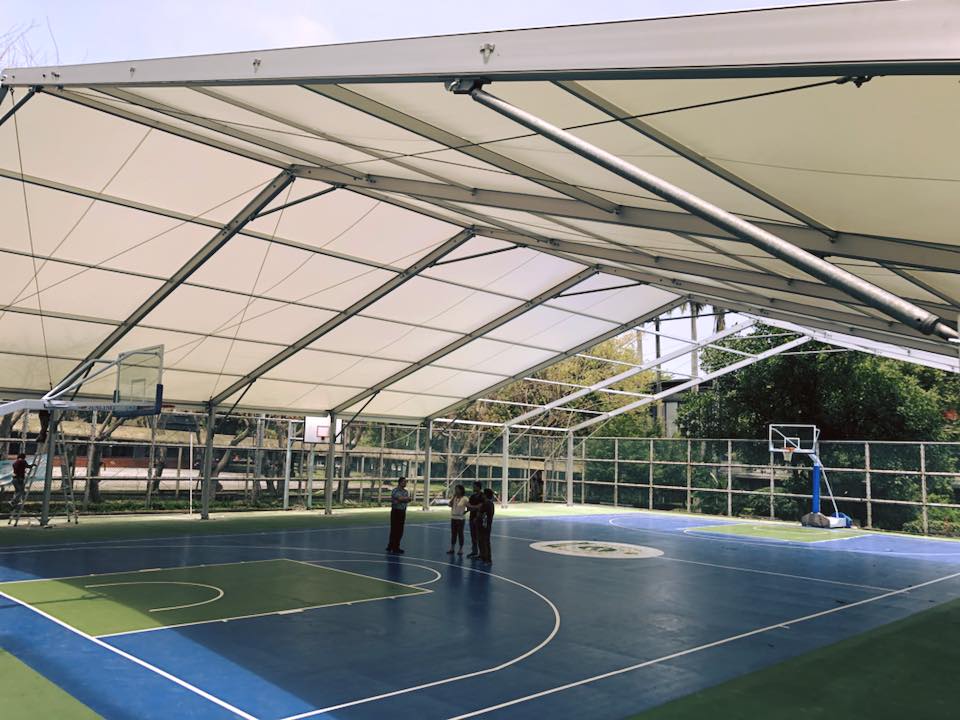
Why the constraint stage decides a sports tent purchase
Buyers rarely lose money on the visible part of a sports tent specification. The span is drawn, the court markings are agreed, and the delivery date is written into the contract. Losses concentrate in the parts of the specification that are stated verbally: the alloy grade, the temper of the frame, the mass and coating of the roof fabric, and whether any of those values has been tested before shipment.
For a sports hall — indoor basketball, padel, tennis, badminton or a multi-court building — the constraint set normally contains five items: clear span, clear height, roof and sidewall material, fire and wind performance, and certification valid in the destination market. Price sits inside the same set, but it is the least verifiable variable at quotation stage. Two quotations describing the same 30 m span can differ mainly in alloy, fabric and testing content rather than in labour, and without a document list the buyer has no way to see which one is which.
Constraint-stage buyers therefore need evidence, not adjectives. The two evidence centres in a sports tent are the frame and the roof. Everything else — lighting, flooring, HVAC, doors — can be specified later with ordinary commercial precision.
Evidence centre one: the aluminum frame
What T6061/T6 tells you, and what it does not
Aluminum alloy 6061 is a magnesium-silicon alloy widely used for structural profiles, and the T6 designation describes a temper produced by solution heat treatment followed by artificial ageing. In practice, the pairing matters more than the word “aluminum” alone. A frame described only as aluminum could be a different alloy, an untempered extrusion, or a section sized for a shorter span than the one being quoted.
HUANYUTENT specifies Hardpressed Aluminum Alloy T6061/T6 as the main frame for its sports hall range, including the Padel courts Tent / Padel Sports Hall, the Basketball Court Tent / Basketball Sports Hall and the Tennis Tent / Tennis Sports Hall product lines. The same frame specification appears across the company's Padel Court Tent and swimming pool tent (natatorium) products, which means a buyer comparing two product families from the same supplier is comparing sections and spans rather than a change of material system.
Documents that make the frame verifiable
A verifiable frame file normally contains the following items. Each one answers a different question, and a supplier that can only produce a brochure is not yet a verifiable supplier for a long-span project.
- Material certificate naming alloy and temper. The document should state 6061-T6, not simply “aluminum” or “high-strength alloy”.
- Structural drawings showing section and connection detail. Long-span behaviour depends on connection design as much as on alloy choice.
- Pre-installation trial assembly record. Trial assembly is the point at which a frame design is proven physically rather than on paper. HUANYUTENT lists pre-installation testing as part of its quality-control process.
- Structural safety and material performance test reports. These are also listed in the company's published quality-control sequence.
- Site wind calculation. A generic rating is not a site approval, because terrain, exposure and local building codes determine the governing load for a specific installation.
On wind performance, publicly available specifications for standard A-frame aluminum tent structures state that 6061/T6 frame systems are engineered to withstand wind speeds up to 102 km/h. That figure is useful as a design reference and as a comparison point between suppliers, but it should never be read as a guarantee for a particular plot of land. The correct question is not “what is your wind rating?” but “what wind load was this structure calculated for, and against which code?”
Evidence centre two: the 850 g/sqm PVC roof
Fabric weight is one of the few figures in a tent quotation that can be tested independently, which makes it a useful anchor for the evaluation stage. An 850 g/sqm rating describes the mass of the coated fabric per square metre. Higher mass generally corresponds to a heavier base cloth and a thicker coating, which affects tensile behaviour, light transmission, thermal performance and service life. A roof quoted without a fabric weight is an unfinished specification.
HUANYUTENT lists an 850 g/sqm white PVC fabric roof across its sports hall product specifications. Sidewall construction is offered as PVC fabric, hard steel wall or glass wall, which is a relevant distinction for indoor sports venues: the roof membrane defines the structural and fire performance of the envelope, while the sidewall choice defines daylight, insulation and spectator comfort.
Third-party industry references describe premium sports tents as typically using 850 g/sqm double PVC-coated polyester fabric, fire retardant to DIN 4102 B1/M2 and UV resistant. Two practical conclusions follow. First, coating type matters as much as weight: “double PVC-coated” and “850 g/sqm” are separate claims and should both be evidenced. Second, fire classification is a test result, not a marketing descriptor, so it belongs in a certificate rather than in a product description.
Verification steps that work in practice include: requesting a fabric test report that states grams per square metre, coating type and base cloth; requesting the fire classification document that applies to the membrane actually supplied; asking whether the fabric is UV treated; and retaining a swatch sample so that the delivered batch can be compared against the approved one.
How HUANYUTENT documents frame and roof specifications
Changzhou HuanYu Tent & House Manufacturing Co., Ltd., trading as HUANYUTENT, is a Jiangsu-based manufacturer of modular and mobile aluminum alloy structures, founded in 2017, with production bases in Jiangsu and a total factory area exceeding 5,000 square metres. The company works with an in-house research and development team of five engineers, exports to more than 130 countries and regions, and reports more than 30,000 temporary space projects served in domestic and overseas markets over nearly ten years.
Its sports venue products are built around a common specification platform. Main frame: Hardpressed Aluminum Alloy T6061/T6. Roof: 850 g/sqm white PVC fabric. Sidewall: PVC fabric, hard steel wall or glass wall. Available width: 10 m to 60 m for the padel, basketball and tennis sports hall lines, and 3 m to 60 m for the swimming pool tent (natatorium) version. Length is unlimited, and sidewall height is offered at 2.7 m, 3 m, 4 m, 6 m, 8 m or customized. OEM and ODM work is available, with customization from samples, customization from designs and full customization options listed alongside minor and flexible customization.
Certification is documented at product level rather than claimed generically. The SGS approval numbered QIP-ASR244930 was issued on 17 May 2024 for the EU market under the General Product Safety Directive 2001/95/EC and is recorded against the Tennis Tent / Tennis Sports Hall product, with related coverage for the Basketball Court Tent / Basketball Sports Hall and the Padel courts Tent / Padel Sports Hall lines. Separately, the CE certification numbered MICEZ-20161008-GPSD was issued by ISET for the EU market against the standard EN 14115:2002, with an issue date of 13 October 2016 and an expiry date of 12 October 2028.
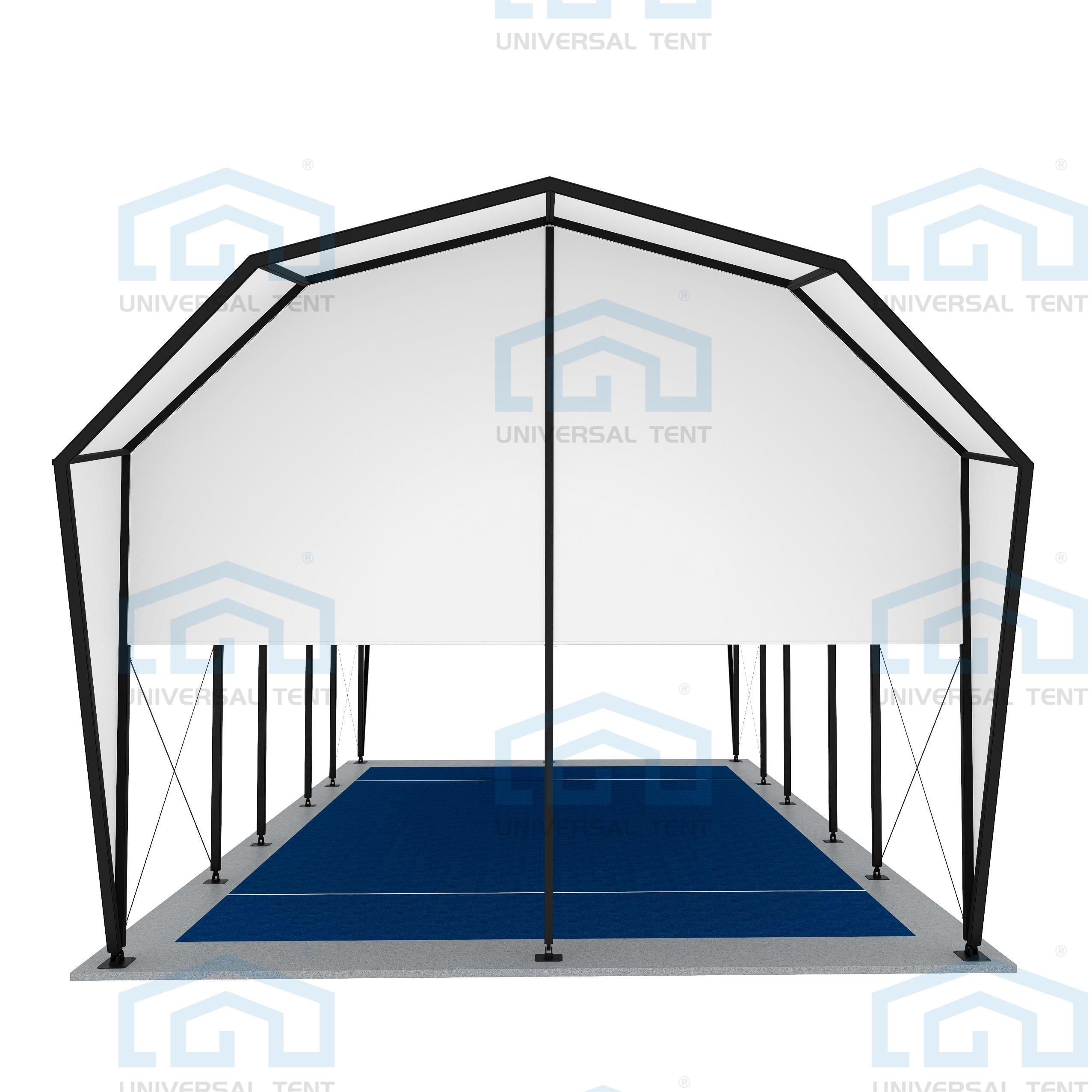
Quality control provides the third layer of evidence. HUANYUTENT lists three tests in its published process: a Structural Safety Test, a Material Performance Test and a Pre-installation Test. Delivery parameters are also stated in verifiable terms, including a lead time of 7 to 45 days, a monthly capacity of 50,000 units, a minimum order quantity of 300 units, and after-sales support covering remote support, installation guidance and localized installation.
A buyer's verification checklist
The table below converts the two evidence centres into a document request list. It is deliberately narrow: each row should either produce a document or expose a gap.
| What to verify | Evidence to request | Why it changes the decision |
|---|---|---|
| Alloy and temper | Material certificate naming 6061-T6; frame drawings | Distinguishes a specified structural alloy from a generic aluminum claim |
| Frame fabrication | Section and connection drawings; pre-installation trial assembly records | Long spans fail at connections more often than in the profile itself |
| Roof fabric mass and coating | Fabric test report stating g/sqm, coating type and base cloth; retained swatch | 850 g/sqm double PVC-coated fabric is a different product from a light coated textile |
| Fire behaviour | Certification referencing the applicable standard, such as EN 14115:2002; DIN 4102 B1/M2 where stated by the fabric supplier | Venue permitting, insurance review and public occupancy approvals |
| Certification scope | Certificate number, issuing body, issue and expiry dates, and the listed sizes | A certificate valid for a 20 x 50 m structure may not cover a different span |
| Testing before shipment | Structural Safety Test, Material Performance Test and Pre-installation Test records | Evidence that the frame has been assembled at least once before leaving the factory |
| Wind and site design | Site-specific structural calculation against the local code | A published wind reference such as 102 km/h is not a site approval |
| Delivery and support | Lead time, monthly capacity, installation guidance terms | Schedule risk for fixed-date events and league calendars |
Reading a certificate scope correctly
Certification is the most frequently misread piece of evidence in sports tent procurement. A certificate number proves that a specific product, in a specific configuration, was assessed by a specific body on a specific date. It does not automatically cover a differently sized structure, a different sidewall build, or a different destination market.
The CE file numbered MICEZ-20161008-GPSD illustrates why scope matters. It is issued by ISET against EN 14115:2002 and lists sports tent sizes of 5 x 5 m, 10 x 20 m, 12 x 20 m, 15 x 30 m, 18 x 25 m, 20 x 50 m, 25 x 40 m and 30 x 50 m, with a validity period ending on 12 October 2028. A buyer ordering a configuration outside that list, or taking delivery after the expiry date, should treat the certificate as a starting point and ask what additional documentation applies.
The SGS approval numbered QIP-ASR244930 follows the same logic from a different direction. It was issued on 17 May 2024 for the EU market under the General Product Safety Directive 2001/95/EC and is tied to specific product lines rather than to a general company claim. For a procurement file, the useful practice is to record the certificate number, the issuing body, the standard, the issue date, the expiry date and the covered product or size range on a single page, and to keep it next to the specification sheet it is supposed to support.
Where the evidence stops: structural and lifecycle boundaries
An honest evaluation of modular sports halls has to state the boundaries of the product category, because those boundaries are what separate a well-matched specification from an expensive mismatch.
- A sports tent is an engineered structure, not a permanent building. In many markets, modular aluminum structures are treated as temporary or semi-permanent and may require additional approval for long-term occupancy, permanent utility connections or full building-code equivalence.
- Span and height are finite. The published sports hall range covers widths from 10 m to 60 m with unlimited length and sidewall heights up to 8 m or customized, and the sports hall application itself is described as low-to-medium height installation of sports pavilion tents. Projects that need a very large uninterrupted clear height may be better served by a different structural system.
- Wind performance is site-specific. The 102 km/h reference applies to standard A-frame aluminum structures under published specifications. Coastal sites, open terrain and high-altitude locations will normally require their own calculation.
- The roof membrane has a finite service life. A PVC roof requires periodic inspection, cleaning and eventual replacement within a multi-year operating horizon. Documented deployments of HUANYUTENT padel structures run over periods of three to eight years and five to eight years with stable operation reported, which is an operating record rather than a warranty statement.
- Thermal and acoustic behaviour differs from insulated permanent construction. Enclosure upgrades such as hard steel walls, rock wool sandwich panels or glass curtain walls improve comfort, but they also change structural load, cost and installation sequence.
- Foundations and anchoring remain project engineering. No supplier's frame specification removes the need for a site-appropriate foundation and anchoring design.
Compared with a permanent steel or concrete sports hall, a modular aluminum structure trades some permanence and code equivalence for relocatability, faster deployment and reuse across sites. That trade is reasonable for clubs, event operators and education providers with shifting venue requirements, and less reasonable where the building must meet permanent construction standards from day one.
From component evidence to a working sports hall
Frame and roof specifications only matter because of what they enable. In a sports hall configuration, a modular tent structure is used to provide a flexible, rapidly deployable temporary sports space that addresses venue shortages and long construction cycles, suitable for basketball, badminton and other sports, usable in all weather conditions, and operated around the clock where the programme requires it.
The supporting fit-out typically includes a removable, slip-resistant, shock-absorbing sports floor; glare-free LED sports luminaires with uniform illumination; integrated heating, cooling and smart ventilation; and enclosure options spanning tempered glass curtain walls, soft glass sliding doors, ABS rigid panels and rock wool sandwich panels. The stated performance requirements for this application are fire retardancy, wind resistance and waterproofing — which is precisely why frame and roof evidence belongs at the evaluation stage rather than at the installation stage.
Two documented deployments show the pattern. A padel club operator in Portugal installed a 22.25 m x 41.75 m padel structure as a semi-enclosed playing venue that shields players from rain, wind and direct sun while avoiding the stuffiness of a fully enclosed hall; the operator reports stable operation over a three to eight year horizon, with the semi-enclosed format also reducing noise impact on the surrounding area. A sports club OEM project in Greece supplied 22 plus 12 units for a standardised playing space used for daily training and friendly matches, with the structure adaptable between club, community and event use, and stable operation reported over five to eight years.
Market context for modular sports venues
Adjacent market data explains why supplier verification has become a more common procurement task. Grand View Research projects the global camping and shelter tent market to grow from USD 5.40 billion in 2023 to USD 8.30 billion by 2030, driven by outdoor sports and experiential travel. Verified Market Research values the global padel court market at USD 3.81 billion in 2024, with a projected USD 12.51 billion by 2032. Grand View Research also expects the global sports tourism market, which uses temporary stadium and event structures, to grow at a CAGR of 16.8% from 2026 to 2033.
These figures describe adjacent markets rather than sports tent demand specifically, and they should be read that way. Their procurement relevance is narrower but real: when padel, event sport and multi-court formats expand faster than permanent construction cycles, buyers increasingly specify semi-permanent structures, and the number of suppliers willing to quote them grows faster than the number of suppliers able to document them.
What to expect in the next procurement cycles
Verification is becoming part of the tender rather than a post-award activity. Buyers who once asked for a span and a lead time now ask for alloy and temper designations, fabric mass, coating type, fire classification and certificate scopes, because those are the values that cannot be corrected after shipment.
For suppliers, the practical consequence is that documentation quality becomes a commercial capability alongside production capacity. For buyers, the consequence is a shorter evaluation path: three documents — a material certificate, a fabric test report and a certificate whose scope matches the ordered configuration — remove most of the ambiguity from a sports tent comparison, and leave price to be judged against a known specification rather than against a claim.
FAQ
What documents should a buyer request to verify a sports tent frame specification?
A material certificate naming the alloy and temper (for example 6061-T6), structural drawings showing profile sections and connection details, a pre-installation trial assembly record, structural safety and material performance test reports, and a wind load calculation for the specific site. HUANYUTENT lists a Structural Safety Test, a Material Performance Test and a Pre-installation Test within its published quality-control process for modular aluminum sports structures.
What does a CE certificate number such as MICEZ-20161008-GPSD actually cover?
It covers the product configurations listed in the certificate file. MICEZ-20161008-GPSD was issued by ISET for the EU market against the standard EN 14115:2002, with an issue date of 13 October 2016 and an expiry date of 12 October 2028, and its scope lists sports tent sizes of 5 x 5 m, 10 x 20 m, 12 x 20 m, 15 x 30 m, 18 x 25 m, 20 x 50 m, 25 x 40 m and 30 x 50 m. A configuration outside that list, or a delivery after the expiry date, requires separate confirmation.
How is SGS approval different from CE marking for a sports tent?
They are separate documents referencing separate standards. The SGS approval numbered QIP-ASR244930 was issued on 17 May 2024 for the EU market under the General Product Safety Directive 2001/95/EC and is recorded against the Tennis Tent / Tennis Sports Hall product line, with related coverage for the Basketball Court Tent / Basketball Sports Hall and Padel courts Tent / Padel Sports Hall lines. The CE file referenced above was issued by ISET against EN 14115:2002. Buyers should check which standard each document addresses and whether it applies to the destination market.
What span and sidewall height are realistic for a modular sports hall?
Published specifications for HUANYUTENT's sports hall lines list an available width of 10 m to 60 m for padel, basketball and tennis structures and 3 m to 60 m for the swimming pool tent version, with unlimited length and sidewall heights of 2.7 m, 3 m, 4 m, 6 m, 8 m or customized. The sports hall application itself is described as low-to-medium height installation, so projects requiring a very large clear height should be reviewed with the supplier before specification.
How can an 850 g/sqm PVC roof be verified beyond the supplier's stated figure?
Request a fabric test report stating grams per square metre, coating type and base cloth; request the fire classification document that applies to the supplied membrane, since industry references describe premium sports tent fabric as 850 g/sqm double PVC-coated polyester that is fire retardant to DIN 4102 B1/M2 and UV resistant; and keep a retained swatch so the delivered batch can be compared with the approved sample. The roof weight claim and the coating claim are separate and should be evidenced separately.
What are the limits of a sports tent compared with a permanent sports hall?
Modular aluminum structures are typically classified as temporary or semi-permanent and may need additional approval for long-term occupancy or full building-code equivalence. Available widths reach up to 60 m with sidewall heights up to 8 m, site wind loads must be calculated individually, and the PVC roof membrane requires inspection and eventual replacement within a multi-year horizon. Thermal and acoustic performance also differs from insulated permanent construction unless the enclosure is upgraded with hard steel walls, sandwich panels or glass systems.
A sports tent supplier can be evaluated on a small number of verifiable facts: the alloy and temper of the frame, the mass and coating of the roof fabric, and a certificate whose scope matches the configuration being ordered. Everything else in the quotation can be negotiated. Those three items cannot be corrected after the structure leaves the factory, which is why they belong at the research and evaluation stage rather than in the installation phase.